|
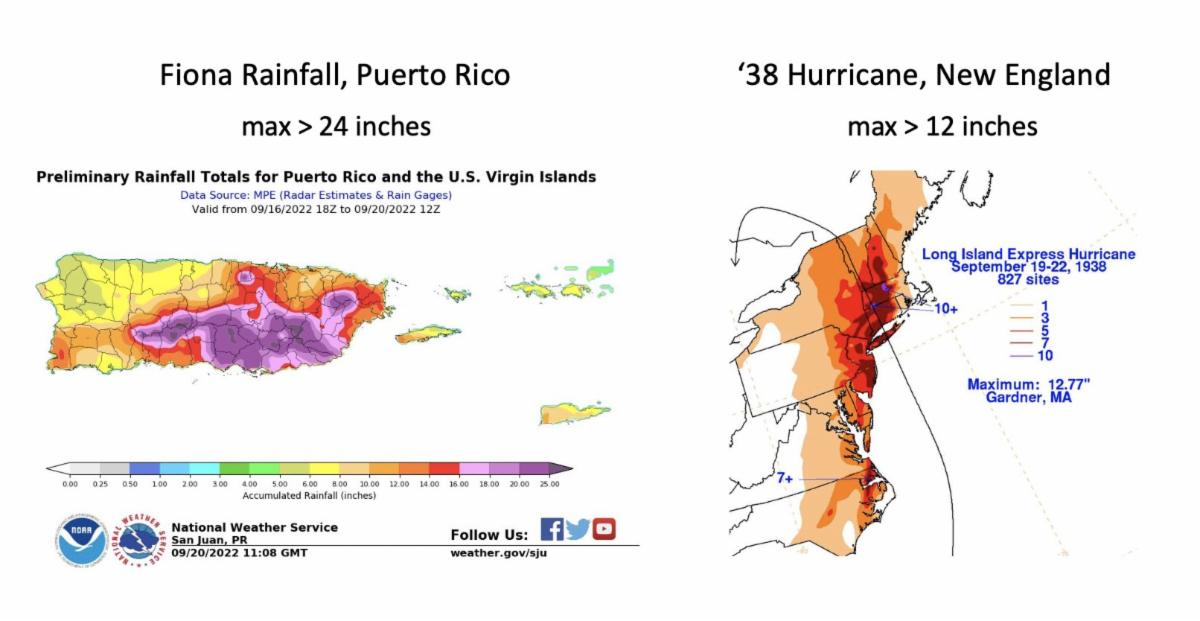
Credit: National Weather Service data via Dr. Mathew Barlow on Twitter
Twice as much rain fell on Puerto Rico during Fiona as New England saw in the worst of its worst-ever hurricane. It's almost unimaginable.
"I had a couple of things in mind when making the comparison," Barlow told me in a message Thursday. "1. People in the Northeast don't always have a good sense of how much rain we can get from a tropical system. They're not that common but set many of our records. 2. It's kind of hard for us in the Northeast to also wrap our heads around just how much more rain those systems create when they're still in the tropics (twice as much!). And they're much more frequent there."
And yet, as he points out, extreme precipitation is already a hallmark of climate change's impacts in both the tropics and, relatively, New England.
"Neither region is prepared for the rainfall events that have already occurred, let alone for the increasing totals we're already seeing and will continue to see as long as we continue to burn fossil fuels," Barlow said.
Add that to Fiona's potential to slam the Canadian Maritimes, he said, and this would be the point at which he'd try to offer his students some relief from climate dread with a cat meme.
It can all feel overwhelming, even just in local terms. Data analyzed by the nonprofit Climate Central shows that Maine's rain events are getting more intense, more frequent and more costly, and the state Climate Council's reports show more frequent intense rains too, such as those storms in summer 2021 that washed out carriage roads in Acadia National Park. Parts of Maine are under flood advisories for heavy rain even as I write this.
The factors that determine the strength of the hurricanes (and nor'easters) we see are also changing. Waters in the Northeast and Gulf of Maine are warming and rising faster than most, adding fuel to storms that pass through. Barlow, on Twitter, pointed to research of his own from 2011 that showed hurricanes as a key factor overall in the rise of extreme precipitation in the Northeast.
It's not the only climate impact we face. Short-term droughts appear to be on the rise at the same time as rain. Our summers are getting longer and hotter. Volatility and extremes are the new normal, here as everywhere — making a new benchmark hurricane for New England surely not a matter of if, but when.
But there is another reason I wanted to highlight that Fiona data this week. Sometimes, the climate story in a place like Maine is about what is not happening here. Fiona, just for this week's example, will not bring Maine a fraction of the damage it's done in Puerto Rico. Here, many of our climate impacts are a slower-moving disaster, less of an immediate existential threat. In fact, Maine could be a potential climate haven for folks migrating from places worse off (more on that in a future newsletter).
So as Puerto Rico struggles to recover from yet another catastrophic storm, I want to hold space for that, and for Maine's role in a global climate system — for our contributions, say, from our disproportionate use of oil heating, to the emissions causing that system to heat up. It shouldn't take a record-breaking hurricane here at home to convince Maine to do its part to help everyone else.
|