The American Society of Le Souvenir Français Inc.
Monthly Bulletin - Vol. II. No 8 - September 2022
|
|
IT ALL HAPPENED IN SEPTEMBER...
FROM THE FIRST FRENCH PILGRIMS IN 1565,
TO COSTES & BELLONTE'S FIRST PARIS - NEW-YORK FLIGHT IN 1930
|
|
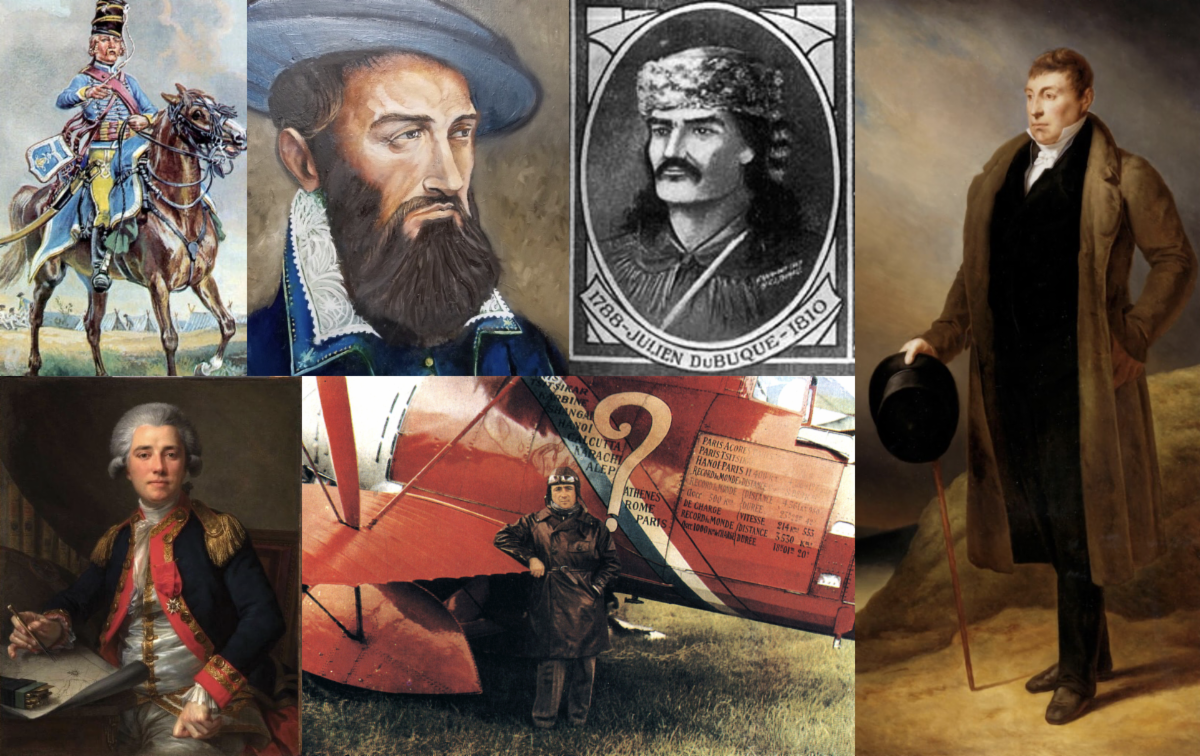
Clockwise from left to right: a hussard from Lauzun's Legion in New Jersey, 1782, explorer Admiral Jean Ribault and the first French protestant pilgrims in Florida, 1565, Julien Dubuque, founder of Dubuque, Iowa, circa 1788, General Marquis de Lafayette during his triumphal tour of the United States in 1824-1825, Lt-Col, French Air Force, Dieudonné Costes and his "Point d'Interrogation" ("Question mark") plane in 1930, Admiral La Pérouse in 1786.
|
|
EDITORIAL
There are some important dates in September worth remembering. Some are extremely sad, such as September 11 - - and all of us vividly remember every detail of this tragic day.
Five centuries before, another tragic event, this one almost completely forgotten, happened in September 20, 1565 and the following days when Spanish soldiers slaughtered in the most brutal way a total of 490 French protestant pilgrims near St Augustine in Florida.
You see, the American Society of Le Souvenir Français is not just covering the 13 original American colonies of the Revolutionary War period, when in fact, "French Memories" in today's United States go back five centuries, and are present all over the continent.
In this Bulletin we will narrate the epic journey of Admiral Jean Ribault and his first colony of French protestant pilgrims, 50 years before the first English pilgrims landed at Portsmouth.
The Souvenir Français, as it name indicates, is all about remembering, and it is part of our mission here at the American Society of Le Souvenir Français to celebrate events that have tied together France and the United States over the past two centuries.
And since this month is "back to school" month, when school children face the task of learning chronological history (to the extent that they still learn history!), we will highlight a few events and places in the United States that all happened in September, some of which will be seeds for future, more complete narrations, in upcoming Bulletins.
Among several dates in September that are worth remembering:
• The most important, at least as far as the United States are concerned, is September 5th, when the victory of the Battle of the Capes by Admiral de Grasse helped, in effect, secure the independence of the United States.
But there are many other significant dates:
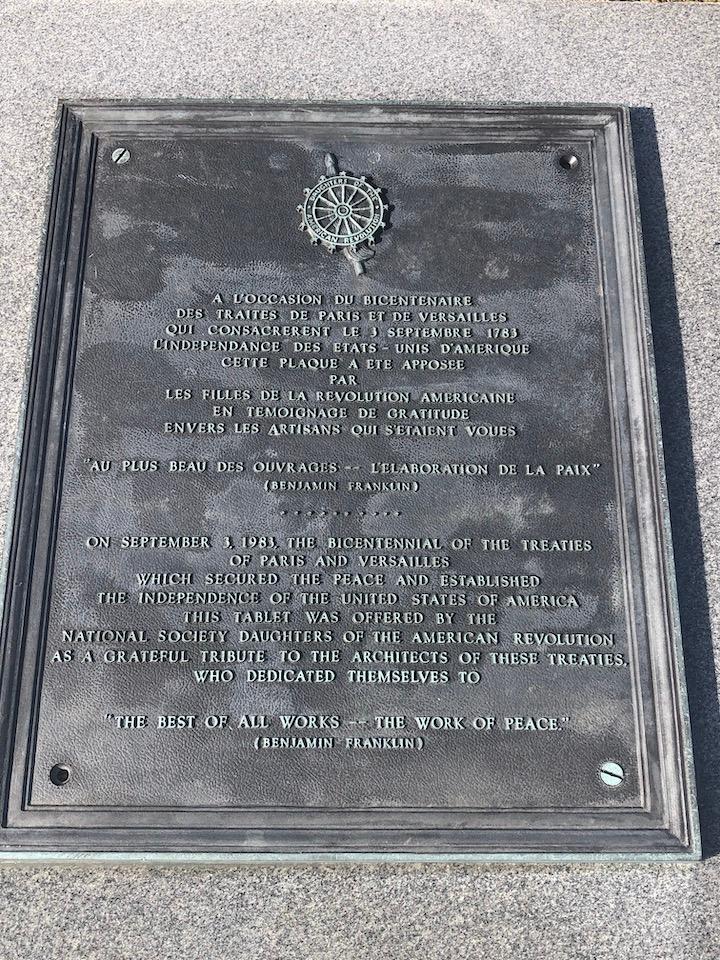
• For instance, did you know that on September 3, 1783, the Treaty of Paris formally ended the Revolutionary War and made the Independence of the United States official?
• Of course, our dear colleagues and friends at the American Friends of Lafayette and at the Lafayette Trail would rightfully be upset if we didn't mention that September 6, 1757 was our common hero's birthday.
• Naturally, we will continue with the narration, which we started last month, of Lafayette's memorable tour of 1824, and we will also continue to walk alongside the French officers and soldiers on the roads of New Jersey, and New York in September 1782.
We will also pick a few sites, all listed in our upcoming book "Memories of France", that all happened in September:
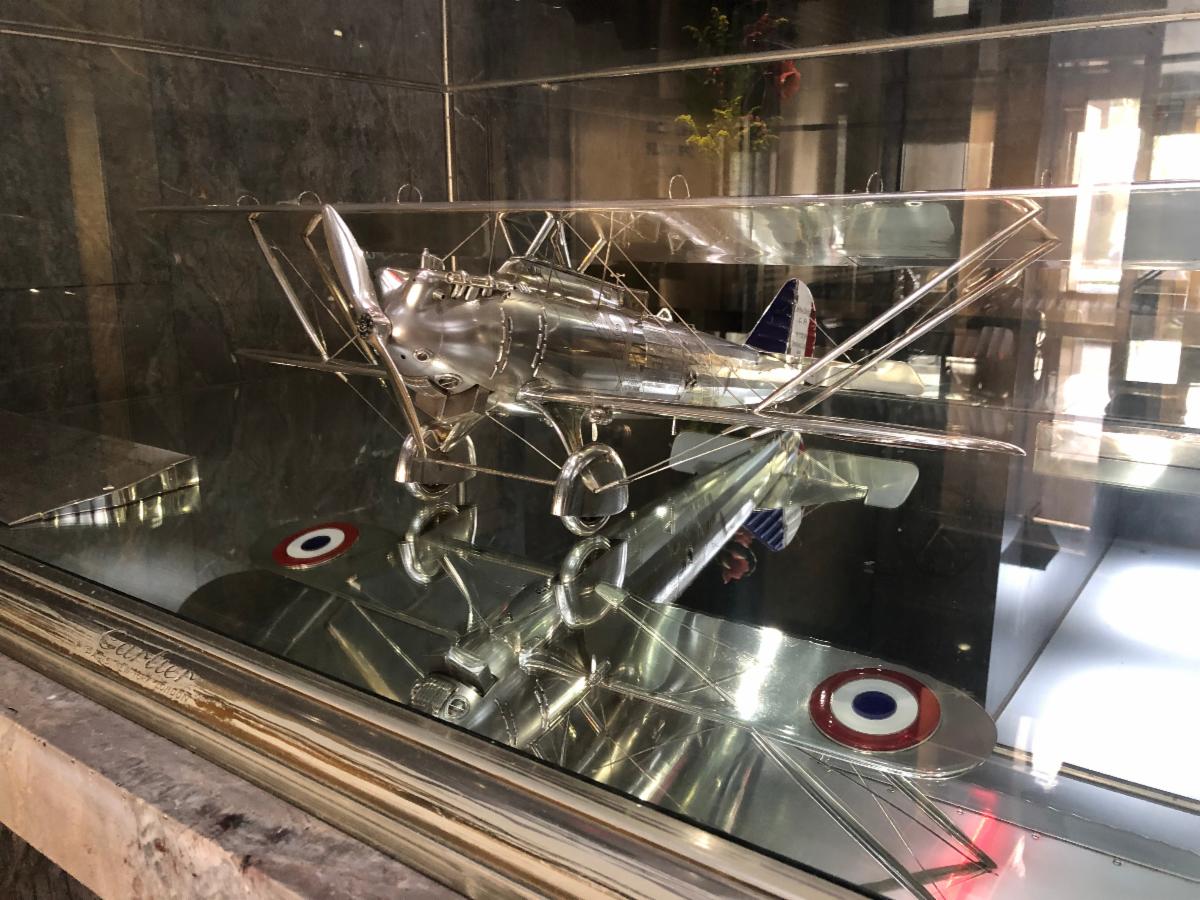
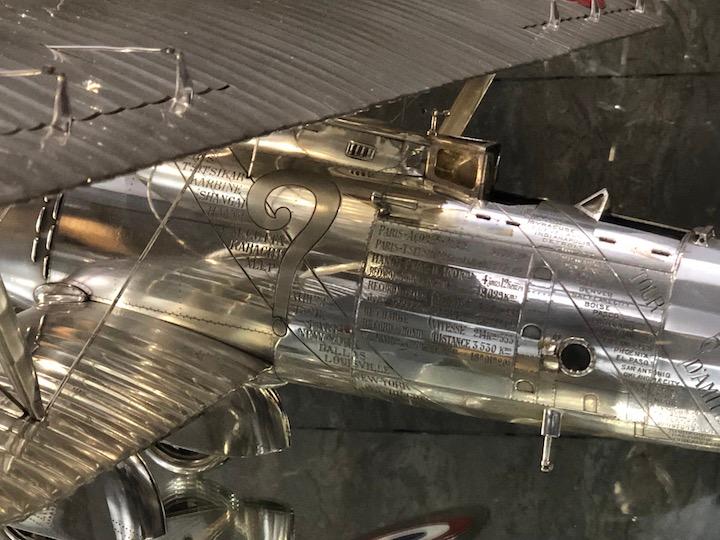
• Did you know that, tucked inside one of the lobbies of the Rockefeller Center, is a magnificent silver replica of the "Point d'Interrogation" plane in which aviation pioneers Dieudonné Costes and Maurice Bellonte first crossed the Atlantic in a direct flight (and against contrary winds) from Paris to New York on September 2, 1930?...
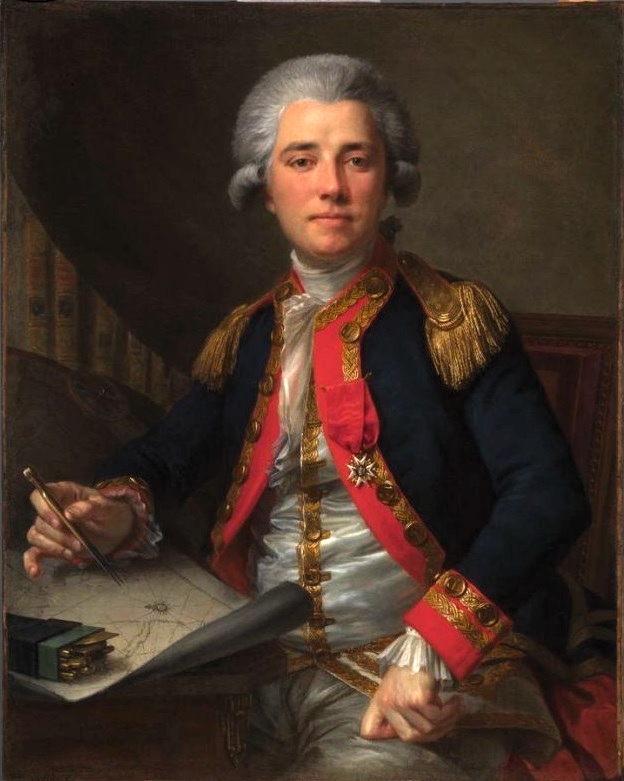
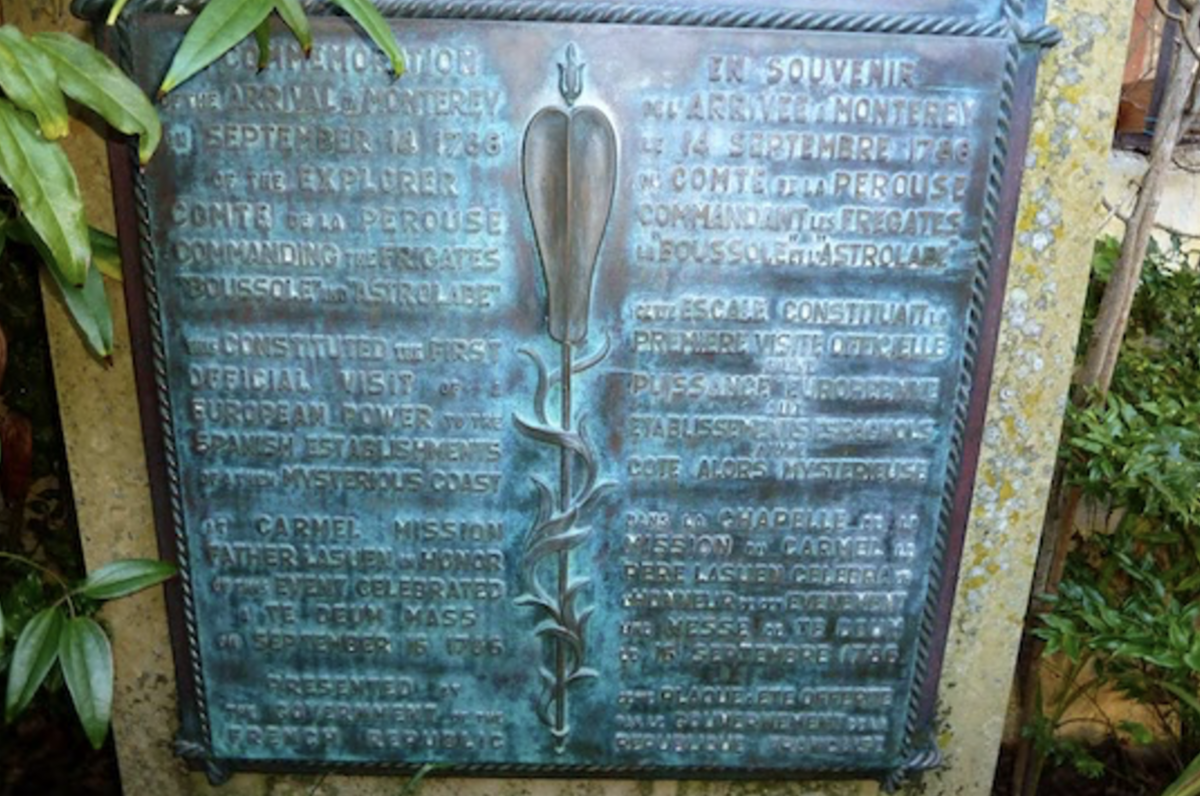
.• Did you know about a little noticed bronze plaque in the church of San Carlos de Borromeo church in Carmel, California, Admiral Lapérouse visited the Spanish mission on September 15, 1786?...
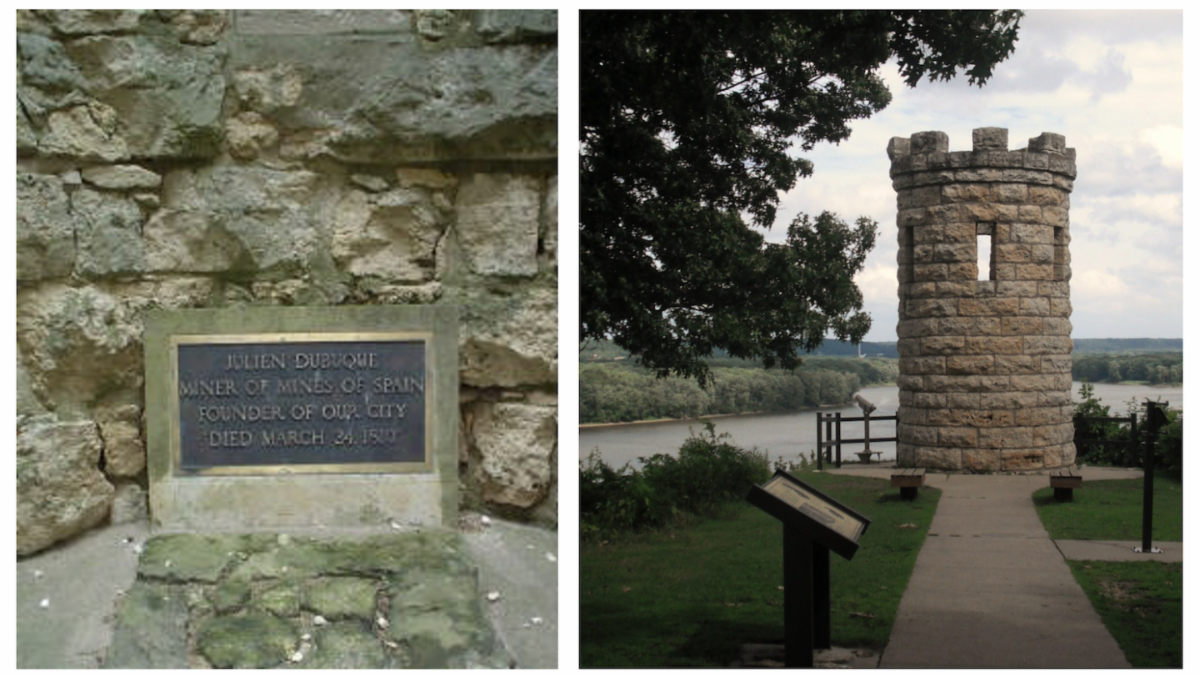
• Did you know that on September 22, 1788, French trapper Julien Dubuque's (born in Trois-Rivière, Québec, in 1762), obtained the right to the land from the Mesquakie tribe in an agreement dated and signed at Prairie du Chien, Wisconsin?...and founded the first European settlement a few miles south, in Dubuque, Iowa.
To conclude, the historical bonds of alliance and friendship between France and the United States continues to this day:
In Eastern France, commemorations are legion. September 26, 2022 marks the start of the Argonne offensive and the fighting side-by-side of French and American troops. Another massacre, of another kind, where thousands of American graves are aligned in several cemeteries, and we will pay proper tribute to these soldiers who gave their lives for freedom and democracy next Veterans Day.
Thank you as always for all your kind words or encouragements and valuable suggestions.
As always, you will also find the activities in which your association participated in since last month's bulletin, as well as other upcoming worthy patriotic events and historical commemorations uniting French and Americans.
We wish you "Bonne Lecture",
On behalf of the Board of Directors.
Thierry Chaunu, President,
American Society of Le Souvenir Français, Inc.
Poor is the nation that has no heroes, but poorer still is the nation that having heroes, fails to remember and honor them. Marcus Tullius Cicero 106-43 BC
|
|
THE TRAGIC FATE OF JEAN RIBAULT
AND FRENCH HUGUENOTS IN FLORIDA
September 29, 1565
|
|
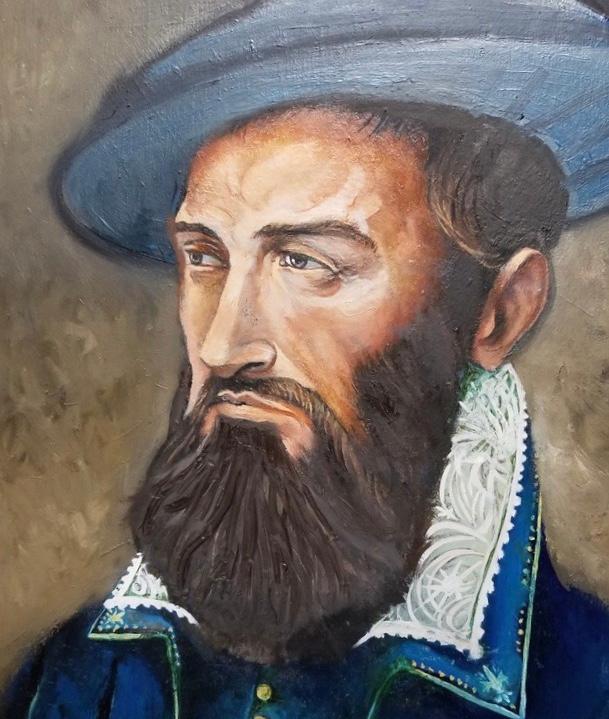
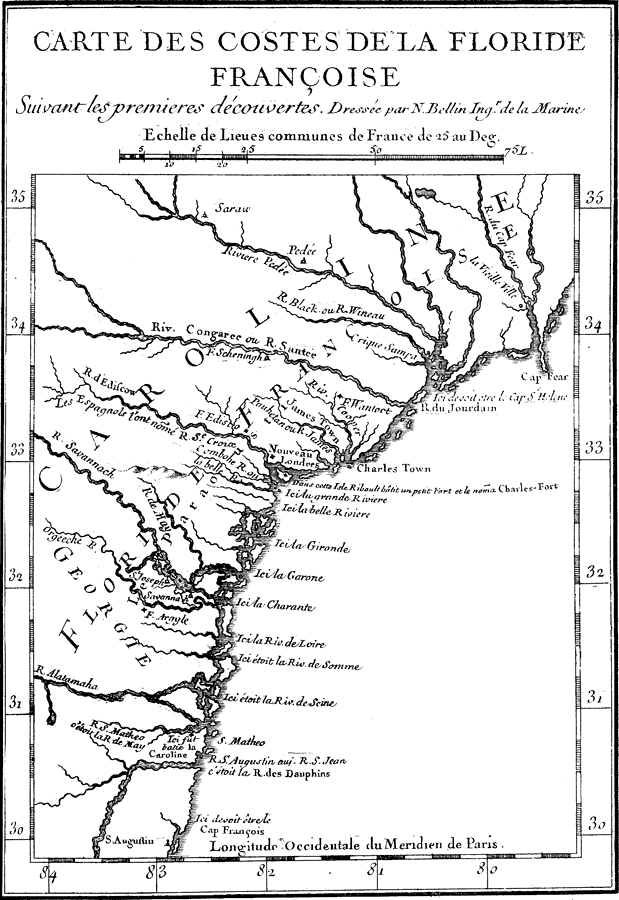
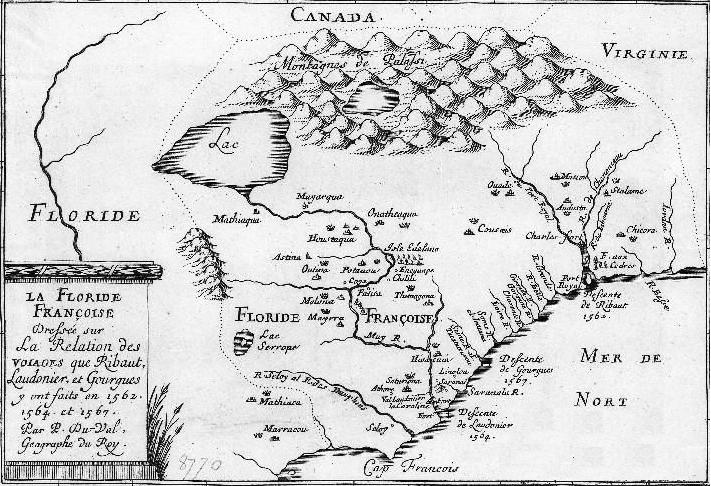
French navigator, Admiral Jean Ribault explored the Florida, Georgia and Carolina coastlines during the years 1562-1565. He was in search of colony locations for French Huguenots fleeing persecution. Jean Ribault’s epic journey’s for religious freedom took place more than 50 years before the Pilgrims landed on Plymouth Rock (1620).
|
|
Coastal map of French Florida, 17th Century
Map of French Florida, 17th Century
|
|
Everyone knows the story of the pilgrims on the Mayflower. Yet hardly anyone knows that some 50 years before their arrival in Portsmouth, a colony of French protestants came to seek refuge from persecution in today's Jacksonville, Florida, and Beaufort, north of Savannah, in South Carolina.
Unfortunately, their fate was tragic. They were not massacred by Indians, with whom they had established very friendly relations, but they were massacred by Spaniards who were determined to claim the area and expel non catholics, whom they viewed as heretics.
Today, a few markers and monuments remain. They attest to a remarkable story, largely forgotten, yet rich in accomplishments.
Jean Ribault (also spelled Ribaut) (born in Dieppe, Normandy 1520 – October 12, 1565) was a French naval officer, navigator, and a colonizer of what would become the southeastern United States. He was a major figure in the French attempts to colonize Florida.
• He entered the French navy under the command of the Huguenot Admiral Gaspard de Coligny, leader of the French protestants, who sent him on a mission to establish a colony for French protestants in the New World, along with René de Laudonnière, second in command, and artist Jacques Le Moyne, in charge of documenting their findings, with 2 vessels and about 150 colonists in the first voyage.
• In 1564, after discovering St James river near modern-day Jacksonville, he established a settlement near the mouth of the river which he called La Caroline ("land of Charles"), in honor of King Charles IX. This settlement was composed of a village and a fort.
After he built Fort Caroline, he built another one, located in the present-day city of Beaufort, near Savannah in South Carolina, named Charlesfort.
|
|
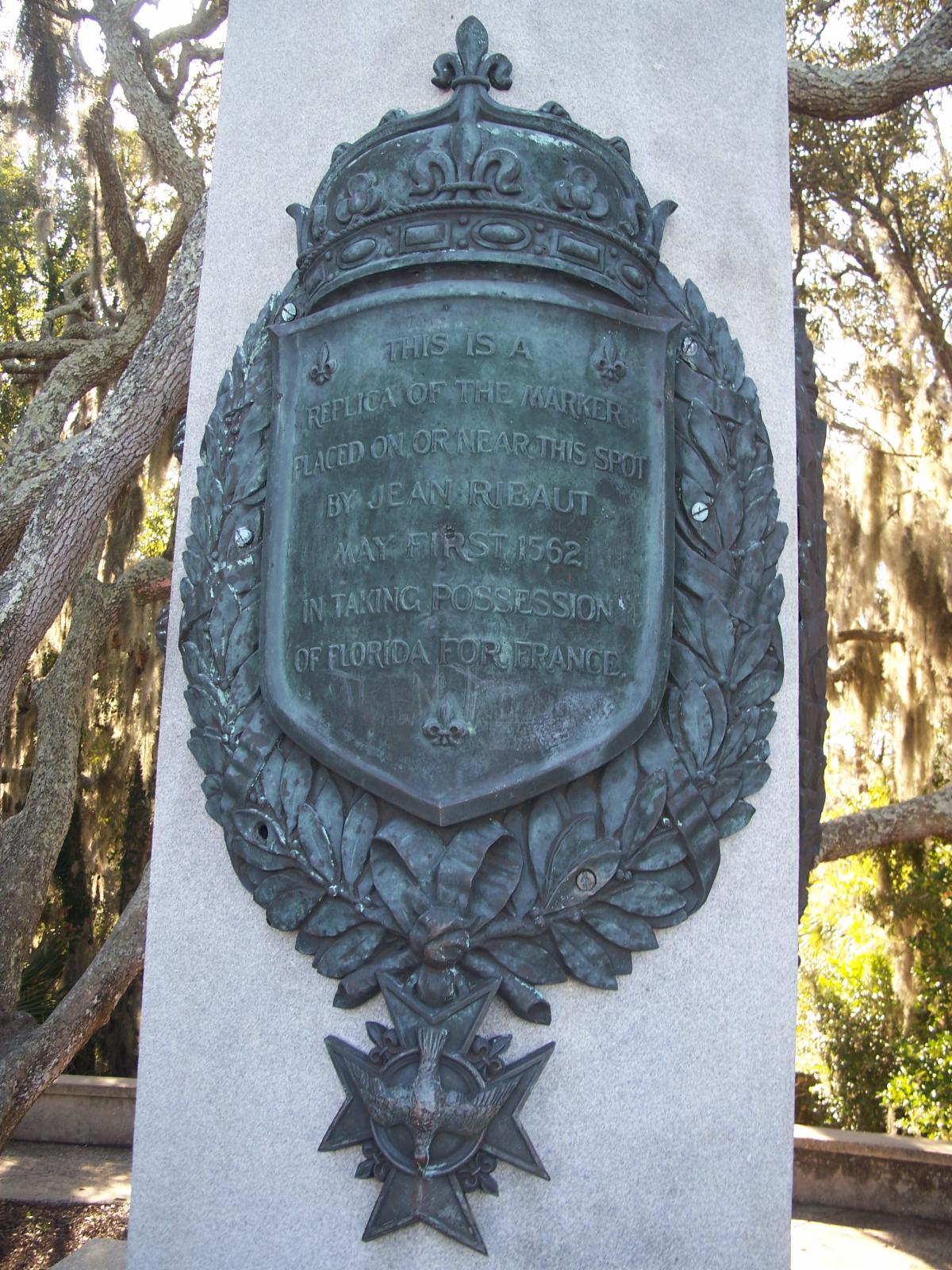
Fort Caroline National Memorial, “Ribault’s Monument”. It is a replica of Jean Ribault's column claiming Florida for France erected in 1562.
13271, Fort Caroline Rd, Jacksonville, FL 32225
Photo credit: by Ebyabe, CC BY-SA 3.0 <https://creativecommons.org/licenses/by-sa/3.0>, via Wikimedia Commons
Originally this marker stood further east at Mayport. When a naval airstation was established there in 1941 the marker was relocated to allow public access. Over the years the marker moved several times until finally placed in the park at an overlook.
|
|
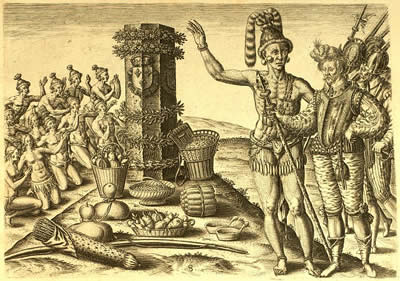
"Jean Ribault taking possession of Florida"
Author: Jacques Lemoyne/Theodore DeBry
This painting by Jacques le Moyne, an artist with the French expedition to colonize Florida in 1564, shows the expedition's leader, René de Laudonnière, standing with a Timucuan chief, Athore. Le Moyne's caption described the Timucuans as "worshiping the stone as an idol."
|
|
• Inscription:
Front: “This is a replica of the marker placed on or near this spot by Jean Ribaut May First 1562 in taking possession of Florida for France.”
Back: Erected by the Florida Daughters of the American Revolution May First 1924 commemorating the first landing of protestants on American soil.
• Fort Caroline National Memorial, administered by the National Park Service, memorializes the French presence in Florida.
• The original site of Fort de la Caroline has never been determined and is believed to have been located near the present day Memorial. The National Park Service constructed an outdoor exhibit of the original fort in 1964.
|
|
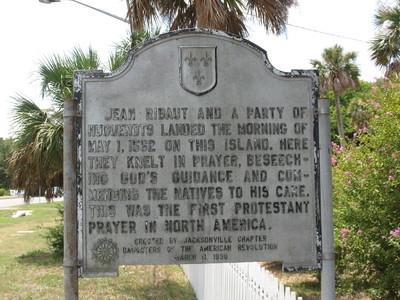
MARKER, THE FIRST PROTESTANT PRAYER IN AMERICA |
|
9953 Heckscher Dr, Jacksonville, FL 32226
|
|
• Inscription:
Jean Ribaut
"Jean Ribaut and a party of Huguenots landed the morning of May 1, 1562 on this island. Here they knelt in prayer, beseeching God's guidance and commending the natives to his care. This was the first Protestant prayer in North America."
"Erected 1936 by the Jacksonville Chapter of the Daughters of the American Revolution."
|
|
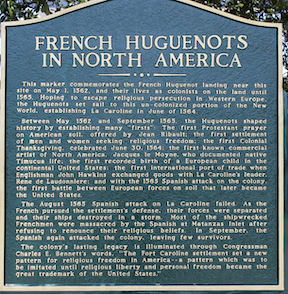
MARKER, FRENCH HUGUENOTS IN NORTH AMERICA |
|
Marker “French Huguenots in North America”
4830 Ocean St, Jacksonville, FL 32233
|
|
The enumeration of all the "firsts" accomplished by Jean Ribault and his companions is quite extraordinary. Yet who, among the general public, knows these facts? History taught in school textbooks only retains clichés, which are self-perpetuating....
Thus, this fairly recent marker (2016) deserves to be better known....
You be the judge...
• Inscription (highlights are ours):
“This marker commemorates the French Huguenot landing near this site on May 1, 1562, and their lives as colonists on the land until 1565. Hoping to escape religious persecution in Western Europe, the Huguenots set sail to this un-colonized portion of the New World, establishing La Caroline in June of 1564. Between May 1562 and September 1565, the Huguenots shaped history by establishing many "firsts":
The first Protestant prayer on American soil, offered by Jean Ribault;
the first settlement of men and women seeking religious freedom;
the first Colonial Thanksgiving, celebrated June 30, 1564;
the first known commercial artist of North America, Jacques le Moyne, who documented native Timucua life;
the first recorded birth of a European child in the continental United States;
the first international port of trade when Englishman John Hawkins exchanged goods with La Caroline's leader, René de Laudonnière;
and with the 1565 Spanish attack on the colony, the first battle between European forces on soil that later became the United States.”
“The August 1565 Spanish attack on La Caroline failed. As the French pursued the settlement's defense, their forces were separated and their ships destroyed in a storm. Most of the shipwrecked Frenchmen were massacred by the Spanish at Matanzas Inlet after refusing to renounce their religious beliefs. In September, the Spanish again attacked the colony, leaving few survivors. The colony's lasting legacy is illuminated through Congressman Charles E. Bennett's words, "The Fort Caroline settlement set a new pattern for religious freedom in America--a pattern which was to be imitated until religious liberty and personal freedom became the great trademark of the United States."
Side 2 of Marker:
“In Honor and Memory of the La Caroline Colonists who perished September 20th at the St. Johns River and Jean Ribault and his men who died at Matanzas defending the colony on September 29th and October 12th, 1565.
Dedicated October 10, 2016 commemorating the 450th Anniversary Year”
|
|
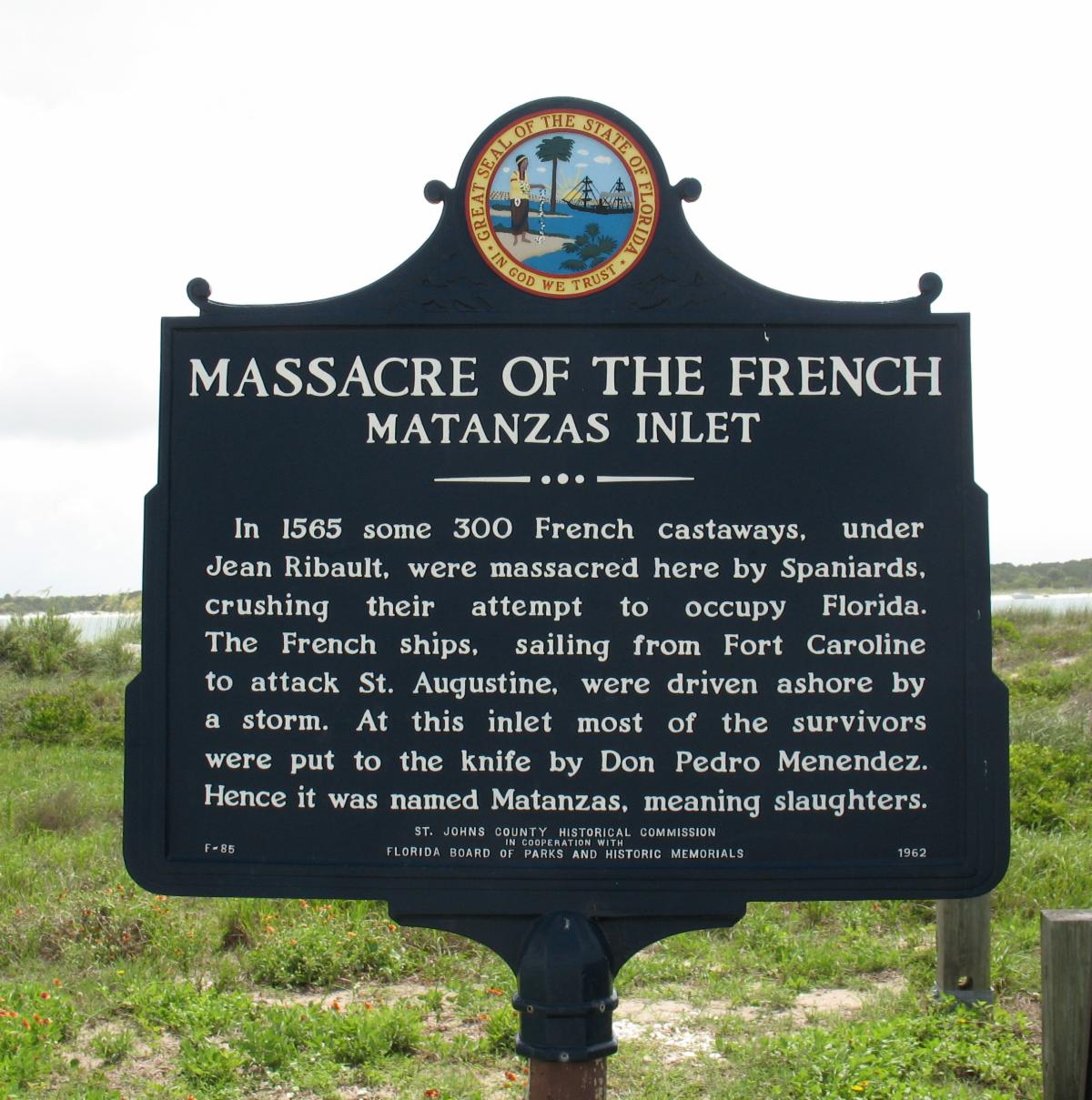
Marker “Massacre of the French”
Matanzas National Monument Inlet, Saint Augustine FL 32080
|
|
• However, having previously laid claim to Florida, Spain viewed this settlement as a threat to Spanish sovereignty in the New World. Accordingly, King Philip II of Spain ordered Don Pedro Menéndez de Avilés and his armada to attack and capture La Caroline.
• The Spanish viewed the French as heretics and intruders and sent an expedition to expel them. Ribault’s fleet was destroyed by a hurricane near cap Canaveral, and the Spanish were able to attack the lightly defended fort.
• On September 20, 1565, the Spaniards slaughtered the garrison and 140 civilians, only sparing women and children. Led by Ribault, survivors of the hurricane who made it on shore were captured and massacred by the Spaniards, who hung their bodies with an inscription, "Not as Frenchmen but as Lutherans.” Another 350, part of the command of Jean Ribault that had arrived just three weeks earlier, were also massacred at a place later named Matanzas ("Slaughter").
• In 2018 the shipwreck of Ribault's flagship, La Trinité, was located off of the coast of Cape Canaveral, Florida. France and the State of Florida signed a “Declaration of Intention to Embark on a Historic Partnership to Research and Preserve the Trinité Shipwreck”. Several places and schools in Florida are named after Ribault.
Side notes:
• An interpretive Marker dedicated to Melendez at 11 Magnolia Avenue, Saint Augustine FL 32084 (GPS: 29.906733, -81.315567) conspicuously does not mention at all the massacre.
• Also, a marker mentioning the massacre located at Matanzas National Monument Inlet, Saint Augustine FL 32080 (GPS: 29.710950, -81.229783) is reportedly sitting next to garbage cans alongside Florida Highway
• Inscription:
“In 1565 some 300 French castaways, under Jean Ribault, were massacred here by Spaniards, crushing their attempt to occupy Florida. The French ships, sailing from Fort Caroline to attack St. Augustine, were driven ashore by a storm. At this inlet most of the survivors were put to the knife by Don Pedro Menendez. Hence it was named Matanzas, meaning slaughters.”
“Erected 1962 by St. Johns County Historical Commission in cooperation with Florida Board of Parks and Historic Memorials.”
Marker “Fort de la Caroline - Fort Caroline National Monument”
Timucuan Ecological and Historic Preserve
Fort Caroline National Memorial, 12713 Fort Caroline Rd, Jacksonville, FL 32225
• Inscription:
"[The Spaniards] made a horrible, tragic slaughter of our forces, so great was the anger and hatred they had for our nation. They vied with one another to see who could best cut the throats of our people...” 1565, "la Caroline" carpenter Nicolas le Chaileux
"Jean Ribault arrived at la Caroline on August 28, 1565, with reinforcements for the failing colony. On Ribault's heels stood a Spanish flotilla bent on ejecting the French. Escaping near-capture, Ribault sailed south to destroy the Spanish. A violent storm wrecked his fleet”...
“Assuming that la Caroline was now vulnerable, Spanish commander Pedro Menéndez ordered an overland assault; a French traitor led 500 Spaniards through jungle and swamp to capture the poorly guarded French colony. The Spaniards killed 143 French colonists but spared 70 women and children. Laudonnière, le Moyne, and 40-50 others escaped into the woods and eventually back to France. Only one Spaniard died.”
“Seeking revenge, a French force led by Dominique de Gourgues returned to Fort de la Caroline (now called San Mateo) in April 1568. With Timucuan help the French surprised Spaniards and captured the fort, Gourgues sailed home and the Spanish reoccupied the fort until 1569.”
"Erected by National Park Service - U.S. Department of the Interior."
|
|
MONUMENT TO JEAN RIBAUT AND CHARLESFORT
PERRIS ISLAND, BEAUFORT, SOUTH CAROLINA
|
|
Marker “Fort San Marcos & The Ribaut Monument”
US Marines Corps Air Station Beaufort
Parris Island, Belleau Wood Road Circle, Beaufort, SC 29902
Photo by Sgt. Dengrier M. Baez, US Marines Corps Air Station Beaufort
A replica of the French Memorial is also part of the Marine Corps Depot entrance wall
|
|
• Inscription on the Marker:
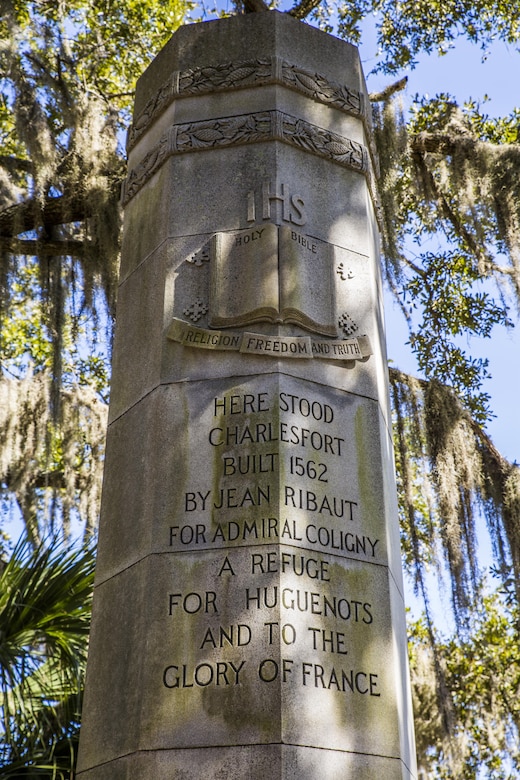
“The concrete pillars and the shallow depression here represent the outline and moat of a fortification excavated by the Marine Corps in 1923. The archaeological dig was supervised by Major George Osterhout who believed this was the site of the French Huguenot (Protestants) outpost Charlesfort founded in 1562 by by Jean Ribaut.
In 1925 the obelisk was erected to honor the early French explorers. Major Osterhout is among the dignitaries present for the dedication of the monument in March of 1926. He is the second from the right in the second row underneath the French flag.
Recent excavations reveal that this is the site of the Spanish Fort San Marcos that guarded the town of Santa Elena from 1577-1587. In 1996 the actual site of Charlesfort was found 200 yards north of here. Erected by U.S. Marine Corps Recruit Depot Parris Island.”
• Inscription on the Monument (West face):
“Here stood / CHARLESFORT / Built 1562 / By Jean Ribaut /
For Admiral Coligny
A refuge for Huguenots / and to the / Glory of France”
• Inscription on the Monument (East face):
"Erected 1925 by the Government of the United States of America
to mark the first stronghold of France on this Continent."
|
|
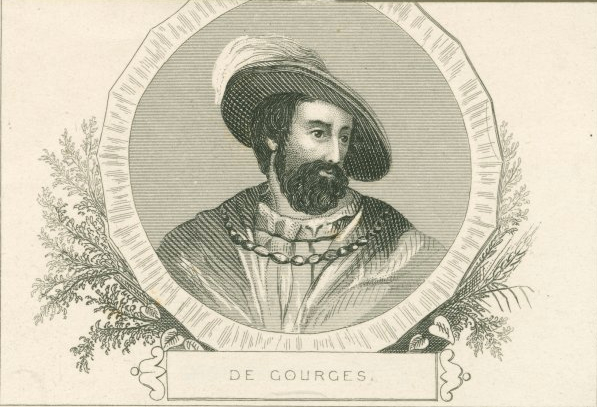
Dominique de Gourgues - By Unknown author - New York Public Library
|
|
• This massacre aroused considerable emotion in France. Three years later, a French expedition led by Dominique de Gourgues (1530–1593), a French nobleman and a captain in King Charles IX's army, set sail to America.
• Although he was himself a catholic, he decided to avenge the murder of his Protestant compatriots and mount an attack on the Spanish garrison.
• He was so determined that he sold all his possessions to arm 3 vessels and buy supplies for a punitive expedition. He raised a small force of 200 men, hid his ultimate intentions to them until he reached Cuba in order to avoid suspicions from Spanish spies . His men were totally supportive of this mission and it is said that the entire crew approved his choice of revenge. They proceeded to attack Fort Caroline, which had been renamed Fort San Mateo. by the Spanish. He enlisted the aid of Fort Caroline's old allies, the Saturiwa and the Tacatacuru clans of the Timucua Indians.
• The fort quickly surrendered to Dominique de Gourgue's forces. The French and Indians killed the Spanish prisoners in retribution for the massacres of their Protestants compatriots. To echo the terrible placard used by Menendez and his men, they hanged the prisoners with the inscription, "Not as Spaniards but as murderers" .
Still, Florida remained firmly in Spanish hands until late in the 18th Century.
However, the French are back in drove today, as entrepreneurs, artists, retirees and their presence in many cities in Florida can be felt in many positive ways...
|
|
EPILOGUE 2 - PRESENT TIMES |
|
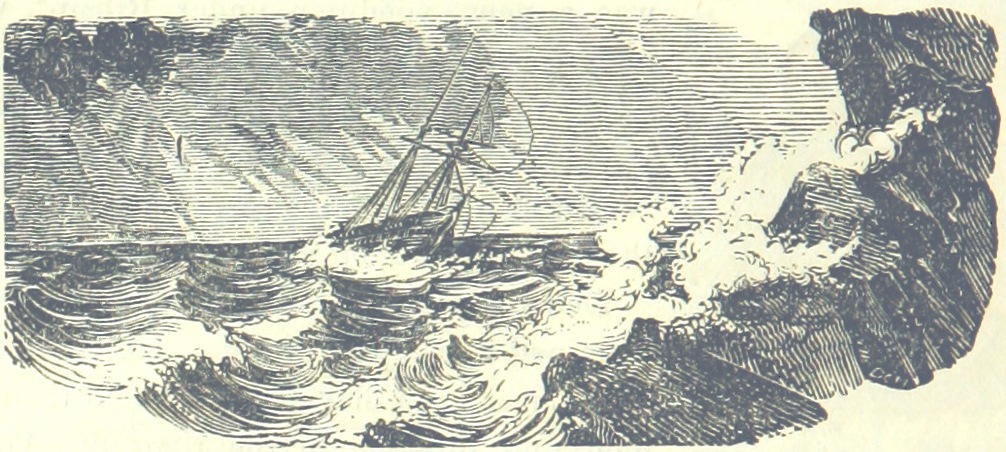
Sinking of Jean Ribault's Ship La Trinité off the Florida Coast, An Illustrated History of the New World, British Library, (1873)
By John Ledyard Denison — This file is from the 'Mechanical Curator' collection, a collection of over one million scanned images from expired copyrighted books placed on Flickr Commons by the British Library. Public domain, https://commons.wikimedia.org/w/index.php?curid=47550626
|
|
• A wreck was discovered off the coast of Cape Canaveral in September 2015 at a depth of 8 meters by a private American underwater exploration company.
19 iron cannons, 12 anchors, a millstone, the ship's ballast, ammunition and fittings from large 16th century ships were found. Among the artefacts found, three large bronze cannons and a marble monument, were all adorned with the "fleur-de-lys" of the coat of arms of the kingdom of France.
• The French Embassy in Washington asserted its rights, as the former French military ship is still the property of the French State as per international law, which law is endorsed by an act of Congress, "Sunken Military Crafts" of 2004. A judgement in Federal Court confirmed the property of the French State and agreed that the wreck was indeed that of La Trinité, Jean Ribault's ship.
• Since then, France and the State of Florida signed a convention in 2018 to agree on the future preservation and exhibition of the artefacts.
• In July 2020, a student follower of cancel culture launched a petition to change the name of the Jean Ribault High School in Jacksonville, Florida and a poll was held. However, it is historically established that Jean Ribault maintained good relations with the Timucua tribe, and 85% of the votes went against the petition to remove Ribault's name from the school.
|
|
PART TWO OF THE SERIES
"LAFAYETTE, GUEST OF THE NATION"
If you missed the episode from our August Bulletin...
• President James Monroe invited Lafayette, the last surviving major general of the American Revolutionary War, to tour the United States, officially to celebrate the nation's 50th anniversary but also to instill the "spirit of 1776" in the next generation of Americans at a time of great political divide. His tour drew large crowds and sparked a renewal of patriotism.
• From July 1824 to September 1825, Lafayette made a tour of all 24 States in the United States. He was received with a hero's welcome everywhere he stopped. Immense crowds, children, old veterans would come from miles away and wait hours to have a chance to see him, approach him, touch him. Many honors and monuments were presented to commemorate and memorialize the visit.
• The 24 states visited were: Alabama, Connecticut, Delaware, Georgia, Illinois, Indiana, Kentucky, Louisiana, Maine (ex-Massachusetts / North part), Maryland, Massachusetts, Mississippi, Missouri, New Hampshire, New Jersey, New York, North Carolina, Ohio, Pennsylvania, Rhode Island, South Carolina, Tennessee, Vermont, Virginia, Washington D.C.
• The main means of transportation were stagecoach, horseback, canal barge, and steamboat.
• Throughout the years 2024 and 2025 each city will celebrate this most illustrious Frenchman, ranked alongside the Founding Fathers, practically on a par with George Washington. If anyone harbors any doubt about it, one only needs to read the some of the hundreds of local newspapers articles and the accounts or memoirs of contemporary witnesses accounts.
|
|
• Several of his stops are memorialized with markers and plaques, some decades-old, and an increasing number of brand new ones, thanks to the energy and enthusiasm deployed by Julien Icher, president of the LafayetteTrail.org, whose goal is to dedicate all 175 markers by 2024.
• These new markers from the LafayetteTrail.org are all made in the same distinctive blue and red cast metal and signed by the William C. Pomeroy Foundation which is generously funding this gigantic project.
• The American Society of Le Souvenir Français Inc. is honored to partner with these two like-minded organizations, all well as all other American patriotic associations and volunteers who are participating in these celebrations.
|
|
As we started with last month's Bulletin, every month we will narrate some of the most salient episodes of this remarkable journey of the corresponding month 198 years ago, while keeping you abreast of the many celebrations planned by the local committees of the American Friends of Lafayette in 2024 and in 2025.
For this series we will also borrow from the testimonies of a privileged close witness, Auguste Levasseur, Lafayette’s personal secretary, who traveled along with the Marquis and his son, George Washington Lafayette, and who published his extensive daily journal: “Lafayette en Amérique 1824-1825, ou Journal d'un voyage au Etats-Unis" (Published by the Librairie Baudoin, Paris, in 1829), as well as other well-documented sources, such as Samuel Lorenzo Knapp. “Memoirs of General Lafayette : with an Account of His Visit to America and His Reception By the People of the United States; From His Arrival, August 15th, to the Celebration at Yorktown, October 19th, 1824”(Published in November, 1824)
|
|
September 1 – Visits Portsmouth, New Hampshire
September 2 – Visits Boston and Lexington, Massachusetts
September 3 – Visits Worcester, Massachusetts and Tolland, Connecticut
September 4 – Visits Hartford and Middletown, Connecticut
September 5 – Arrives back in New York City
September 10 – Visits African Free School No. 2 on Mulberry Street; celebrated with a short speech by 11-year old pupil James McCune Smith, later a prominent anti-slavery scholar, writer, and physician.
September 11 – Celebrates the 47th anniversary of the Battle of Brandywine with French residents of New York
September 15 – Visits Newburgh, New York
September 16 – Visits Poughkeepsie, New York
September 28 – Visit to Philadelphia with a parade followed by speeches at the State House (Independence Hall) under Philadelphia architect William Strickland's Triumphal Arches
|
|
LAFAYETTE AT LANCASTER, MASSACHUSETTS
September 3, 1824
|
|
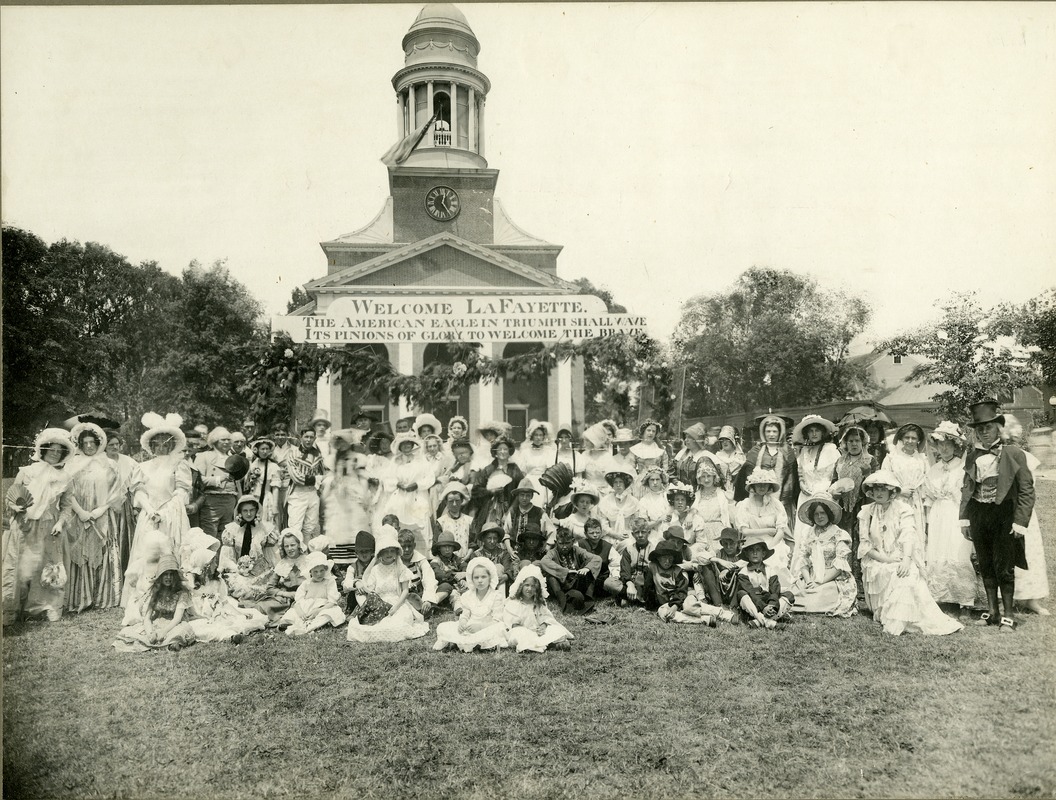
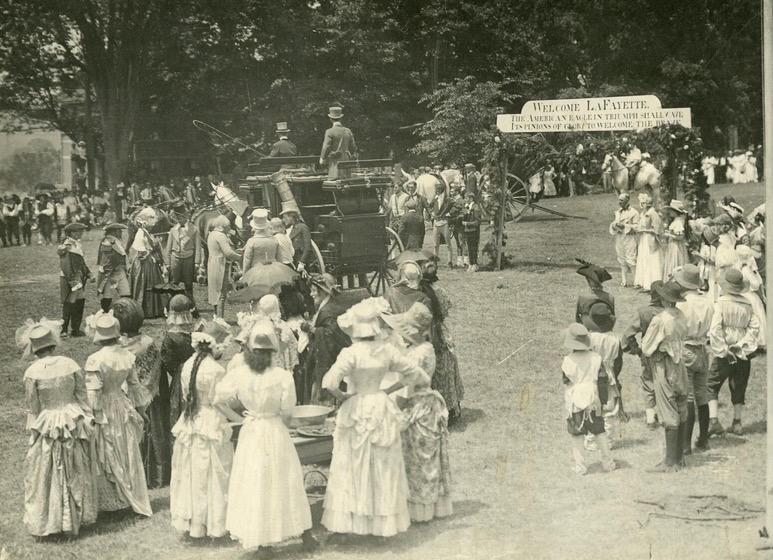
A photograph of the actors who participated in the final episode, the Reception to Lafayette, of the Lancaster, Massachusetts 1912 Fourth of July pageant
Marker “Lafayette in Lancaster, MA.” Sept 3, 1824
Located on the grounds of First Church of Lancaster, Unitarian Universalist
725 Main St, Lancaster, MA 01523
|
|
• On September 2, 1824, Lafayette set out from Boston, spent the night in Bolton at the mansion of S.V.S. Wilder and on September 3, was escorted to Lancaster by the Bolton Rifle Company. He arrived at Lancaster on September 3, 1824 at half past six in the morning. A reception on the Lancaster Town Green was memorialized in a stone marker set in the grounds of the First Church of Lancaster, Unitarian Universalist.
• Inscription of marker:
‘On the common near the brick
church, general Lafayette was
received by the citizens of
Lancaster on September 3, 1824
“Welcome Lafayette
The American eagle in triumph
shall wave its pinions of glory
to welcome the brave”
• On July 4, 1912, a pageant recreated the event and several digitalized B&W photos can be viewed on the Digital Commonwealth website.
|
|
LAFAYETTE IN HARTFORD, CONNECTICUT
September 4, 1824
|
|
Marker, Lafayette’s tour, Hartford, CT
Central Row and Travelers, Hartford, CT 06103
|
|
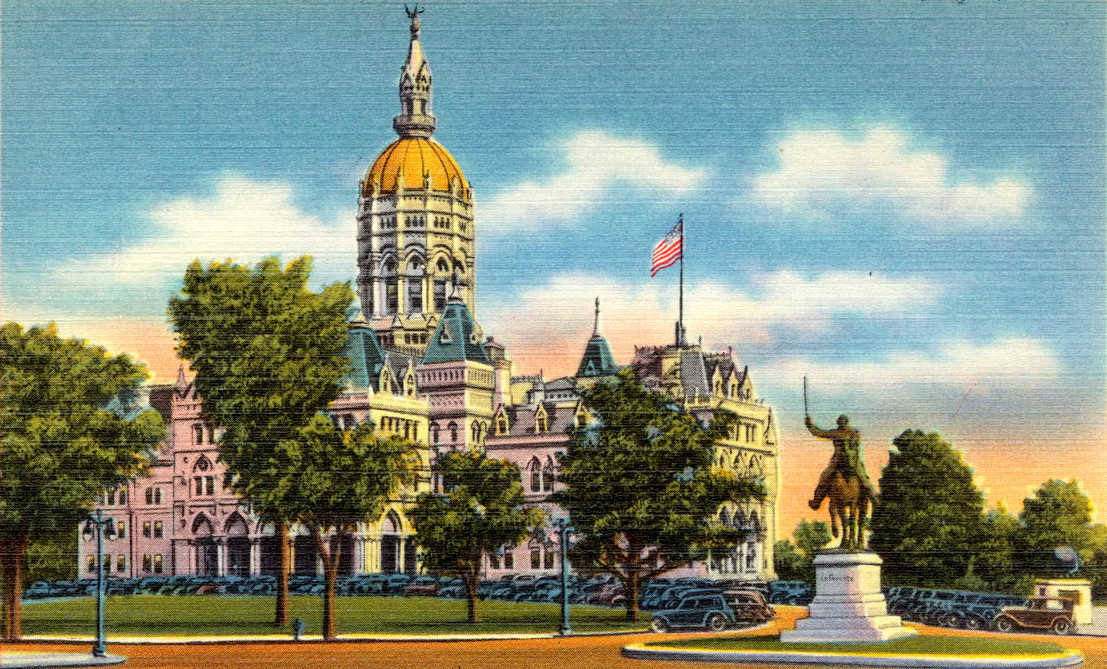
• “...He [Lafayette] entered the capital of Connecticut at 10 o’ clock on Saturday morning, preceded by a military escort, and civic procession, and welcomed by those splendid demonstrations of respect and affection, which the dense population, ability and taste of the citizens of the State,-one and all, enabled them to proffer. On alighting, the Mayor welcomed him with an address. He was then introduced to the State house, where the welcome of the State was given by Governor Wolcott. In the State House yard were 800 children, the girls all dressed in white, and wearing badges with the motto: “Nous vous aimons LAFAYETTE.” <We love you Lafayette>. Many hundred Ladies, and some gentlemen were introduced to him. He was afterwards conducted to the stage, where nearly 100 of the veterans of the revolutionary army marched before him, to their own music, and received a cordial greeting. He then reviewed a body of about 1200 troops, commanded by Gen. Johnson...”The Boston Recorder, Sept 8, 1824
• Inscription of marker:
“On Sept. 4, 1824, general
Lafayette visited Hartford
during his triumphal return
to the U.S. he was addressed
here by Governor Wolcott.”
William G. Pomeroy foundation 2021
|
|
VISIT OF MANHATTAN'S PUBLIC SCHOOL
September 10, 1824
|
|
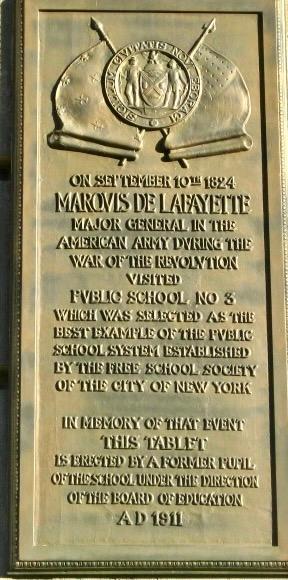
Lafayette Plaque, Public School #3, Lower Manhattan
September 10, 1824
490 Hudson St, New York, NY 10014
|
|
• During his visit, local authorities were eager to show Lafayette the many accomplishments and progress achieved by the young Nation in just a few decades. Public education was a rightful source of pride and Lafayette was very impressed with what he saw. So were the young students, who remembered this important day for the rest of their lives.
• A commemorative plaque in the West Village of Manhattan marks this particular visit. It’s on Hudson Street affixed to the facade of Public School # 3. At the time, the school was run by the “Free School Society” and was considered a fine example of public educaoon, worthy enough to show the Marquis.
• Inscription:
“On September 10th 1824 Marquis de Lafayette Major General in the American Army during the War of the Revolution visited Public School No. 3 which was selected as the best example of the public school system established by the Free School Society of the City of New York.In memory of that event this tablet is erected by a former pupil of the school under the direction of the Board of Education AD 1911"
"Erected 1911 by Board of Education.”
|
|
A PRIVATE DINNER IN TOWN...
September 10, 1824
|
|
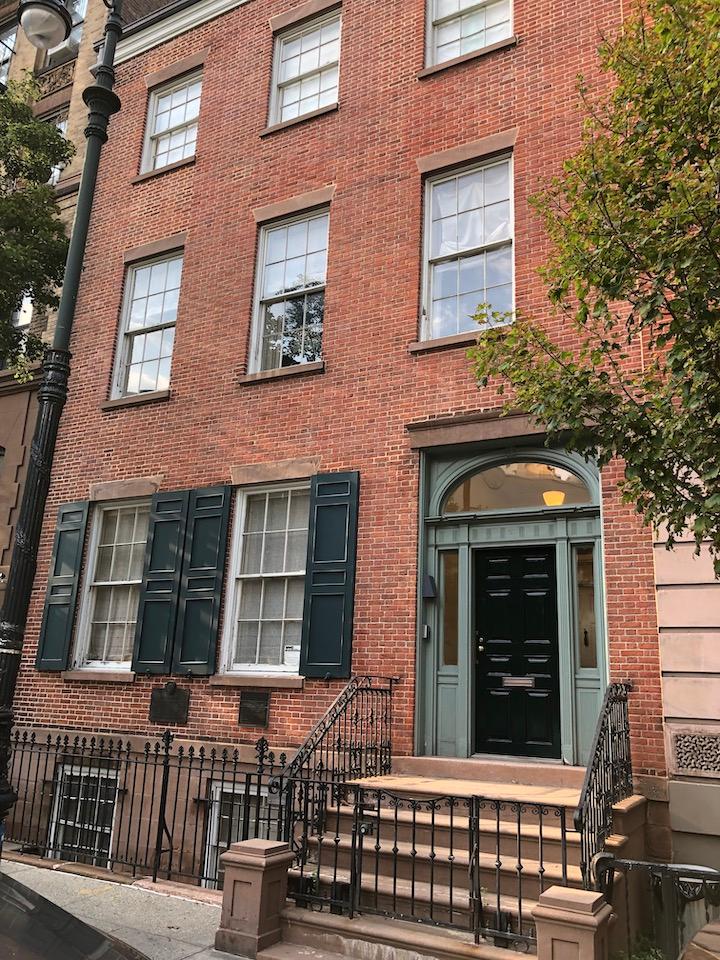
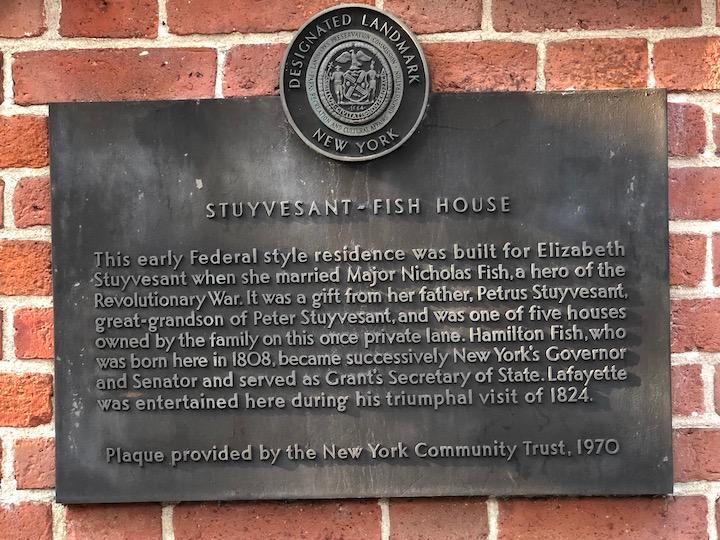
Plaque, “Stuyvesant – Fish House”
21 Stuyvesant Street, New York NY 10003
Photo: Thierry Chaunu (2022)
|
|
• During his 13-months visit, Lafayette was regularly invited to public balls, receptions of all kinds, as well as private dinners. It is particularly moving to see well-preserved residences, exactly as they would have appeared to the dear Marquis' eyes, still standing today. It is said that the inside of the house (occupied by staff of the College of Mechanics) is also very much preerved the way it was in 1824. Back in September 10, 1824, Lafayette was invited for a "dinner in town" by Major Nicholas Fish.
• Major Nicholas Fish (1758-1833) served on the staff of Lafayette during the Revolutionary War. At Yorktown, he served as second-in-command to Alexander Hamilton, and commanded Hamilton's New York Battalion in the Assault on Redoubt 10. He became Adjutant General in New York, married into the Dutch Stuyvesant dynasty, a founding family of New York City.
• Inscription (Left plaque):
“This early Federal style residence was built for Elizabeth Stuyvesant when she married Major Nicholas Fish, a hero of the Revolutionary War. It was a gift from her father, Petrus Stuyvesant, great-grandson of Peter Stuyvesant, and was one of five houses owned by the family on this once private lane. Hamilton Fish, who was born here in 1808, became successively New York’s Governor and Senator and served as Grant’s Secretary of State. Lafayette was entertained here during his triumphal visit of 1824.”
[Right Plaque]
Hamilton Fish House has been designated a National Historic Landmark
This site possesses national significance in commemorating the history of the
United States of America
1975, National Park Service, United States Department of the Interior"
Erected 1970 by New York Community Trust.
|
|
LAFAYETTE AT WEST POINT ACADEMY, NY
September 15, 1824
|
|
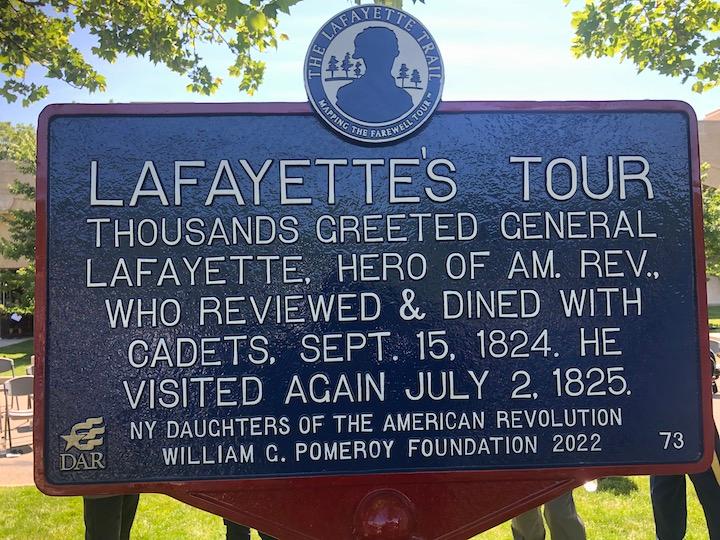
Marker Lafayette’s tour, West Point NY
Sept 15, 1824 & July 2, 1825
West Point Military Academy, Visitors Center, New South Post Rd, Highland Falls, NY 10928
Photos: Thierry Chaunu (2022)
|
|
• This marker was dedicated on June 6, 2022 by the LafayetteTrail.org and the Daughters of the American Revolution, during a beautiful intimate ceremony. It is placed directly in front of the famous military academy's Visitors Center, and next to a series of interpretive panels which narrate the role of French engineers in the formation of the prestigious academy, including manuals that served to educate cadets. We will devote a future Bulletin on this chapter of French-American relations.
• The Magazine of American history states that “Lafayette left at 2:00AM on board the steamboat James Kent, that had been provided for his trip to Albany, and the towns of the Hudson River. When off Tarrytown the boat was enveloped in a fog so dense that the pilot could not see five rods ahead. The result was that the boat ran aground on the Oyster Bank, where she was detained for several hours. West Point was reached at half past 12:00PM, where the General partook of an entertainment, one of the volunteer toasts. At 6:00PM, he re-embarked on the Kent which proceeded to Newburgh.”
• Inscription:
“Thousands greeted general
Lafayette, hero of the Am. Rev.
who reviewed & dined with
cadets, Sept. 15, 1824. He
visited again July 2, 1825.”
NY Daughters of the American Revolution, William G. Pomeroy Foundation 2022
|
|
LAFAYETTE AT THE STATE CAPITAL ALBANY, NEW YORK
September 17, 1824
|
|
Marker, Albany, NY, September 17, 1824
59 Washington Avenue, Albany, NY 12210
By Kenneth C. Zirkel - Own work, CC BY-SA 4.0, https://commons.wikimedia.org/w/index.php?curid=85600176
|
|
• “At the moment of our landing the multitude redoubled their cries of joy [...] it is difficult to conceive how so many people, whom the enthusiasm of gratitude had urged upon the very wheels of Lafayette’s carriage, could escape uninjured. At the entrance of the suburb a procession was formed in order; a band of musicians led the march, and we went to the capitol through the principal streets, all of which were rendered light by innumerable illuminations, and high pyramids of blazing wood. At the entrance of the street leading to the capitol, was an arch of triumph [...]. We entered the senate chamber of the capitol. The galleries were filled with a great number of ladies. The municipality were assembled there. The general was received and addressed by the mayor, who eloquently expressed the gratitude of the United States, and especially of the city of Albany, “those who have shared with you the toils of our revolution, and who still live,” said he, “hail you as a friend and brother. The generation which has arisen since you quitted these shores, is animated with the same sentiments, and those which shall be born in future ages, will celebrate in you the benefactor of America, the hero of liberty. In each of the hearts which beat around you, you hold the place of friendship, and your eulogy is in all mouths.” Excerpt From: Auguste Levasseur, “Lafayette in America in 1824 and 1825 - Vol I.”
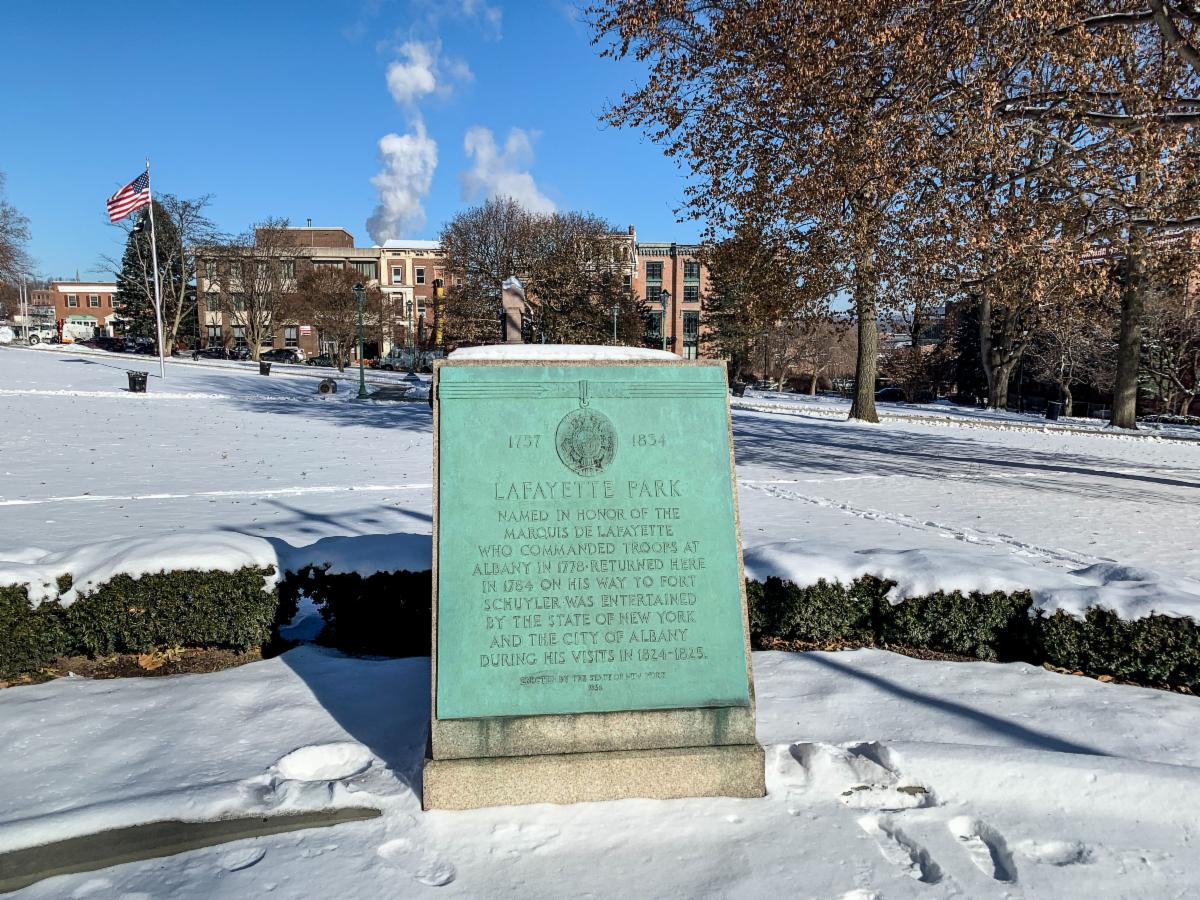
• Inscription :
“Named in honor of the Marquis de LaFayette who commanded troops at Albany in 1778. Returned here in 1784 on his way to Fort Schuyler was entertained by the State of New York and the City of Albany during his visits in 1824-1825."
"Erected 1936 by New York State.”
|
|
AT THE SEMINARY, TROY, NEW YORK
September 18, 1824
|
|
Marker, Lafayette’s tour, Troy, NY September 18, 1824
2 1st St #614, Troy, NY 12180
Postcard Historic Murals by George Gray, The Hendrick Hudson, Troy
|
|
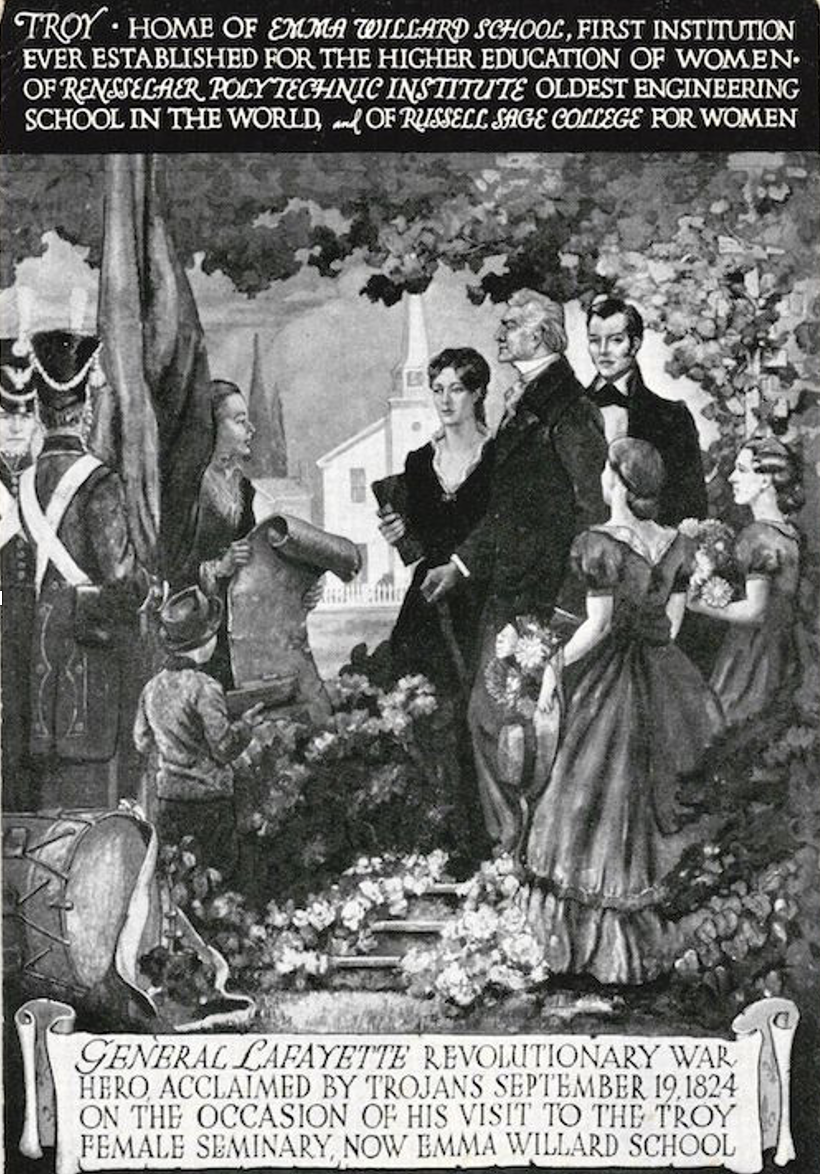
• “He [Lafayette] was conducted by this committee into the interior of the establishment, where no other man went with him, and some moments after, we heard the pure and angelic voices of the young girls repeating in chorus, “To visit us thou hast left thy beloved family in a distant land, but be not afflicted; art thou not here in thy country? Behold how many of the daughters of Columbia are proud and happy to salute thee by the tender name of father. “The general soon returned from the house; his features exhibiting profound emotion, and his eyes swimming in tears. He slowly descended the steps surrounded and supported by the principal ladies of the institution. Two hundred young girls followed him, clothed in white, harmoniously raising to heaven their grateful voices. They accompanied him to the outer gate where they took a tender leave of him, in the presence of several thousand spectators, whom this scene kept plunged in reverential silence.” (Auguste Levasseur. “Lafayette in America in 1824 and 1825 - Vol I. p. 265)
• Inscription :
“On Sept. 18, 1824, general
Lafayette was met here at
the Troy house and addressed
a crowd before going to meet
Emma Willard at her school.”
NY Daughters of the American Revolution
William G. Pomeroy foundation 2022
|
|
TO BE CONTINUED NEXT MONTH!... |
|
SEASON 2, EPISODE 2, SEPTEMBER 1782:
THE FRENCH ARMY FROM KINGSTON, NJ TO BOSTON
|
|
MISSION ACCOMPLISHED
Last year we narrated in 5 episodes, from June to October, the long march of the French Army under general comte de Rochambeau from Newport, R.I. to Yorktown, VA, through the States of CT, NJ, NY, PA, DE, MD
We are resuming the series, which will extend from this month until December: "Season 2, Episode 2: September 1782, New Jersey & New York"
After the victory in Yorktown, the war was not officially over. It would take several more months before England would recognize the independence of the United States and sign the Treaty of Paris on September 3, 1783.
During that time, British forces were still in control of cities such as New York.
The French army spent the most part of the winter of 1781-1782 stationed in Williamsburg, VA, and starting marching north in July 1st, 1782 to reach Boston in December and sail home.
Some units stayed behind, such as the famous Lauzun Legion of hussards, who kept watch during the winter of 1782-1783.
The return march route was in a much lighter mood, understandably so. It is not as well documented than the south-bound march we narrated last year. Still, there are several markers along the way which we will select, as well as a few nice anecdotes which we will tell in future bulletins until December.
Below are a few markers pertaining to the month of SEPTEMBER 1782, while crossing the States of Pennsylvania, New Jersey and New York.
|
|
A FEW SELECTED MARKERS ALONG THE WAY...
September 1782
|
|
Marker, 22nd (South) & 32nd (North) camp of the French Army at Liberty Corner, NJ
3625 Valley Road, Liberty Corner, NJ, 07938
Photo: Basking Ridge Chapter, Daughters of the American Revolution
|
|
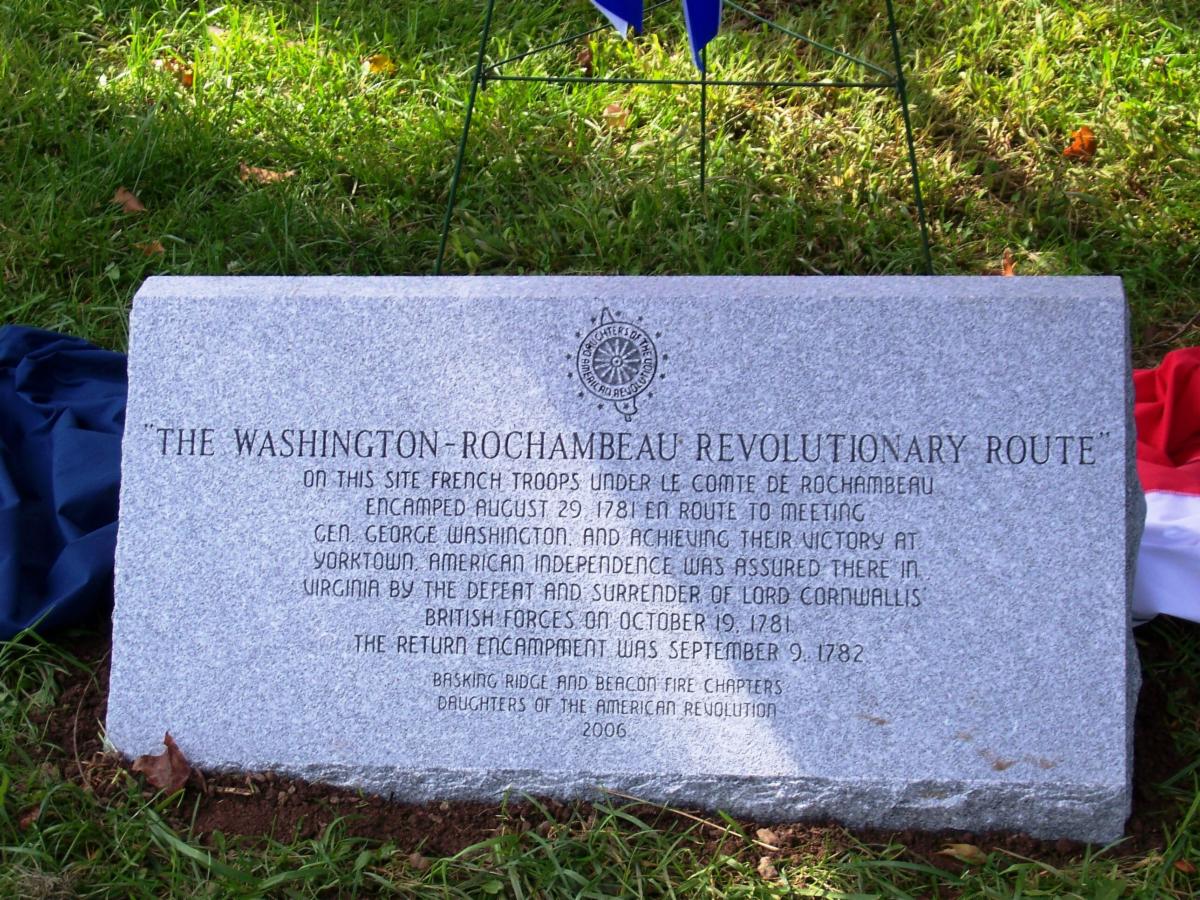
• This marker above commemorates the site where, from August 29-31, 1781, French forces camped on the grounds of the "English Farm" in Liberty Corner, New Jersey. French troops camped here again a year later, on September 9, 1782, when they returned from Virginia.
• A marble monument was erected by the Basking Ridge and Beacon Fire Chapters of the Daughters of the American Revolution in 2006 (photo above)
• There are not many markers devoted to the encampments of the French Army on their march north to Boston. The reason is simple, many of these sites are the same ones that were chosen by French engineers and commissaries on their way South, and therefore a simple mention is often added.
For instance, throughout September, we have the following sites:
• Marker, 26th (South) and 28th (North) Camp, Bensalem, PA
September 2-4. 1781 & September 2-3, 1782
At the Red Lion Inn, 511 Bristol Pike (Rt. 13) & Mill Rd., Bensalem 19020
• 25th (South) & 29th (North) Camp, Trenton, NJ
September 1-2. 1781 & September 3-7, 1782
(No known marker)
• 24th (South) & 30th (North) Camp Princeton, NJ
August 31 – September 1, 1781 & September 8-9, 1782
1895 Clubhouse Dr., Princeton, NJ 8540
The First Brigade of the French Army encamped here on September 7/8, 1782, their thirtieth camp since departure from Williamsburg, Virginia,on July 1, 1782, on the march back from Virginia. The Second Brigade followed the next day.
• 23rd (South) & 31st (North) Camp, Sommerset/Millstone, NJ
August 30-31, 1781 & September 8-9 & 9-10, 1782
The First Brigade of the French Army encamped here on September 8/9, 1782, their thirty-first camp since departure from Williamsburg, Virginia, on July 1, 1782, on the march back from Virginia. The Second Brigade followed the next day.
• 21st (South) & 33rd (North) Camp, Whippany, NJ
August 27-29, 1781 & September 10-12, 1782
67 Whippany Rd./Lucent Technology Park (511 South) Whippany, NJ 7981
French forces camped here on August 27-29, 1781, their twenty-first camp since departure from their first camp in Providence, Rhode Island, on June 18, 1781, and again on the return march on September 10-12, 1782, their thirty-third camp since departure from their camp in Williamsburg, Virginia,on July 1, 1782.
• 20th (South) & 34th (North) Camp at Pompton Plains, NJ
August 26-28, 1781 & September 12-13, 1782
The First Brigade of the French Army encamped here on September 12/13, 1782, their thirty-fourth camp since departure from Williamsburg, Virginia, on July 1, 1782. The Second Brigade followed the next day.
|
|
OTHER PLAQUES AND MARKERS ALL DATED IN SEPTEMBER THROUGHOUT THE UNITED STATES |
|
JULIEN DUBUQUE, IOWA
September 22, 1788
|
|
Marker, “Julien Dubuque”
1810 Monument Dr, Dubuque, IA 52003
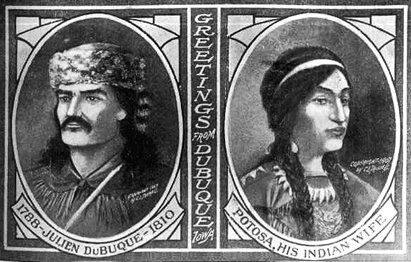
An artist's 1907 conception of Julien Dubuque and his Indian wife Potosa
Julien Dubuque Monument and tomb, Confluence of the Mississippi River and Catfish Creek, State Recreation Area Dubuque
1810 Monument Dr, Dubuque, IA 52003
|
|
• Excerpts of marker:
“Julien Dubuque was born on January 10, 1762 at Trois Rivières near Quebec, Canada. In 1788, he established a trading post and lead mining smelter at the mouth of Catfish Creek. He was active in fur trading and lead mining with the Mesquakie (Sac & Fox) tribe who lived nearby. According to the legend, Dubuque married Potosa, daughter of Chief Peosta. Julien Dubuque died on March 24, 1810 and was buried by the Mesquakie (or Meskwaki) with tribal honors overlooking Catfish Creek and the Mines of Spain. In 1897, the Old Settlers Association erected the 25 foot tall limestone monument that exists today known as the Julien Dubuque Monument” [...]
...“Dubuque's right to the land was originally obtained from the Mesquakie in an agreement dated September 22, 1788 and signed at Prairie du Chien, Wisconsin. On November 10, 1796, Julien Dubuque obtained an official land grant from the Spanish Governor, Baron de Carondelet in St. Louis. The Spanish grant included 73,324 acres of land. It stretched for eleven miles north and south of Catfish Creek and nine miles west. This area shown on early 18th Century maps as "Mines de Plomb" (lead mines) became known as “Mines of Spain”...
|
|
THE PLAQUE OF THE UNITED STATES INDEPENDENCE
YORKTOWN VICTORY MONUMENT, VIRGINIA
September 3, 1783
|
|
A few feet near the Monument to the Alliance & Victory, Yorktown, VA
|
|
• Inscription (bilingual):
“A l'occasion du bicentenaire des traités de Paris et de Versailles qui consacrèrent le 3 septembre 1783 l'Indépendance des Etats-Unis d'Amerique cette plaque a été apposée par les Filles de la Révolution Américaine en témoignage de gratitude envers les artisans qui s'étaient voués
"Au plus beau des ouvrages -- l'elaboration de la paix"
(Benjamin Franklin)
ON SEPTEMBER 3, 1983, THE BICENTENNIAL OF THE TREATIES
OF PARIS AND VERSAILLES
WHICH SECURED THE PEACE AND ESTABLISHED
THE INDEPENDENCE OF THE UNITED STATES OF AMERICA
THIS TABLET WAS OFFERED BY THE
NATIONAL SOCIETY, DAUGHTERS OF THE AMERICAN REVOLUTION
AS A GRATEFUL TRIBUTE TO THE ARCHITECTS OF THESE TREATIES, WHO DEDICATED THEMSELVES TO
"THE BEST OF ALL WORKS -- THE WORK OF PEACE."
(BENJAMIN FRANKLIN)
Erected by The National Society, Daughters of the American Revolution."
|
|
LA PÉROUSE IN MONTEREY, CALIFORNIA
September 15, 1786
|
|
Plaque, Visit of La Pérouse in Monterey, CA in 1786
San Carlos de Borromeo church in Carmel, CA
3080 Rio Rd, Carmel-By-The-Sea, CA 93923
Jean-François de Galaup de La Pérouse by Geneviève Brossard de Beaulieu, Fine Arts Museums of San Francisco - Public domain, via Wikimedia Commons –
Photo of plaque: Marc Onetto
|
|
• Inscription:
“In memory of the arrival at Monterey on September 14, 1786, of the explorer Comte de La Pérouse, commanding the frigates Boussole and Astrolabe. This constitutes the first official visit of a European power to the Spanish establishments on a then mysterious coast. In this chapel of the Carmel mission, Father Lasuen in honor of the event celebrated a Te Deum mass on September 16, 1786.”
• Jean-François de Galaup de La Pérouse (1741-1788) was a French naval officer and explorer. Having enlisted at the age of 15, he had a successful naval career and in 1785, was appointed to lead a scientific expedition around the world. His ships stopped in Chile, Hawaii, Alaska, California, Macau, Japan, Russia, and Australia, before wrecking on the reefs of Vanikoro in the Solomon Islands. He first distinguished himself during the Revolutionary War of Independence, commanding the frigate Amazone.
• La Pérouse and his ships were the first non-Spanish European visitors to this region of Alta California. On 15th September 1786 the Boussole and the Astrolabe dropped anchor in the Bay and were given an enthusiastic reception. The fort of Monterey fired a seven-gun salute in welcome. During their ten-day visit, the French visitors received generous offers of supplies for their voyage. There is a memorial plaque commemorating La Pérouse's visit at the entrance to the present-day San Carlos de Borromeo church in Carmel, presented by the French government in 1948.
|
|
TRIBUTE TO FRENCH AVIATION PIONEERS
COSTES & BELLONTE
September 1-2, 1930
|
|
Rockefeller Center, Maison Française, 610 Fifth Avenue & 49th Street, New York, NY 10020
Photos: Thierry Chaunu (2019)
|
|
• Inside the Lobby (entrance on the side, from the central alley nicknamed “the Channel”, there is a monumental reproduction in sterling silver of the famous plane from French aviation pioneers Costes and Bellonte.
• We will devote a full Bulletin early next year to pay tribute to these largely forgotten aviation pioneers, who were celebrated with a ticker tape parade.
• Inscription:
Reproduction in sterling silver of the
“Question Mark”
which made the first non-stop flight from Paris to New York
in September 1930, piloted by the french aviators
Costes and Bellonte
this good-will flight was the return visit of
Lindbergh's historic flight to paris in 1927
this reproduction, which is scientifically correct in
every detail, is the gift of the French government to
Rockefeller center for La Maison française
presented on November 8, 1933
by the French ambassador to the United States.
His Excellency Monsieur André Lefevre de Laboulaye
Executed by Cartier
|
|
PAST MONTHLY BULLETINS
OUR GOAL: turn the spotlight on a famous, or less famous, episode or historical figure during the long shared history between France and the United States, with illustrations and anecdotes.
You can have access to all our past Monthly Bulletin
since February 2021 by visiting our website:
You can click on the photos in our bulletins and on the links indicated in blue for more information and direct access to the references.
|
|
In our next Bulletin in October we will continue to follow the steps of the Marquis during his tour in October 1824 through Delaware, District of Columbia, Virginia, as well as the long march of the French Army back to Boston in 1782 following the victory in Yorktown. |
|
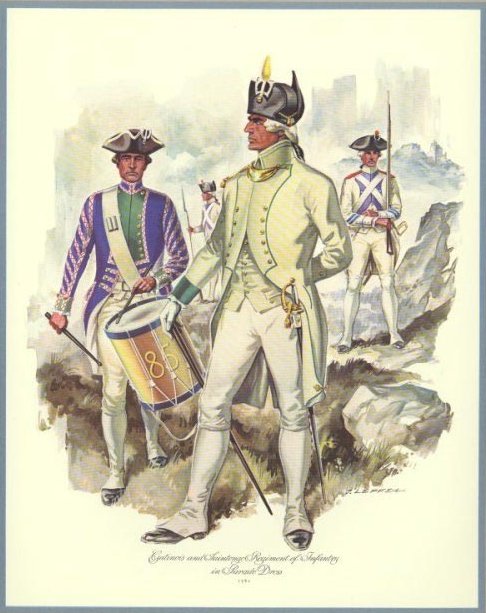
Pictured above: Gâtinois and Saintonge Regiment of Infantry in Parade Dress 1781 - SOURCE: The American Revolution, 1775-1783. Paintings by Jean Leffel, based upon illustrations of H. A. Ogden and Lt. Charles M. Lefferts. Photolithos printed Zurich, Switzerland. Historical descriptions by Harry W. Barker, Jr.
|
|
• We started a fund raising campaign for the purpose of providing volunteers from the French military contingent stationed at NATO headquarters in Virginia with period uniforms, to participate alongside American volunteers in joint patriotic ceremonies. These sets of period military uniforms are made in the USA by very skilled specialized tailors and will be exact reproductions, down to the last button.
We gratefully acknowledge a generous contribution from the Association des Cadres de Réserve Français aux Etats-Unis (ACREFEU) however we are still short $2,000 from our goal.
Please help! Your donation is tax deductible! Suggested donations: $50 - $100 – A recognition medal from Le Souvenir Français will be offered for donations over $500.
Please send your donation via PayPal: https://souvenirfrancaisusa.org/donate/ or by check, payable to "American Society of Le Souvenir Français, Inc"
Please indicate: "Rochambeau Historical Uniforms"
|
|
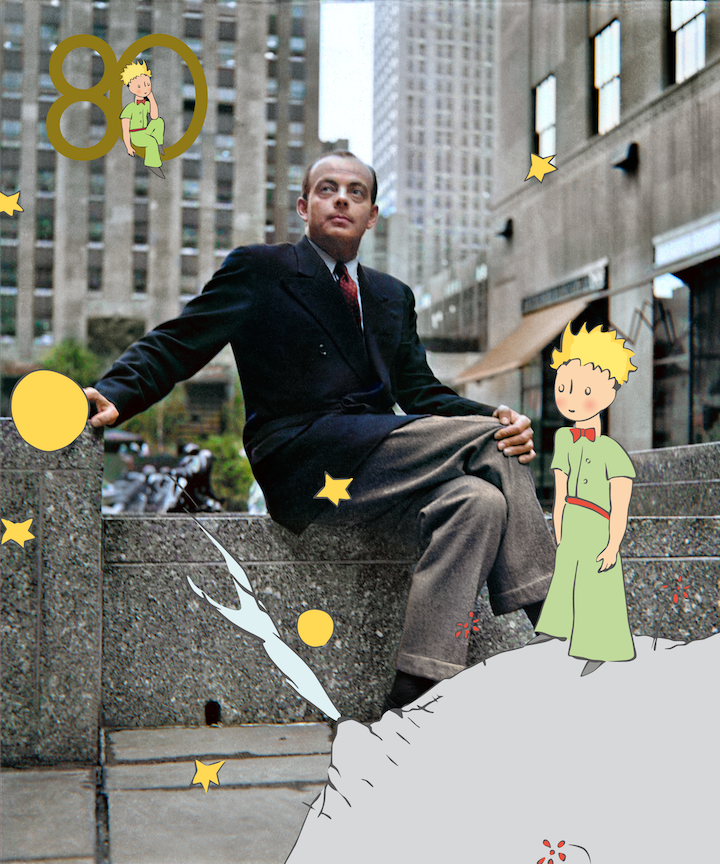
Antoine de Saint-Exupéry, Rockefeller Center, NY, July 13, 1939
Original photo and collage courtesy of Fondation Saint-Exupéry Pour la Jeunesse
|
|
• We started a fund raising campaign to install the long-awaited a sculpture of The Little Prince in Manhattan, which will be placed near the entrance of Villa Albertine, Services Culturels on Fifth Avenue between 79th and 78th Streets, by renowned sculptor Jean-Marc de Pas.
• Stacy Schiff, Author, "Saint-Exupéry: A Biography" and Mr. Olivier d’Agay, Vice President of the Fondation Saint-Exupéry Pour la Jeunesse, and grand-nephew of Antoine de Saint-Exupéry, are co-presiding our Honorary Committee.
• The Steering Committee is composed by Nicolas Delsalle, General Delegate, Fondation Saint-Exupéry Pour la Jeunesse, our Board Members Jean-Hugues Monier and Francis Dubois.
or by check, made payable to “American Society of Le Souvenir Français, Inc”
Please indicate “PetitPrinceUSA”
|
|
NEW REGIONAL DELEGATE, SOUVENIR FRANÇAIS
FOR NEW ENGLAND
|
|
Pictured above: annual commemoration in honor of the 25 (at least) French soldiers buried in Providence, Rhode Island, November 6, 2021. Professor Desmarais is leading the re-enactment in period costume as a French army chaplain.
Photo courtesy of Prof. Norman Desmarais
|
|
• We are honored to welcome Professor Norman Desmarais in our midst as our new Regional Delegate for New England:
Norman Desmarais is professor emeritus at Providence College, Providence, Rhode Island, and a very active re-enactor. He is a member of the Bourbonnais Regiment, the 2nd Rhode Island Regiment and the American Revolutionary Brigade.
Professor Desmarais is the author of:
• Guide to the American Revolutionary War series (six volumes about the war on land and seven volumes about the war at sea and overseas), as well as • America’s First Ally: France in the American Revolutionary War,
• Washington’s Engineer: Louis Duportail and the Creation of an Army Corps, and
• The Road to Yorktown: The French Campaigns in the American Revolution, 1780-1783.
• He is the former editor-in- chief of The Brigade Dispatch, the journal of the Brigade of the American Revolution.
• He translated the Gazette Françoise
, the French newspaper published in Newport, Rhode Island by the French fleet that carried the Count of Rochambeau and 6,100 French troops to America in July 1780. It is the first known service newspaper published by an expeditionary force.
Mr. Desmarais is fluent in French and Italian, and has a reading knowledge of German and Spanish as well as classical Latin and Greek. He served as Vice President of Le Foyer Club and the Club Richelieu (which became the Aram Pothier Club), social organizations for the preservation and promotion of the French language and culture. He serves on the Board of Directors of the Boivin Center, University of Massachusetts, Dartmouth.
He was a pioneer in the CD-ROM industry. He set up and managed the first CD-ROM network in Rhode Island and served as Senior Editor of CD-ROM World, contributing editor of Optical Information Systems, and was the founding editor and editor-in-chief of Electronic Resources Review.
He is listed in Men of Achievement; International Directory of Distinguished Leadership, the Dictionary of International Biography, Who's Who of Information Technology, Outstanding People of the 20th Century, 2000 Outstanding Intellectuals of the 20th Century, and Marquis Who’s Who.
Norm was inducted into the American French Genealogical Society
French-Canadian Hall of Fame in 2015, and received the Albert Nelson Marquis Lifetime Achievement Award in 2019 and 2020.
Highlights Books & Publications
• Why Newport, Rhode Island, Scorned The French. Journal of the American Revolution. January 2, 2020. (https://allthingsliberty.com/2020/01/why-newport-rhode-island-scorned- the-french/)
• The First Catholic Mass in Rhode Island—Newport, 1780. Online Journal of Rhode Island History. February 2, 2019. http://smallstatebighistory.com/identifying-french-landing-site-newport/
• Identifying the French Landing Site in Newport. Online Journal of Rhode Island History. January 21, 2017. http://smallstatebighistory.com/identifying-french-landing-site-newport/
• A French Officer Seeks to Rebuild Aquidneck Island’s Revolutionary War Fortifications. Online Journal of Rhode Island History. August 25, 2016. http://smallstatebighistory.com/french-officer-seeks-rebuild-aquidneck-islands- revolutionary-war-fortifications/
• The French Soldiers Who Died at Newport During the Revolutionary War. Online Journal of Rhode Island History. March 4, 2016. http://smallstatebighistory.com/french-soldiers- who-died-at-newport-during-the-revolutionary-war/
|
|
UPCOMING YORKTOWN CELEBRATIONS |
|
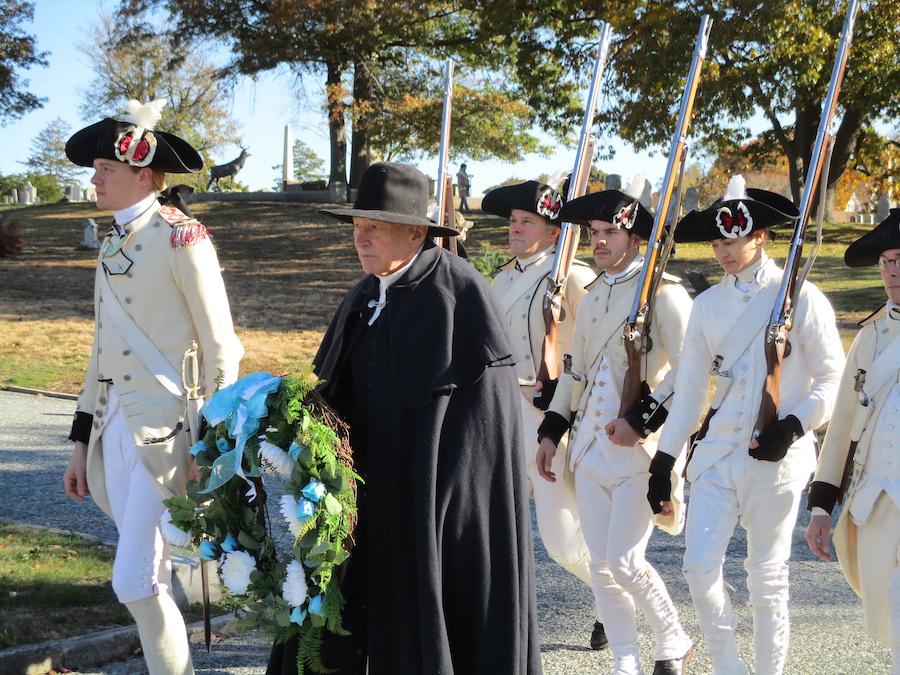
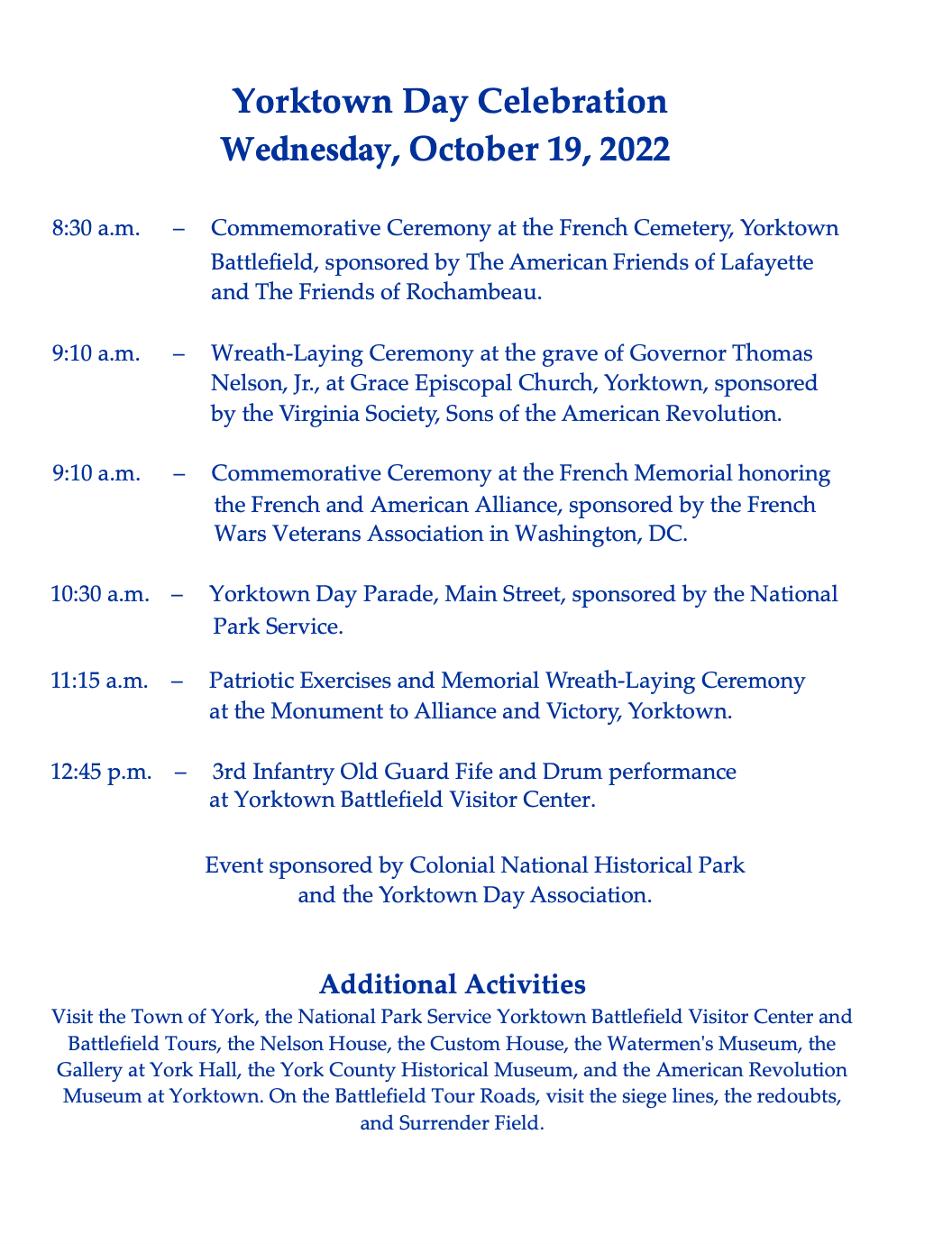
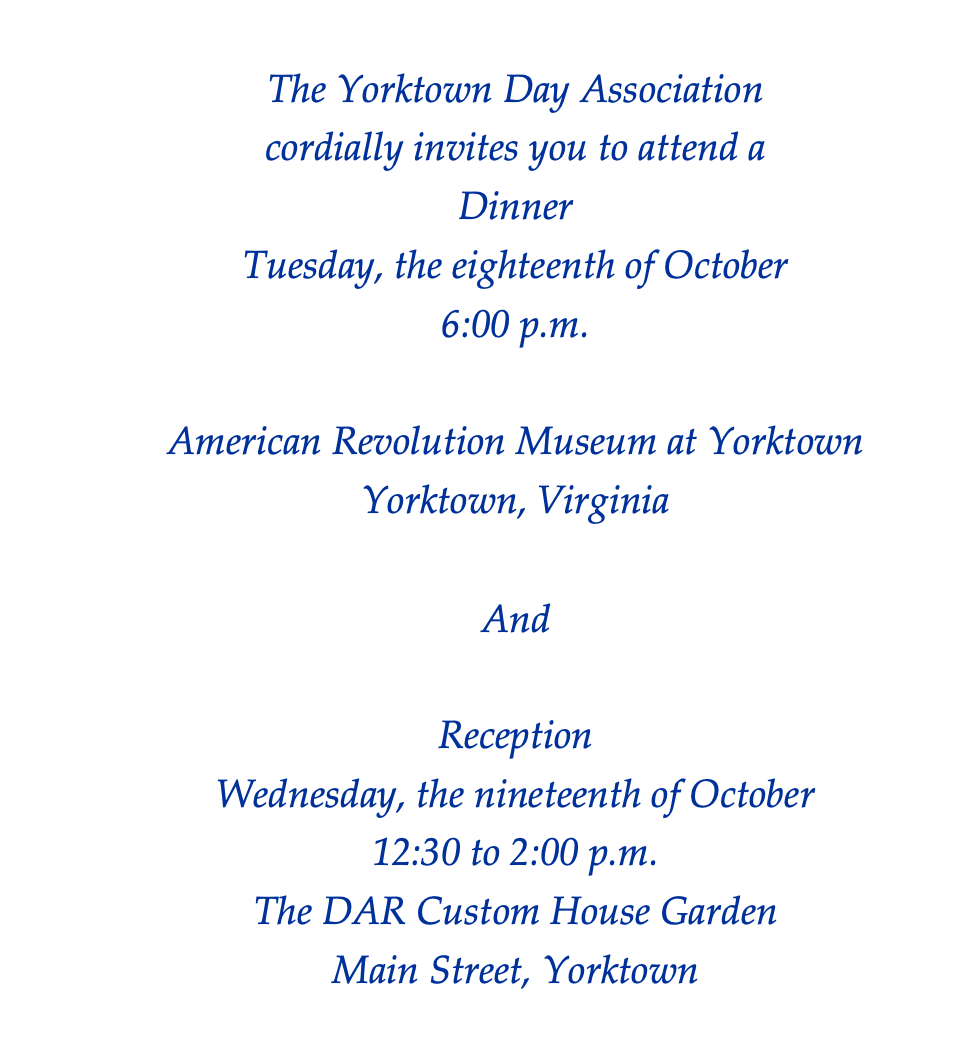
Our association will be represented and will participate in ceremonies planned to commemorate the allied victory 240 years ago. |
|
All events are subject to change.
For event information and schedule updates, visit:
In the event of rain, the information will be posted on this website.
|
|
A NEW INTERPRETIVE MARKER
We are also planning the dedication of a new interpretive marker dedicated to the crucial role of Admiral de Grasse and the French Navy in the war for the Independence of the United States.
As we are publishing this Bulletin, the ribbon-cutting is planned for Tuesday, October 18 at 5:00PM on Riverwalk. However it will be officially confirmed in the coming days and a special invitation will be sent by email. Please stay tuned for more details.
|
|
AN ANNOUNCEMENT FROM
The BATTLE OF RHODE ISLAND ASSOCIATION
|
|
Battle of Rhode Island Association Launches New Website
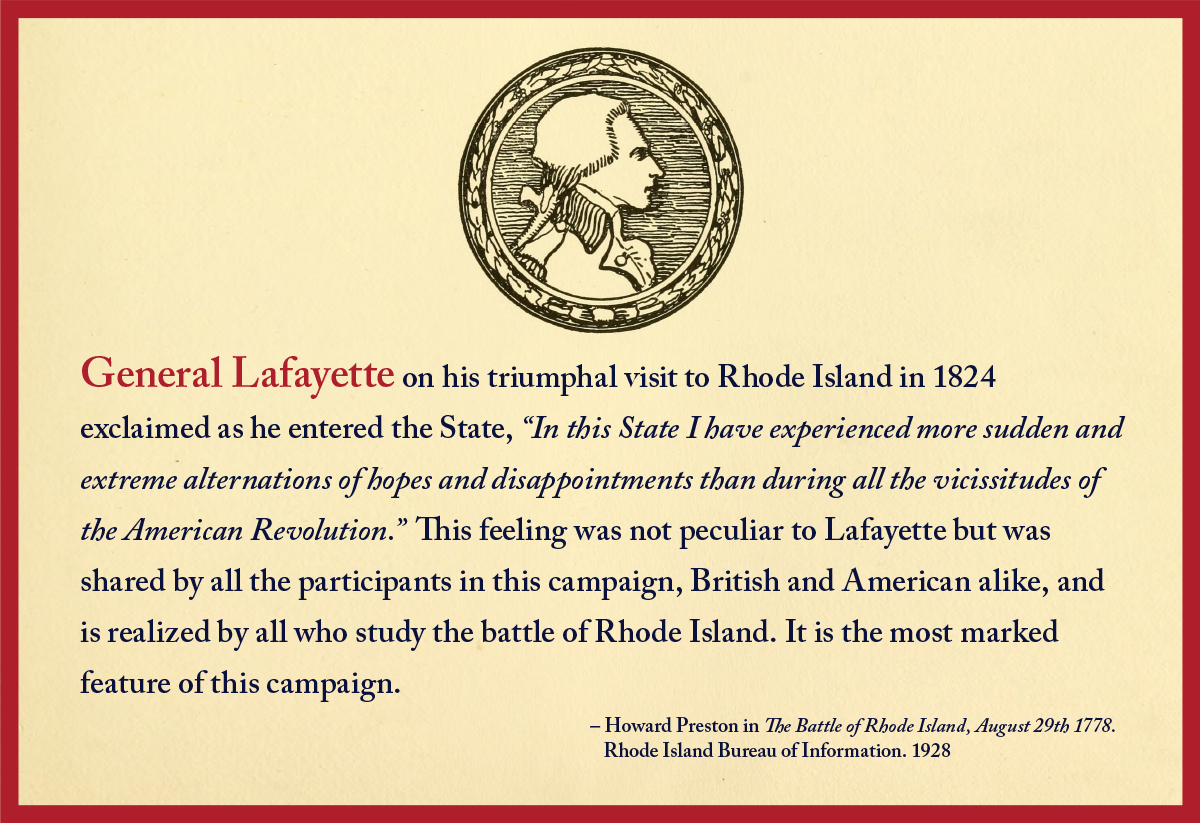
August 29, 2022 is the 244th anniversary of the Battle of Rhode Island. The Battle was the concluding phase of the Rhode Island Campaign, the first combined French and American operation of the Revolutionary War. To mark this anniversary the Battle of Rhode Island Association today launches its website: www.battleofrhodeisland.org.
The Battle of Rhode Island Association (BoRIA) was formed to broaden public knowledge of the role Rhode Island played in the War for Independence, in particular the Battle of Rhode Island and historic Butts Hill Fort, which is now under restoration. The website is designed to be an exchange for information about Rhode Island events, many no longer not widely known, from the earliest protests against Royal Navy ships through the attack on HMS Gaspee, the British occupation, the 1778 Battle, the coming of the French allies, and the building and remodeling, of Butts Hill Fort until 1783. In addition, the website will announce events held by the Association and its Butts Hill Fort Restoration Committee as well as events held by our more than 25 partner organizations. The list of partners includes: Rhode Island Historical Society, Jamestown Historical Society, Portsmouth Historical Society, Middletown Historical Society, Bristol Historical and Preservation Society, NAACP Newport, Varnum Armory Museum, RI250 Commission, Sons of the Revolution, Society of the Cincinnati, and the Washington-Rochambeau Revolutionary Route Association.
The BoRIA believes these efforts to expand appreciation for Rhode Island’s place in the Revolution are especially important as we approach the 250th anniversary celebrations of the Declaration of Independence in 2026 and the Battle of Rhode Island in 2028.
Our goal is to have the restoration of Butts Hill Fort completed for the 2028 celebration of the Battle.
The website was funded by the Heritage Harbor Foundation of Rhode Island and by the Massachusetts Society of the Cincinnati. Contributors to the site include many noted Rhode Island historians and several local and regional historical societies and lineage organizations. In 2023 the site will incorporate educational materials for use by teachers, parents, and students.
The BATTLE OF RHODE ISLAND ASSOCIATION is a registered 501(c)(3) non-profit committed to raising awareness of Rhode Island’s role in the War for Independence and to the support of the BUTTS HILL FORT RESTORATION COMMITTEE whose mission is to restore and maintain the Revolutionary War fort in order to provide a safe and accessible educational and recreational site that raises public interest in this National Historic Landmark and its role in the Battle of Rhode Island. Donations may be made payable to “BoRIA” at PO Box 626, Portsmouth, RI 02871.
FOR MORE INFORMATION, CONTACT:
Burton Quist
Battle of Rhode Island Association
401-439-0187
|
|
NEWS FROM THE LAFAYETTETRAIL.ORG |
|
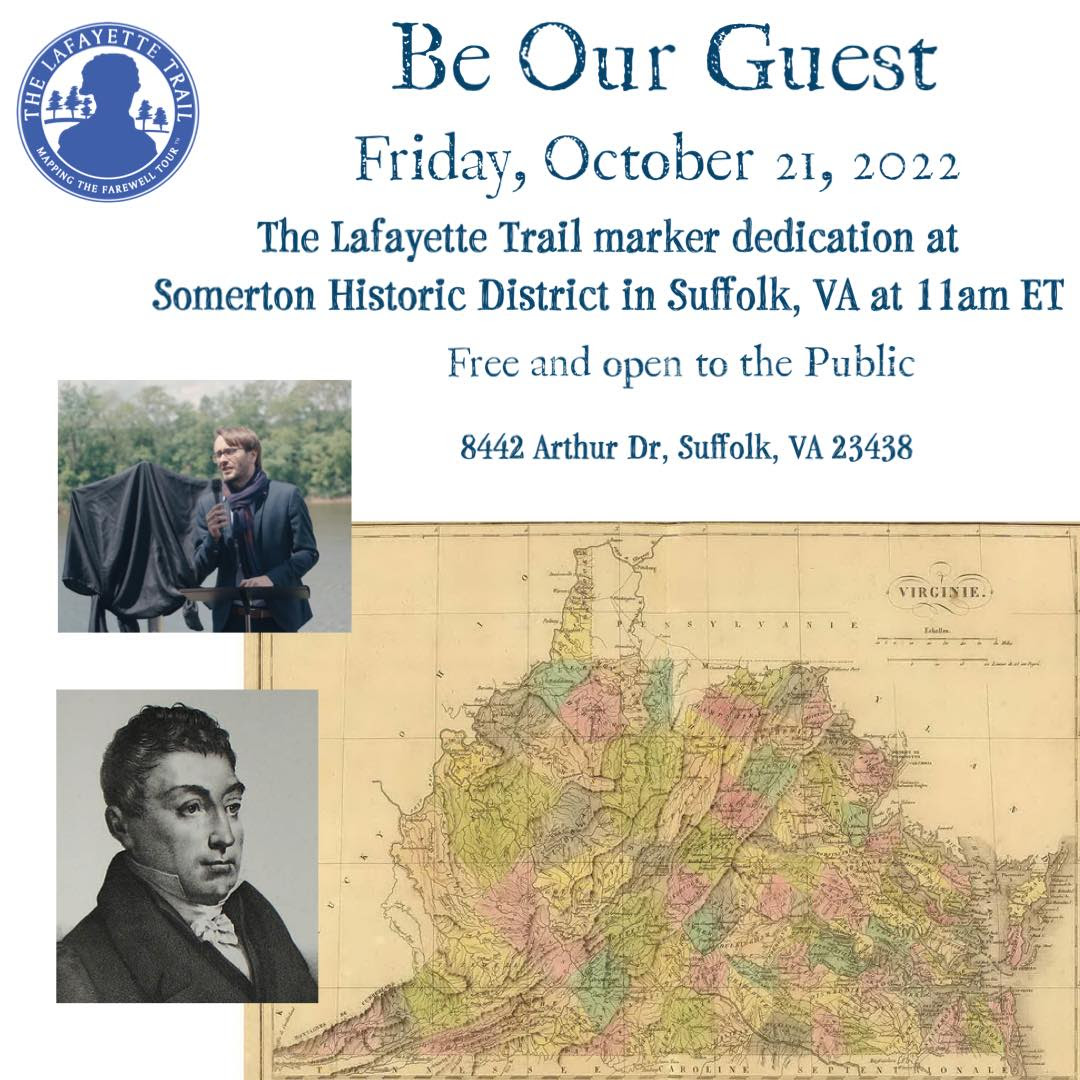
The Lafayette Trail, Inc. is pleased to announce the upcoming dedication of a new Lafayette Trail historic marker in the Somerton Historic District of Suffolk, VA on Friday, October 21 at 11 am ET.
The Somerton marker dedication ceremony will take place at 8442 Arthur Drive, Suffolk, VA 23438.
|
|
LAST, BUT NOT LEAST, IF YOU ARE IN FRANCE....
FROM THE FRIENDS OF ROCHAMBEAU
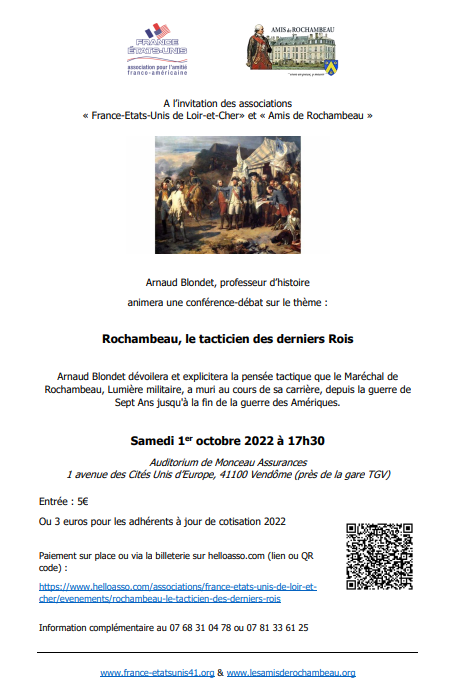
October 1, 2022
|
|
MARK YOUR CALENDAR!
MORE DETAILS WILL BE FORTHCOMING IN OUR NEXT BULLETINS
(Dates are subject to change)
THURSDAY, OCTOBER 13, 2022
Cocktail reception to launch the Sculpture of Le Petit Prince and Antoine de Saint-Exupéry: at the French Cultural Services, New York. Invitations will be finalized soon.
TUESDAY, OCTOBER 18, 2022
Inauguration of the Interpretive Marker "The Crucial Role of the French Navy in the War of Independence", Yorktown Riverfront, Yorktown, Virginia. Confirmation and Invitations to be finalized soon.
WEDNESDAY OCTOBER 19, 2022
YORKTOWN ANNUAL VICTORY CELEBRATIONS
Laying of wreaths at the French cemetery
Wreath laying at the French Memorial
Ceremony, Victory Monument
SATURDAY NOVEMBER 5, 2022
Annual ceremony to pay tribute to the memory of 25 soldiers from Rochambeau buried in Providence Cemetery, Rhode Island organized by Prof. Norman Desmarais.
SUNDAY NOVEMBER 6, 2022
Ceremony in tribute to Mr. André Joseph Scheinmann, alias Maurice Peulevey, German-born, French naturalized resistance fighter in Brittany, 1940-1942, Member of the réseau Overcloud, parachuted from London, arrested and deported to the concentration camps of Struthoff and Dachau 1942-1945, who emigrated to the United States after the war and is buried in New Bedford, Massachusetts
|
|
FRIDAY NOVEMBER 11, 2022 - VETERANS DAY |
|
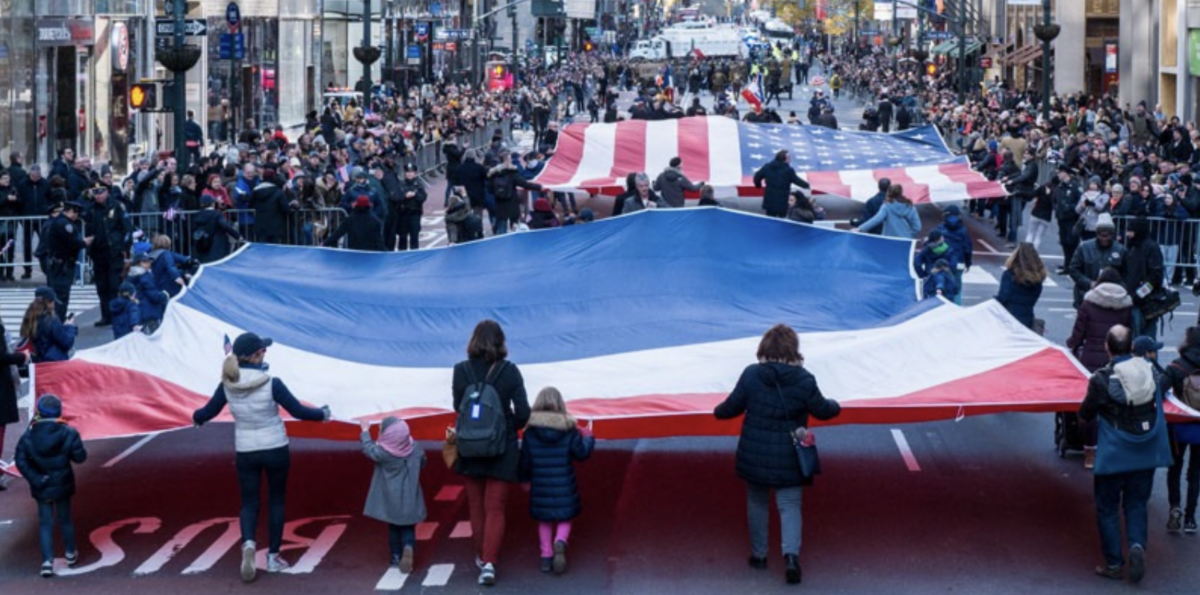
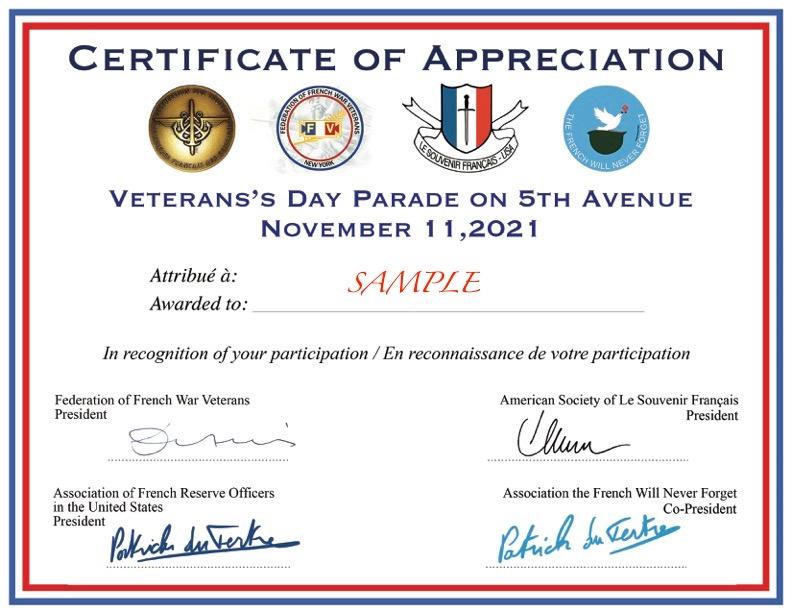
Pictured above: last year's parade on Fifth Avenue with giant French and American flags, and copy of Certificate made available last year to the Scouts of Troop #1, their leaders and volunteers. |
|
To continue our well-established tradition, we will join the Federation of French War Veterans, the Association of French Reserve Officers in the United States (ACREFEU), and TheFrenchWillNeverForget.org in the Veterans' Day parade on 5th Avenue. Last year we started the tradition to give a Certificate of Appreciation (sample above).
Please join us and the 60 scouts of Troop 1, their parents and volunteers who will be carrying the two giant American and French flags on Fifth Avenue! (weather and wind permitting)
-
Map of Parade Area: https://parade.uwvc.org/map
-
Date: Friday, November 11, 2022
- Time:
- Parade: 12:30pm – 3:30pm (approx)
- TV Broadcast: 12:30pm – 3:00pm
-
Parade Route: North on Fifth Avenue, between 26th St & 50th St (approx), New York (Manhattan), NY (Map)
-
Broadcast information: The Parade will be broadcast live on WABC in the New York area, and will also be streamed online. Further details will be provided closer to the event.
-
Formation (Assembly) Area: Groups and vehicles will assemble on 24th Street – 29th Street, between Fifth & Sixth Avenues (west and northwest of Madison Square Park). Selected groups and vehicles will assemble on Fifth Avenue itself, or on other temporary holding streets as directed. (Map)
-
Arrival Time: Marching groups will arrive between 9:30am – 1:30pm, depending on their place in the Line of March. Vehicles will arrive between 8:00am – 1:30pm (i.e. some vehicles will be asked to arrive earlier)
-
Opening ceremony/ Wreath laying: There will be a traditional wreath-laying at the Eternal Light Monument in Madison Square Park at 11:00 – 11:45am (approx). Attendance will be limited during the ceremony itself. NOTE: Due to the large number of wreaths presented, most will be pre-placed.
-
Reviewing stand / TV compound: The Reviewing Stand (and TV broadcast compound) will be located on the west side of Fifth Avenue, just south of 26th Street (to marchers’ left as they proceed up the Parade route)
-
Dispersal / End of Route: The Parade will end at approximately 50th St (to be finalized). Marchers and vehicles will disperse as directed, toward Sixth Avenue or Madison Avenue.
- On the Route:
- Participants in marching formation must line up in minimum four abreast (across) formation.
- Participants may not throw items into the crowd
- Marchers may interact with spectators along the route, so long as they do not slow down the Parade and that such interactions are positive and respectful.
- All participants must adhere to the Parade Code of Conduct
- The New York City Veterans Day is a non-partisan, non-political event. No political messaging, other than general expressions of support for veterans, is permitted on the Parade Route or in the Formation areas.
For participation registration and questions, contact:
|
|
OUR MISSIONS:
• To preserve the memory of the French soldiers, sailors and airmen who gave their lives for freedom, and who are buried in the United States.
• To honor French Citizens who did great deeds in the United States, or with a strong connection with the United States,
• To promote the appreciation for French culture and heritage in the United States, and the ideals that unite our two nations, in order to pass the torch of memory to younger generations.
• To strengthen the long-standing traditional bonds of friendship between the American and French peoples, and to this end: erect or maintain memorials and monuments and encourage historical research, public presentations and publications in the media.
We are looking to complete our geographic coverage with Regional Delegates for the SouthWest in cities such as Austin, or Houston, and Louisiana, in cities such as New Orleans or Baton Rouge.
The American Society of Le Souvenir Français, Inc. is an independent American corporation, apolitical, established in 1993 in NY, with 501 (c) 3 non-profit status.
|
|
Did you know that a portion of every purchase you make on Amazon can benefit American Society of Le Souvenir Francais Inc, at no cost to you?
Simply go to: smile.amazon.com, designate American Society of Le Souvenir Francais Inc. as your beneficiary, and shop away
|
|
Help us implement several historic commemorative projects celebrating the 244-year-old Franco-American friendship and alliance! |
|
The American Society of Le Souvenir Français, Inc. is a registered NY State non-profit corporation and has full IRS tax exempt 501(c)3 status. All donations are tax deductible.
Copyright © 2022 The American Society of Le Souvenir Français, Inc.
Merci de nous contacter si vous souhaitez recevoir ce bulletin dans sa version traduite en français.
Contact: Thierry Chaunu, President
697 Third Avenue #341 New York, NY 10017
|
|
|
|
|
|
|