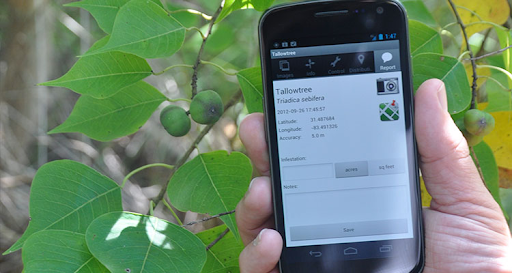
Monthly News & Updates from DFFM's Specialized Forestry Programs | | Image: Using EDDMaps in the field from a mobile device. Photo Credit: EDDMapS Army Corps of Engineers | |
EDDMapS: An Accessible Data Collection Tool
to Map Invasive Species
For this edition of Forestry in Focus, our Invasive Plant Program Coordinator Jessi Szopinski highlights EDDMapS - an Early Detection and Distribution Mapping System.
EDDMapS is a free mobile app that allows you to identify and map invasive species throughout the country. With built-in field guides that detail the appearance of noxious weeds and dozens of photos to reference, you can quickly learn how to identify invasive plants like a pro. Even if you are in remote areas without service, you can still map species and upload your findings after the trip. If you’re unsure of a sighting, rest assured - all records are verified by an expert before being added to the national database.
The records collected by citizen scientists (like you!) on this app will help us create maps and tools for monitoring and managing populations of noxious weeds. This fall, in partnership with the Bureau of Land Management and the Arizona-Sonora Desert Museum, AZ DFFM will be launching a Spatial Invasive Infestation and Priority Analysis tool- or SIIPA for short! The SIIPA tool utilizes data from the EDDMapS platform, so all verified sightings will update and improve it’s modeling capabilities in real time. New records from EDDMapS will help us generate accurate maps and provide up-to-date guidance on prioritizing invasive plant treatment throughout the state. Check out the link to the Florida SIIPA tool below, which is a model for Arizona's tool.
When it comes to managing invasive species and their impacts, early detection is key. The more trained eyes and reporting happening in the field, the better we can manage these species. If you are eager to participate in efforts to help minimize the negative impacts of invasive plants in our ecosystems, this app is a critical tool that is readily available and right in your pocket. If you have questions about using EDDMapS, or need assistance identifying an invasive plant, we're happy to help! You can reach out to our team at invasiveplants@dffm.az.gov.
Learn more:
| | | Resources, Reads and Engagement | | |
|
It's PlayCleanGo Awareness Week!
June 7 - 14th, 2025
| |
Join the movement to raise awareness and inspire action to prevent the spread of invasive plants! You can help spread the word by downloading their free outreach toolkit with graphics and messaging for social media. Let’s work together to protect trails, parks, and waterways now and for future generations.
This year’s theme is “Partnering Together to Protect Our Favorite Places” because it takes all of us to stop the spread of invasive species.
| | |
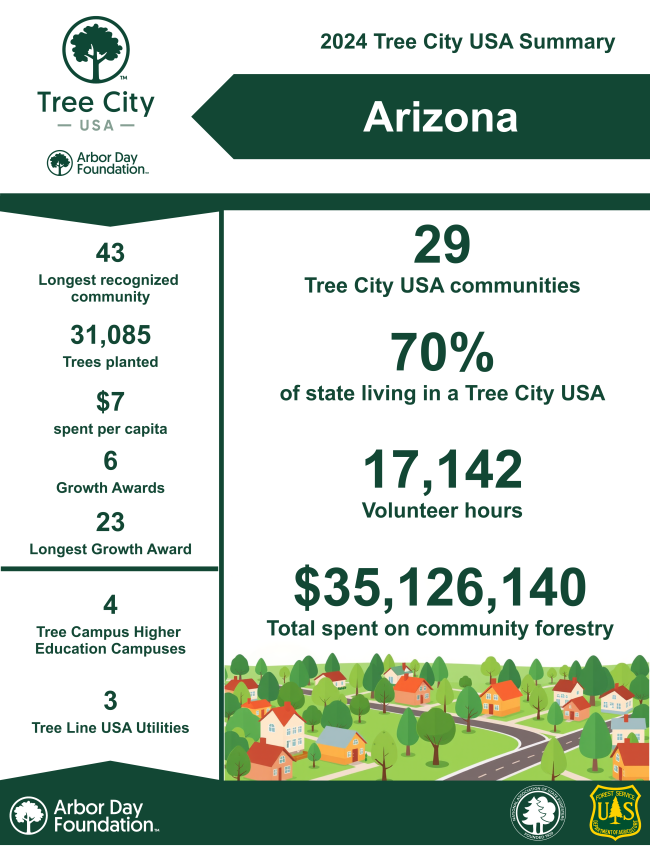
Arizona's 2024
Tree City USA Statistics
PDF published by the Arbor Day Foundation
Did you know? 70% of our state residents live in a Tree City USA recognized community. In 2024 alone, over 31 thousand trees were planted in these cities and towns, with more than 17 thousand volunteer hours logged to benefit the trees and community programs!
Trees provide many benefits to our environment and communities, and it's important that we invest the time and resources to care for trees in return. Reach out to our Urban Forestry Specialist Timara Crichlow to see how your community can get involved!
| | | |
Recent Misinformation Regarding the Spotted Latternfly in Arizona
Over the last few weeks, several media stations have shared stories that the Spotted Lanternfly (SLF) has been found in Arizona, while others suggested that the insect had returned to the state.
At this time, the Spotted Lanternfly has NOT been found in Arizona by the Arizona Dept. of Agriculture, the Arizona Animal and Plant Health Inspection Services (APHIS), or Arizona Dept. of Forestry and Fire Management.
The USDA APHIS Spotted Lanternfly webpage is the official location to determine whether or not the insect has been found in the state. Cornell University's Integrated Pest Management program has created a Reported Distribution Map to view where the insect has been previously detected and/or currently found. Neither of these locations indicate the presence of Spotted Lanternfly in Arizona.
If you have questions or suspect you have found this insect, please report to the Arizona Dept. of Forestry and Fire Management at foresthealth@dffm.az.gov or call 602-771-1407.
For more information on Spotted Lanternfly, you can also view, utilize, and share the informational materials created by DFFM in English and Spanish below. Thank you for staying alert and helping to prevent the spread of this invasive insect!
| | | |
-
KidsGardening: Lots of Compassion Grant Program - an initiative that provides support to local leaders looking to transform vacant lots into gardens to help grow compassion in their community - Deadline: June 16, 2025
-
Advancing Tribal Conservation Easements - grant funding and technical assistance available to support tribal acquisitions of conservation easements - Deadline: June 26, 2025
-
MAP: Connecting People to Forests - funding for community engagement and forest stewardship activities taking place on US National Forests and Grasslands or adjacent public lands - Deadline: June 27, 2025
-
2025 Global E-Stem Awards - funding for environmental education proposals of new or expanded E-STEM (Environmental - Science, Technology, Engineering, and Math) projects or programs - Deadline: July 2, 2025
-
Priority US Trees Conservation Awards - funding for US-based institutions to support their tree conservation collections, with the two rounds of proposals due June 15, and August 15, 2025
| | | |
And remember, as you travel this summer.. don't take firewood with you! Buy it where you burn it to avoid the unintentional spread of forest threats.
| | | Image is a free "Don't Move Firewood" image that is available to use at dontmovefirewood.org | | Next month, our Forest Health Team will provide an insect and disease highlight. In the meantime, stay cool! | | | |
Major funding for the Specialized Forestry Programs is provided by the Arizona Department of Forestry and Fire Management and USDA Forest Service. These institutions are equal opportunity providers and employers.
Suggestions or comments? Contact Megan Lasley, Forestry Outreach Coordinator at mlasley@dffm.az.gov
| | |
John Richardson, Assistant State Forester - Forestry Programs
jrichardson@dffm.az.gov
(602) 771-1420
Cori Dolan, Deputy Assistant State Forester
cdolan@dffm.az.gov
(520) 262-5519
LoriAnne Barnett Warren, Specialized Forestry Program Administrator
lwarren@dffm.az.gov
(602) 399-9447
Madeline Burton, Urban and Community Forestry Program Manager
mburton@dffm.az.gov
(480) 769-4184
Alison Faller, Urban and Community Forestry Specialist
afaller@dffm.az.gov
(602) 739-9763
Timara Crichlow, Urban and Community Forestry Specialist
tcrichlow@dffm.az.gov
(480) 978-6551
| |  | |
Aly McAlexander, Forest Health Program Manager
amcalexander@dffm.az.gov
(602) 290-9644
Viri Quinonez, Forest Health Specialist
vquinonez@dffm.az.gov
(480) 349-7585
Mike Juarez, Forest Health Technician
mjuarez@dffm.az.gov
(623-606-2624)
Jessi Szopinski, Invasive Plant Program Specialist
jszopinski@dffm.az.gov
(602) 291-4167
Matthew Jewell, Forest Legacy Program Manager
mjewell@dffm.az.gov
(520) 260-0476
Megan Lasley, Forestry Outreach Coordinator
mlasley@dffm.az.gov
(602) 206-9830
Wolfgang Grunberg, GIS & Data Supervisor
wgrunberg@dffm.az.gov
(602) 399-1886
| | | | |