|
Labour Market Trend: 'Out with the Young, In with the Old'
Data / Demographics
According to new research, Atlantic Canada is losing it's youngest workers while simultaneously picking up workers later in life.
The Atlantic Provinces have largely returned to their historical norm of working-age people leaving the region combined with a large in-flow of older working and retirement-aged Canadians, according to a new study published recently by the Fraser Institute.
“Despite a brief change during COVID, Atlantic Canada has since reverted to its historical pattern of prime working aged residents leaving the region for other parts of Canada,” said Fred McMahon, author of 'Out with the Young and In with the Old: Patterns of Interprovincial Migration to and from Atlantic Canada, 2001–2025'.
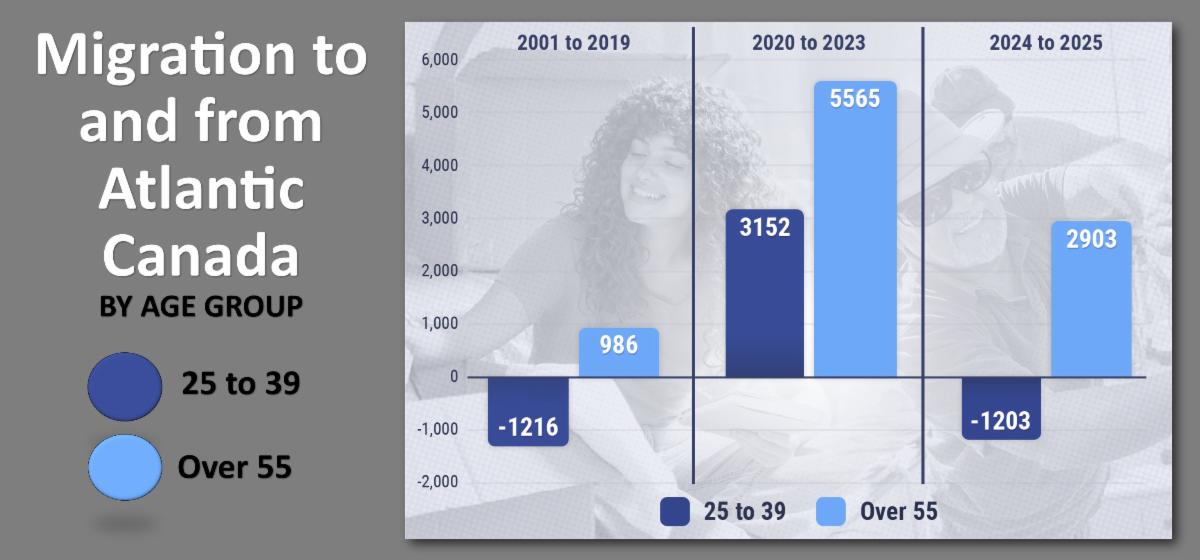
The study finds that pre-COVID (2001-2019), the Atlantic Provinces attracted an average of 986 seniors per year (55+) compared to a loss of 1216 working-age Canadians (aged 25 to 39). However, during the COVID-19 period (roughly 2020 2023), the in-migration of those 55 and over increased to 5,565 per year while a comparable 3152 residents between the ages of 25 and 39 arrived—a marked change from the region’s historical norm.
However, critically, by the end of 2024 and beginning of 2025, 55+ migration was 2,904 compared to a loss of -1,203 in the 25 to 39 demographic, suggesting a return to the status quo.
The report provides a breakdown for each province.
Newfoundland and Labrador: The report provides details on the destination and origin of migration to and from Newfoundland & Labrador. It shows that, over the full period from 2001 to 2022, net out-migration of all age categories was 13,209. Without Alberta, that turns to net in-migration of 7,470. Ontario was the only jurisdiction noted in the report that provided net in-migration to Newfoundland & Labrador at 10,188.
Prince Edward Island: Prince Edward Island, like the other Atlantic provinces, had its largest out-migration to Alberta before COVID but had in-migration from all the other jurisdictions listed except British Columbia. After COVID, there was net out-migration from Prince Edward Island only to British Columbia while there was a quite small net in-migration of 172 from Alberta to Prince Edward Island.
Nova Scotia: The pattern with Nova Scotia is similar to that of the other Atlantic provinces. Alberta dominated net out-migration, though the province also experienced out-migration to Ontario and British Columbia in the two youngest working-age cohorts, particularly 25 to 39. Net migration from the rest of Canada post-COVID to Nova Scotia was the largest found in the Atlantic provinces, 25,679, compared to 13,121 from Newfoundland & Labrador and 16,200 from New Brunswick, while Prince Edward Island had a small net inflow of 3,551
New Brunswick: The patterns for New Brunswick are similar to those of Prince Edward Island and Nova Scotia. New Brunswick’s net out-migration was dominated by Alberta, particularly in all working-age
cohorts except the oldest. New Brunswick also saw a significant outflow to Ontario in the youngest working-age cohort prior to COVID. Its largest, by far, post-COVID inflow was from Ontario.
*Within the report there are detailed tables breaking down these demographic changes.
The region losing more younger workers compared to a higher ratio of older Canadians will have numerous consequences including increased strain on provincial finances.
“The study’s findings underscore the need for policies that will generate the economic opportunities required to attract younger residents in the key 25 to 39 group,” McMahon commented.
“Should these numbers in the region continue to reflect its historical norm, it could mean negative implications for the economic future of Atlantic Canada.”
The report states a major concern. If the trend holds, it could have three negative effects upon Atlantic Canada:
- an uncertain economic future due to a lack of prime working-age people;
- difficulties in fiscal sustainability (and, more broadly, for fiscal federalism’s ability to sustain the region) as an aging population grows older; and
- faltering social structures, particularly in older rural communities.
McMahon provides a caution. The consistent outflow of young working-age Canadians in all except a handful of years over the last half century should cause Atlantic leaders deep concerns about future demographics and lead to a serious assessment of policies that discourage young people from moving to the region and encourage an outflow. Growth-friendly policy in the region would help keep younger Atlantic Canadians in the region and even attract them to Atlantic Canada.
Click here to download: Out with the Young and In with the Old: Patterns of Interprovincial Migration to and from Atlantic Canada, 2001–2025
|