Weekly update from the National Housing Conference | |
News from Washington | By Brittany Webb
| |
|
GAO reports on growing senior homelessness crisis
The Government Accountability Office (GAO) released a new report on actions to help better address the growing homelessness crisis for older adults. The report explains that an estimated 138,000 older adults, defined as aged 55 and up, experienced homelessness on a single night in 2023 according to the Department of Housing and Urban Development’s (HUD) Point-in-Time count. The report specifically examines national estimates of older adults experiencing homelessness and housing cost data that could indicate risks of homelessness for older renters; housing needs prevalent among older adults experiencing homelessness and barriers communities may face in addressing those needs; and federal strategic planning and the Department of Health and Human Services (HHS), HUD, and the Department of Veterans Affairs efforts to address homelessness among older adults.
GAO highlights how this population can be challenging to address by service providers, as older adults can require accessibility features in housing due to mobility limitations, functional impairments, and chronic conditions that shelters are often not able to provide. It further notes that older adults seeking to exit homelessness are more likely to face challenges from income constraints and employment, as many are beyond working age or unable to work due to disabilities and/or health conditions. Further, some older adults can no longer live independently and need to be placed in a nursing home or facility to successfully exit homelessness. Despite these challenges, the report explains that some providers are taking steps necessary to promote more equitable services in their programs.
The report has two main recommendations. First, for HHS to ensure that the Administration for Community Living (ACL) “as the lead agency for the Housing and Services Resource Center, works with partner agencies to clearly define short- and long-term outcomes for the center, consistent with leading collaboration practices.” Second, for HHS and ACL to work “with partner agencies to collect and use performance information and other relevant evidence to assess progress toward the center’s desired outcomes, consistent with leading collaboration practices.”
| | |
Many of our most relied-upon federal housing programs have gone without significant updates in decades, creating an opportunity to improve housing services through modernization of existing tools. The Case for Updates: Modernizing Federal Housing Programs panel will teach attendees which programs are most in need of modernization and how implementation can help or hinder success, as well as lessons learned from the most recent actions for the Housing Opportunity Through Modernization Act, Community Reinvestment Act, and NSPIRE. | |
|
In-Person Tickets
$175
Use Code: Member2024
| |  |
|
Virtual Tickets
$125
Use Code: MemberVirtual2024
| |
|
Local reps launch National Housing Crisis Task Force
A bipartisan group of Mayors launched a new National Housing Crisis Task Force through a public-private sector group composed bipartisan local representatives. According to the announcement, the task force will work to identify “transformative and implementable innovations in the housing ecosystem related to public land, capital, construction, regulation, and governance” and create pathways to scaling such innovations for national impact. The initiative was announced via an opinion piece in Newsweek penned by Cleveland Mayor Justin Bibb, Utah Governor Spencer Cox, Atlanta Mayor Andre Dickens, and president of Fifth Third Community Development Corporation Susan Thomas.
“The current presidential administration has put forward proposals to address the housing crisis. These are welcome, but we'll need to do even more if we are to truly face this crisis head on. The federal government must move faster to expand the toolbox and incentivize policies that work,” the piece reads. “In Utah, Atlanta, and Cleveland, we are treating the housing crisis like a true crisis. State and local governments have more capacity, capital, and power at their disposal than is first apparent, but it is still far from enough. What Americans need is a holistic evaluation of the current interventions and the elevation of those that work best.”.
The group plans on publishing a national policy agenda for local action that they believe the new administration should include in a first 100-day plan.
| | |
|
Ginnie Mae publishes rural MBS disclosures
Ginnie Mae announced a new mortgage-backed securities (MBS) disclosure for rural borrowers that will allow deeper insights into rural housing profiles. Ginnie will publish monthly disclosures at the mortgage-backed securities level of the number of loans with rural borrowers and the percentage of unpaid principal balance. The announcement also notes that Ginnie worked with the U.S. Department of Agriculture (USDA) and USDA geographers to develop data parameters, including an accurate definition of rural borrowers. Acting President Sam Valverde stated that the expanded definition helps to demonstrate commitment to Veterans Affairs and Federal Housing Administration borrowers, given that many borrowers live in rural areas. Publication is planned to be monthly.
“This disclosure adds more granularity regarding our MBS collateral makeup,” said Richard Perrelli, Product Manager, Office of Capital Markets. “This enables investors to shift from an over-emphasis upon the insuring agency program by including additional borrower attributes. These factors will help create superlative MBS valuation models.”
| | |
|
FHFA unveils new manufactured housing price index
The Federal Housing Finance Agency (FHFA) announced new national datasets for manufactured homes price trends based on data from Fannie Mae and Freddie Mac (the Enterprises) that will be updated monthly. The two data series are Developmental House Prices Indexes and House Price Medians and will provide deeper insights to a market segment that serves as an affordable home option for many consumers. In an accompanying blog post, FHFA notes that since mid-2019, manufactured housing’s share of Enterprise single-family acquisitions has nearly doubled.
The new datasets include purchase-only as well as transactions combining purchases and refinances, both that show quarterly price changes since 2000. Initial key findings of the new dataset show that house price indexes for manufactured homes increased by 7.9% year over year from 2023 to 2024, with the median price of a home at $231,000 in Q2 or 2024. The data also show that six states account for nearly half of manufactured homes transactions included in the data: Florida, Arizona, North Carolina, Washington, California, and Oregon.
“FHFA’s new data resource on manufactured homes provides relevant, up-to-date information on an important but less-understood segment of the housing market,” said FHFA Director Sandra Thompson. “In a housing market with elevated home prices, manufactured housing remains an affordable option. This new data should help advance discussions on responsible efforts to expand homeownership opportunities.”
| | |
|
MBA announces new CONVERGENCE Collaborative
The Mortgage Bankers Association (MBA) announced a new coordinated effort to identify and develop solutions to help close the racial homeownership gap called the CONVERGENCE Collaborative. The collaborative launched with 13 leading industry stakeholders including: the American Land Title Association (ALTA), DHI Mortgage, Fannie Mae, Fifth Third Bank, Freddie Mac, Lennar Mortgage, National Association of Realtors ® (NAR), Navy Federal Credit Union, Pulte Financial Services, Taylor Morrison Home Funding, U.S. Mortgage Insurers (USMI), and Wells Fargo Home Lending. The collaborative builds off of MBA’s current CONVERGENCE work in Memphis, Tennessee; Columbus, Ohio; and Philadelphia, Pennsylvania and will expand upon and utilize those networks to create evidence-based tools and roadmaps to help all industry stakeholders better reach aspiring minority homeowners. MBA is committing $1 million per year to the work of the collaborative.
“The barriers to minority homeownership require a collective effort. In recognition of this challenge, we believe the approach embodied in the CONVERGENCE framework can have a greater impact with this new industry partnership,” said MBA President and CEO Bob Broeksmit. “By working together, we can produce more and faster results that will reduce the racial homeownership gap.”
| | |
Join or renew your NHC membership today! | |
|
Your involvement is essential to addressing today’s housing challenges, and NHC relies on active members to maximize our impact and remain a leader in tackling today’s housing issues.
As we launch our 2025 membership drive, it's the perfect time to renew and take advantage of new benefits through Oct. 31. If you're not yet a member, we invite you to join with membership levels tailored to individuals, nonprofits, and for-profits. Membership offers exclusive networking opportunities, access to our weekly Member Brief, and other key housing resources such as our Housing Resource Center, Paycheck to Paycheck database, and Employer Assisted Housing Toolkit. We look forward to working with you to address America's housing challenges.
| |
|
HUD provides $420 million to remove lead hazards
HUD announced over $420 million in funding to remove lead hazards from homes across 32 states, Washington, D.C., and Puerto Rico. This initiative aims to safeguard families, particularly children, from lead exposure and other housing-related dangers. HUD is also allocating $2 million for weatherization efforts and $10 million for research on hazard identification.
“Addressing lead poisoning is a top priority at HUD,” said HUD Acting Secretary Adrianne Todman. The funding supports the Biden-Harris Administration’s efforts to protect children and communities from lead hazards, as part of their broader health and safety initiatives.
This announcement follows other federal actions to combat lead exposure, including a rule to replace lead service lines within 10 years and $2.6 billion for water system upgrades. Lead exposure is particularly harmful to young children, pregnant women, and adults, leading to severe health risks.
A significant portion of the funding, $395 million, will go to 73 local governments to reduce lead poisoning risks for children under six. Additionally, $13 million will support infrastructure development to identify lead hazards, and $2 million will help coordinate lead prevention services alongside weatherization efforts. The awards align with HUD’s commitment to the President’s Justice40 Initiative, which aims to benefit disadvantaged communities.
| | |
|
Seven states seeing faster return to pre-pandemic inventory levels
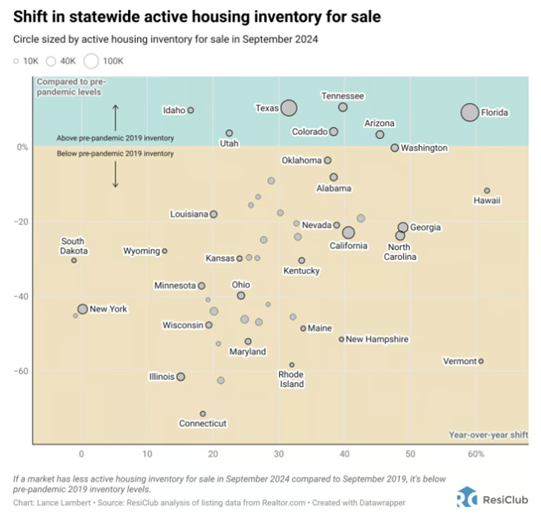
Analysis from ResiClub using NAR data shows that only seven states have returned to or surpassed pre-pandemic active inventory levels. Those states are Tennessee, Texas, Idaho, Florida, Colorado, Utah, and Arizona, with Washington trailing the goal by only 35 homes. The analysis highlights that an increase in active listings often signals potential price declines, while a decline suggests a heating market. Nationally, active listings have risen by 34% between September 2023 and 2024 but remain below the pre-pandemic levels. Florida has seen significant inventory increases, especially in areas hit by Hurricane Ian, leading to market softening. Sun Belt and Mountain West markets are seeing faster returns to pre-pandemic inventory levels due to high pandemic price growth, while the Northeast and Midwest are slower due to lower homebuilding levels.
| |
|
An article by HousingWire explores the growing crisis in the home insurance market, worsened by extreme weather events like Hurricane Helene, which recently devastated multiple states and raised insurance premiums further. With over 230 lives lost and homes without flood insurance destroyed, experts fear even more financial strain on homeowners and the mortgage industry. As Hurricane Milton travels through, housing leaders are calling for a reevaluation of the insurance and mortgage industries’ approach to these climate-driven challenges.
A blog post from Century 21 highlights how Americans are valuing community in the pursuit of homeownership and the power of community in creating a sense of belonging and stability. The study shows that most homebuyers are prioritizing a sense of community over traditional elements like home size, even as affordability becomes a challenge. This is particularly true for Millennials and Gen Z buyers who are leading efforts in building vibrant and inclusive communities.
CoreLogic reported that as home values continue to rise, U.S. homeowners are increasingly tapping into their equity through home-equity loans, which have reached their highest levels since 2008. In the first half of 2024, lenders originated over 333,000 home-equity loans totaling in $23.6 billion, with California leading in lending activity. Many homeowners are turning to these loans to cover renovations or consolidate debt, avoiding refinancing in order to keep their low primary mortgage rates amid a housing market slowdown.
| |
|
Tuesday, October 15
Mortgage Market Resilience and Access to Credit Summit | Ginnie Mae, 8:30-1:30 PM ET
Wednesday, October 16
Learning in Real Time: Experts Share Their Forecasts for Real Estate in ’24, ’25, and ’26 | ULI Americas, 1-2 PM ET
From Local to National: Scaling Solutions for Homelessness | Bipartisan Policy Center, 1-2 PM ET
Co-op Fest | NCRC, 6-10 PM ET
Thursday, October 17
Sustainable Homeownership and Wealth Preservation for Communities of Color | Urban Institute, 12-4 PM ET
NAHRO Housing Updates from Washington, 1:30 PM ET
An Effective and Equitable Homeless Response System - National Alliance to End Homelessness, 3-4:30 PM ET
Friday, October 18
The Role of Public Housing in a New Social Housing System | Joint Center for Housing Studies (harvard.edu), 12:15 PM ET
2024 Q4 State of the Multifamily Market Webinar | NMHC, 2-3 PM ET
| |
The National Housing Conference is a diverse continuum of affordable housing stakeholders that convene and collaborate through dialogue, advocacy, research, and education, to develop equitable solutions that serve our common interest. | |
Defending Our American Home since 1931 | |
Copyright © 2024. All Rights Reserved. | | | | |