JULY 27, 2026

CONTRIBUTIONS HELP PAY FOR THE WEBSITE, CONSTANT

CONTACT, AND DUES TO ATTEND CLUBS TO HEAR

SPEAKERS. THANK YOU FOR YOUR CONTINUED SUPPORT!

The Primary Is Finally Behind Us


The primary election is finally over—thank goodness! It was one of the nastiest primaries I have seen in a very long time.


I miss the days when candidates spent their time telling voters what they had accomplished, what they believed, and what they hoped to achieve if elected. Campaigns used to focus on why a candidate was the best person for the job. Too often today, campaigns seem more interested in convincing voters why the other candidate is terrible instead of explaining why they deserve our support.


As with every primary election, some of the candidates I supported won, and others came up short. That is part of the political process. Now it is time to look ahead. Republicans have selected their nominees, and the focus shifts to the general election. It is time for legislative districts, Republican clubs, and grassroots organizations to unite behind our Republican candidates and begin preparing their "golden tickets" for the fall campaign.


Over the next few weeks, I will be researching the ballot measures and digging into races where information is limited or difficult to find. Ballot propositions often have long-term consequences, and voters deserve clear, factual information before casting their ballots. My goal is to help provide that information so you can make informed decisions.


To those who won their primary races, congratulations. I also hope you recognize the tremendous responsibility that comes with earning the trust of the voters. Campaign promises matter. Constituents expect their elected officials to show up, work hard, and keep the commitments they made on the campaign trail.


The general election is only a few short months away, and there is still an incredible amount of work to do. Then, before we know it, the holiday season will be upon us. As the saying goes, there is no rest for the weary—but serving our communities and protecting the future of Arizona is work worth doing.

The 2026 Arizona Primary Election by the Numbers


The 2026 Arizona Primary Election is in the books, and while there are still ballots left to process, Election Night gave us an early look at voter participation across the state.


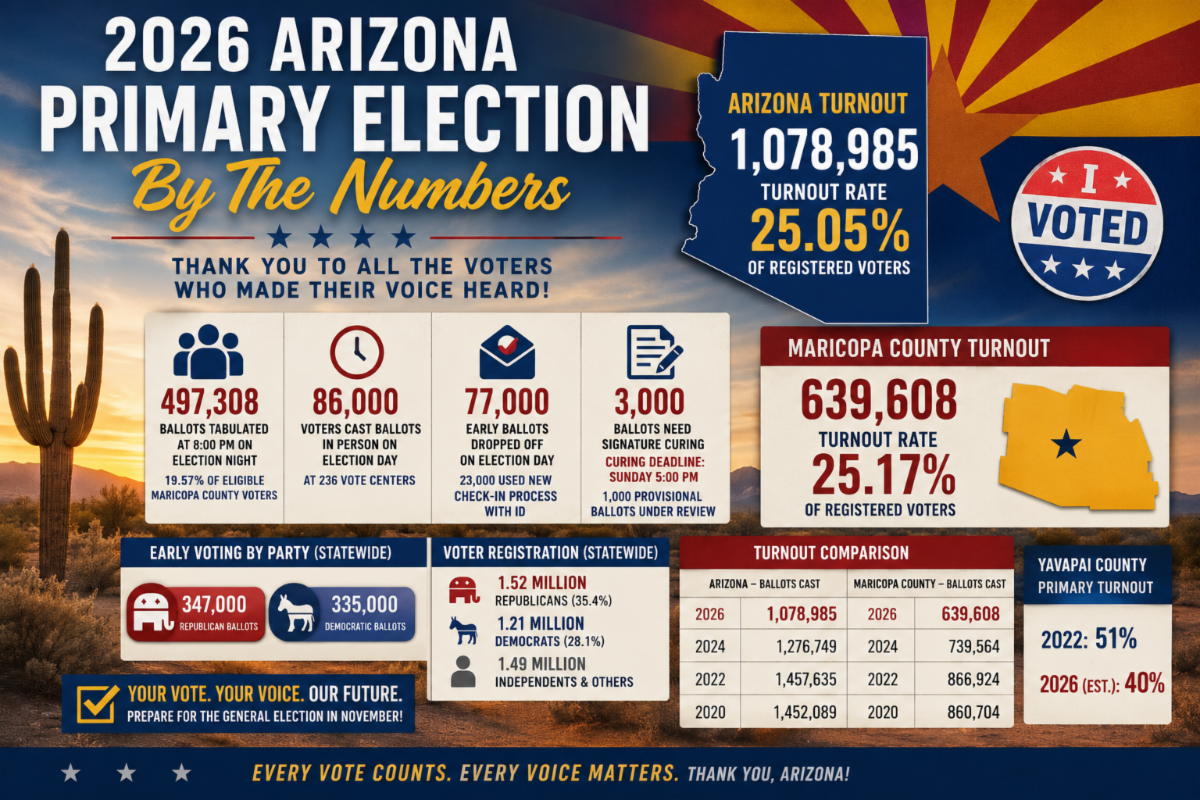
Even before Election Day began, voter participation was significant. According to data compiled by the Associated Press, roughly 755,000 early ballots had already been processed statewide, including approximately 347,000 Republican ballots and 335,000 Democratic ballots, demonstrating once again that early voting continues to play a major role in Arizona elections.


Final Turnout Numbers

As more ballots were processed, Arizona finished with approximately 1,078,985 ballots cast, resulting in an overall turnout of 25.05% of registered voters statewide.


Maricopa County reported 639,608 ballots cast, meaning only 25.17% of registered voters participated in the county's largest election jurisdiction.

When compared with previous statewide primary elections, turnout has steadily declined:


Election Year Arizona Turnout

2026 1,078,985

2024 1,276,749

2022 1,457,635

2020 1,452,089


Maricopa County followed the same trend:


Election Year Maricopa County Ballots

2026 639,608

2024 739,564

2022 866,924

2020 860,704


One county stood out. Yavapai County has traditionally produced some of Arizona's highest voter participation. Turnout there was approximately 51% in the 2022 Primary, compared with an estimated 40% in the 2026 Primary. While still well above the statewide average, even Yavapai experienced a noticeable decline.


Ballot Processing Continues

Approximately 77,000 early ballots were dropped off on Election Day. Of those, nearly 23,000 voters took advantage of Arizona's new early ballot check-in process, presenting identification at a Vote Center so their ballots could be tabulated immediately rather than waiting for signature verification after Election Day.


There were about 3,000 ballots requiring signature curing. Ballot curing occurs when election officials cannot verify the signature on the return envelope. Rather than automatically rejecting the ballot, voters are contacted and given the opportunity to confirm their identity and verify that they personally signed the envelope. The deadline to cure those ballots was Sunday at 5:00 p.m.


In addition, approximately 1,000 provisional ballots were reviewed before election officials determine whether they can legally be counted.


Understanding Election Day Issues

As expected, social media was filled with rumors and accusations of election problems throughout the day.


Early Tuesday morning, a connectivity issue affected many voting locations across the Valley. The problem was resolved quickly, and most locations experienced disruptions lasting less than twenty minutes.


Having worked numerous elections in both Arizona and Texas, I believe one of the biggest challenges is that many people simply do not understand how our election system actually works.


The electronic site books used to check in voters are connected to the internet—and for good reason. They verify that each voter is registered, has not already voted, and is receiving the correct ballot style. The site books also communicate with ballot printers so the correct ballot can be printed on demand.


The vote tabulators are entirely different. They are not connected to the internet or to any outside network. They function as stand-alone devices whose sole purpose is to scan and count completed ballots. This separation is one of the important security features built into Arizona's election system.


If you have never taken a tour of the Maricopa County Tabulation and Election Center (MCTEC), I encourage you to do so. Seeing the process firsthand answers many of the questions people have about how elections are administered. A peek behind the curtain often replaces suspicion with understanding.


Vote Centers Continue to Prove Their Value

One of the advantages of Arizona's Vote Center model became evident on Election Day.


When portions of Wittmann experienced a lengthy power outage, voters simply traveled to another nearby Vote Center to cast their ballots. I was working at one of the westernmost voting locations in Surprise, and we welcomed many Wittmann voters without any difficulty. Ballot-on-demand technology allows voters to cast their ballot at any Vote Center in the county rather than being limited to a single neighborhood precinct.


I was also encouraged by the positive response to Arizona's new option allowing voters to bring their completed early ballot to a Vote Center, present identification, and have that ballot tabulated immediately. This bypasses the post-election signature verification process and should help

produce election results more quickly in future elections.


A Final Thought

After working many elections over the years, I could not help but notice what felt like lower turnout than I have seen in previous primaries. The final numbers confirmed that impression. Participation declined both statewide and in Maricopa County compared with each of the last three statewide primary elections.


There are likely many reasons why voters choose not to participate, and each voter has their own reasons. One possibility worth considering is whether the increasingly negative tone of campaigns discourages participation. Many voters tell me they grow tired of constant personal attacks, harsh rhetoric, and campaign promises that never seem to materialize.


Our democracy is strongest when campaigns focus on ideas, accomplishments, and a vision for the future rather than simply tearing down an opponent.


Now that the primary is behind us, it is time to prepare for the General Election. I look forward to researching the ballot measures, providing information about the issues that matter most, and helping voters make informed decisions when they head back to the polls in November.

I Made the Ballot and Congratulations to all who did


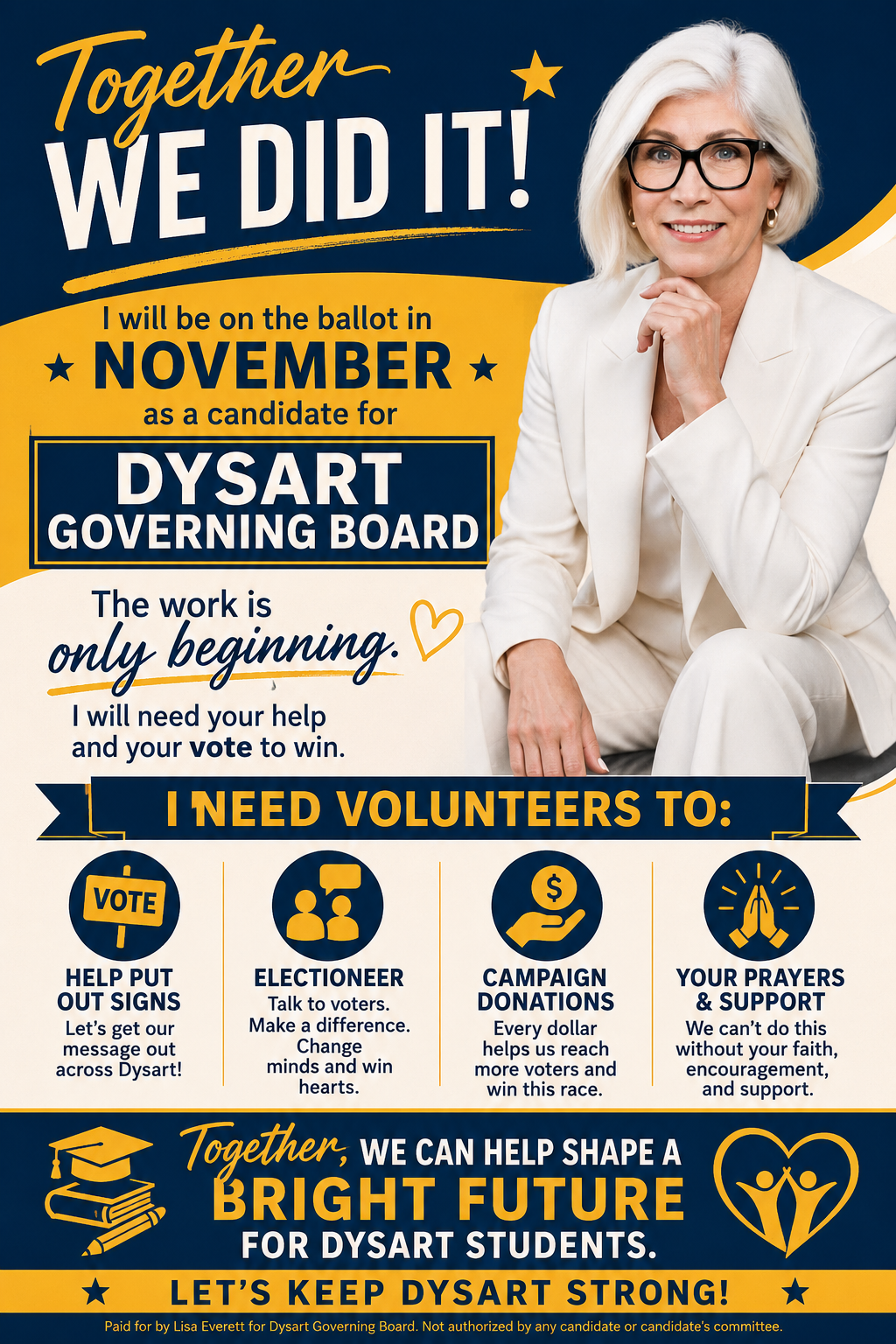
The challenge period officially ended on July 20, and I am grateful to announce that I will be on the ballot for the Dysart Governing Board this November.


Running for office is no small task. Before a candidate's name can even appear on the ballot, they must collect a required number of valid signatures from registered voters who live within the district. In Maricopa County this election cycle, 160 candidates submitted nomination petitions for various school board races.


Of those 160 candidates, almost half had someone request copies of their petition signatures for review. Once petitions are obtained, individuals may challenge the validity of signatures in court. They may argue that a signer does not live within the district, is not a registered voter, or even claim that a signature or printed name is not legible. If enough signatures are disqualified to reduce a candidate below the required threshold, that candidate can be removed from the ballot.

Ultimately, 24 school board candidates were required to appear in court to defend the validity of their nomination petitions.


Why do people challenge signatures? There are many possible reasons. Sometimes it is a legitimate effort to ensure election laws are followed. Other times, it may be a political strategy to eliminate competition before voters ever have a chance to cast a ballot. In some cases, candidates hold views that differ from current board members or established interests. Unfortunately, there are also times when challenges appear to be driven more by personal animosity than by genuine concerns over election integrity.


Most experienced candidates collect significantly more signatures than required, anticipating that some signatures may be challenged or found invalid. It is simply part of running for office.


Still, it is disappointing to see how contentious local elections have become. School board positions are among the most important public service roles in our communities. We should be encouraging qualified individuals to step forward, not discouraging them through unnecessary conflict.


This has been one of the most divisive election seasons I have witnessed. Too often, campaigns become consumed by personal attacks rather than thoughtful discussions about the issues that matter to students, parents, teachers, and taxpayers.


I am thankful for everyone who signed my petition, volunteered their time, and supported my candidacy. Because of you, I successfully qualified for the ballot, and I look forward to earning your vote in November.


My hope is that as this campaign continues, we focus less on attacking one another and more on sharing ideas, discussing solutions, and giving voters the information they need to make informed decisions. Our students, our schools, and our community deserve nothing less.


Before Arizona became a state in 1912, most states already had a lieutenant governor. For more than a century, Arizona was one of only a handful of states that did not. Instead, the elected Secretary of State served as the first person in line to become governor if the governor died, resigned, was removed from office, or became permanently unable to serve. That changes this year.


Arizona voters approved Proposition 131 in 2022, creating the office of Lieutenant Governor. The 2026 General Election will mark the first time Arizonans will elect a governor and lieutenant governor together on the same ticket. Beginning in January 2027, the lieutenant governor will become the first in the line of succession, replacing the Secretary of State in that role.


Unlike many other statewide offices, voters did not choose lieutenant governor candidates in the July primary. Instead, each party's nominee for governor now selects a running mate after winning the nomination. The governor and lieutenant governor will appear together on a single ballot line in the November General Election, meaning voters cast one vote for the ticket rather than voting separately for each office.


This creates an interesting dynamic. The choice of lieutenant governor rests entirely with the gubernatorial nominee. Voters will undoubtedly examine the qualifications, experience, and background of each running mate because, if the governor leaves office before the end of the term, the lieutenant governor automatically becomes governor.


The office itself has fewer constitutional duties than many people realize. Its primary responsibility is to ensure continuity of government by succeeding to the governorship when necessary. The governor may also assign the lieutenant governor additional responsibilities, such as overseeing state agencies or leading special initiatives. The Legislature authorized governors to appoint their lieutenant governor to executive branch positions, giving each administration flexibility in how the office is utilized.


Arizona has experienced several gubernatorial successions over the years, including governors leaving office because of resignation, death, or impeachment. Those transitions were previously handled by the Secretary of State or, in one case, the Attorney General because the Secretary of State had been appointed rather than elected. Proposition 131 was designed to provide a clearer and more consistent succession process.


The next milestone comes quickly. The Democratic and Republican nominees for governor must announce their selections for lieutenant governor by September 4, 2026. That gives voters about two months before the November General Election to evaluate not only the candidates for governor but also the individuals who could one day become Arizona's chief executive.


This election is historic for Arizona. For the first time since statehood, voters will choose not just who they want to lead the state, but also who should be prepared to step into the governor's office should the need ever arise. The people selected over the next several weeks will become part of Arizona history as the state's first candidates for lieutenant governor.

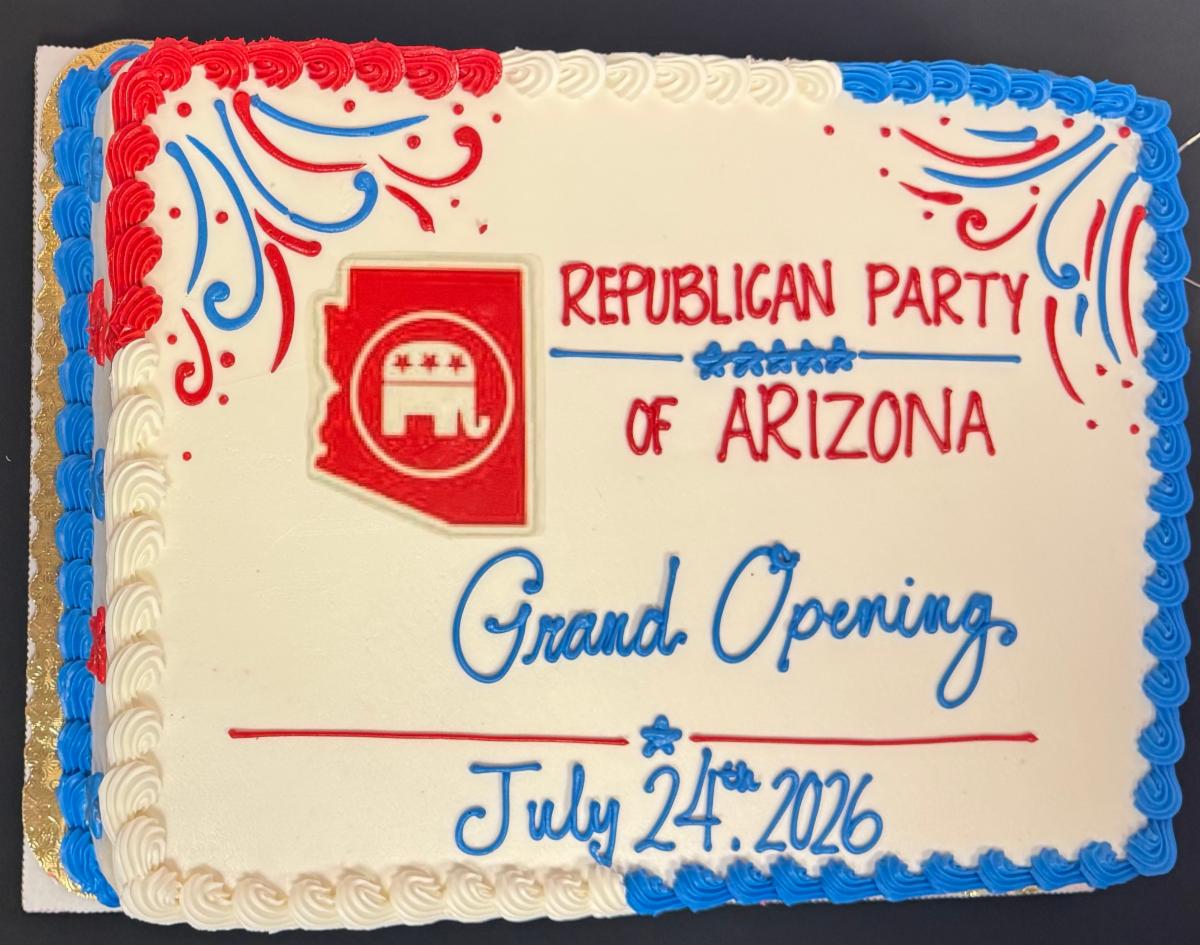
AZGOP Celebrates New Headquarters with Successful Open House


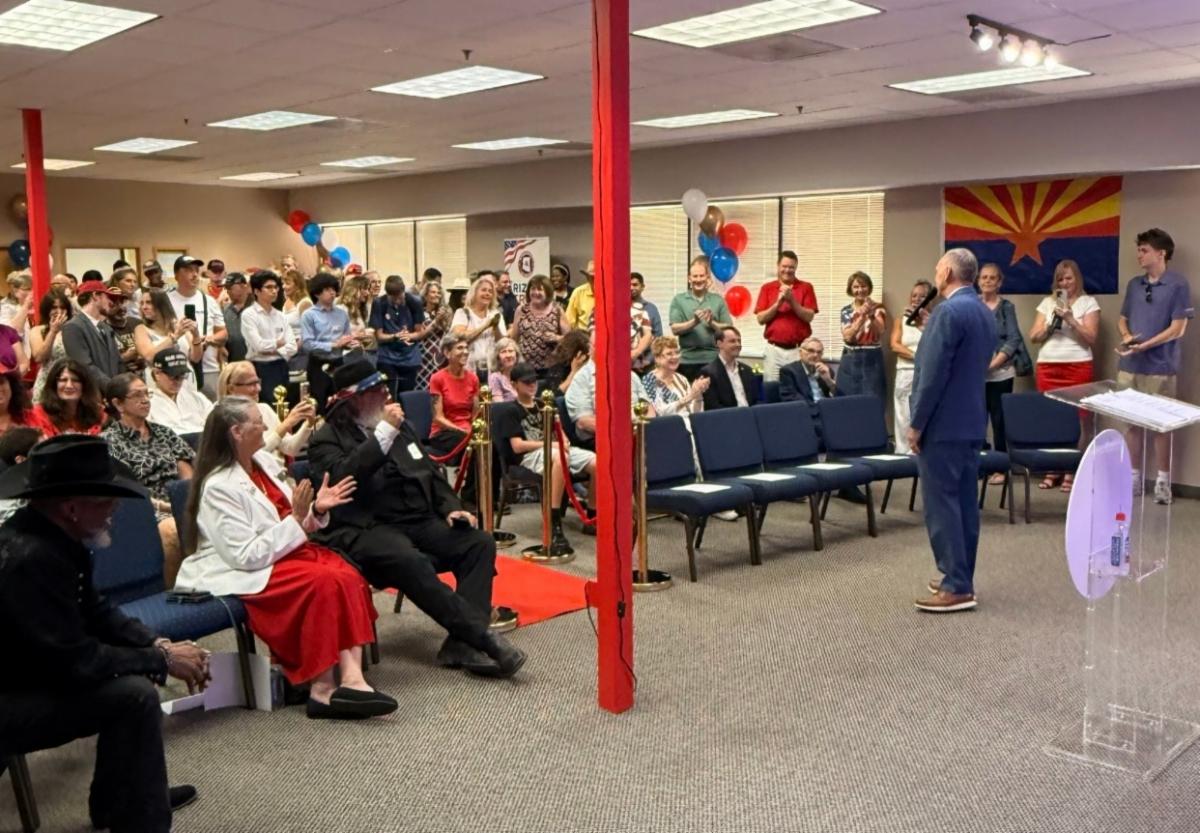
Last Friday, the Arizona Republican Party welcomed supporters, elected officials, candidates, and activists to an open house celebrating its new state headquarters. I was honored to attend along with approximately 200 fellow Republicans for an afternoon of conversation, networking, and optimism about the upcoming General Election.


The event truly was a "who's who" of Arizona Republican politics. Among those in attendance were gubernatorial candidate Congressman Andy Biggs, Senate President Warren Petersen, Representative Alex Kolodin, Republican National Committee Chairman Joe Gruters, Arizona Republican Party Chairman Sergio Arellano, Maricopa County Supervisor Mark Stewart, and many other Republican leaders, candidates, and grassroots volunteers from across the state.

One thing I did notice was the absence of the leadership from the Maricopa County Republican Committee. Given Maricopa County's importance in Arizona elections, their absence was noticeable, although many grassroots Republicans from throughout the county were in attendance.


The event featured remarks from several candidates and party leaders who spoke about the importance of the 2026 election and the need for Republicans to remain united heading into November. Their message was consistent: now that many of the primaries are behind us, it is time to focus on winning the General Election.


Beyond the speeches, the event provided an excellent opportunity for attendees to reconnect with old friends, meet new Republicans from around the state, and discuss the issues facing Arizona. Guests enjoyed a wonderful selection of hors d'oeuvres while mingling throughout the new headquarters, creating an atmosphere that was both welcoming and energetic.


The open house was clearly a success. It showcased a party that is working to build enthusiasm and momentum as the General Election approaches. If the energy and optimism displayed Friday night are any indication, Republicans are ready to roll up their sleeves and get to work.


Now comes the most important part. Successful events are encouraging, but elections are won through hard work, voter outreach, and turnout. As November approaches, Republicans across Arizona will need to unite behind their nominees and focus on the common goal of winning elections.


Congratulations to the Arizona Republican Party on its beautiful new headquarters and a successful grand opening. Here's hoping the enthusiasm on display Friday night carries through to Election Day.

1,357 Voters Had to Vote in Person After Mail Ballots Were Returned for Unpaid Postage


One of the more troubling stories to emerge from Arizona's 2026 Primary Election did not involve vote counting or election results. Instead, it involved 1,357 voters whose mail-in ballots were returned to the Navajo County Recorder's Office because the U.S. Postal Service determined that postage had not been paid.


Fortunately, none of these voters lost their right to vote.


According to Navajo County Recorder David Marshall, affected voters were notified of the problem and instructed to cast their ballots in person during the early voting period or on Election Day. While this required additional effort from those voters, they were still able to participate in Arizona's Primary Election.


Marshall assumed the duties of Navajo County Recorder on March 27, 2026, after being appointed to fill the vacancy created by the resignation of the previous recorder.


The situation has raised important questions about how election mail is handled and whether the problem could have been avoided.


Former Maricopa County Recorder Stephen Richer offered an interesting perspective. Richer said he believes the Postal Service should have delivered the ballots despite the apparent postage issue and then recovered any unpaid costs afterward. As Richer explained:

The postage not being funded is very bizarre. I think that would have been something that the USPS would have looked past for the immediate time being. And then they would have cleared that up later with Navajo County, knowing that Navajo County was good for it.

Whether the Postal Service followed its normal procedures or whether a breakdown occurred somewhere in the mailing process remains under investigation. Officials have indicated they are working with USPS to determine exactly why the ballots were returned.


The good news is that election officials acted quickly enough to notify affected voters before the election concluded, allowing each of them the opportunity to vote in person. While the incident created an unnecessary inconvenience for more than 1,300 citizens, it did not ultimately prevent them from exercising their right to vote.


As Arizona prepares for the November General Election, voters who plan to vote by mail should continue to monitor their ballot status, verify that their mailing address is current, and allow plenty of time for mailing. If there is ever a problem with a mailed ballot, voters still have the option of voting in person before or on Election Day, ensuring that every eligible voter has the opportunity to have their ballot counted.

News Resource


Thank you for reading my newsletter each week. It truly is a labor of love. My goal is to provide timely, factual information and local news that you may not find covered elsewhere. Whether it's elections, public policy, local government, or community issues, I strive to bring you information that helps you stay informed and engaged.


If you ever want to revisit a previous story or look up something from an earlier edition, every newsletter is archived on my website for easy access. Simply click the link below to browse past editions. Thank you for your continued support and for being part of this journey—it means more than you know.


Thank you,

Lisa Everett


www.patriotnheels.com


Follow me on:

X - @patriotnheels

Facebook - @patriotnheels

Instagram - @patriotnheels