|
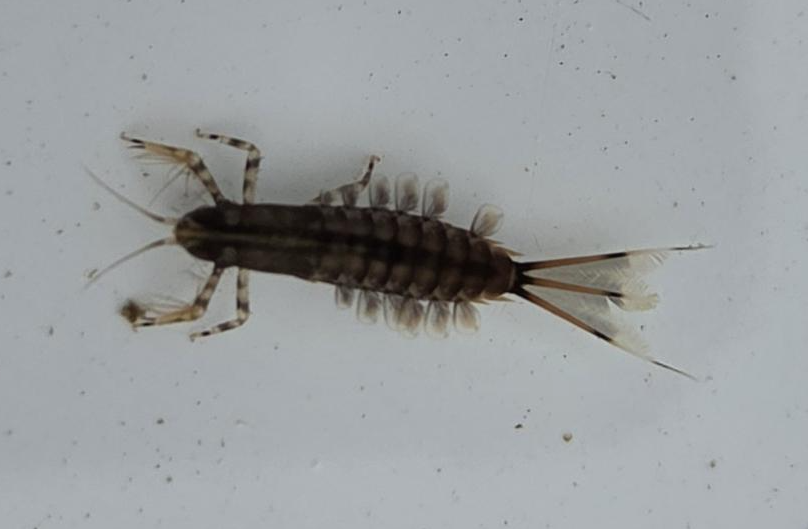
These stout-looking mayflies are found throughout North America in all sizes of rapidly flowing waters. Whether they are found in shallow riffle areas, leaf packs, vegetation, rocks, or other debris, they are always in flowing water. Although brushlegged mayflies are found throughout North America, they are most common in the east and there are a few different kinds! This family consists of one genus and 17 species. Most Isonychiidae are different shades of brown, with a white or cream stripe running front to back along the body. However, the stripe does not always extend the entire length of the body and the stripe may even be absent.
Brushlegged mayflies are very strong swimmers, but they spend most of their time clinging to surfaces in their environments. In fact, this is how these larvae feed! They face into the current, holding fast to a surface with their middle and hind legs. This is where their “brush legs” that they are named for come in handy. As the mayfly is clinging to a surface with its back two sets of legs, it holds its front brush legs close together below the head. The long hairs on the front legs overlap and filter particles of material from the water. In the photo above, the brush-like hairs on the front legs of the mayfly can be observed. Particles that are collected consist of algae, diatoms, and detritus. Sometimes, insect larvae such as midges or black flies can end up in these hairs, and they will also be consumed.
This family of mayflies have one or two generations per year, depending on species and environmental factors; temperature is a major determining factor in the amount of generations. Adults emerge from May through August.
If you find this macroinvertebrate while conducting Missouri Stream Team sampling, it belongs to the Group One Taxa!
Source:
Voshell, J. Reese, Jr. A Guide to Common Freshwater Invertebrates of North America. The McDonald and Woodward Publishing Company, 2011.
|