News and information that journalists need to serve the public and stay safe.
April 1, 2020

Advice from  Jill Geisler ,
Bill Plante Chair in Leadership & Media Integrity, Loyola University Chicago
Freedom Forum Fellow in Women’s Leadership

For those accustomed to working in a newsroom or classroom, the switch to working from home seemed instantaneous, even miraculous. How did people make the shift so fast, so inventively, so cooperatively? 

They drew on their session of mission, their adaptability, and frankly, their desire to have jobs. 

Now, they’re doing the best they can with what they have, likely a hybrid mixture of employer-supplied tools and whatever they already had at home — laptops, tablets, phones, bandwidth, software, work space, and office supplies. Many are sharing those essentials with other family members who also need them for work and school.

It’s a juggling act, but good enough for now.

But “now” is looking like a long stretch ahead. It’s important for leaders to recognize the increasing strain that “good enough” will cause. 

In the rush to keep the journalism flowing safely there wasn’t time to discuss, much less negotiate, the mix of time and tools this would take. 

That’s why it’s important for leaders to remember that people carry a ledger in their heads. They know the value of personal property they’re using for work, the professional tools they wish they still had at their fingertips, the extra hours they’ve spent coaching colleagues who needed tech advice, and odd hours they may be working as they juggle family needs.

They think the “give” side of their ledger is pretty valuable. You are responsible for the other side of that ledger, making sure the “get” side evens things out. That’s the real magic of management: knowing how to balance the ledger, as best as humanly possible, with each member of your team, so they feel that what they get is as good as what they give.

Read on to learn what makes teams feel they’re giving more than they’re getting, and what leaders can do to restore balance.
Email interviews are a trusted tool for journalists seeking information. But with more messages than ever competing urgently for attention in our inboxes, there are a few extra ways to stand out and get the responses you need:

  • Include your questions in the initial interview request. People are more likely to respond if they know what you really want from them and how long it will take them to provide it.
  • Place your questions directly in the body of the e-mail. Do not include them as an attachment.  
  • Question order matters. Ask your most important question first. It conveys that you take their work seriously and that you aren’t going to waste their time. 
  • Use open-ended questions. You may not have an opportunity for follow-up, so closed questions that generate yes/no answers won’t be as helpful as exploratory questions that ask how or why. 
  • Keep questions simple and answerable, one at a time. If you ask a double-barreled question, they may only give you part of the information you want.
  • In complex subjects, ask for examples or analogies. They can help subjects step away from the formality of an email response.
  • Avoid a lengthy list of questions. If you have more than 3-5 questions and it will take them longer than 15-20 minutes for them to answer by email, share the questions and request a phone interview.
  • Describe as much about the story you are reporting as you can so the subject knows what you are after, and indicate what you know so they don’t direct you to generic statements or their website.
  • Give them the opportunity with the last question to add anything that you may not have asked.
  • And now more than ever, remember basic email etiquette: use the subject line to clearly and concisely convey your request in 5 or 6 words; explain your purpose and deadline in the first sentence of your email; and ask for links to any additional materials or resources.

If you don’t hear back, assume your email could have been filtered into junk or spam unintentionally and try sending again from another email address.
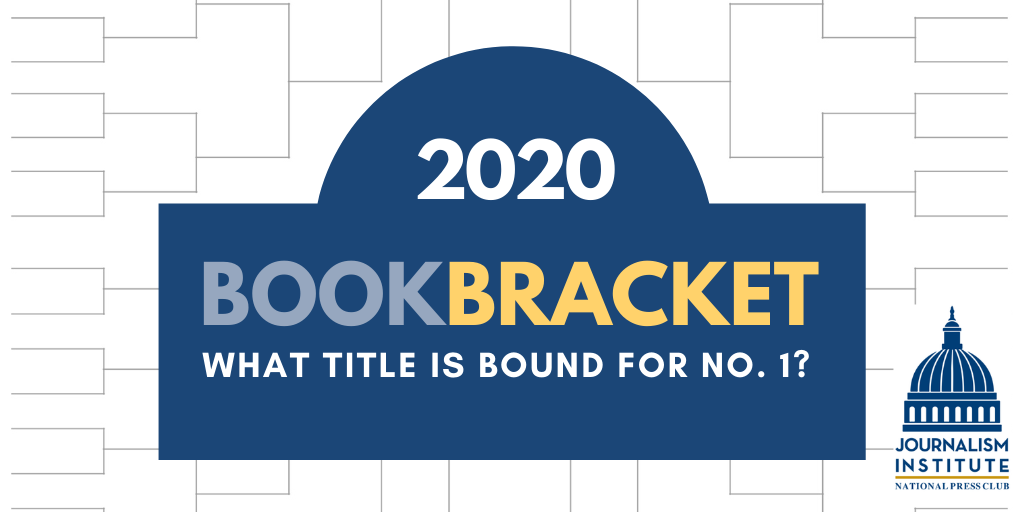
All the President’s Men is the No. 1 seed in the inaugural 2020 Book Bracket, organized by the National Press Club Journalism Institute. But in the five-round competition, any of the 64 titles that made the cut is competitive. It’s now in your hands. 

Brackets are now open and accepting predictions. Make your picks by midnight Wednesday, April 8.

Book lovers submitted 128 titles for the best journalism books. Each book was ranked and seeded based on how many votes it received.

Your votes will determine the winners in each round. Miss a vote? That’s OK — join in for the next round. Make it even more interesting: Share this with your friends to get them involved. Everyone loves a little competition. 

Round Vote by midnight
1 April 13
2 April 16
3 April 20
4 April 23

Votes in the championship round must be made by midnight April 27.

The winning title — and the runners up — will be featured at the National Press Club's Eric Friedheim National Journalism Library as the Institute curates titles for the collection later this year.

And, the person who most closely predicts the winners in each round will receive special recognition and a surprise once the 2020 Book Bracket champion title is announced.
Self-care is as much about learning as it is about practicing. Help our journalism community by sharing how you are getting through this challenging time . Tips from building your home gym to homeschooling during the workday or sharing a great book on managing grief — your tips could help make this tough time a little more manageable for a fellow journalist. 

Email us to share: 
  • What’s your go-to activity to de-stress?
  • How do you create a boundary between work time and home time?
  • How do you manage your email to avoid feeling overwhelmed?
  • How did you adapt your work-at-home space to make it ergonomically friendly?
  • What book do you rely on to escape reality? Why?

This newsletter is written & edited by the National Press Club Journalism Institute staff: Beth Francesco, Holly Butcher Grant, Jim Kuhnhenn, and Julie Moos. Send us your questions and suggestions for topics to cover.

Get this from a friend? Subscribe , and view the archives .
SUPPORT THE INSTITUTE
The National Press Club Journalism Institute promotes an engaged global citizenry through an independent and free press, and equips journalists with skills and standards to inform the public in ways that inspire civic engagement. Support our important work with a tax-deductible contribution today.