|
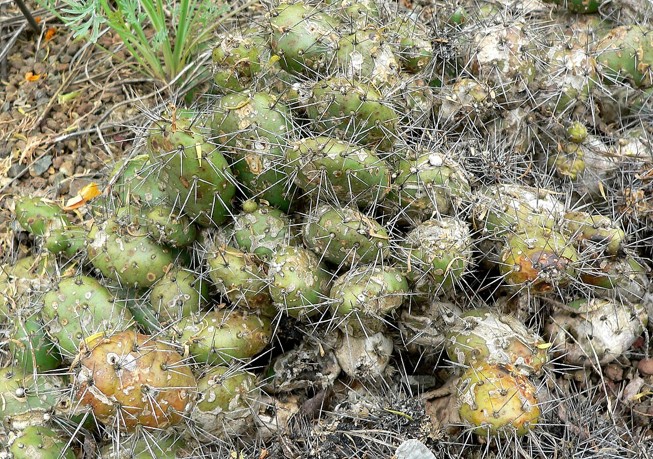
Fragile prickly pear, Opuntia fragilis, is a native, perennial, low growing succulent that is extremely drought tolerant and usually inconspicuous until easily detached stem segments becomes attached to your clothing or skin.
It grows well at low to moderate abundance on sandy, shallow, and silty ecological sites. Aerial growth has numerous jointed stems forming clumps that are sometimes 3.5 inches tall. Stems are somewhat bilaterally flattened, less than 2 inches long with few to several stem segments joined together.
Barbed spines are numerous about 1 inch long with a group of spines forming at areolae (a small area arising from below the epidermis) equally distributed at close intervals over the stem with the longer spines towards the top. The barbed spines readily cling to fur, clothing, and leather boots; the stem segments easily detach at the joint and are transported until the spine breaks. The detached transported stem segments develop roots and form new plants.
The root system has extensive shallow lateral roots. The yellow showy flowers have both male and female organs emerge infrequently during June to July but are seldom observed. The fruit is an ovoid spiney green berry. The seeds are whitish to gray.
Cacti do not conduct photosynthesis by the same processes as cool-season and warm-season plants. Cacti photosynthesize by a third method called Crassulacean Acid Metabolism (CAM) that is an evolved photosynthetic process providing a solution with reduced water loss.
Cacti open their stomatas only at night, when evaporation of water is naturally less. Atmospheric carbon dioxide is taken into the stem where it combines with an organic acid and is stored until daylight. During the daytime, the stomata are closed, stopping all exchanges with the outside atmosphere, the presence of sunlight activities the photosynthetic processes in cells with chlorophyll, and the previously night time captured carbon dioxide becomes available to produce carbohydrates.
Closed stomata during the daytime prevents foliage-active herbicides from entering cacti plants when applied during daylight hours and are thus totally ineffective. However, there is an effective alternative, foliage-active herbicides applied during night time hours, when the stomata are fully open, is a workable modification. Problematically, there is possibly a negative side effect from performance of this successful scientifically modified treatment in the middle of the night; your neighbors will be convinced that you are totally daft.
We collected plant basal cover densities with the point frame method for 30 years from 1983 to 2012. The changes in plant densities were greatly affected by the drought of 1988 and the low water period through 1992.
The mean annual basal cover of fragile prickly pear during the 5 year period before the drought was 0.67%. The mean annual basal cover increased to 1.38% during the 5 year period of the drought and low water interval. During the following 20 year period, the mean basal cover remained at a low of 0.37%.
The 5 year period of drought and low water reduced the density of most forbs and some grasses, which provided space for fragile prickly pear to increase. By using the CAM method as its photosynthetic processes, fragile prickly pear had major water efficiencies that permitted it to increase its mean annual basal cover at a time that most plants had to decrease.
|