|
“The Interview” features John Rossant, a leading expert on sustainable mobility and renewable energy. He founded the New Cities Foundation, a global nonprofit focused on urban innovation, and serves as CEO of CoMotion, a Los Angeles-based events and media company covering the transformation of urban mobility. John previously led the team that produced the World Economic Forum’s renowned Annual Meeting in Davos, Switzerland, each January. He also founded and chairs the Monaco Hydrogen Alliance, a Monaco-based think tank focused on renewable hydrogen and alternative fuels, under the patronage of Prince Albert II of Monaco. He serves on the board of the Foundation Tocqueville in Paris and on the Global Advisory Board of NEOM, the large new city project in northwestern Saudi Arabia. We spoke with John virtually about what to expect at this year’s CoMotion, where the transportation sector is headed, and the challenges and opportunities that lie ahead.
Tell our readers about your path into the transportation space and any unexpected twists and turns along the way.
My whole career has been a series of twists and turns, some expected, many not. I didn't start in transportation. I spent years building convenings at the intersection of technology, policy and business: leading the team that produced the World Economic Forum's Annual Meeting in Davos, organizing the e-G8 on the future of the internet for France's President Sarkozy in 2010, and launching the Monaco Media Forum. Through the NewCities Foundation, which I launched in 2010, I became obsessed with how cities work, and it became pretty obvious pretty quickly that mobility is the beating heart of any city.
The timing of launching CoMotion in 2017 was luck, really. You couldn't have picked a more consequential moment -- or a more consequential city at that time, Los Angeles. Micromobility exploded in late 2017, when a little startup called Bird started placing connected electric scooters on the streets of Santa Monica, in West LA. Up in the Bay Area, Google's self-driving project was graduating into what became Waymo. Ride-hailing in the form of Uber and Lyft was reshaping how people moved, and electrification was moving from niche to mainstream. Suddenly every assumption about how we get around was up for grabs.
We saw that cities, startups, investors and established industry weren't speaking to each other -- they were speaking at each other, if they were speaking at all. CoMotion set out to change that. Timing is everything in life, and we got lucky with ours.
AI and autonomous vehicles have driven the biggest transformation of the last five years. What impacts have you seen and where do we go next?
Autonomy is here to stay, and we are only in the very, very early innings. A few years ago, driverless cars were a demo. Today, robotaxis carry paying passengers every day in a growing list of cities, with no one behind the wheel. The conversation has moved from "if" to "how fast" and "where next."
The bigger story, though, is that AI will permeate every layer of transportation, not just the car. It will optimize traffic signals and transit schedules, predict maintenance before a part fails, route freight more efficiently, and spot dangerous intersections before the crashes happen. I think this will be overwhelmingly positive.
This helps lead cities to truly seamless, multimodal mobility. AI can stitch together a robotaxi, a train, a bike and a walk into one trip that feels like a single service. For our cities and urban regions, that's the real prize: fewer cars, safer streets and more equitable access to opportunity.
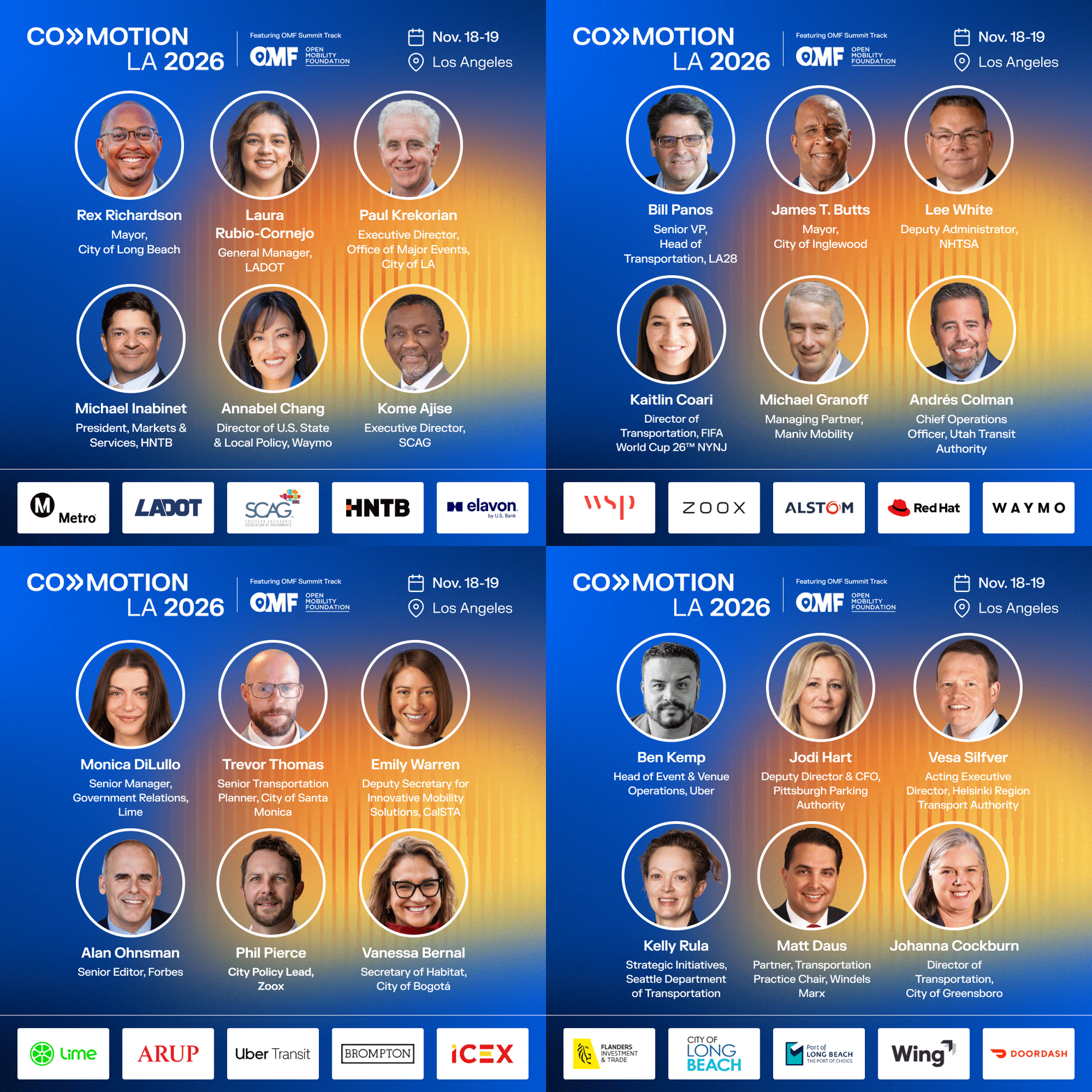
With CoMotion LA coming up on November 18–19 tell us about the conference, its main themes, and your goals for this year.
CoMotion LA is our flagship, and it has become the place where the people building the future of mobility actually meet: city leaders, founders, investors, automakers, regulators and technologists. We take place in Downtown LA on November 18–19, and this year feels especially charged.
A few big themes run through the program:
-
Autonomy at scale: Robotaxis and autonomous freight are arriving in force. What does that mean for our cities?
-
AI everywhere: how AI is changing traffic management, transit, logistics and safety.
-
Safety: how technology, design and smart policy can bring down the number of people killed and injured on our streets.
-
Getting LA ready for 2028: the Olympic and Paralympic Games are a once-in-a-generation deadline to transform how the region moves.
-
Electrification and infrastructure: charging, the grid and who pays for it.
Our goal is simple: we want people to leave with new partners, real deals and concrete ideas they can put to work in their own cities. CoMotion has never been about talk for its own sake. We've got the most important heads of transit agencies coming in from across the country, along with incredible founders, CEO's and senior players ininnovative companies like Glydways, Humble Robotics, Waymo, Zoox, Uber....
You are working in partnership with Los Angeles Cleantech Incubator’s (LACI) and the Miami-Dade Innovation Authority on this year's LA New Mobility Challenge. What should readers know and how can they get involved?
The LA New Mobility Challenge is our annual competition for early-stage mobility startups, and 2026 is its tenth edition. We run it with our partners at LACI, the Los Angeles Cleantech Incubator, and the Miami-Dade Innovation Authority. That gives the winners a real pathway into two of the most dynamic mobility markets in the country.
The idea has always been to find the founders who are solving real problems for real cities and put them in front of the people who can help them scale: investors, city officials and corporate partners. Over ten years, the Challenge has helped launch some genuine success stories. itselectric, which brings curbside EV charging to people without driveways, is one of the alumni we're proudest of.
This year, the finalists pitch at CoMotion NXT in Long Beach on November 17, and we announce the winner on November 19 at CoMotion LA in Downtown LA.
How to get involved: come and watch the pitches, connect with the finalists, or, if you're a city, investor or corporate partner, talk to us about supporting the next cohort. Here's how you can apply - if you're a cool mobility startup.
Can you tell us more about this gathering?
We're very excited about NXT. It takes place in Long Beach on November 17, the day before CoMotion LA, in partnership with Mayor Rex Richardson and his team. It lets us expand into areas adjacent to pure mobility: advanced manufacturing, dual-use technologies, aerospace and space.
Long Beach is the perfect place for it. Thanks to the city's "Space Beach" strategy, it has become a real hub for the space and aerospace industry, with a deep bench of companies building rockets, satellites and the advanced manufacturing behind them.
Why does space matter for mobility? Because it is increasingly what connects our vehicles. Satellites provide the positioning, communications and data that connected and autonomous vehicles rely on. And that connectivity is becoming critical to keeping them safe, from precise location to real-time hazard warnings and over-the-air updates.
The future of mobility will be built on the ground and in orbit, and NXT is where those two worlds meet.
Besides the US, which country should mobility experts keep an eye on and why?
That's an easy one: China. It is stunning to see how far Chinese automakers have pulled ahead on electric vehicles.
They develop new models in a fraction of the time Western manufacturers take, and their cars are packed with software, sensors and driver-assistance features at prices that are hard to match. Battery technology is the same story.
It isn't only the cars. China has built charging infrastructure at enormous scale, and Chinese companies are running robotaxi services in several cities. The whole ecosystem, from batteries and chips to software and manufacturing, moves at a speed the rest of the world is still trying to understand.
You don't have to agree with every aspect of China's model to learn from it. Anyone who cares about the future of mobility, including its safety and sustainability, needs to be watching closely.
Looking at the air as well as our roads, are you seeing real advances in flying taxis beyond the headlines and hype?
Absolutely. This is coming. The leading companies are flying certification-standard aircraft, regulators are working through the rules, and the first commercial passenger services are close.
But it won't be the Jetsons future of flying cars on demand, at least not for a while. The first use cases will be short, high-value hops: downtown to the airport in minutes instead of an hour in traffic, or between a city center and nearby hubs. Think premium shuttle first, mass transit much later.
The biggest hurdle is trust. People have to be convinced these aircraft are safe, and that becomes even more important when they eventually fly without a pilot on board. That has to happen for the business models to make sense. The industry will have to earn public confidence step by step, with a flawless safety record from day one.
Anything else you'd like to share about safer mobility and how what comes out of CoMotion is helping save lives on our streets?
Safety has been core to everything we look at, and so much of the innovation in mobility is fundamentally about safety. Driverless cars are already proving safer than human drivers, because they don't get distracted, drunk or tired. Advanced driver-assistance systems, like automatic emergency braking and lane keeping, are making the cars we already drive safer every year.
One area that still needs work is micromobility. E-bikes and e-scooters are wonderful tools for cities, but injuries have risen along with their popularity. They probably need additional layers of smart regulation: sensible speed limits, better standards for batteries and equipment, rider education, and above all safer street design with protected lanes.
What CoMotion does is put the people who can fix these problems in the same room: the engineers building the technology, the cities that design and regulate the streets, and the investors who fund what comes next.
When those conversations turn into pilots, partnerships and better policy, that's how lives get saved.
|