Rail Workers Weekly News Digest
Number 15 - July 2nd, 2019
|
|
Below is a series of articles compiled over the previous week.
They are of interest to railroad workers.
_____________________________________________
|
|
2019 - 15 Article 1
NTSB calls on FRA to stop delaying passenger-rail safety rule
The NTSB statement followed the release yesterday of its
final report
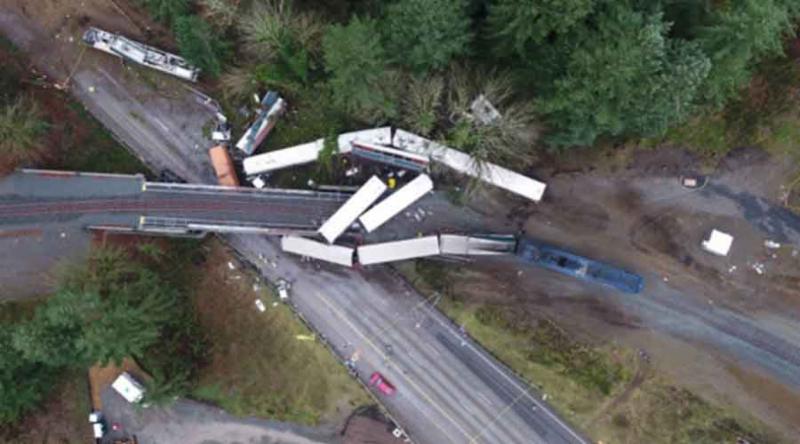
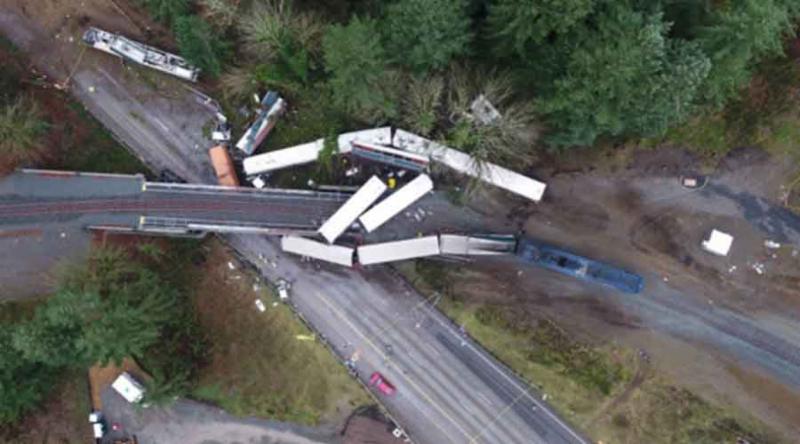
on the agency's investigation into the Amtrak derailment that occurred in DuPont, Washington.
The report details the NTSB's investigation of the accident, which concluded that failure to provide effective mitigation of a hazardous curve and inadequate training of the locomotive engineer led to the derailment.
Read more ...
|
|
2019-15 Article 2
Impact of Precision Scheduled Railroading shows up in Class I employment figures
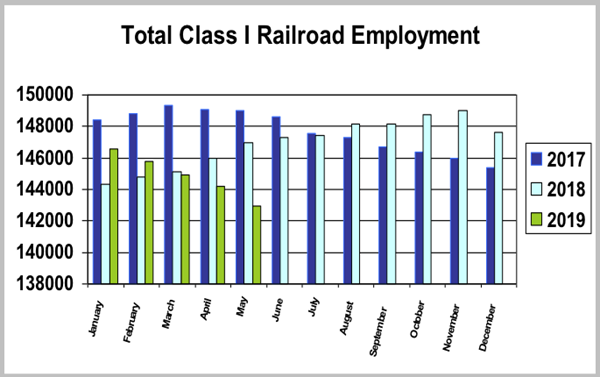
Employment at U.S. Class I railroads has fallen 4% since February 2017, the month before E. Hunter Harrison began implementing Precision Scheduled Railroading at CSX Transportation.
Harrison’s efficiency-driven operating model has since spread to Union Pacific, Norfolk Southern, and Kansas City Southern, making additional workforce reductions likely through the end of 2020.
Overall railroad employment tends to ebb and flow with traffic volumes. But now the Class I systems are moving more traffic with fewer people: U.S. rail traffic was 24% higher in May 2019 than it was in February 2017, according to Association of American Railroads data.
Read more ...
|
|
2019-15 Article 3
‘Titanic-like complacency’: Official blasts Amtrak for fatal 2017 train crash
SEATTLE — The National Transportation Safety Board has published its final report on a deadly Amtrak derailment in 2017, with the agency’s vice chairman blasting what he described as a “Titanic-like complacency” among those charged with ensuring train operations were safe.
The train was on its first paid passenger run on a new route from Tacoma to Portland, Ore., when it plunged onto Interstate 5, killing three people and injuring dozens.
In findings released last month, the NTSB said the engineer lost track of where he was and failed to slow down before a curve. The agency said a series of decisions or inactions by Amtrak as well as state and federal regulators set the engineer up to fail.
The agency’s vice chairman, Bruce Landsberg, wrote in comments published with the final report Monday that the root cause was “extremely lax safety oversight, unclear responsibility, and poor training.”
“There was a Titanic-like complacency and certainty exhibited by those tasked with the safety, operation and management of the Point Defiance Bypass rail line before the revenue service started in 2017,” Landsberg wrote.
Read more ...
|
|
2019-15 Article 4
NJ TRANSIT Engineers Refusing To Pick Up Extra Shifts To Cover Sick Days, Vacations
SUMMIT, N.J. (CBSNewYork) —
NJ TRANSIT
riders should brace for more canceled trains.
There’s already a shortage of engineers, and now, many of them are refusing to pick up extra shifts, like filling in for people on summer vacation.
An on-time train is something NJ TRANSIT riders have learned to cherish. One passenger told CBS2’s Lisa Rozner she takes the first one into New York City and sometimes, because there’s no engineer, it never shows.
“He calls out sick or something. My train gets canceled,” she said. Dan Tague commutes from Roxbury. “You could be in 20 minutes late, you could be in an hour late, you never know. That’s the problem,” he said. This weekend, more than 40 trains were canceled.
Read more ....
|
|
2019-15 Article 5
Two-person crew bill introduced in United States Senate
A two-person crew bill was introduced in the United States Senate on June 26. The Safe Freight Act, a companion bill to H.R. 1748 in the U.S. House of Representatives, would promote rail safety by mandating at least two-person crews on all freight trains in the United States. The bill was introduced by Senators Edward J. Markey (D-Mass.) and Ron Wyden (D-Ore.).
According to a press release from Senator Markey’s office: “The bill is designed to correct the Federal Railroad Administration’s recent rollback of a proposed rule that would have established these necessary safety standards. The Safe Freight Act will specifically require that all freight trains have at least one certified conductor and one certified engineer on board, who can then work together to protect the safety of both the train and people living near the tracks.”
Other Senators co-sponsoring the Safe Freight Act are Senators Richard Blumenthal (D-Conn.), Angus King (I-Maine), Elizabeth Warren (D-Mass.), Tina Smith (D-Minn.), Amy Klobuchar (D-Minn.), Sherrod Brown (D-Ohio), Dianne Feinstein (D-Calif.), and Jeff Merkley (D-Ore.)
.
Read more ...
|
|
2019-15 Article 6
U.S. Sen. Roger Wicker, R-Miss., chairman of the Committee on Commerce, Science, and Transportation, will convene a hearing titled, “Amtrak: Next Steps for Passenger Rail,” at 10:00 a.m. on Wednesday, June 26, 2019. The hearing will examine implementation of the rail title of the Fixing America’s Surface Transportation (FAST) Act, which expires at the end of fiscal year 2020, and priorities for reauthorization of Amtrak.
|
|
2019-15 Article 7
RMT PREPARES TO BALLOT FOR NATIONAL RAIL STRIKE
RMT prepares to ballot for first national rail strike in a generation as Government and train companies fail to give assurances on pensions.
RAIL UNION RMT said today that is preparing to ballot for the first national rail strike since privatisation over twenty years ago after the Government and the train companies failed to respond to requests from the union for cast iron assurances that there will be no undermining of the current pension arrangements.
RMT has written to Transport Secretary Chris Grayling, the Industry's regulator, all TOC employers and the Rail Delivery Group making it clear that if there is a move to impose reductions in future pension benefits or significantly increase member contributions the union will take the necessary action to defend pensions.
The union has not received the cast-iron assurances it has been seeking and as a result the preparations for a national rail strike vote are now being put in hand.
|
|
2019-15 Article 8
CEO-to-Worker Pay Inequity Reaches all-time High
CSX 131-to-1
Kansas City Southern 115-to-1
Norfolk Southern 145-to-1
Union Pacific 174-to-1
In 2018, CEOs of S&P 500 companies received, on average, $14.5 million in total compensation.
The average S&P 500 company CEO-to-worker pay ratio was 287 to 1.
The imbalance in our economy between the pay of CEOs and working people continues to be a problem.
This year marks the first where nearly all S&P 500 companies have disclosed the pay ratio between their CEO and median employee. This important disclosure did not come easy. Major corporations and industry groups lobbied long and hard to hide this valuable information from shareholders and the general public.
CEO-to-worker pay ratio data is important. A higher ratio could be a sign that companies suffer from a winner-take-all philosophy where executives reap the lion’s share of compensation. A lower ratio could indicate which companies were dedicated to creating high-wage jobs and investing in their employees for the company's long-term health.
Read more ...
|
|
Railroad Workers United
Solidarity -- Unity -- Democracy
|
|
|
|
|
|
|