Walking along Tahoe’s beaches in spring is a popular activity. Before the summer crowds descend on the lake, one can usually enjoy the tranquility of the lake set against the backdrop of snowy peaks with a ribbon of sandy beach separating the two. Not this year. |
|
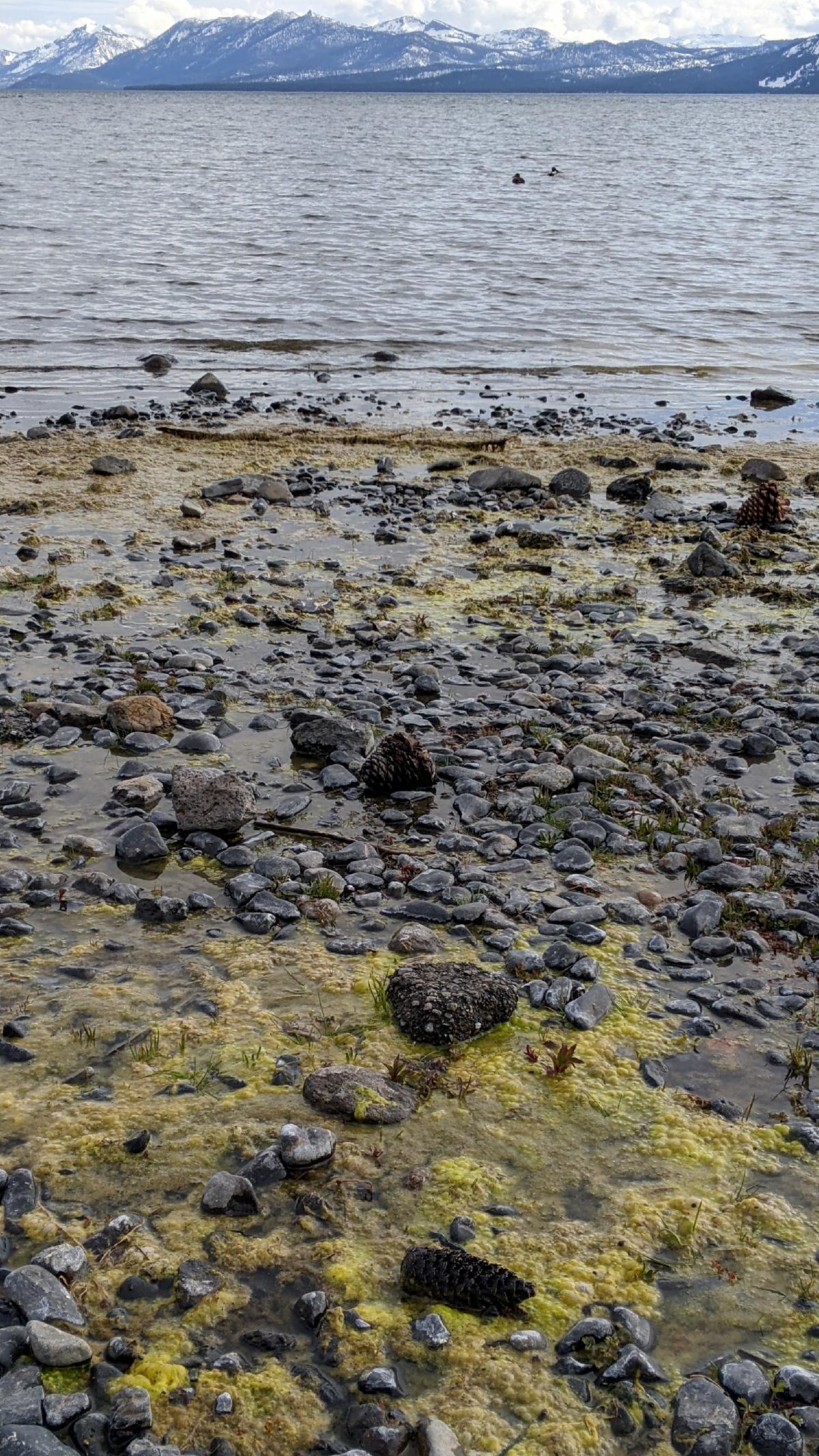
While some sections of the shoreline are still pristine, this spring much of it is impacted by algal and bacterial growth. This is the case all around the lake, on both the California and Nevada sides. The photo above (courtesy of Scott Hackley) shows the sandy beach between the Upper Truckee marsh and the lake on April 7, 2022. Green algae and orange coloration associated with iron-oxidizing bacterial activity is evident on the right. To the left one can see the dried, algal crust that is left behind as the lake level falls. |
|
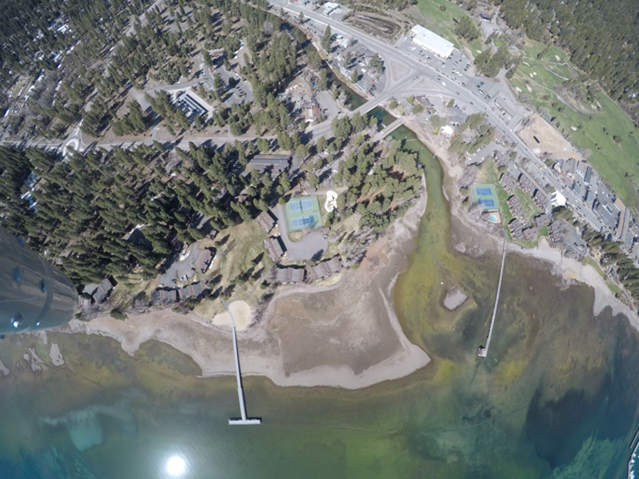
The extent of the growth this year, can only be appreciated when viewed from the air. Since 2017, TERC Board member Mike Bruno has documented the degradation of the nearshore using helicopter surveys around the lake and seen the extent grow over the years. The photo above, also from April 7, shows the Tahoe City dam at the outlet of the Truckee River, laden with brown areas of attached algae and green areas of filamentous algae. |
|
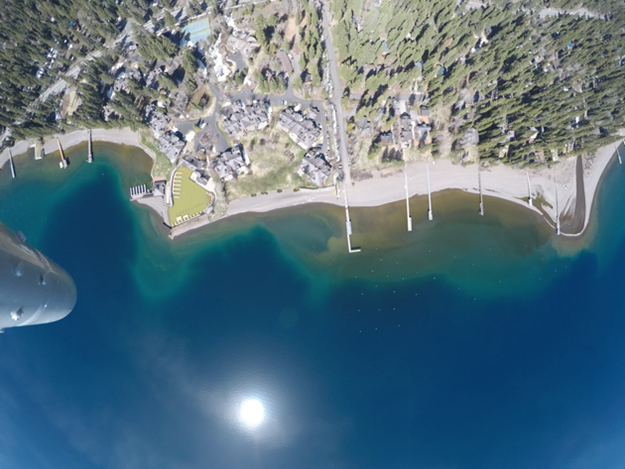
On the west shore, south of Blackwood Creek (shown entering the lake on the right), extensive attached algae growth is visible by the presence of tan areas closest to shore at a depth of 0-2m. The pale blue areas fringing the tan areas are the lake bottom where algal growth is not occurring. The small chartreuse colored area is algae within the Fleur du Lac harbor. |
|
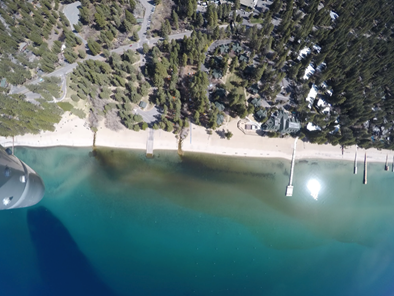
At Incline Village on the north shore (pictured above), the dark colored turbid plumes from Third Creek and Incline Creek are seen being carried along the shoreline by the current. The stream flows at the time were very low, in the vicinity of 10 cubic feet/second. |
|
Over the last 40 years, TERC has monitored algal growth around the lake’s shoreline using multiple fixed stations. While these served a role in helping to quantify spatial differences around the lake, the present imagery highlights the beneficial use of helicopters and drones to additionally measure the extent and the variability of nearshore algae. The testing of this approach to determine its ability to help quantify shoreline algal growth was undertaken in 2019 on behalf of the Nevada Division of State Lands.
While in the past, it was possible to link nearshore algal growth to external sources of nutrients, the previous imagery suggests that a great many other factors are at play. These include the complex lake currents in the nearshore that are evolving as climate change increasingly impacts the lake; lake water level; and the presence of invasive species. Regular images such as those above would help researchers to disentangle the major causes, and allow for the development of better mitigation measures.
What can YOU do? One easy way to help with data collection is to provide “ground-truthing” images from anywhere around the lake. Use your phone to visit TERC’s Citizen Science Tahoe web app (https://citizensciencetahoe.app/), no downloads necessary, and simply take a photo and include any additional comments to be directly uploaded to us. Show us both the good and the bad.
|
|
|
|
Additionally, a second thing is to be part of the solution. As the lake level recedes, the algae will wash up onshore and dry out, leaving the beaches covered in desiccated algal mats. This will happen more and more as the lake level continues to drop in summer and fall. Removal of these mats is literally the removal of excess nutrients from Lake Tahoe. An individual can remove them, or groups can organize beach clean ups. These clumps of dried algae can be used as mulch in gardens to provide natural fertilizer. Every application of dried algae can reduce the use of fertilizers brought into the basin.
Check out what your favorite beach is like in our complete set of images taken around Lake Tahoe on April 7, 2022 by TERC researcher Brandon Berry. Just click on an icon on the shoreline to see what conditions are like there. It may be clean now, but that will likely change as the year progresses. |
|
|
|
|
|
|