Weekly Digest Number 25 - June 21st, 2022 |
|
Welcome to the RWU Rail & Labor News! This news bulletin is produced and emailed out each Tuesday morning. We hope you find each week's news and information useful. If so, please share with co-workers, friends, and colleagues. If you like, you can sign them up to get all the news from RWU HERE. Or forward them the link. Note: If you read over this news bulletin each week, you will be sure to never miss the important news of what is going on in the railroad world from a worker's perspective!
|
|
United Rail Unions Statement on Proffer of Arbitration, June 15, 2022 |
|
The United Rail Unions issued the following statement on June 15, 2022:
Following the conclusion of our third week of compulsory mediation conducted by the National Mediation Board (NMB), the Rail Unions who are bargaining as part of the Coordinated Bargaining Coalition and the Brotherhood of Maintenance of Way/SMART Mechanical Coalition pursuant to Section 5 First of the Railway Labor Act, received a proffer of arbitration from the NMB.
As previously stated, all of the Carriers’ proposals to date serve as an insult to our collective membership. These essential employees carried the railroads to their record profits throughout the last several years. As much as the Rail Unions would have preferred to reach a voluntary settlement, this has become the only viable path to reaching a satisfactory conclusion. The Chiefs of all 12 Rail Unions wish to thank the NMB Members and the assigned Mediators for their efforts in trying to bring us to a voluntary agreement, and for their recognition that such an agreement was not possible under the current circumstances.
With regard to the proffer of arbitration, the NMB urged the parties to enter into an agreement to resolve the dispute via binding arbitration in accordance with Section 8 of the Railway Labor Act. If either party rejects the NMB’s proffer, or fails to respond prior to the deadline of 5:00 p.m. (EDT) on June 16, 2022, the parties will enter a 30-day “cooling off” period where the status quo is maintained. While each Rail Union has its own process for considering whether or not to accept the NMB’s proffer, it is anticipated that we will unanimously reject it in the coming days.
At any point during the aforementioned 30-day cooling off period, President Biden may appoint a Presidential Emergency Board (PEB), which typically consists of three to five members. The PEB will conduct a hearing and issue a recommendation regarding settlement of the dispute. The issuance of the PEB recommendation starts another 30-day cooling off period.
During this second cooling-off period, the parties may choose to accept or reject the PEB’s recommendation. If either party rejects the PEB’s recommendation, or if the cooling off period expires and the dispute has not been resolved, either party may engage in self-help.
|
|
(Editor's Note: Within weeks of RWU promulgating a resolution to get the DOT/FRA to act on the law adopted 14 years ago, something is happening. Coincidence? Read the RWU Resolution HERE.)
|
|
FRA Releases New Rule on Fatigue Management
Union leader responds positively to new regulation calling for employee involvement in plans to identify, address risks
|
|
WASHINGTON — The Federal Railroad Administration has issued its new rule on railroad fatigue management, set for formal publication on Monday, and at least one rail union leader has offered a positive response.
The final rule, “Fatigue Risk Management Programs for Certain Passenger and Freight Railroads,” is available here for public inspection. Following its publication on Monday, it will become effective July 13. It requires railroads to identify situations with a risk of fatigue and mitigate or eliminate those risks, including such factors as scheduling practices and employees’ consecutive off-duty hours.
“Under the regulation,” the FRA said in a statement, “Class I freight railroads, Amtrak and commuter railroads must develop and implement a Fatigue Risk Management Program (FRMP) as part of their larger system safety and risk reduction programs. Before submitting a FMRP plan to FRA for approval, each railroad is required to consult with affected employees to identify fatigue hazards, as well as specific actions to be taken to mitigate or eliminate those risks. … This rule is one of several ongoing FRA initiatives to address the complex operational, environmental, and cultural issues that contribute to fatigue.”
Greg Regan, president of the Transportation Trades Department, AFL-CIO, said in a statement that his organization’s 37 unions “welcome the FRA’s new rule requiring freight and passenger railroads to have Fatigue and Risk Management Plans that they develop with workers to address scheduling, drug and alcohol testing, and hours of service concerns. This rule provides a solid framework for continued engagement between labor unions and the FRA to ensure that employers are providing working conditions that keep workers and the public safe.
Regan said “punative attendance policies such as the policies at Union Pacific and BNSF Railway, as well as other Class I railroads, have exacerbated the fatigue issue, putting the employees and public at great risk.” The FRA is currently studying fatigue among conductors and engineers, he said, “and we are confident the final results of this study will show that fatigue is linked to worsening workplace conditions for these workers.”
|
|
(Editor's Note: This is a good sign that the ETB is not simply going to accept that the railroads' "recovery plans" are going to get the job done.) |
|
Regulators Scold Railroads Over Recovery Plans, Order Improvements
Union Pacific draws strongest criticism from STB for insufficient filing; fines possible
|
|
WASHINGTON — The Surface Transportation Board, making clear its unhappiness with service recovery plans filed by the four largest U.S. Class I railroads, will require those railroads to correct deficiencies in service recovery plans submitted to the board, and to provide additional information on how they plan to improve service and communication with customers.
At least two of the railroads face the prospect of financial penalties if they do not provide sufficiently improved plans. The new plans are due June 23.
The plans submitted by BNSF Railway, CSX Transportation, Norfolk Southern, and Union Pacific “were perfunctory and lacked the level of detail that was mandated by the Board’s order,” the board said in a Monday release announcing its new order. Those plans were in response to an order issued by the board in May [see “Federal regulators order railroads to provide more service data …,” Trains News Wire, May 6, 2022], with initial six-month plans filed later that month [see “Railroads outline six-month service recovery plans …,” News Wire, May 23, 2022].
In Monday’s release, STB Chairman Martin Oberman said the railroads’ plans “are woefully deficient and do not comport with the spirit or the letter of the Board’s order. The plans simply failed to instill confidence that the carriers have a serious approach to fixing a problem caused by their own lack of preparedness to respond to external shocks and fluctuations in demand, including especially short-sighted management of labor forces and other resources. While the railroads must always comply with Board orders, it is particularly disturbing that the railroads failed to comply with the order requiring them to file adequate service recovery plans. … I had expected a better response from the carriers to the Board’s previous order, and now with more explicit instructions, which should not have been needed, there will be no excuse for continued lack of compliance.”
The board’s 19-page decision also notes two railroads were almost a week late in filing April 2022 employment data, and that “even with the additional time, one carrier’s filings had deficiencies so serieous that that the data was rendered functionally useless. … The carriers must treat the data reporting requirement with the seriousness and diligence called for by the prevailing challenges in the freight network.
|
|
(Editor's Note: Newspapers across the country are running article about this phenomenon. We are definitely on the map.) |
|
BNSF Railroaders Quit, Citing Concerns Over Attendance Policy |
|
SPOKANE, Wash. - As the nation continues to be buried in supply chain issues and worker shortages, one company is taking the brunt of it, at least according to their employees.
A day in the life of a railroad engineer looks much different than it did 20 years ago. At BNSF, one of the largest freight railroad companies in North America, employees say it's now a day of long hours, unsafe conditions, and no help in sight.
"There's no such thing as a weekend on the railroad," Steve Snyder, a BNSF employee, says. "I don't know when I'm going to work. All I know is I'm online, and when they start calling people—when my name comes up—it's time to go."
Snyder has worked as a locomotive engineer for BNSF since 1996 and currently serves as a local Chairman for the Brotherhood Of Locomotive Engineers and Trainmen Union. "I think that's 26 years," he says. But in all those years, Snyder can't recall a time the railroad life has ever been as unkind as it is right now.
"You have this mass exodus of people mid-career that are hanging up their boots and finding something better, [a job] that's much more friendly to their families and to their health," he claims.Just last month, the locomotive union reported 217 people left BNSF—a continuation of a longer trend.
As a way to handle the worker shortage, BNSF implemented a new attendance policy called Hi-Viz, which went into effect in February. It's a policy they say will make staff more available for different shifts.
According to company documents KHQ obtained, an employee gets 30 points for their career. If they miss a call or take an unplanned day off, even for a family emergency, points are deducted. If it falls on a weekend or high impact days like a holiday, it costs additional points.
|
|
(Editor's Note: This brings us one step closer to a possible strike. The larger group of 10 rail unions - the Coordinated Bargaining Coalition - responded favorably and now all rail unions are united! See lead article.) |
|
BMWED Delegation Unanimously Votes to Reject Arbitration and Asks For P.E.B. |
|
The National Mediation Board Proffers Arbitration to BMWED/SMART-Mechanical and Coordinated Bargaining Coalition. BMWED Delegation Unanimously Votes to Reject Arbitration and Asks For Presidential Emergency Board
The National Mediation Board (NMB) today proffered arbitration in accordance with Section 5, First, of the Railway Labor Act (RLA) to the BMWED/SMART-Mechanical Bargaining Coalition, as provided in Section 8 of the RLA.
Immediately upon receiving this proffer, Vice President Bruce Glover made a motion on the floor of the BMWED National Division Fifth Regular Convention for the Delegates to unanimously reject the proffer of arbitration on behalf of the entire Brotherhood Membership. The Delegation emphatically approved the motion, therefore setting the stage for our Union to request a Presidential Emergency Board to resolve our bargaining dispute.
“What this says is this delegation, representing the entirety of the BMWED, rejects arbitration and wants a P.E.B. and a fair and equitable contract, and we want it now!” BMWED Secretary-Treasurer David Joynt said on the convention floor.
The rejection of arbitration starts a 30-day cooling off period and sets the stage for a Presidential Emergency Board to settle our dispute with the Class 1 carriers.
BMWED President Freddie N. Simpson said from the convention dais that the expectation is for the entirety of Rail Labor to respond in unity to the NMB soon, rejecting arbitration.
|
|
Congress Raises Questions About Rail Safety and Precision Scheduled Railroading
House subcommittee hearing focuses on long trains, train and track inspections, and crew size
|
|
WASHINGTON – Operational changes related to Precision Scheduled Railroading - including a reliance on longer trains - took center stage at a congressional hearing focused on rail safety.
Rail labor leaders and some safety officials were critical of PSR during a House Transportation & Infrastructure subcommittee hearing on Tuesday. But little light, backed up with data, was shed on safety trends in the industry.
Federal Railroad Administration Administrator Amit Bose said he was amazed that the safety watchdog was not collecting train-length data as part of its accident investigations. “We’ve changed that,” he says.
In response to a question from Rep. Seth Moulton, D-Mass., Thomas Chapman, a member of the National Transportation Safety Board, said the board is aware of safety concerns related to PSR operational changes that range from worker fatigue to the makeup of longer trains.
“Those are issues that we would look at in any accident investigation. It’s on our radar…” he said. “We’ve had no accident investigations that were specifically related to PSR.”
Moulton asked whether the NTSB knew whether derailments and train pull-aparts were rising. Chapman was unsure. “It’s striking to me that you would not know,” Moulton said.
Bose said the FRA is looking at operational processes that have changed under PSR, including training for crews that must operate longer trains, the reduction of train and track inspectors, fatigue issues, and hours of service.
|
|
(Editor's Note: We wish the IBEW the best in their strike efforts, and urge all Canadian rail workers to honor the strike and picket line!) |
|
CN Maintains Rail Operations as IBEW Begins Strike |
|
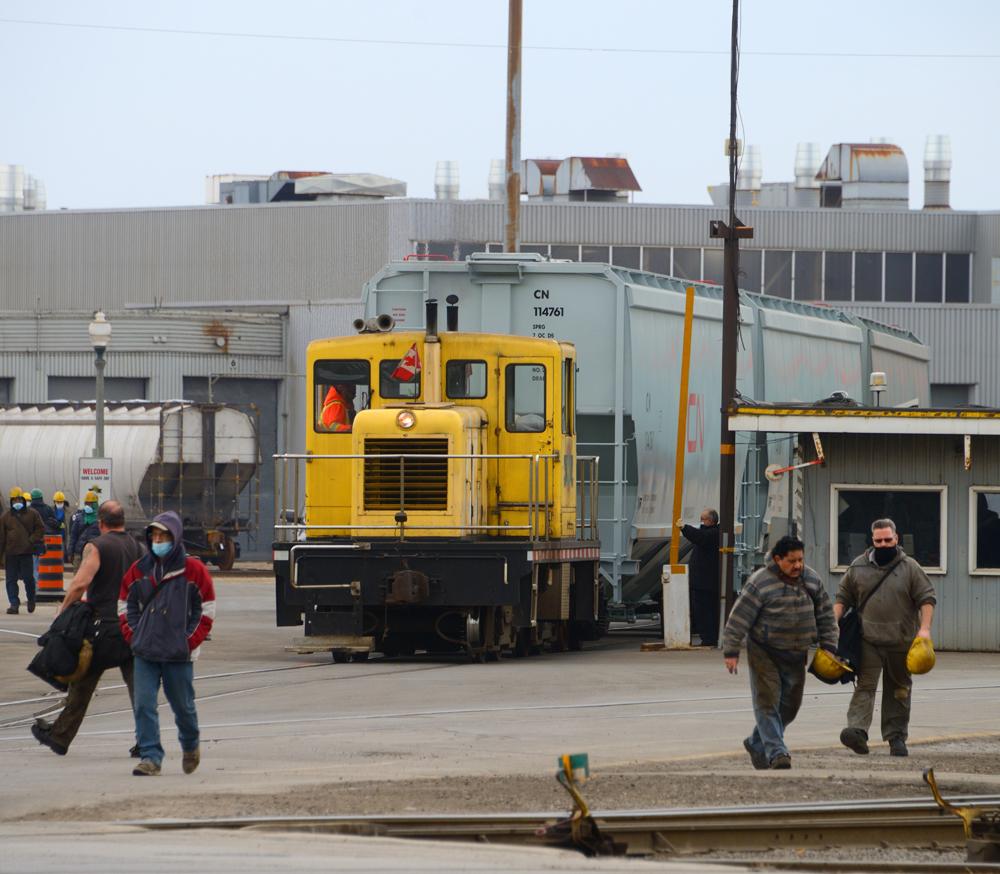
Rail operations are continuing safely under the plan, CN officials said in a press release. The plan allows the company to maintain a normal level of safe rail operations across Canada and serve its customers for as long as required, they said.
Following the IBEW's rejection of CN’s latest offer, CN Executive Vice President and Chief Operating Officer Rob Reilly sent a letter to all employees represented by the union to inform them of CN’s latest offer. The letter is available here.
"While the company is disappointed with the current situation, CN remains committed to finding a resolution and it continues to encourage the IBEW to end its strike through an agreement or through binding arbitration," CN officials said.
|
|
(Editor's Note: The "action" by NJT locomotive engineers represents a giant step forward, a display of the deep anger and discontent among the rail workforce.) |
|
Judge Bars NJ Transit Engineers From Future Strikes |
|
New Jersey Transit locomotive engineers are temporarily barred from creating any future strikes after 481 of them called out of work over the weekend.
Locomotive engineers called out at "unusually high numbers" June 18-19, causing hundreds of trains to be canceled, reported NorthJersey.com, which covers northern New Jersey. An emergency order was issued yesterday by U.S. District Judge Christine O'Hearn ahead of a hearing scheduled for tomorrow in Camden.
The engineers are members of the Brotherhood of Locomotive Engineers and Trainmen. While employees are prohibited from instigating any work stoppages, those who continue to miss work without a legitimate reason could face discipline, fines or jail time.
The work stoppage occurred because the engineers were not receiving holiday pay for Juneteenth yesterday, according to an email from BLET General Chairman James Brown sent June 13. The email encouraged union members to observe the holiday. On June 17, NJ Transit filed a complaint in federal court after discovering the plans to call out, NorthJersey.com reported. The mass call-out aimed to put pressure on the transit agency during collective-bargaining negotiations.
On June 17, 205 engineers did not show up to work, while another 143 called out on June 18 and 133 on June 19.
NJ Transit's contracts with all 15 transportation unions expired Dec. 31, 2019. All unions, except for BLET, have agreed to new collective bargaining agreements, which allowed employees to observe Juneteenth as a paid holiday. Juneteenth became a federal holiday last year.
NJ Transit and BLET have engaged in mediation since 2020, but the union requested a release in March 2022, which has not yet been approved by the National Mediation Board.
|
|
Canadian Railcar Manufacturer Faces ‘Critical Injury’ Cases in Addition to Series of Seaths |
|
HAMILTON, Ontario — Railcar manufacturer National Steel Car, the target of worker protests last week after a third employee death in 21 months, is also facing charges over two “critical injury” cases, the Hamilton Spectator newspaper reports.
Welder Quoc Le, 51 died June 6, reportedly after the fall of a 2,000-pound metal bulkhead. That led to a rally by members of National Steelworkers Local 8135, asking for police to open a criminal negligence investigation as well as a safety review by the Ministry of Labour [see “Workers protest after employee death …,” Trains News Wire, June 10, 2022].
In an email to the Spectator, lawyers for the company said it was “irresponsible for the union to issue such a statement without any information to support such serious allegations” and argued the newspaper should not report the request.
Previous workplace deaths at National Steel Car involved crane operator Fraser Cowan in September 2020 and painter Collin Grayley in April 2021. The newspaper has also found that the company is facing two occupational health and safety charges from a March 2021 incident for failure to ensure required safe lifting measures and to provide instruction and supervision to workers, in an incident involving a worker assisting a crane operator. It also faces three charges from an unspecified August 2109 incident which alleges the company failed to provide information or instruction about working near an open pit and failing to acquaint a worker or supervisor about hazards in the workplace.
The office of the provincial labour minister said in a statement that the province has issued 78 orders or requirements for the company since June 2021, but would not reveal details.
|
|
(Editor's Note: The latest in the ongoing war between Amtrak and NS/CSX over resumption of Gulf Coast passenger rail service. The freights got mediation, Amtrak got the right to see the data. This might just make for a breakthrough.) |
|
STB Grants Amtrak Access to NS, CSX Data, Orders Mediation |
|
WASHINGTON — The Surface Transportation Board will allow a limited number of Amtrak personnel access to raw train data used by CSX Transportation and Norfolk Southern so the passenger operator can run its own Rail Traffic Controller capacity modeling study.
In a decision issued Friday, the STB also ordered board-sponsored mediation to address the differences between Amtrak, CSX, NS, and the Port of Mobile.
As a result of the ruling on the data, submission of supplemental evidence by all parties, a precursor to resuming the long-running hearings on Amtrak’s effort to launch passenger service between New Orleans and Mobile, Ala., was pushed back a month, from June 13 to July 13, 2022.
Amtrak had opposed mediation, while the railroads had asked for the evidentiary hearing process be put on hold while it took place [see “CSX, NS again ask for mediation …,” Trains News Wire, May 26, 2022]. The passenger operator, meanwhile, sought to have the STB compel the railroads to release system data covering routes far removed from New Orleans-Mobile [see “CSX, NS call Amtrak request …,” News Wire, June 1, 2022]. Sensing irreconcilable differences on the exchange of information, the board took a middle ground by ordering a 30-day mediation period, but “will not hold the underlying proceeding in abeyance during the pendency of the mediation.”
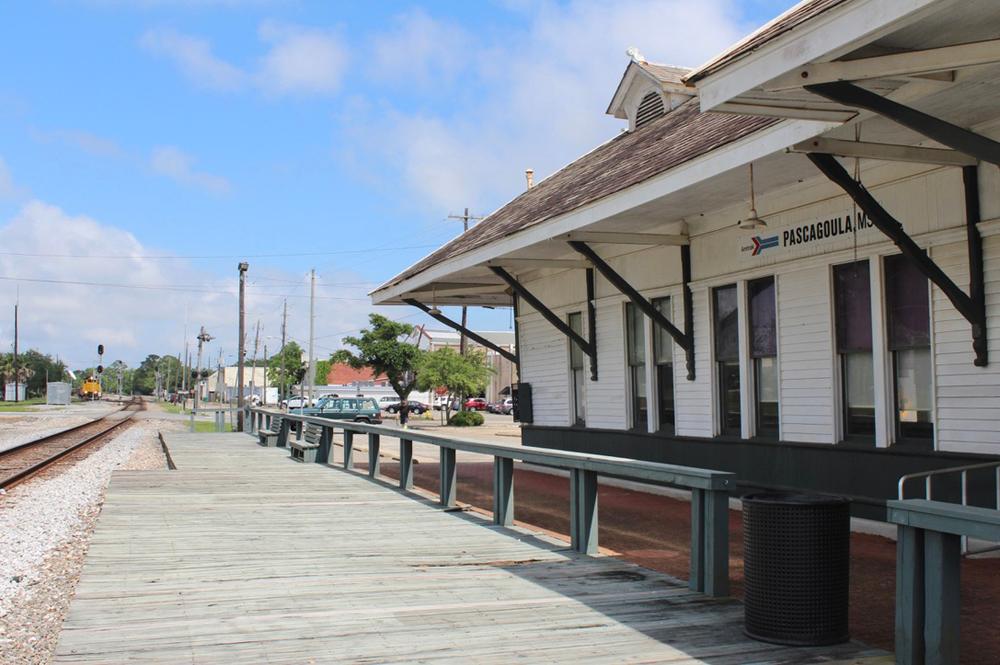
A Pascagoula station sign, dating from the 1980s when a single daily New Orleans-Mobile round trip first operated, awaits new information. (Bob Johnston)
In the most recent of 11 days of hearings on the Gulf Coast case, STB Chairman Martin Oberman and other board members repeatedly expressed frustration about information received from both camps. They say they have not received the information needed to help them decide whether adding two Amtrak round trips between New Orleans and Mobile would “unreasonably impair” CSX, NS, and Port of Mobile rail operations — the regulatory standard which would prevent the start of passenger service
|
|
NTSB Determines Cause of Union Pacific Derailment in Tempe, Ariz. |
|
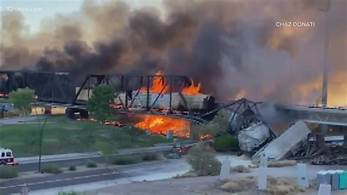
The National Transportation Safety Board released its completed investigation report on a Union Pacific derailment that occurred nearly two years ago. The derailment cased a hazardous material release and fire.
On July 29, 2020, about 6:06 a.m. local time, a northbound Union Pacific Railroad (UP) freight train, MTUPX-29, derailed 12 railcars at the south end of the railroad bridge over Tempe Town Lake on UP’s Phoenix Subdivision in Tempe, Arizona. At the time of the derailment, train MTUPX-29 was a mixed freight train consisting of 3 locomotives and 97 railcars. One of the derailed railcars struck the bridge structure, and part of the bridge collapsed, dropping railcars and bridge structure onto Rio Salado Parkway below and temporarily shutting down the road. Five of the derailed railcars were DOT-111 tank cars carrying various hazardous materials.[2] Two of these tank cars, both carrying UN1915 cyclohexanone, a flammable hazardous material, fell from the bridge during the derailment; the rest remained in-line with the track. One of the fallen DOT-111 tank cars released about 2,200 gallons of cyclohexanone, creating a pool of hazardous material below the damaged bridge. The cyclohexanone did not ignite, and no other tank cars were breached. Derailed lumber cars, which remained on the bridge, caught fire during the derailment. Some lumber fell onto and near the road, where it burned for several hours. (See figure 1.) There were no fatalities; one firefighter was treated for smoke inhalation at the scene. UP estimated the damage costs to be about $485,000 for railroad equipment, $435,000 for track and structures, and $10 million for the bridge.
|
|
NTSB Releases Findings in Two Rail-Worker Fatality Cases |
|
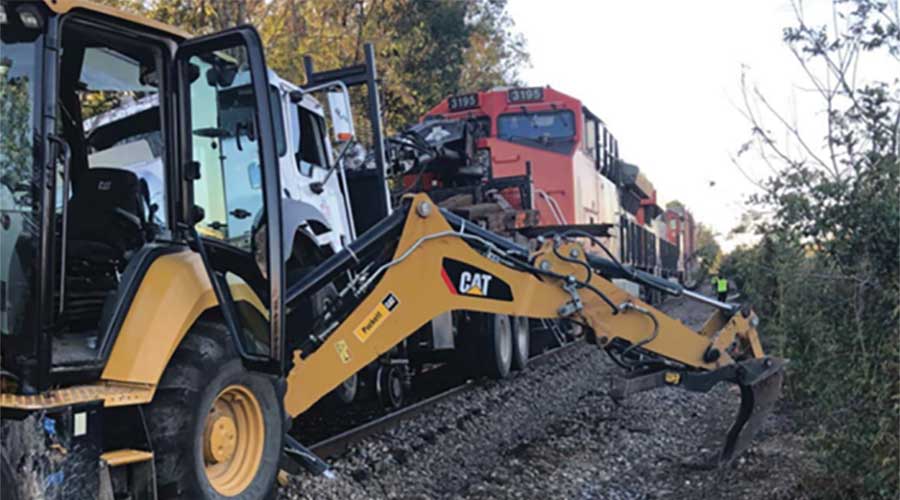
The Alabama accident occurred Nov. 17, 2020, when a CN train operated by an Alabama Export Railroad engineer collided with on-track maintenance equipment. As a result, one contractor was killed and three were injured.
The agency determined the accident's probable cause was the failure of the engineer to operate his train in accordance with restricted speed requirements and stop before colliding with the equipment because he was engaged in the prohibited use of a personal electronic device.
The Missouri accident occurred April 7, 2021, when a BNSF Railway Co. conductor was killed while dropping off and picking up rail cars near the Dyno Nobel Inc. industrial facility. In its report, NTSB officials determined the probable cause of the conductor’s death was the result of being impacted by the moving rail cars during a shoving movement while located in an area with insufficient walking space available for the employee to perform trackside duties.
NTSB officials remain concerned about the number of rail employee deaths and injuries. Last year, the agency added rail worker safety to its list of 2021-2022 Most Wanted List of Transportation Safety Improvements. Since 1997, when the Federal Railroad Administration implemented rail worker safety regulations, there have been 466 railroad employee fatalities and 134,850 injuries.
|
|
Rail Strikes: Anger as UK Government Refuses to Join Last-Ditch Talks |
|
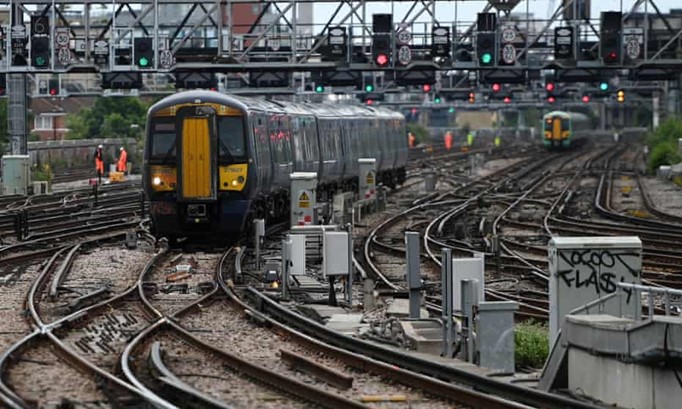
The government is facing growing anger over its refusal to join last-ditch talks to avert the biggest rail strike for three decades, with millions of people facing a week of cancelled trains and union leaders saying industrial action could spread.
With 40,000 rail workers due to join three daylong walkouts this week, Grant Shapps, the transport secretary, insisted it was not the government’s job to negotiate with the unions over pay, conditions, job cuts and safety.
But Jake Berry, a Conservative MP and former rail minister, was among those who said ministers should get around the table with Network Rail – which is government-owned – train operators and the unions.mLabour demanded ministers drop the boycott of talks, which continued on Sunday in a bid to bring the threatened action to a halt.
The Trades Union Congress (TUC) also called on the government to adopt a positive role in the rail dispute instead of “inflaming tensions”. “The government has the power to help end this dispute,” said Frances O’Grady, the TUC general secretary.
The strike is due to start on Tuesday, followed by further strike days on Thursday and Saturday, with RMT union members walking out. Because of knock-on disruption, a special timetable will be in operation from Monday, with some evening services curbed, until Sunday. About 20% of trains will run on mainlines and urban areas.
The RMT and Unite are also holding a separate 24-hour walkout for London Underground workers on Tuesday, which will cause huge disruption to the tube.
|
|
|
|
|
|
|