Family, Church, School - A Cord of Three Strands

August 2024

Dear Parents:


Once a month, you can expect a letter from a member of our administrative leadership team that addresses a topic germane to our PreK-12 community. The purpose of these letters is to share topics and issues relative to your investment in a Christian education, thereby helping to strengthen the bond between home and school.


Critical to the holistic approach of your child’s development is the triad of home, school, and church (a “cord of three” - Ecclesiastes 4:12). While the majority of a child’s waking hours are spent at home and in school, the inclusion of the church is essential for a student’s spiritual, moral, emotional, and social development. The church has been strategically placed in a position of great importance within our communities to do His work, and the importance of helping your child identify their spiritual gifts is critical to ensure they become an active participant and not an observer in your church body.

During preplanning, I shared a presentation with the faculty and staff that highlighted the synergy created by this cord of three to illustrate how this triad’s whole is stronger than the sum of its individual parts. The presentation was also accompanied by a warning that without this network of support, students are more susceptible to the pluralistic influences of today’s post-modern society.


Secular education openly encourages students to explore and formulate their own opinions on moral conduct based on what society deems as socially acceptable. As believers, we can see this is a dangerous path. Not surprisingly, 83% of self-professing born-again teenagers report they embrace relative morality with the justification that decision-making should be based upon doing whatever feels right (Pew Research, 2020).

Today, many Christ followers are labeled as socially disconnected for upholding biblical truths that have sustained communities for millennia, and litigious efforts to force Christians to privatize their faith and remove it from the public square are legion. These factors, combined with Americans’ often exhaustive work schedules, can create situations where parents unknowingly begin to embrace secular practices camouflaged in the fabric of today’s society.


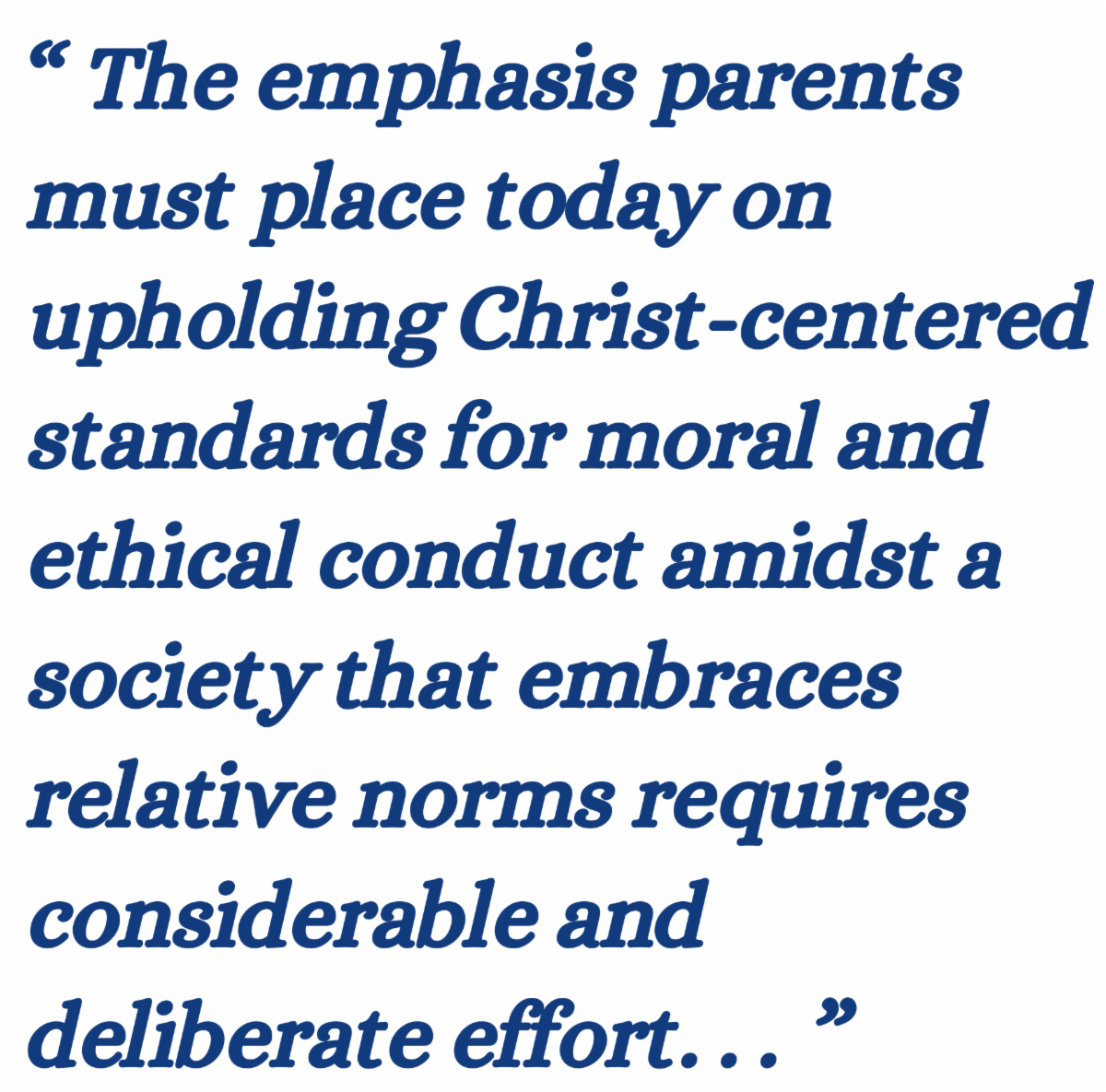
The emphasis parents must place today on upholding Christ-centered standards for moral and ethical conduct amidst a society that embraces relative norms requires considerable and deliberate effort; I commend you for this commitment. The depth of the chasm between what society regards as morally acceptable and what is defined in God’s word is growing at an exponential rate. From the Supreme Court’s rulings in 1962 and 1963 that eliminated prayer, reading the Bible, and hanging the Ten Commandments in public schools to today’s rapidly expanding case law relative to bathroom choices tied to student gender identification, parents are ultimately accountable to God for their child’s education (Deut. 6:7-9, 11:19; and Ephes. 6:4). Thankfully, your investment in a distinctly Christian education helps ensure a consistent moral message is being taught to your child at home, at church, and in school.


Each day, as I enter my office, I have the privilege of seeing the school’s mural of Romans 12:2, which reads, “Do not conform to the pattern of this world, but be transformed by the renewing of your mind.” Our partnership between family, church, and school provides a cord of three that strengthens the process of preparing tomorrow’s leaders for Christ.


In His service,


Col Seth A. Hathaway, Ed.D.

Head of School

Twitter: @PACS_Head

Instagram: @pacsheadofschool


Reference Pew Research Center (2020). Religious Beliefs Among American Adolescents.