|
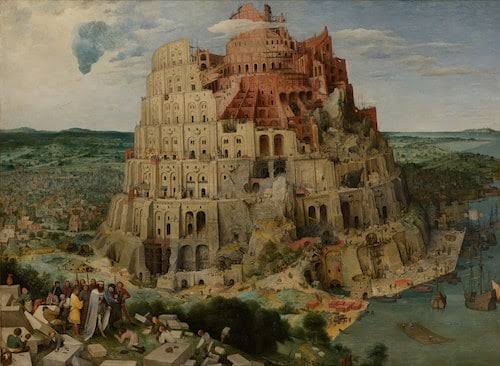
The Torah portion of No’ach tells the story of the Tower of Bavel which led to the formation of the 70 ancient languages of the world.[1] This article explores how this story led to those languages.
Hebrew Was the Original
Ancient Hebrew (lashon hakodesh) was original language with which G-d created the world and was the spoken language of humanity until the Tower of Bavel. This can be inferred from the fact that the name Adam is related to the Hebrew word for earth - adamah,[2] Chava was so named because she was the mother of all living things (chai)[3] and Kayin was so named because he was acquired (kaniti) with the help of G-d.[4] These linguistic connections only exist in Hebrew.[5]
What Was their Sin?
There are many different opinions as to the precise sin of those who build the Tower of Bavel. Here are some of them:
· Humanity Shouldn’t Be Too Concentrated
According to Ibn Ezra and Ralbag the people committed no sin at all. They simply wanted to all live comfortably in the fertile valley of Babylon and they built a tower to remain united around it. G-d dispersed them because He wants humanity to be spread out across the world to ensure that they not be wiped out by a natural disaster such as a flood, earthquake or a hail storm. According to this opinion it’s possible that No’ach and Shem participated in building this tower.
The Ohr HaChaim adds that, the Almighty, for reasons known only to Him, wanted humanity to spread out and inhabit the entire world. As He commanded Adam; “Fill the world and conquer it.”[6] Similarly, G-d said to Noa’ch (after the flood), “And now be fruitful and multiply, spread throughout the earth and multiply on it.”[7] (This may have to do with the Kabbalistic concept that we need to elevate the sparks of holiness which are spread throughout the world.)
· Fighting with the Almighty
According to Rashi (based on the Midrash), they wanted ascend to Heaven and make war with G-d. The Gur Aryeh adds that they built the tower with occult knowledge in order to channel the forces of nature to their benefit despite not being deserving of such benefit.
· Trying to Tap into Divine Blessings
The Alshich explains that they wanted to divert the Divine blessing and beneficence that was destined to go to the Jewish people, to themselves. They attempted this by living in unity and harmony, a prerequisite for Divine blessing, and by building a tower that corresponded to what would later be the Beit HaMikdash. Since they weren’t deserving of His bounty, G-d disrupted their plan by sowing disunity among them. He didn’t destroy them as He had done to the generation of the flood because of the fact that they were living in harmony.
· Focusing on the Physical
According to Abarbanel their sin was that, instead of spending time with spiritual, Heavenly pursuits, they focused on physical accomplishments. Although they hadn’t sinned per se, it was a continuation of the attitude of the hedonistic attitude of the generation of the flood. They, in turn were following the attitude of Kayin who chose to be a farmer and focus his energy on earthly matters rather than be a shepherd (like his brother Hevel) who has time to pursue more sublime goals. The sin that led to all of these was that of the Tree of Knowledge in which Adam and Chava sought a mundane pleasure instead of focusing on Divine service.
· Tried to Kill Avraham
Rabbi Naftaly Tzvi Berlin says that they tried to kill Avraham by throwing him into the fiery furnace which they had made to make their bricks.
How Did the Language Change?
The verse states that G-d said (to the angels),[8] “Let us descend and jumble their language, that they will not understand one another’s language.” The commentaries offer differing explanations as to how this change of language took place.
1) Composed the Language Themselves and then Moved
Some say (quoted in Abarbanel) that each family composed a separate language for themselves because they had started to hate each other and wanted to become more insular.
Similarly, the Ran says (quoted in Abarbanel) that G-d made them forget their shared language thereby forcing them to come up with individual languages which caused them to spread out to different areas. On a slightly different note, the Ralbag writes that G-d caused each family to feel more tribal and to compose their own language which led to each of these families deciding to move to a different area.
2) Moved and then Composed the Languages
According to Ibn Ezra the people first moved away from each other and then, due to their geographical distance, formed different languages in their separate countries.
3) 70 Cultures that go with the 70 Languages
The Abrabanel explains that the 70 languages stem from the 70 different cultures of the 70 distinct nations of that era. At that time each nation received a distinct archangel through which their Divine energy flows. G-d caused humanity to splinter into these different cultures which naturally led to each culture speaking a different language.
4) The Languages Preceded the Story
According to Rabbi Yosef Bechor Shor, the 70 languages preceded the story of the Tower of Bavel. What changed is that, originally, all of the people in the world understood all of the languages. As a result of the building of the Tower of Bavel, G-d caused each of the nations to forget the languages of the other nations and retain only their own, thus causing their dispersion.
Who Were the 70 Nations?
The 70 nations of the ancient world (each of whom had their own language as explained above) were the families of several generations of the descendants of Shem, Cham, and Yefet, the sons of No’ach. The list includes many ancestors and their descendants. As such, it seems that these ancestors had additional children besides those in this list, which is why the ancestors are considered to be the founders of separate nations.[9] Here is the list as enumerated in the 10th chapter of Genesis (see the Stone edition Chumash, page 47).
The following 14 nations were descendants of Yefet:
1) Gomer (Cimmerians?) 2) Magog 3) Madai (Media) 4) Yavan (Greece) 5) Tuval (the Tiberani?) 6) Meshech (possibly the Mushki in Georgia) 7) Tiras (Persia) 8) Ashkenaz (Germany) 9) Riphat (possibly the Paphaplgonians in ancient Anatolia) 10) Togarmah (Armenia?) 11) Elishah 12) Tarshish (this may refer to Sardinia, an island in the Mediterranean) 13) Kittim (Cyprus?) and 14) Dodanim (these may be the people of the island of Rhodes)
The following 31 nations were descendants of Cham:
15) Cush (Ethiopia) 16) Mitzrayim (Egypt) 17) Put (Lybia) 18) Canaan 19) Seva (may be in the area of Sudan) 20) Chavilah (son of Cush) 21) Savtah 22) Ra’amah 23) Sav’techa 24) Nimrod or the Philistines 25) Sheba (son of Ra’ama) 26) Dedan (may be associated with (Al-‘Ula, Saudi Arabia) 27) Ludim 28) Anamim 29) Lehavim (also associated with Libya) 30) Naphtuchim 31) Patrusim (Pathros was a city in ancient Egypt) 32) Kasluchim (affiliated with the Philistines) 33) Kaphtorim (possibly from Crete) 34) Sidon (a city in Lebanon) 35) Chet (the Hitites) 36) Yevusites (one of the peoples of the land of Canaan) 37) Emorites 38) Girgashites (they left Canaan before the Jewish people conquered it) 39) Chivites 40) Arkites (they may be associated with the city of Arqa in ancient Lebanon) 41) Sinites (Chinese?) 42) Arvadites (may be connected to Arwad, an island off the coast of Syria) 43) Zemarites (may be from the Phoenician city of Sumur) 44) Hamatites (Hamat is a city in Syria)
The Last 26 Are Descendants of Shem:
45) Elam (a city in Southwestern Iran) 46) Asshur (Assyria) 47) Arpachshad (the Chaldeans?) 48) Lud (the Lydians of Western Turkey) 49) Aram (in the area of Syria) 50) Uz 51) Chul 52) Geter 53) Mash (might be the people of the Zagros Mountains between Iran and Iraq) 54) Shelach 55) Ever (the Jewish people descended from Ever) 56) Peleg 57) Yoktan (associated with the people of Southern Arabia) 58) Almodad 59) Sheleph 60) Chatzarmavet 61) Yerach 62) Hadoram 63) Uzal 64) Diklah 65) Yuval 66) Avima’el 67) Sheva (son of Yoktan) 68) Ophir 69) Chavilah (son of Yoktan) and 70) Yovav.
May We Unite in Harmony to Serve Our Father in Heaven!
[1] Gen. 11:1 – 9.
[2] See Ibid. 2:7 with commentaries.
[3] Ibid. 3:20.
[4] Ibid. 4:1.
[5] Ibn Ezra on ibid. 11:1.
[6] Ibid. 1:28 (Bechor Shor).
[7] Ibid. 9:7 (Ha’amek Davar).
[8] Gen. 11:7.
[9] This is difficult to say regarding Ever about whom the verse says (Gen. 10:25) “Two sons were born to Ever… Peleg… and Yoktan.” This seems to indicate that he only had two sons. Yet he is listed as a separate nation besides the nations of those two sons.
Wishing you a Shabbat Shalom UMevorach!
|