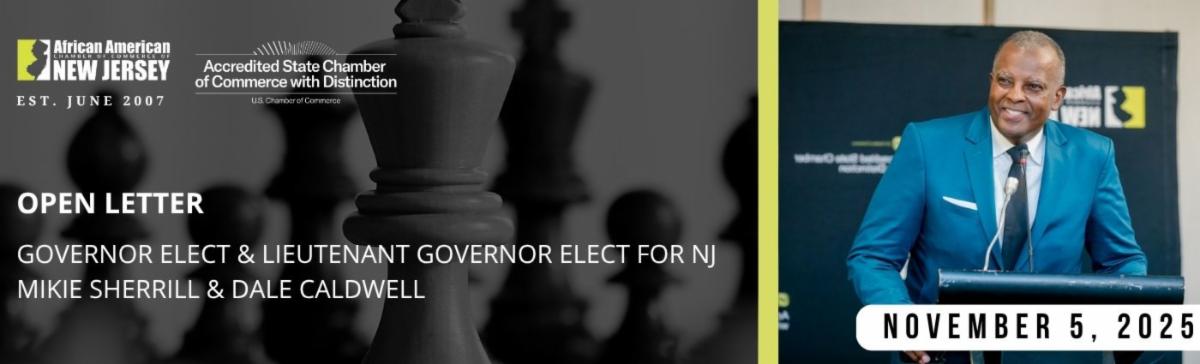
Dear Governor-Elect Sherrill and Lieutenant Governor-Elect Caldwell, | | |
On behalf of the Board of Directors, staff, and members of the African American Chamber of Commerce of NJ (AACCNJ), we extend our sincere congratulations on your recent electoral victory.
This is a tremendous opportunity to lead our state toward a more equitable future and directly address the economic disparities, issues, and concerns of the ninety-four percent of Black New Jerseyans whose support propelled you to a double-digit victory.
Black people have consistently delivered for the Democratic Party when called upon, and this time was no different. We approached this gubernatorial contest seeking to collect on the check that remains unfunded, a sentiment rooted in the quote from the late Dr. Martin Luther King, Jr. Throughout this contest, we sought clarity on how Black New Jerseyans would benefit once a winner was declared, given our systemic underperformance in the state's economy due to a lack of equitable inclusion.
Now, as you and the Democratic Party have been overwhelmingly declared the winner, the 1.2 million Black residents and over 124,000 Black businesses in New Jersey are seeking a substantive relationship with the incoming administration. Our goal is to mitigate the many systemic challenges that Black communities have endured over the years, including:
- Access to well-paying career opportunities
- Homeownership opportunities
- Prime contract opportunities
- Equitable healthcare access
- Public safety measures that align with mainstream New Jersey
- Access to educational modules that improve outcomes and position young and seasoned Black residents for a better life
| | |
These are the core areas where the AACCNJ would like to partner with the Sherrill Administration. Black voters put their trust in you, and now is the time to immediately reengage to deliver impactful outcomes.
We must confront the current socioeconomic standing in New Jersey, where, according to recent data, Black residents are positioned at the bottom of the economic hierarchy, following Asians, Whites, and Hispanics. This disparity is sharply highlighted by the staggering wealth gap: the median net worth of Black households is just $17,000, compared to $322,000 for white households, and Black homeownership stands at forty percent versus seventy-six percent for whites in the state.
These inequities are sustained by systemic factors, including discriminatory lending practices, limited generational wealth transfer, and unequal access to high-paying jobs. Consequently, Black communities in New Jersey experience the highest poverty and unemployment rates in the state, creating a cycle of economic disenfranchisement that urgently demands targeted policy interventions and equitable investment.
Our collective goal must be to achieve more equitable participation for Black New Jerseyans in the state’s economy, whether through careers, business ownership, or other avenues that increase annual income. Attaining this equity will enable our community to better afford homes, pay for healthcare, address inflationary pressures, and minimize the impact on disposable income.
| | |
Furthermore, we must address the severe disparity revealed in the public contracting study: over a five-year period in New Jersey, Black businesses received only 13 contracts totaling $3.3 million. In stark contrast, white women received 250 contracts totaling $277 million, and white men were awarded 2,500 contracts totaling $10 billion. This profound disparity in public contracting must be rectified.
We look forward to working collaboratively with you, as we have with past administrations—both Republican and Democratic—to build a stronger and more prosperous state for all citizens and to ensure that these critical economic equity goals are met.
We would also like to extend a special thanks to Mayor Ras J. Baraka and Marilyn Davis and others for their collective efforts in deploying strategies to leverage the votes of black women and men, which contributed to your successful run for Governor and Lieutenant Governor of New Jersey.
| | |
Sincerely,
Dr. John E. Harmon, Sr., IOM
Founder, President & CEO
African American Chamber of Commerce of NJ
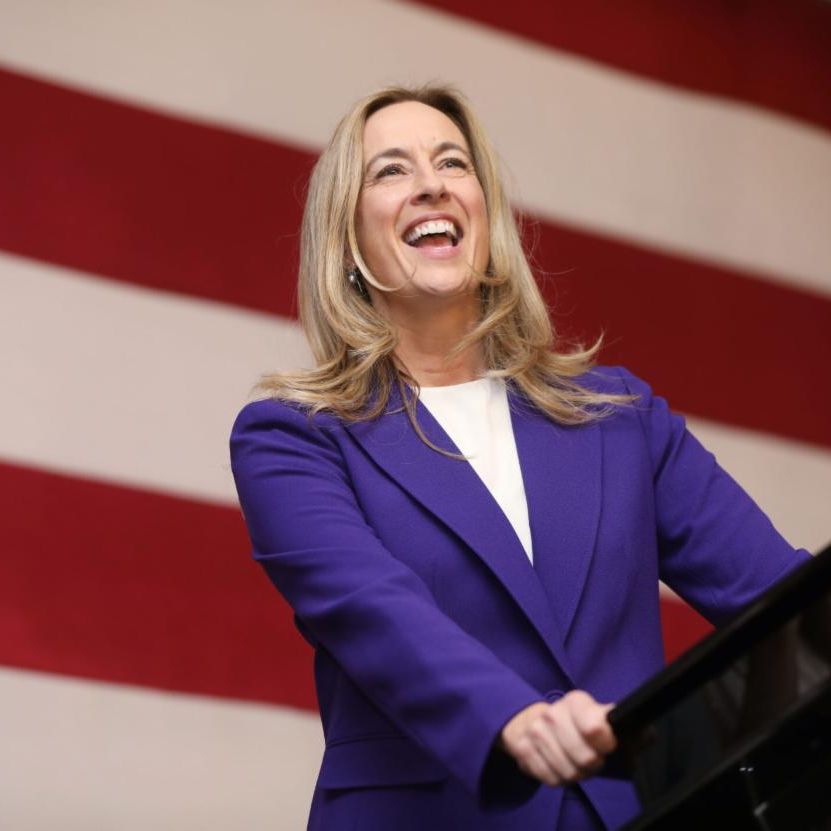
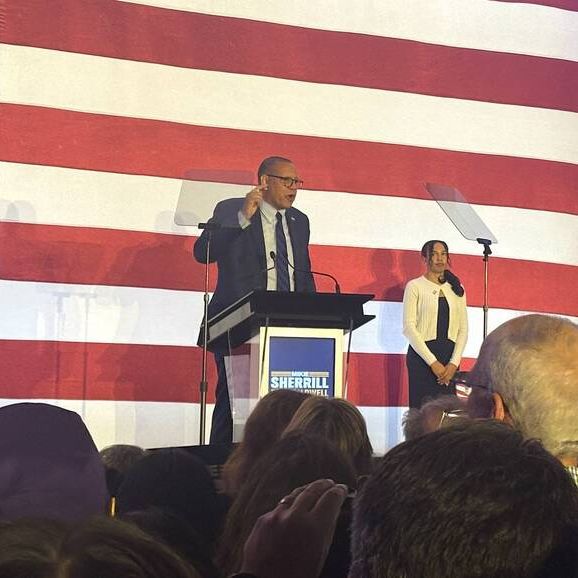
| | Gov.-elect Mikie Sherrill (D) makes her victory speech in front of supporters at the Hilton East Brunswick on Nov. 4, 2025.
(Photo by Amanda Brown for New Jersey Monitor) | | Lieutenant Governor Elect - Dr. Dale Caldwell | | |
https://www.nj.com/politics/2025/11/democrats-flip-6-nj-counties-back-to-blue-cementing-sherrills-sweep-for-governor.html
STATISTICS - Voter Turnout, Counties, and General Assembly Races
Democrats will expand their membership from 52 to 55 members, with the potential to have 57 members based upon leads in two other races that are too close to call.
About 3.2 million registered voters cast ballots statewide, which is a record turnout historically. By comparison, turnout was 2.1 million when Governor Murphy won his first term in 2017, and about 2.6 million votes were cast in the 2021 gubernatorial election. Governor-elect Sherrill and Lt. Governor-elect Caldwell carried 14 of New Jersey’s 21 counties, including Mr. Ciattarelli’s home county of Somerset by about 18 percentage points. As compared to his 2021 campaign where he lost to Governor Murphy by 3 points, Mr. Ciattarelli carried fewer counties (losing Gloucester Atlantic, Morris, and Cumberland), and his comparative margin of victory was generally smaller in those counties that he won.
As for the General Assembly, the most anticipated competitive races were safe Democratic wins. In Legislative Districts 3 (Gloucester, Salem, Cumberland Counties) and Legislative District 8 (Burlington and Atlantic Counties), the incumbent Democrats won by several percentage points, and Democrat Anthony Angelozzi defeated incumbent Republican Michael Torrissi to pick up the second Assembly seat in District 8. Other legislative races that Republicans expected to be competitive, specifically those in District 11 (Monmouth County), District 16 (Hunterdon, Mercer, Middlesex and Somerset Counties) and District 38 (Bergen County), failed to be close with the Democratic incumbents winning by at least 5 points in each race. Republicans also considered Democratic Assemblyman Avi Schnall in Legislative District 30 to be vulnerable, but that proved incorrect with him easily winning reelection.
The large Democratic voter turnout propelled other Democratic Assembly candidates to victory over the Republican incumbents. In Legislative District 21 (Middlesex, Morris, Somerset, and Union Counties), Democratic challengers Andrew Macurdy and Vincent Kearney defeated Republican incumbents Michele Matiskoudis and Nancy Munoz by 5,000 votes. In Legislative District 2 (Atlantic County), incumbent Republican Claire Swift will likely lose reelection as she currently trails her Republican running mate and both Democratic challengers. Democrats may also pick up a seat in Legislative District 25 (Morris and Passaic Counties), where Democratic challenger Marisa Sweeney leads incumbent Republican Assemblyman Christian Barranco by 155 votes (one-tenth of a percent). It is expected the races in Districts 2 and 25 will be officially called in the next several days.
| | | | |