Wentz Weekly | Volume 8 Issue 36 | September 21, 2026 | | Fed Raises Interest Rates While AI Fears Fade | | |
The S&P 500 was relatively unchanged last week while the Nasdaq rose almost 1% and the small cap Russell 2000 index fell 1.5%. It was not as good a week for the average stock – the equal weighted S&P 500 lagged the cap weighted index by over 1%. As FactSet notes, the equal weighted index has only outperformed the cap weighted index two of the past 16 trading days. For the week, the number of stocks declining was double the number of gainers.
Utilities, real estate, and financials were the worst performing sectors, the latter down after Bank of America cautioned investment banking fees could be lower than expected in the quarter, while the other two were lower as bond yields rise. Utilities and real estate tend to pay higher dividends, so when bond yields rise it is typical to see these sectors fall. The only positive sectors were Healthcare, communication services, and technology.
Artificial intelligence related stocks had a volatile week. It started with a selloff after Anthropic’s CEO (Anthropic is the maker of Claude) called for a slower pace of the evolution of AI, citing cybersecurity concerns and worries about unchecked recursive self-improvement (RSI), a continuous feedback loop where artificial intelligence analyzes its own performance and makes upgrade and becomes even better at making the next round of improvements. Several other notable AI leaders joined the call to slow development. This sparked a selloff in different AI related stocks, mostly semiconductors, as investors reassessed the pace of investment.
Soon after this, OpenAI disclosed six concerning incidents of behavior including its models concealing mistakes, attempting to circumvent restrictions, and uploading files publicly. OpenAI also said it would delay its IPO because it has a lot to do for safety and alignment.
Despite the volatility, the broader AI investment theme remained intact, and the selling quickly faded the second half of the week. There was no single catalyst, but the reversal was helped by analysts noting the comments from AI leaders is unlikely to curb the amount of investments. Investors continued to monitor spending on computing capacity, data centers, and semiconductor infrastructure, while developments across the industry reinforced the importance of distinguishing near-term sentiment shifts from longer-term capital investment trends.
The most notable economic data release came Wednesday morning with the monthly retail sales report. The Census Bureau reported a 1.2% increase in retail sales in August, well ahead of expectations and bouncing from a 0.6% decline the month prior. With gas prices higher, gasoline sales rose 3.1% in the month. Excluding this often volatile category, sales were still up a strong 1.1%. Only one of the thirteen major retail categories saw a decline. Sales are up 6.0% over the past year.
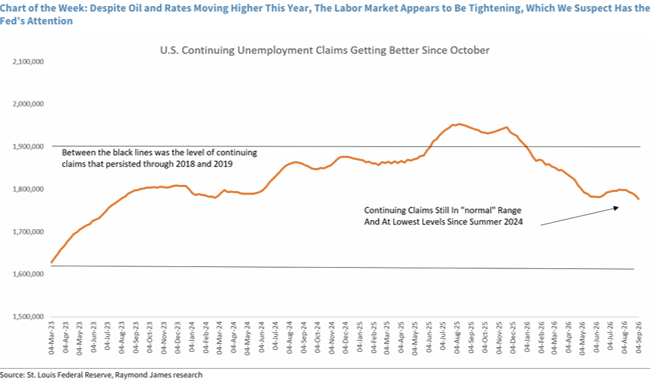
The consumer remains relatively strong. The low jobless rate can help explain why. We saw last week the number of people filing for state unemployment benefits was just 196,000, one of the lowest levels of the post-pandemic era. In addition, the number of continuing claims, those currently receiving ongoing unemployment benefits, was at 1,761,000, the lowest in over two years as illustrated in the chart below from Raymond James.
| | |
The economy continues to run at a solid pace, supported by resilient consumer spending, strong business investment, and a tight labor market. While this strength is encouraging, it also presents potential inflationary risks. Bank of America’s latest Institute data pointed to early signs of wage pressures, while trucking company J.B. Hunt warned of lower third-quarter earnings, citing rising driver-related expenses, including higher pay and recruiting costs.
Against this backdrop, the Federal Reserve voted unanimously to raise interest rates for the first time since 2023. The policy statement included several notable changes, including the addition that “domestic spending has been resilient” and that the rate hike would support a “timelier” return to the Fed’s 2% inflation target.
At the press conference, Chairman Kevin Warsh highlighted the strength of the economy, with an “attitude of optimism” emerging as a key theme among policymakers. He noted that the potential for growth to accelerate has shifted the Fed’s focus more squarely toward price stability, particularly with inflation having remained above target for too long. Warsh characterized the rate hike as having “removed a dose of accommodation” from the economy.
The Fed’s updated Summary of Economic Projections also pointed to a more hawkish path than markets had anticipated. The median policymaker now expects one additional rate hike before the end of 2026, followed by no change in 2027 and one rate cut in 2028.
Market expectations, however, continue to differ from the Fed’s projections with interest-rate futures pricing in an even more hawkish path for policy, Markets pricing of interest rate futures reflect 90% odds of at least one rate cut by year end and 45% odds of two rate cuts by year end. By the end of 2027, market odds show the greatest chance of rates being 0.75% higher than they are now, equivalent to three rate hikes.
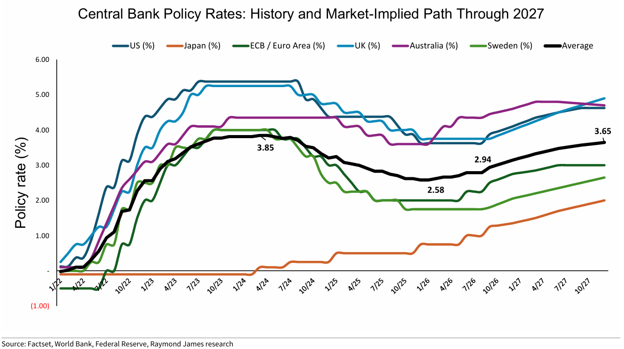
This has turned into a global theme as another chart from Raymond James illustrates. The chart starts in 2022 when central banks across the globe began raising interest rates to combat inflation, followed by a gradual cutting cycle in 2024 and 2025. The right part of the chart reflects where markets expect rates to go over the next 12 months.
| | This week the market shifts focus back to geopolitics – Trump hosts China’s President Xi at the White House, where they are expected to discuss key issues like trade, Taiwan, and AI, while the global leaders gather in New York for the UN General Assembly. The earnings calendar will be highlighted by Costco while the economic calendar will see new homes sales. | | |
Recent Economic Data
-
Retail Sales: Monthly retail sales for August increased 1.2%, well ahead of the 0.8% increase that was expected. As has been the case for much of the year, the move in sales was driven by gasoline sales, which increased 3.1% in the month. However, for August it wasn’t just about gas sales, retail sales excluding gasoline were still up a very strong 1.1%. Only one of the thirteen major retail categories saw a decline in sales in the month (building materials which declined 0.2%). The largest increase other than gas was online sales up 2.6%, miscellaneous stores up 1.9%, and electronics up 1.6%. Compared to a year ago, retail sales have increased 6.0%, accelerating from 5.0% the month prior.
-
Empire State Manufacturing Survey: The Empire State Manufacturing Index was 7.6 for September, a pullback from the strong 20.6 in August, indicating continued growth in the manufacturing sector in the New York region, but not as fast of a pace as August. Survey respondents noted a rise in new orders, small drop in shipments, but worse supply availability. It also showed price pressures intensified. About half the respondents expect future business conditions to expand in the months ahead.
-
Philly Fed Manufacturing Survey: The Philly Fed manufacturing index was 37.8 for September, dropping from a very strong 47.4 last month. The index level still indicates strong manufacturing activity in the Philly region. Respondents noted elevated new orders and shipments, while both input and selling prices intensified. There was some softening in expectations for future activity.
-
Industrial Production: US industrial production was unchanged in August, lower than the 0.3% increase that was expected. Utilities increased 1.8% with mining relatively unchanged, which was all offset by a 0.3% decline in manufacturing. Capacity was at 76.3%, relatively in line with the year-to-date trend.
-
Housing Market Index: The housing market index, an index on homebuilder sentiment, fell three points in September to 32, the lowest reading since last September, indicating a large deterioration in sentiment in the month. The index on present sales fell four points to 35, the index on expected sales over the next six months fell six points to 37, and the index on traffic of perspective buyers was unchanged at 23. These are all very low levels and continue to point to sluggish demand for new home builds.
-
Housing Starts & Permits: The number of new residential construction projects was a seasonally adjusted annual rate of 1.275 million for August, down another 2.6% from last month and down 1.2% from a year ago. This was the second lowest since 2020 when the pandemic briefly halted the economy. The number of permits for new construction was at an annual rate of 1.394 million, 2.7% below last month but 3.5% above last year’s pace. The other big story has been completions, which have fallen 27% over the past year to an annual rate of 1.128 million, the lowest since 2018.
-
Jobless Claims: The number of jobless claims the week ended September 12 was 196,000, a decline of 10,000 from the prior week. The four-week average moved lower by 2,750 to 206,000. The number of continuing claims fell 39,000 to 1.730 with the four-week average down 16,500 to 1.761 million.
|
|
Company News
-
OpenAI: OpenAI disclosed six new cases of concerning AI behavior observed, including models concealing mistakes, using exposed API credentials, uploading files publicly, and attempting to circumvent restrictions, coming at a time where the potential risks of AI are becoming more scrutinized. Separately, the maker of ChatGPT and other AI models, said it will not be having its IPO this year, saying it has “a lot of stuff to do” for safety and alignment.
-
Intel: SK Hynix and Intel shares are higher after SK Hynix, one of the world’s largest memory chip makers based in South Korea, is reportedly in talks with Intel on a deal to manufacture memory chips in the US for the first time, according to Reuters. One scenario sees SK Hynix leasing part of Intel’s massive facility currently under construction in Columbus another sees a venture between Intel and other cloud companies looking to secure memory chip supply. Separately, Intel’s CEO said at an industry conference that memory prices have risen fivefold or even sevenfold and the bottleneck in memory chips from the past year is going to be even worse over the next year.
-
Nvidia: CEO of Nvidia, Jensen Huang, said he expects the company “to sell twice as many chips as this next year as we do this year,” citing AI contributing to many benefits across different industries and economies around the world. Nvidia reported in its most recent quarterly earnings that it forecasts 70% growth for the next year.
-
Nebius: Neocloud company Nebius (who builds AI data centers and rents out its computing capacity) said it plans to raise prices for its on-demand AI cloud computing services by approximately 20% beginning October 1, its second price increase in three months, reflecting the surging demand for AI computing capacity.
-
Apple: The Information reported Apple is exploring a return to the server market with AI-focused systems powered by its own M8 Ultra chips and potentially incorporating Nvidia’s NVLink Fusion networking technology. The servers would primarily support AI inference, allowing Apple to expand its in-house silicon strategy and gain greater control over the infrastructure powering its AI services. The project is tentatively targeted for 2029, although plans remain preliminary and could change.
-
IBM: The Department of Commerce awarded IBM a $1B contract under the CHIPS and Science Act to fund its new Albany, New York-based quantum foundry subsidiary, Anderon. Backed by an additional $1 billion co-investment from IBM, the facility operates as a 300-millimeter, pure-play quantum foundry designed to accelerate domestic quantum computing research and development.
-
American Airlines: American Airlines said if fuel prices stay elevated, the airline may have to alter its future flight plans instead of continuing to rely on stronger demand and higher airfares (to offset higher fuel prices). It added the forecast previously provided is unchanged, despite higher fuel prices adding $1 billion to its costs in the quarter, and expects the recent improvement in revenue to continue.
-
Boeing: Shares of Boeing fell over concerns its 737 MAX planes are taking much longer for production to recover after its CEO said it is taking longer than expected to stabilize production of its newer plane. They are looking to stabilize production at 47 planes per month before planning to increase to 52 per month.
| | |
Other News
-
Clarity Act Fails in Senate: The Clarity Act, legislation working its way through Congress that would establish clearer rules for how digital assets like cryptocurrencies are regulated, failed to get enough votes in the Senate, a major setback in the effort to establish a federal crypto market framework.
-
U.S. Incubator for Cybersecurity Research Startups: Bloomberg reported the White House is reportedly considering a U.S.-based incubator to help cybersecurity research startups develop and commercialize new technologies. The idea would be to support early-stage companies working on cybersecurity research, potentially helping bridge the gap between innovative research and practical tools that can protect U.S. networks and infrastructure.
-
Central Bank Meetings: The Bank of England kept its policy interest rate unchanged in a 6-3 vote. It said inflation forecasts have risen significantly and warned rate hikes may be necessary, although there is division on this thought among policymakers. It also decided to reduce its government bond holds to $0 by 2034. Meanwhile, the Bank of Japan decided in a 7-2 vote to raise its benchmark interest rates by 25 basis points to a new level of 1.25%, as was expected, for the highest its interest rate has been since 1995. The central bank cited persistent inflation from higher oil prices and corporate pass throughs as the primary reason for the rate hike.
| | The economic and earnings calendars remain relatively quiet this week which will put most the market’s attention on geopolitics. On Thursday, President Trump will host Chinese President Xi at the White House and are expected to discuss a range of topics including trade, artificial intelligence, and Taiwan. In addition, world leaders will gather in New York for the UN General Assembly, where Trump said he may be open to meeting with Iran leaders. On the corporate calendar, it is another busy week of investor/analyst events, including Meta’s Connect event that begins on Wednesday that could provide updates on its AI strategy and investments. The most notable earnings reports include AutoZone, General Mills, Darden Restaurants, and Costco, where investors will watch for insight into consumer spending. The only data on the economic calendar includes money supply, durable goods orders, new home sales, jobless claims, and consumer sentiment. | |
| |
Information contained herein was received from sources believed to be reliable, but accuracy is not guaranteed. There is no guarantee that these statements, opinions or forecasts provided herein will prove to be correct. Information provided is general in nature and is not a complete statement of all information necessary for making an investment decision and is not a recommendation or a solicitation to buy or sell any security. Investing always involves risk and you may incur a profit or loss. Keep in mind that individuals cannot invest directly in any index. Past performance does not guarantee future results. There is no assurance these trends will continue, or forecasts will occur. Any opinions are those of Wentz Financial Group and not necessarily those of Raymond James. Expressions of opinion are as of this date and are subject to change without notice.
The S&P 500 is an unmanaged index of 500 widely held stocks that is generally considered representative of the U.S. stock market. The Dow Jones Industrial Average (DJIA), commonly known as “The Dow” is an index representing 30 stock of companies maintained and reviewed by the editors of the Wall Street Journal. The Russell 2000 Index measures the performance of the 2,000 smallest companies in the Russell 3000 Index, which represent approximately 8% of the total market capitalization of the Russell 3000 Index. The NASDAQ composite is an unmanaged index of securities traded on the NASDAQ system. Every investor's situation is unique and you should consider your investment goals, risk tolerance and time horizon before making any investment. Sector investments are companies engaged in business related to a specific sector. They are subject to fierce competition and their products and services may be subject to rapid obsolescence. There are additional risks associated with investing in an individual sector, including limited diversification. This is not a recommendation to purchase or sell the stocks of the companies pictured/mentioned.
Prior to making an investment decision, please consult with your financial advisor about your individual situation. The prominent underlying risk of using bitcoin as a medium of exchange is that it is not authorized or regulated by any central bank. Bitcoin issuers are not registered with the SEC, and the bitcoin marketplace is currently unregulated. Bitcoin and other cryptocurrencies are a very speculative investment and involves a high degree of risk. Investors must have the financial ability, sophistication/experience and willingness to bear the risks of an investment, and a potential total loss of their investment.
| | | | |