|
Happy New Year and welcome to our January newsletter!
Wisconsin CONNECT is a collaborative. We seek to provide technical assistance and training opportunities for substance use prevention and treatment grantees, providers, clinicians, social workers, and support staff.
We draw on local and national academic and community resources to reduce and prevent substance use and improve overall health and wellness in Wisconsin.
To that end, we want to help you connect the dots with this newsletter. It is a tool to support our efforts to promote new research, share tools and trainings that aim to help you engage in different communities, enhance practice and improve the health of your clients and program participants.
| |
2026 Motivational Interviewing Conference
Call for Proposals
Dear Motivational interviewing enthusiasts,
As an MI practitioner/trainer or Member of the MINT we'd like you to consider being a part of our dynamic, innovative and unique conference.
This conference is for helpers across professions and skill levels to ignite or reignite their skills and knowledge around the important practice of MI.
IF you have something you'd like to share please consider submitting an application by Monday, January 26, 2026.
Submit your Call for Proposal application here!
Motivational interviewing practitioners are eager to learn from you!
Questions? Laura.Saunders@wisc.edu
| |
Opioid Use Among Pregnant Women Shows Alarming Rise, Study Says
article from HealthDay
Key Takeaways
- A growing number of pregnant women are addicted to opioids
- The rate of opioid use during pregnancy doubled between 2008 and 2020
- Both mother and child face health risks from opioid use
Read full article here.
| |
Treatment and Research Needs for Pregnant Individuals With Substance Use Disorders
publication from The American Journal of Psychiatry
The author, Dr. Constance Guille is funded by NIDA and the NIH Office of Research on Women’s Health as part of a Specialized Center of Research Excellence on Sex Differences (U54DA016511).
Get access here.
| | | | |
Growing Minds and Modern Highs: THC, Hemp, and Kratom
from Operation Parent
January 13
12:00pm CT
Virtual
Explore the latest youth substances, including high-potency THC, hemp products, kratom, and psilocybin, and their effects on developing brains and mental health. Julie Dreifaldt shares the science, product insights, and practical strategies to help parents, educators, and adults guide youth safely.
The webinar will be recorded, and Spanish translations will be available with the recording for those who cannot attend.
Register here.
Explore more webinars here.
| |
Empowerment Coalition of Milwaukee Housing Workshop
from Community Advocates
January 21
9:30am-12:00pm
In person at Community Advocates, 728 N. James Lovell St., Milwaukee.
The Empowerment Coalition of Milwaukee (ECOM) is a monthly gathering that aims to bring social service professionals and advocates together. It is a networking, educational, and professional development opportunity, featuring multiple presentations from experts in the field.
At this session. learn about Impact 211, shelters in the Milwaukee area, rent-to-own programs, and resources and programs offered by the Department of Neighborhood Services.
RSVP here.
| |
Addressing Substance Use in Youth with a Prevention Approach
from NAADAC
January 15
7:30am-10:45am CT
Virtual
The purpose of this training will be to provide an overview of Substance Use in Youth through a prevention lens. Much of the structure of the presentation will be adapted from the Stanford REACH Labs: Safety First drug education curriculum. The training will go over the Safety First curriculum in detail and the group will discuss preconceived ideas and biases of past drug education and why they have not worked. The presenter will discuss recent Youth Risk Behavior Survey (YRBS) data and how it impacts our NH youth. In relation to this data, the group will discuss best practices for engaging with specific NH youth while using evidence-based drug education. The reasons for youth substance use, such as mental health, social determinants factors and family history of SUD, will be reviewed. The goal of this training is to have professionals walk away with a destigmatized and evidence-based approach to youth drug education.
As a result of this training, participants will be able to:
Define what evidence-based drug education is; Explain how scare tactics are used in the setting of working with youth; and Demonstrate an understanding for why youth may develop substance use disorder and how Safety First curriculum can be applied when working with youth in prevention through the lens of data.
Register here.
| | |
Fetal Alcohol Spectrum Disorder: Data, Systems, and Strategies for Change
from National Center on Substance Abuse and Child Welfare
January 21
1:00-2:00pm CT
Virtual
Alcohol remains the most prevalent substance used during pregnancy, and its long-term developmental effects on children and families can be profound
This free 1-hour session explores fetal alcohol spectrum disorder (FASD) through the statutory lens of the Child Abuse Prevention and Treatment Act (CAPTA), focusing on its provision that infants affected by FASD receive a Plan of Safe Care (POSC).
- Learn how prenatal alcohol exposure affects individuals throughout their lives
- Review actionable data on FASD prevalence
- Discover how jurisdictions can use this information to shape policy and practice
We’ll review shared responsibilities across health care, child welfare, education, substance use treatment, and other systems, while also examining community norms that influence prevention and intervention.
The webinar draws on state-level examples to help professionals strengthen FASD responses and improve family outcomes—turning knowledge into action through research, policy, and practice.
Join the session to explore these key learning objectives:
- Define prenatal alcohol exposure and its long-term developmental effects
- Learn the connection between FASD, CAPTA, and POSC
- Identify actionable data to inform policy and program responses
- Apply strategies for cross-system collaboration to improve prevention and intervention
Register here.
| | |
Upcoming trainings from Wisconsin CONNECT
We are putting together some exciting revivals of our past trainings and putting together new resources! In the first quarter of 2026, we will be releasing updated programs, including:
FASD Self-Paced Training
This FASD self-paced learning series helps decrease the knowledge gap by providing on-demand educational opportunities to learn more about the prevention, identification, and treatment of FASD.
Substance Use and Pregnancy Certificate Program
This program provides evidence-based information on substance use and pregnancy and provides the framework to understand the short- and long-term effects of a variety of drugs on mother and child. This certificate program supplements other professional training and provides an opportunity to develop an Action Plan and Poster Presentation to take back to an agency to strengthen opportunities for clients and their families.
Contingency Management Resources
Contingency Management (CM) is an intervention that can be used within all levels of outpatient care. And as part of the "aftercare" or "continuing care" following inpatient rehab or detox. This new page will be for anyone who is interested in learning more about the what, why, and how of CM.
Keep an eye out for launch announcements in your inbox! You can explore our past offerings, including some programs above, here.
| |
The Sustainable Mindset: Creating Lasting Change to Improve Your Mental Health
from Mental Health America
January 20
12:00pm CT
Virtual
The New Year inspires us to set goals and embrace new beginnings. But most resolutions, especially those about health, often fade away by the spring. Sustainable health practices need more than just a goal; they need a practical plan and consistent support.
This year, be intentional about setting goals and welcoming change that improves your mental health. We'll equip you with tools to shift from hard-to-attain resolutions to actionable mental health practices.
Join MHA for this free, 60-minute session where we will:
- Discuss how to identify supportive changes that could have the greatest impact on your mental health.
- Explore strategies for creating goals that support long-term well-being.
- Review small, actionable practices that have a big impact over time.
Register here.
| |
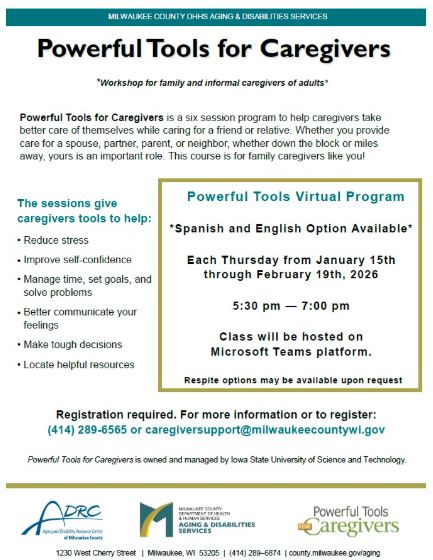
Powerful Tools for Caregivers
from Milwaukee County Department of Health and Human Services
Powerful Tools for Caregivers is a six session program to help caregivers take better care of themselves while caring for a friend or relative. Whether you provide care for a spouse, partner, parent or neighbor, whether down the block or miles away, yours is an important role. This course is for family caregivers like you and it is also offered in Spanish! For more information or to register,: 414-289-6565 or caregiversupport@milwaukeecountywi.gov
| | |
Check out our video archive to find a session you might have missed.
You can also go back to the training session webpage to find other resources, slides and handouts.
| | | |
Click here below to see all the upcoming trainings and events across topics. | |  |
Have a training interest? Looking for technical assistance? Simply fill out this online form with what you are seeking, and we will follow up to further explore your needs. | | Wisconsin CONNECT Social Media | | Go follow the new Wisconsin CONNECT social media pages for regular updates on training opportunities as well as to connect and network with other professionals. | | |
|
We do this in partnership with the Bureau of Prevention, Treatment and Recovery within the Wisconsin Department of Health Service's Division of Care and Treatment Services, UW-Milwaukee, and our network of training providers. |
| | | |