We’re back after a little fun at the beach. We hope you’re looking forward to more news about trademarks, franchises, and other legal stuff. 


In this edition:


  • LIVing it up with trademarks on the golf course


  • Yes, we are going to talk about the Afroman case


  • Shout out to Friend of the Firm Mills Gallivan


  • Can acronyms be trademarks?


  • And trivia!


If some nice person forwarded this to you and you’d like to be on our list, you can sign up here.


The newsletter will take another short break as we lead up to Easter next week, but will be back in action soon.


It’s Golf (and Trademark) Season


The grass is growing and the pollen is blowing, so it’s also time to get back out on the golf course. Maybe you’ll check out some PGA events, or maybe those by its pesky rival, LIV Golf. But if you’re at a LIV Golf tournament and sampling some of their adult beverages, are you also enabling trademark infringement?


That’s the issue in a new lawsuit brought by Long Island Spirits, which also claims rights to “LIV” as a trademark. According to the complaint, the distillery in New York first used the “LIV” brand - often shown as “LíV” - to refer to its “flagship” product, “Long Island Vodka,” but that term is “now associated with an array of LIV-branded vodka, gin, and other alcohols, as well as with branded apparel that LIV sells and distributes throughout the Tri-State area at LIV’s distillery, local events, and via its online marketplace.” 


The distillery believes its brand is “now threatened by Defendant LIV Golf’s infringement” and that LIV Golf has “brazenly used the ‘LIV’ mark to promote signature vodka-based cocktails at tournaments,” like the “LIV Clubhouse Cooler” and the “LIV It Up Bloody Mary.” You can read more about the case on ESPN.


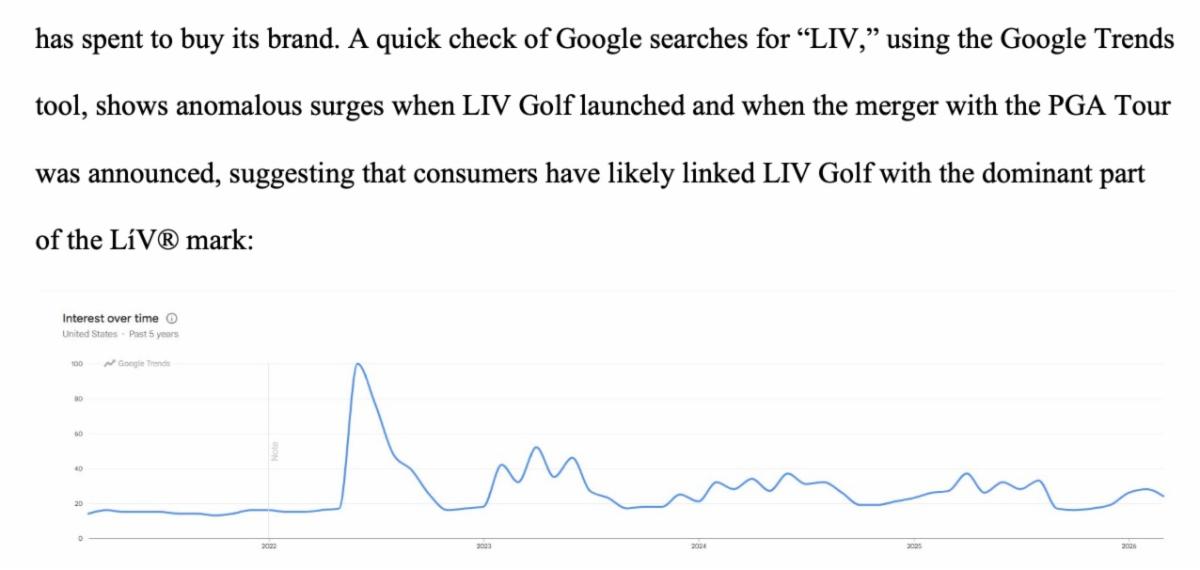
One interesting part of the complaint is a snapshot of the “Google Trends” tool, which the distillery claims shows “anomalous surges” when LIV Golf has been in the news:

The complaint seems to argue that LIV Golf’s “billions of dollars” are dwarfing the distillery’s “painstaking efforts to build its reputation with consumers over nearly two decades.” 


To be sure, an earlier or “senior” user of a trademark can claim that a newer or “junior” user is flooding the market so much that the senior user loses control of its brand, amounting to “reverse confusion” - where consumers mistakenly think the senior user’s goods actually come from the junior user. But at the same time, just because LIV Golf spent a lot of money on its golf league and has been in the news for various reasons, does this mean that consumers are likely to confuse the brands? 


Trademarks and golf-related beverages are nothing new. Consider the well-known Arnold Palmer lemonade-tea combo, the subject of a federal trademark registration and a great ESPN SportsCenter commercial.


Afroman, Barbra Streisand, and IP Law


It’s probably no surprise that we, like many of you, have been reading about the Afroman case. But what does Afroman have to do with Barbra Streisand, much less intellectual property law?


For those of you who haven’t read about Afroman, he’s a rapper whose house was searched by police. Afroman was not pleased with the search, much less how it was conducted. But instead of suing the police for violation of his rights, Afroman took a different approach. Using his own home video surveillance footage of the search, he made several satirical rap songs and videos.


For example, one song stemmed from footage of a law enforcement officer possibly distracted by a lemon pound cake in Afroman’s kitchen. This led to the song “Lemon Pound Cake” (whose tune may or may not resemble “Under the Boardwalk”), with lyrics like: 


“Mama’s Lemon Pound Cake, it tastes so nice…,

It made the sheriff want to put down his gun, and cut him a slice….” 


Just as Afroman didn’t care for the search, the sheriff’s deputies didn’t care for the songs, which included others that were, shall we say, more explicit. They sued Afroman for defamation, claiming that he damaged their reputations and affected their jobs. (For example, the deputy shown in the kitchen supposedly eyeing the cake - nicknamed “Officer Poundcake” by Afroman - testified at trial that he’d received hundreds of poundcakes at work due to the videos.)  


Last week an Ohio jury sided with Afroman. You can read more about it on NPR. Or all over social media.


So while this case is mostly about the First Amendment and police searches (and baked goods, so to speak), some have cited it as an example of the “Streisand effect.” That phenomenon is named after, you guessed it, Barbra Streisand, who filed a lawsuit complaining that her Malibu home was visible in an aerial photograph among thousands of photographs of the California coastline. Reportedly, the photo had only been downloaded 6 times before the lawsuit was filed, but was downloaded 420,000 times in the month after. The court dismissed the case and ordered Streisand to pay the defendant $177,000 in legal fees. The L.A. Times reported on that case. 


In the intellectual property world, clients often want their lawyers to send cease-and-desist letters over potential misuse of patents, trademarks, and copyrights. But clients should also be aware of the potential “Streisand effect” and how drawing attention to an issue - or how the issue is handled - can sometimes make things worse, especially if the recipient takes to social media. And even more so if he is Afroman.


Shout Out


We’d like to give a shout out to a longtime Friend of the Firm, the esteemed lawyer and mediator Mills Gallivan, for his new book The American Crisis in Civility: Professional Parables, co-authored with Ned Currie, which is now available on Amazon. Profits are being donated, and Mills said they are offering discounts and continuing education to firms that place bulk orders over a certain amount.


You can reach Mills at mgallivan@gwblawfirm.com. Congrats!


VANDERBLOEMEN LAW FIRM'S

FREQUENTLY ASKED QUESTIONS (VLFAQs)

Can acronyms be trademarks?


Yes, they can. In the LIV Golf case mentioned above, the New York distillery refers to its trademark as “LIV,” which is an acronym for “Long Island Vodka.”


There are many well-known acronym trademarks - think ESPN (Entertainment and Sports Programming Network) or IHOP (International House of Pancakes).


Apart from reflecting consumers’ penchant for short, catchy terms, acronym trademarks can also be helpful in avoiding concerns that a trademark is too descriptive or generic. After all, “Cable News Network” would seem to be a pretty descriptive term and, at least when first used, may not have been very protectable as a trademark. But abbreviate it as “CNN” and, voila, you may have yourself a brand.


All this said, if an acronym is used generically or descriptively, it may not be a trademark any single business can monopolize. SCUBA (self contained underwater breathing apparatus) and LASER (light amplification by stimulated emission of radiation) are common terms, even if acronyms. In the trademark application process, it’s possible an examiner may ask about the meaning of an apparent acronym and whether it is common in an industry. 


TRIVIA

(or what you may have really been scrolling for)

LAST ISSUE’S QUESTION


Congratulations to longtime Friend of the Firm, high-powered lawyer, and former University of Florida football team equipment manager Scott Edson for having the closest answer/guess that the top “category” of mascot represented in the men’s and women’s NCAA basketball tournaments is “other” animals. 


While there are certainly a lot of mascot dogs, cats, and birds (and “people” - which was pretty close one), not to mention weather events and supernatural beings/phenomena, there are quite a few “other” animal mascots in competition. Consider all the gators, razorbacks, badgers, jackrabbits, rams, gophers, spiders, longhorns, bulls, broncos, buffalo, bison, terrapins, and others - they add up! Enjoy the rest of the games!


THIS WEEK’S QUESTION


We mentioned the “Arnold Palmer,” a well-known trademark associated with that golfer’s beverage of choice, a combination of lemonade and tea. But there is another, boozier version of the same, where vodka is added. And that drink is often named after another golfer, a more casual “everyman” competitor known for his unconventional and short warmup, which often consists of several cigarettes and Diet Cokes, and his conspicuously loud pants (even by golf standards). Who is this golfer?


Reply to us if you think you know. We love hearing from you all, so please don’t be bashful about answering, even if you’ve already won or never won - it’s all in good fun and a nice way to stay in touch. We pick one winner from among the correct answers received, but do try to even things out from time to time.

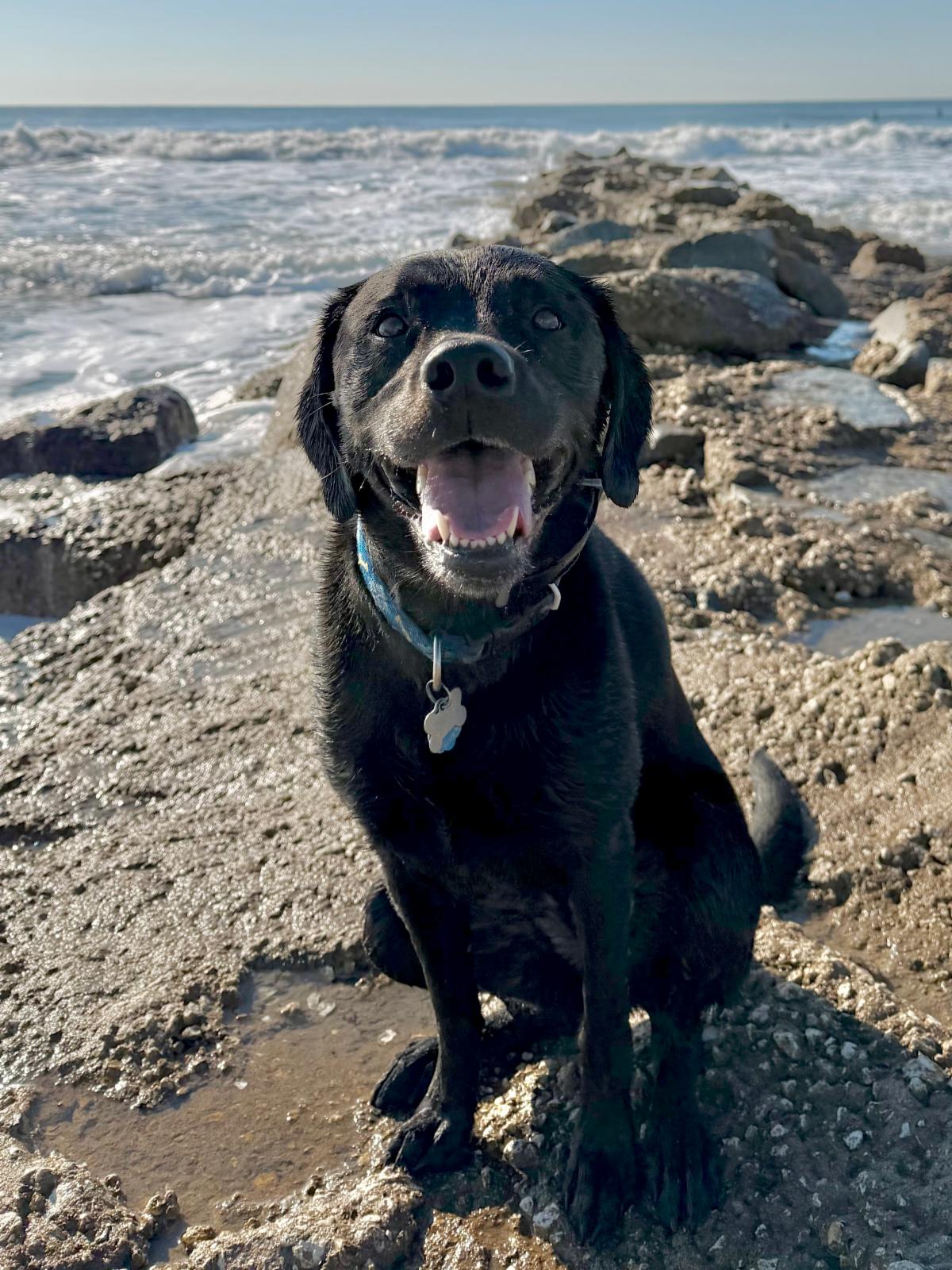
Our law clerk (pictured) does not mind a day at the beach, but she still wants you to remember that our newsletter, while sometimes a source of amusement (we think), is for informational purposes only, does not constitute legal advice, and does not create an attorney-client relationship. If you want to be considered for the trivia question, please respond within five days of posting. We may link to third-party sites, but we cannot control the links or their content, and they may sometimes redirect to other locations after some time has passed. If you think a link is not leading you to the place we intended, please let us know.

We share our newsletter with past and present clients, colleagues, and other friends of the firm who have communicated and worked with us. If you prefer not to receive these messages or believe you received this in error, please see the link below to unsubscribe. The content we create is protected by copyright. Because, you know, that's kind of what we do.