Access our research on the Bloomberg Terminal with ERH GXY <GO> |
|
gm,
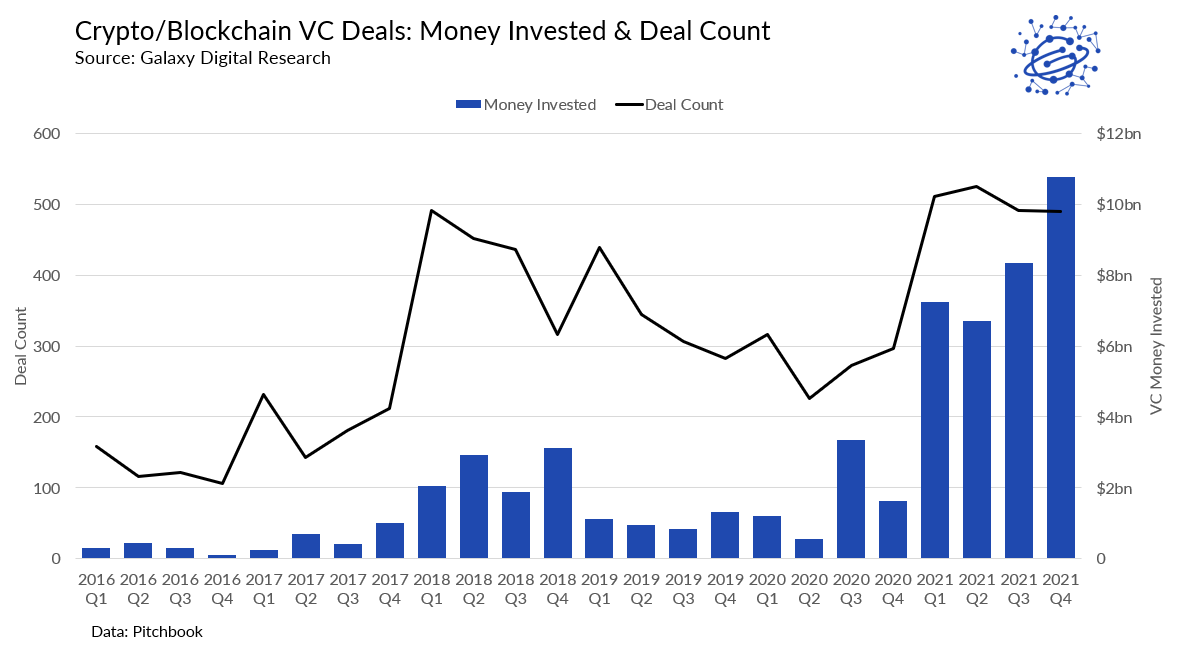
venture capitalists invested more than $32bn in crypto/blockchain startups in 2021, more than all prior years combined. we've got a new report detailing the crypto/blockchain venture capital scene from last year, packed full of insightful data.
crypto markets also dropped significantly yesterday along with equities as risk appetite waned following the release of minutes from last month's FOMC meeting. i have market commentary for you below. mike novogratz is also appearing on CNBC in 5 minutes (8:40 am ET).
best,
alex
|
|
NEW REPORT: 2021 - Crypto VC's Biggest Year |
|
Last year, venture capital firms invested more money into startups building in the crypto & blockchain technology sector than all prior years combined. Companies facilitating digital assets trading or building in the Web3 segment raised the most. |
|
- Venture capitalists invested more than $33bn into crypto/blockchain startups in 2021, more than all prior years combined. $22bn of that total (67%) went to fundraising rounds with deal sizes above $100m. Crypto/blockchain startups received almost 5% of venture capital deployed in 2021.
- Valuations in the crypto/blockchain space were 141% higher than the rest of the venture capital space in Q4, highlighting a founder-friendly environment and the intense competition among investors for deal allocations. Deal sizes were elevated but comparable to the rest of the VC landscape.
- At least 43 companies that raised venture capital in 2021 are unicorns. Pre-Seed deal counts continue to decline while Series A and later are growing, a sign that companies built in the 2018-2020 crypto bear market are maturing to later stages.
- Companies offering trading, investing, exchange, and lending services to digital assets investors led the pack with more than 41% of the capital share, but startups building in the NFT, Web3, DAO, and Metaverse sub-sectors came in second with 17% of the capital allocation.
- Crypto focused funds are larger than they’ve ever been, and 62% of managers that raised in 2020 also raised new vintages in again 2021.
|
|
Risk Appetite Wanes but Long Term Outlook Remains Bullish |
|
GM – Markets tumbled yesterday after the Fed signaled more hawkishness, but the crypto markets had already been mostly stagnant leading into the release. Crypto markets feel soft this morning. Whether Bitcoin’s adoption by El Salvador, the adoption of NFTs, a future of blockchain-based games, or alternate layer 1 blockchains, narratives are feeling stale this week under the yoke of a complicating macro picture and lack of near-term catalysts. Before I dive into this, let’s take stock of the market’s recent movements.
Minutes published yesterday from the FOMC meeting on December 14 and 15 pointed to faster and earlier rate increases from the central bank, and some FOMC members indicated they favored also shrinking the Fed’s balance sheet after rate increases begin. Rate increases could come “sooner or at a faster pace than participants had earlier anticipated.” The detail contained within the minutes indicated a more widespread belief among FOMC participants that the Fed needed to move sooner and more quickly in reducing the overall size of the Fed balance sheet and has spooked markets. The release of the FOMC minutes sent the S&P 500 down significantly, closing down nearly 2% (the largest drop since February 2020), and the NASDAQ down almost 3.3%. Treasury yields rose, gold dropped (paring gains from earlier in the day), and the dollar rose. Real yields (10y inflation-adjusted yield) are approaching positive territory, having risen from -1.20 back up to -0.83, rapidly approaching pre-pandemic levels of -0.60. The speed of the move in real yields could hold the key to risk appetite this year. Bitcoin dropped as low as $42.5k before paring some losses, while Ethereum fell as low as $3300 and is now trading up slightly.
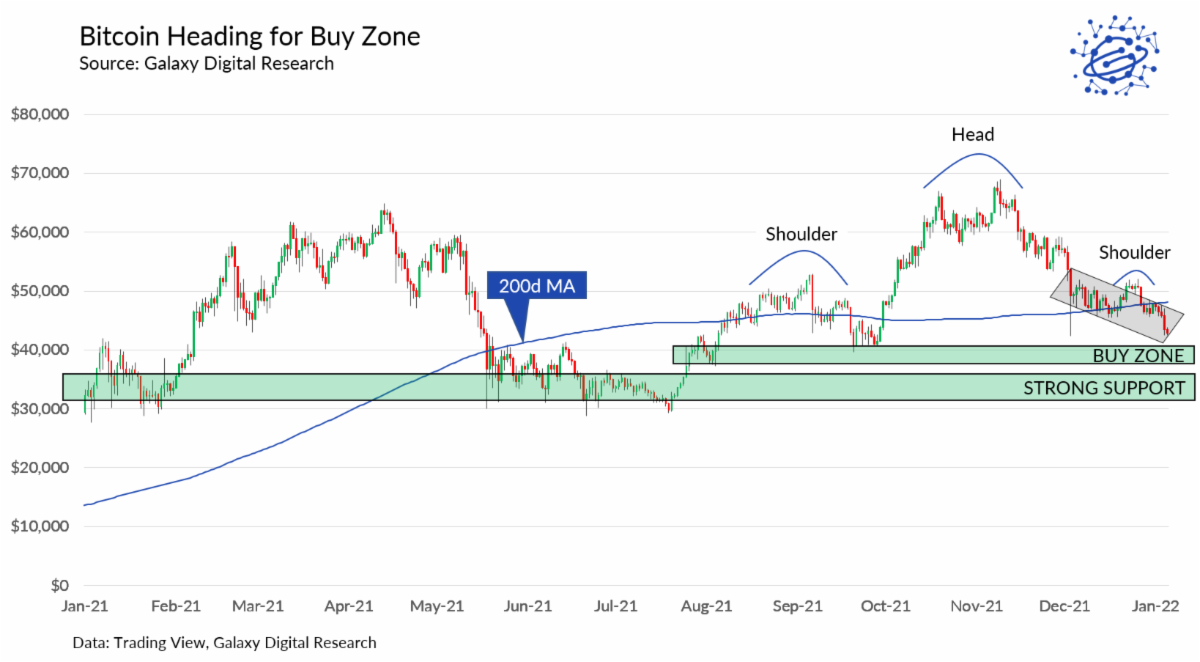
Bitcoin had been trading in a tight range between $45.5k and $48.5k for the last 8 days. And except for 5 days surrounding Christmas, Bitcoin has traded in a descending channel since December 4. Whereas the 200d moving average had served as support through most of December, the average has flipped from support to resistance, capping upside since December 29. Bitcoin fell to the bottom of the descending channel overnight, though the downward trendline is serving as support at the moment. A possible head and shoulders pattern also emerged over the last couple weeks, with a right shoulder forming on the daily chart. The descending channel, 200d MA resistance, and HNS pattern suggests a move down to the $38-41k range over the next several days. A deeper move down to the mid $30k range is also possible but less likely, and Bitcoin will find strong support at those levels. A powerful move above $52-53k would invalidate the head and shoulders pattern.
|
|
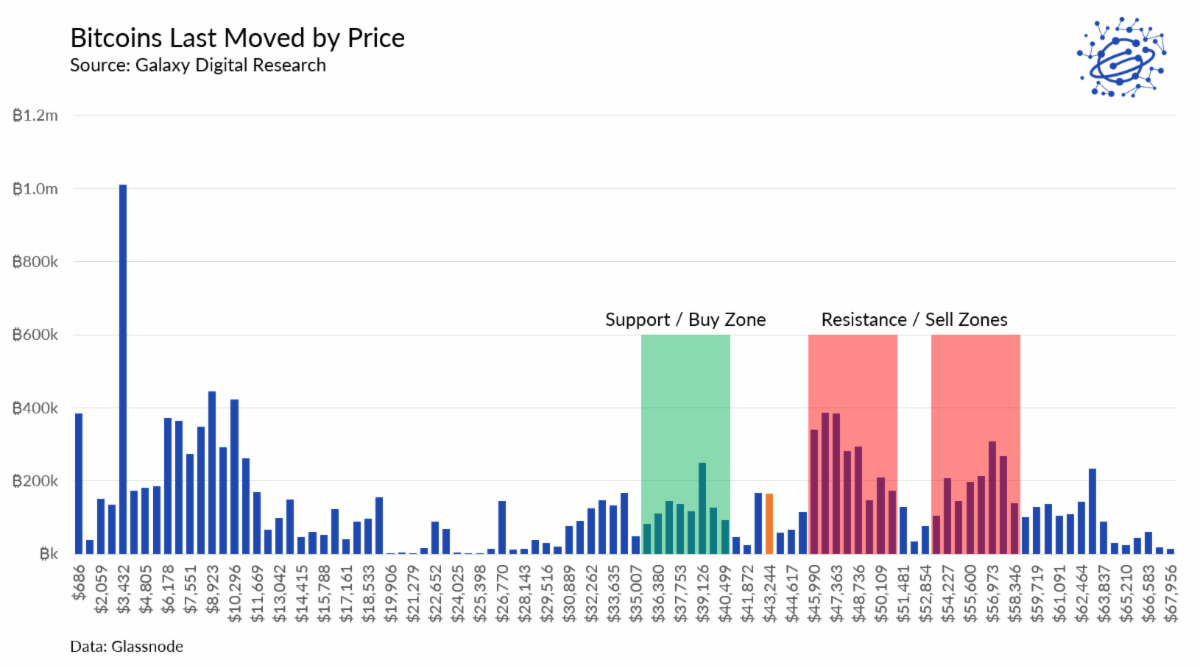
A price-band analysis of unspent coins, which evaluates each coin on-chain by the price at which the coin was created (last moved), suggests Bitcoin should find support in the $35.5-$40k range, with particularly strong support around $39.1-$39.8k. The resistance and sell zones in the chart below will change and move lower if holders who purchased at those levels move their coins at these lower levels. |
|
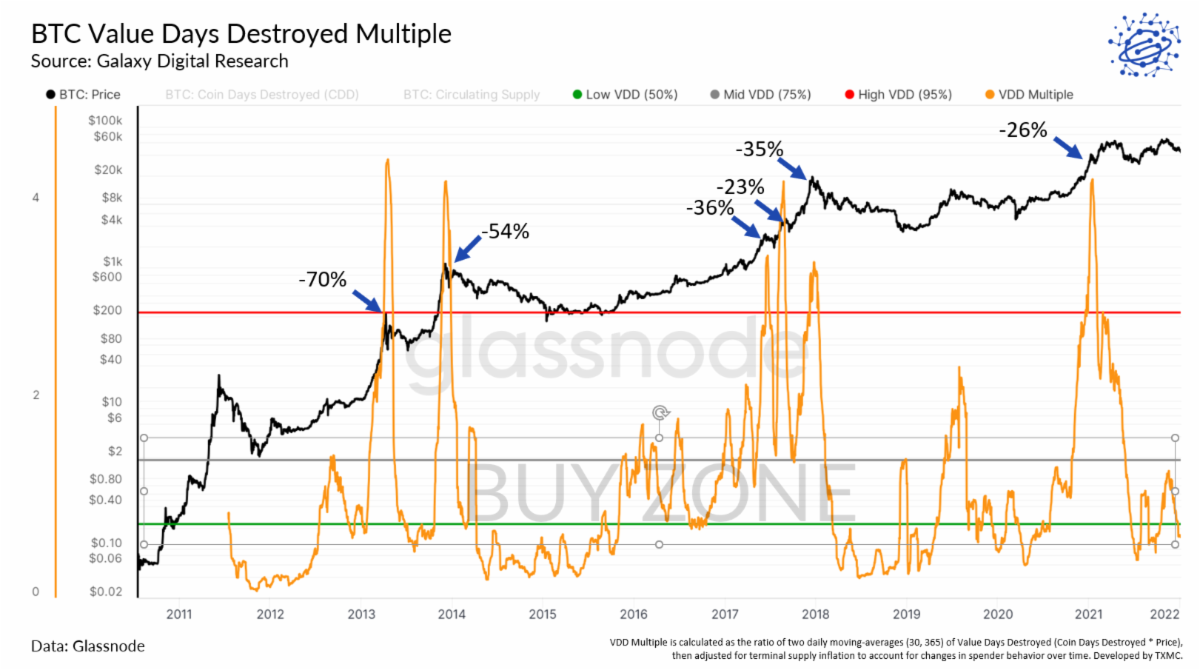
Other on-chain analysis supports a similar view. The Value Days Destroyed (VDD) Multiple, which was devised by analyst TXMC and is calculated as the ratio of two daily moving averages (30, 365) of the VDD (Coin Days Destroyed * Price) and adjusted for terminal supply inflation, suggests Bitcoin is already in a solid buying zone, though a lower move for the metric would be more in line with other recent buying opportunities. Essentially, this metric is a variation of coin days destroyed, which takes the total number of coins transacted on a daily basis and multiplies by the total number of days it has been since those coins were last spent, giving insight into the activity of old coins. The metric tends to peak at market tops and bottom around market lows.
|
|
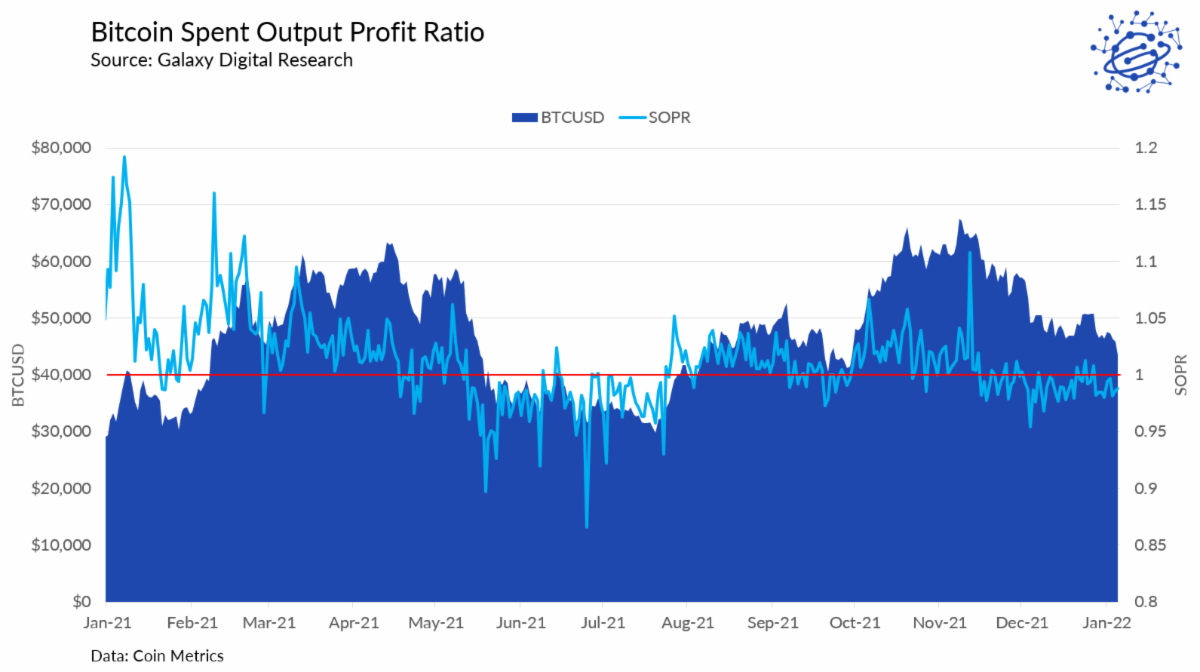
Amidst the downturn, we can also see coins moving at a loss. The spent output profit ratio (SOPR), which divides the realized value of coins on-chain by the value at creation on-chain (i.e., price sold / price paid), has been mostly below 1 since late November, indicating that more coins moving on chain had previously moved at higher prices. |
|
The move down saw nearly $900m in liquidations on futures platforms across all coins over the last 24h, with $330m BTC positions liquidated and $222m ETH positions. While notable, unlike other sharp downward moves, the liquidations were not the cause of the selloff, with heavy spot selling seen across markets. On Galaxy’s electronic trading platform, we saw almost half our normally daily trade volume during just the 2-3pm hour yesterday, with institutional BTC and ETH selling as the primary flow theme. Volumes today are about 3x the normal daily average.
Outside of Bitcoin, the rest of the crypto markets were broadly down. Ultimately, every single non-stable coin in the top 100 is down over the last 24 hours, and nearly all are down WoW. Stablecoins like USDT, USDC, BUSD,, UST, DAI and MIM were up slightly over the last 24 hours, with USDT, USDC, and BUSD up almost 1%, a consequence of traders fleeing to safety (these will come down to par as their various supply dynamics kick-in). Some of the biggest declines were seen in coins that had performed well over the last several months including alt layer 1 tokens SOL, LUNA, AVAX, MATIC, and ATOM, which are all down more than 10%. Metaverse plays SAND and AXIE were among the worst hit, with both down more than 17% WoW.
The long term picture remains extremely bullish, but before I dive into that, I want to highlight some areas where exuberance has outpaced fundamentals. A few areas that stand out:
- Non-fungible tokens are one such example. Analysis shows that most NFTs are owned by just the top 0.1% of holders. The recent $SOS airdrop to OpenSea users also confirmed that—the airdrop went to users of the world’s largest NFT platform proportionate to the amount of money spent and resulted in 95% of the drop going to 0.1% of users. Furthermore, while NFTs hold enormous promise across a range of use cases even beyond digital collectibles, the tech stack supporting these unique tokens leaves a lot to be desired.
- Blockchain gaming is another category that has yet to see a truly major win. Despite the performance and adoption of Axie Infinity ($AXS), the reality is that the game’s tokenomics have serious flaws, and most of the game’s usage has come from users operating click-farms rather than consistent, organic gameplay. Decentraland and The Sandbox—leaders in the virtual property ecosystem—today lack the kind of user experience to which gamers are accustomed, and so owners of assets in those worlds are also mostly speculating on the future possibilities of those worlds rather than current experience. Ultimately, bringing NFTs to video games—an industry that generates significantly more revenue than movies and music combined—is a massive opportunity that will likely succeed in revolutionizing the digital world. But today, the category lacks a breakout hit, and given the hit-driven nature of games, absent a crossover phenomenon, this category will remain niche.
-
Decentralized finance has proven to be immensely useful for those who use it, but the user base is still relatively small, although it is growing. These applications are still mostly used by crypto natives, many of them wealthy, and although that cohort is growing, we have yet to see DeFi adoption outside the bored apes. Until we see institutional adoption of these protocols or much wider accessibility for retail or the unbanked, DeFi will could remain mostly a tool for deep-pocketed on-chain actors.
- The metaverse already exists, albeit mostly without VR. Our lives are heavily digital today, with many spending hours curating their online presences, which are often already represented with avatars. Communities organize in group chats, plan events through shared calendars, and congregate on video calls with beaches or moons as their backgrounds. Decentralized Autonomous Organizations (DAOs), a major advancement for online organization, are still nascent and require significant advancement before they can really be considered decentralized and autonomous.
- Ethereum’s challengers have done well in the absence of truly ETH scaling solutions, but they could come back to Earth as data vendors begin to offer coverage of their ecosystems. Sunlight will perhaps show less usage and slower adoption that many market participants anticipate.
But none of these shortfalls are inherent or permanent—all represent opportunities for growth. We remain broadly bullish on the space across a range of categories.
- Institutional adoption of Bitcoin will continue to grow, with many major allocators planning to become involved over the next 3-9 months. Growing institutional ownership will help bolster BTC as a digital store of value in 2022. Bitcoin’s Lightning Network continues to grow significantly along with BTC’s use for payments and remittances, adding more utility for the world’s most valuable cryptoassets and challenging the narrative that Bitcoin is only digital gold. Some momentum has begun building for another upgrade, OP_CHECKTEMPLATEVERIFY, which would enable significant additional features for Bitcoin users, including much more robust smart contracting. And DeFi on Bitcoin is actually beginning to grow, with sidechains like RSK, Liquid, and DeFiChain beginning to see growing activity, along with adjacent networks like STACKS.
- Ethereum’s “ETH 2.0” upgrade is planned for this year, with “The Merge” expected to occur sometime in Q2 or Q3. This could set the stage for Ethereum to become more scalable just as the world looks for more on-chain capability. Until that happens, alternative layer 1 protocols will continue to expand their ecosystems, and those that build strong communities, as many have, will continue to flourish post-Merge.
- DeFi is also poised for a big year, with more non-crypto-native firms likely to begin operating on-chain to offer more robust and cheaper financial services to their customers. The likelihood of robust DeFi options markets materializing in 2022 also seems high, which would bring significant risk management tools to on-chain actors.
-
Venture funds hold an enormous amount of dry powder after a year of epic fundraising in 2021, and with Web3/NFTs/DAOs/Metaverse as the second largest investment category last year, improvements and expanded use cases for blockchain gaming, NFTs, decentralized autonomous organizations, and metaverses is likely on the horizon. As more tooling appears for Web3, making the accountless internet more accessible will make it easier for average users to participate in DeFi and DAOs, which will spur additional adoption. Indeed, so much money has been raised by crypto/blockchain companies, let alone that which has yet to been deployed by funds, that it’s hard not to see usability improve, product offerings mature, and use-case breadth increase over the next year.
The bottom line is that risk appetite in broader markets is changing in the face of inflation and resulting central bank policy. Absent major near term catalysts, and coming off an extremely hot year, crypto markets are set for a bearish turn over the next several weeks and perhaps months. But with crypto markets reacting to exogenous circumstances rather than some fundamental change in their viability, the longer term outlook for public blockchains and digital assets remains incredibly bullish. 2021 was a truly massive year for the space that saw enormous adoption, growing usage, increased regulatory clarity, and significant wealth creation. The digitization of our world, coupled with the ongoing “Great Wealth Transfer,” will continue to push digital assets to the forefront, and the primacy of blockchains within that paradigm will persist. Longer term investors seeking to build positions may find the next several weeks to be a ripe opportunity for accumulation.
|
|
Alex Thorn
Head of Firmwide Research
|
|
Legal Disclosure:
This document provides links to other websites that we think might be of interest to you. Please note that when you click on one of these links, you may be moving to a provider's website that is not associated with Galaxy Digital. These linked sites and their providers are not controlled by us, and we are not responsible for the contents or the proper operation of any linked site. The inclusion of any link does not imply our endorsement or our adoption of the statements therein. We encourage you to read the terms of use and privacy statements of these linked sites as their policies may differ from ours. This document, and the information contained herein, has been provided to you by Galaxy Digital Holdings LP and its affiliates (“Galaxy Digital”) solely for informational purposes. This document may not be reproduced or redistributed in whole or in part, in any format, without the express written approval of Galaxy Digital. Neither the information, nor any opinion contained in this document, constitutes an offer to buy or sell, or a solicitation of an offer to buy or sell, any advisory services, securities, futures, options or other financial instruments or to participate in any advisory services or trading strategy. Nothing contained in this document constitutes investment, legal or tax advice. You should make your own investigations and evaluations of the information herein. Any decisions based on information contained in this document are the sole responsibility of the reader. Certain statements in this document reflect Galaxy Digital’s views, estimates, opinions or predictions (which may be based on proprietary models and assumptions, including, in particular, Galaxy Digital’s views on the current and future market for certain digital assets), and there is no guarantee that these views, estimates, opinions or predictions are currently accurate or that they will be ultimately realized. To the extent these assumptions or models are not correct or circumstances change, the actual performance may vary substantially from, and be less than, the estimates included herein. None of Galaxy Digital nor any of its affiliates, shareholders, partners, members, directors, officers, management, employees or representatives makes any representation or warranty, express or implied, as to the accuracy or completeness of any of the information or any other information (whether communicated in written or oral form) transmitted or made available to you. Each of the aforementioned parties expressly disclaims any and all liability relating to or resulting from the use of this information. Certain information contained herein (including financial information) has been obtained from published and non-published sources. Such information has not been independently verified by Galaxy Digital and, Galaxy Digital, does not assume responsibility for the accuracy of such information. Affiliates of Galaxy Digital own investments in some of the digital assets and protocols discussed in this document. Except where otherwise indicated, the information in this document is based on matters as they exist as of the date of preparation and not as of any future date, and will not be updated or otherwise revised to reflect information that subsequently becomes available, or circumstances existing or changes occurring after the date hereof. The foregoing does not constitute a "research report" as defined by FINRA Rule 2241 or a "debt research report" as defined by FINRA Rule 2242 and was not prepared by Galaxy Digital Partners LLC. For all inquiries, please email contact@galaxydigital.io. ©Copyright Galaxy Digital Holdings LP 2021. All rights reserved.
|
|
|
|
|
|
|