A Message from the Executive Director |
It has been more than six months since we all entered this era of COVID-19. As of today, we have lost more than 202,000 people in this country. Of this number, 1,749 were American Indians with half of them below the age of 40.
These were individuals and they had names. They were our grandparents, parents, brothers, sisters, uncles, aunts, cousins and friends. They were not just numbers streaming across our TV screens or numbers on the front page of newspapers.
They had dreams, goals and they filled the lives of those around them and many made this world a better place because they lived. But it was unnecessary, and it shouldn’t have become the unwanted deadly stranger who came to our shores and claimed the lives of our loved ones.
Our elders are our living histories, our traditions and our language. In this era of uncertainty, we must do all we can to protect them and thereby ensure our continuity as American Indian and Alaska Native peoples. I am sure that among the 1,749 who succumbed to this virus, many were elders — we lost a piece of history with their passing.
The National Indian Council on Aging (NICOA) mourns their passing and prays that their journey into the other world is serene and peaceful. We pray that their journey ends with a reunion with the loved ones who await them there. Those of us who remain must honor them and do what we can to serve our people.
In the next few weeks, we have the opportunity to do just that. NICOA urges all tribal communities to participate in the U.S. Census and be counted. By participating and filling out those forms, we help our grandchildren, children, and grandparents.
The other matter is to urge all American Indian and Alaska Native people to vote. This is your right and it is a hard fought right that our grandparents fought and died for. Our country needs your voice and your participation. If you haven’t registered, please do. Together as one Native American voice, we can affect national policies and point this country in the direction of our choosing.
Sincerely,
Larry Curley
Executive Director
|
|
|
|
Survey: What Long-Term Services and Supports Does Your Tribe Need? |
NICOA received a Cooperative Agreement from the Administration on Community Living/Administration on Aging in 2019 to develop and implement a Tribal Long-Term Services and Supports (LTSS) program which will establish an Advisory Council and a tribal LTSS website, provide technical assistance to tribes in the development of a tribal LTSS program, and hire navigators to provide onsite technical assistance to selected tribal governments in the development of the tribe’s LTSS. With the advent of COVID-19, it is more likely that this technical assistance will be provided virtually.
To ensure that NICOA receives accurate information regarding needed services and appropriate technical assistance, we have created a needs assessment survey that we are requesting tribes to fill out, thereby enabling NICOA to identify relevant subject matter experts to provide the needed and requested technical assistance.
|
|
|
|
New Tribal Long-Term Services and Supports Website |
We are thrilled to announce a new website NICOA has created specifically for tribal long-term services and supports (LTSS). NICOA’s LTSS Compass is now live. We invite you to view the new website and let us know your thoughts.
LTSS are an is the entire range of services including, but not limited to, such as chore services, home delivered meals, senior centers, transportation, caregivers, legal services, guardianships, home health services, elder protection programs, intergenerational programs, assisted living, long term care facilities and many others. Coordinating these services in a manner that meets reimbursement requirements from funding sources such as Medicare, Medicaid, Veteran’s Administration and private insurance, can be complicated and time-consuming.
Our goal with this website is to provide tribal leaders and community members an easier way to learn about long-term services and supports and find resources based on their location. You can use the website to find information on aging in place, policies and program examples, learn how to both plan for and pay for your care, find services near you, and more.
We endeavor to provide tribal leaders and community members with the most accurate, up-to-date information and to share our knowledge and expertise in the field of aging. The website offers user-friendly navigation, a responsive design, and an abundance of aging information.
To assess the site’s usability, we are asking that you fill out this quick 10-question survey. If you have any questions, comments or suggestions, please send them our way. |
|
|
|
"Why Every Elder Vote Counts": A Live Webinar Oct. 1 |
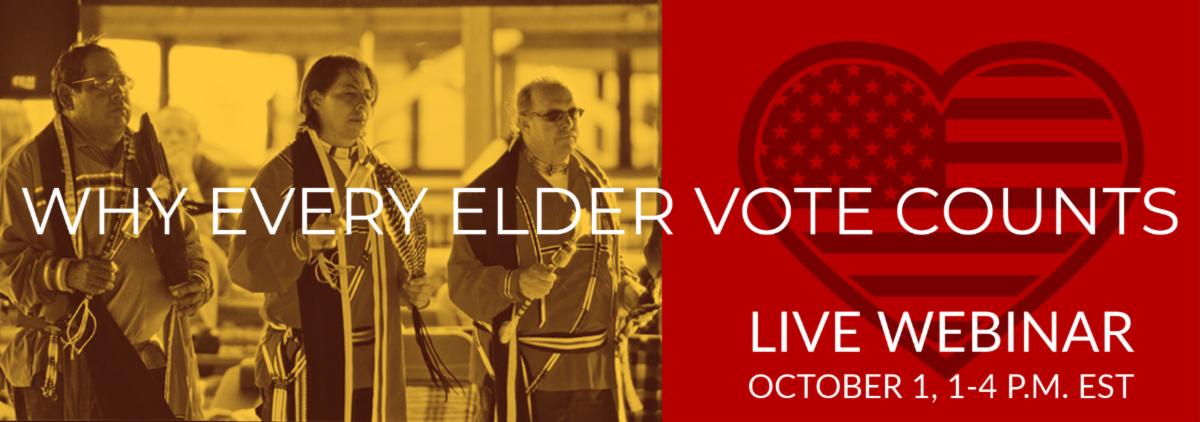
Join NICOA and AARP as we prepare to play our part in an historic United States presidential election. NICOA will be holding a live, national webinar about " Why Every Elder Vote Counts" on October 1 at 1-4 p.m. EST.
Learn about the history of American Indian and Alaska Native voting rights, hear from AARP on voter engagement, learn approaches you can take to vote safely, reflect on the barriers facing Native people and what can be done to overcome those barriers. Discussions on the importance of advocacy, data, census, and financial security wrap up an information packed three-hour session. Arm yourself with strategies to make your vote count during this pivotal period in our history.
There will be raffles throughout the event, so stay tuned! You must be present to win.
|
|
|
|
Racial Disparities and Reactions to COVID-19, and Aiming for Equity in Navajo Nation |
|
|
|
|
|
In August, American Society on Aging President and CEO Peter Kaldes and NICOA Executive Director Larry Curley discussed issues of equity and justice and how they intersect with his work with elders in the Navajo Nation and how recently there have been resurgences in racism against members of the Navajo Nation in New Mexico due to COVID-19. |
|
Greetings from the Senior Community Service Employment Program!
While the world is slowly starting to re-open, NICOA too is working to get SCSEP participants back to training when safe. Calls are being made weekly to get updates on openings and re-closings. Staff priorities at this time are to be aware of what is going on in each of the participants and communities we serve and identify who can safely return to training.
Due to the ongoing coronavirus pandemic, people are spending much more time inside their homes. While it can be frustrating to be confined indoors, it is the best thing to do to keep everyone safe. While at home, everyone is encouraged to stay active. It's a great way to cope with the stress and anxiety you may be feeling.
Ways to keep active in your home:
- Do at-home workouts: Even the simplest exercises can be beneficial.
- Do some arts and crafts: Something as simple as coloring can pass the time while providing benefits. Coloring is known to improve one’s motor skills while also reducing their anxiety and stress levels.
- Read or listen to books.
- Play cards and board games, or if you enjoy words and language, consider doing a crossword puzzle, word search or Sudoku.
- Have a movie night: Maybe a virtual watch party with friends and/or family.
- Listen to music: Especially the oldies and have yourself a good dance!
If needed, reach out to friends and loved ones for support, or if you need someone to talk to, call the National Lifeline chat at 1-800-273-8255. Remember to stay home, maintain physical distance and wear a mask. Be safe all!
Sue Chapman
SCSEP Director
|
|
|
|
Partner Spotlight: C. Carter Crane |
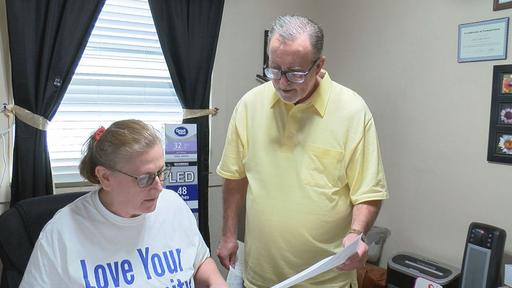
They share the story of Scott Cunningham, who was homeless before entering NICOA’s SCSEP and getting a job at age 55. Now, not only is he employed, he’s living on his own and has a car.
|
|
|
|
|
|
National Employ Older Workers Week |
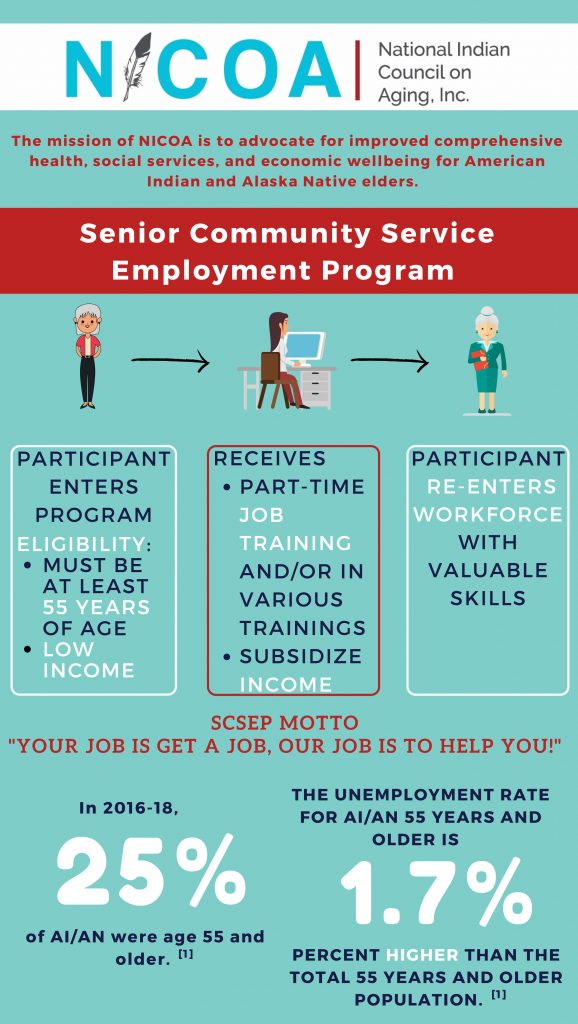
The U.S. workforce is undergoing a dramatic demographic shift. The average age of the population is rising, and the composition of the workforce with it. It is estimated that workers 55 and over now make up 25 percent of the labor force — up from 13 percent in 2000, according to the U.S. Department of Labor.
In addition, as life expectancies grow, education increases, retirement plans shrink and Social Security is cut, individual workers are remaining in the workforce longer and retiring later. The number of workers over the traditional retirement age of 65 is increasing, and it’s estimated that they now make up more than 7 percent of the American labor force. The U.S. Bureau of Labor Statistics estimates that 23.3 percent of elders over age 65 are expected to continue working in 2028, compared with 12 percent in 1998.
The economic benefit of elder workers boosts the national economy because individuals are more likely to have the finances to cover expenses longer and continue to pay taxes.
|
|
|
|
Also, elder workers represent a great opportunity to employers. Employers rate elder workers high in judgment, commitment to quality, attendance, and punctuality.
National Employ Older Workers Week, held annually the last week of September, recognizes the vital role of elders in the workforce and aims to increase awareness of this labor segment and develop innovative strategies to utilize it.
|
|
A Message from the Elder Equity Program |
Happy Fall! I always find the change in the weather this time of year to be energizing. Here at NICOA there are lots of positive changes underway and I want to share two of them.
On October 1 NICOA is partnering with AARP and Kauffman and Associates to offer a virtual educational seminar on the upcoming election. Larry Curley, NICOA executive director, will be hosting, and we will have two special guests. Jacqueline DeLeón (Isleta Pueblo), staff attorney at the Native America Rights Fund, will discuss her recent report titled “Obstacles at Every Turn: Barriers to Political Participation Faced by Native American Voters.” Then we’ll hear from Charmaine Fuller Cooper, AARP South Region field manager and campaign liaison on multicultural voter engagement efforts, who will speak about protecting voters over 50.
NICOA staff will round out the program with lots of good information to help you make informed decisions about your vote and ways to stay involved after election day. Don’t forget to register.
On November 10, NICOA will host a “Celebration of Native Elders.” This event should be lively and engaging. We want to celebrate the strength and resilience of Native elders. This program is still being developed so stay tuned.
If you haven’t attended a virtual event before there are lots of tutorials to walk you through it. AARP has a great one to teach you how to use zoom. Each session will have raffles throughout the program. You must be present to win. Join us and learn and share together as once again Native elders overcome the odds and make their voices heard.
Rebecca Owl Morgan
Eastern Band of Cherokee Indians
Project Coordinator
|
|
|
|
New Grant to Provide Technical Assistance to Elders |
The Minority Organization TARC Program will provide targeted technical assistance and training to the aging services network and other relevant stakeholders and consumers. Program activities will focus on elder populations, including American Indians. NICOA is partnering with AARP, the National Association of Area Agencies on Aging, ADvancing States, and the National Resource Center on Native American Aging, to implement a three-level strategy to expand and increase services to American Indian and Alaska Native elders over the next three years.
|
|
|
|
Using Values to Set Goals |
Introducing NICOA's first video podcast, “Using Your Values to Set Goals”. This is the first of six podcasts focusing on money management during COVID-19.
In this episode, NICOA Executive Director Larry Curley (Navajo Nation) shares his top three values and how they affect the way he manages his financial resources. Take some time while you’re stuck at home during this pandemic and think about your community’s values and how they influence your goals.
|
|
|
|
|
2020-2021 Membership Available Online |
|
Membership with NICOA offers many valuable benefits. As a paid member you will receive NICOA’s online bimonthly newsletter, legislative updates on important issues and resolutions affecting elders, voting privileges for qualified members and discounted registration fees for qualified members to attend our biennial conferences.
Be an important part of a national membership network and become a NICOA member by applying online or by mail. |
|
|
|
Report: The Profile of Older Americans |
The Profile of Older Americans is an annual summary of critical statistics related to the older population in the U.S. Relying primarily on data offered by the U.S. Census Bureau, the profile illustrates the shifting demographics of Americans age 65 and older.
It includes key topic areas such as income, living arrangements, education, health, and caregiving. The 2019 Profile includes special sections on obesity as well as aerobic activity and muscle-strengthening activities.
|
|
|
|
AARP Battleground Polls Show Voters Over 50 Split on Candidates |
Voters over age 50 in six battleground states were evenly divided when asked whether they support or oppose Donald J. Trump's handling of the coronavirus crisis.
Americans over 50 are considered among the most vulnerable to COVID-19, and an AARP poll in the spring found that 62 percent of the 50-plus population was very concerned about the virus, while 70 percent were worried that they or a family member would contract the illness. |
|
|
|
Eight Demographic Trends Transforming America’s Elders |
A new publication from the National Academies of Sciences, Engineering, and Medicine identifies eight key demographic trends shaping the rapidly growing U.S. population ages 65 and older — projected to nearly double from 51 million in 2017 to 95 million by 2060.
The publication, “ Future Directions for the Demography of Aging,” reflects the perspectives of nearly two dozen National Institute on Aging-supported researchers who examine recent demographic shifts along with “positive changes and disquieting trends.” They also explore research and policies that could improve health and wellbeing among elders in the U.S. |
|
|
|
|
|
Native Artists' COVID-19 Posters Target Indigenous Communities |
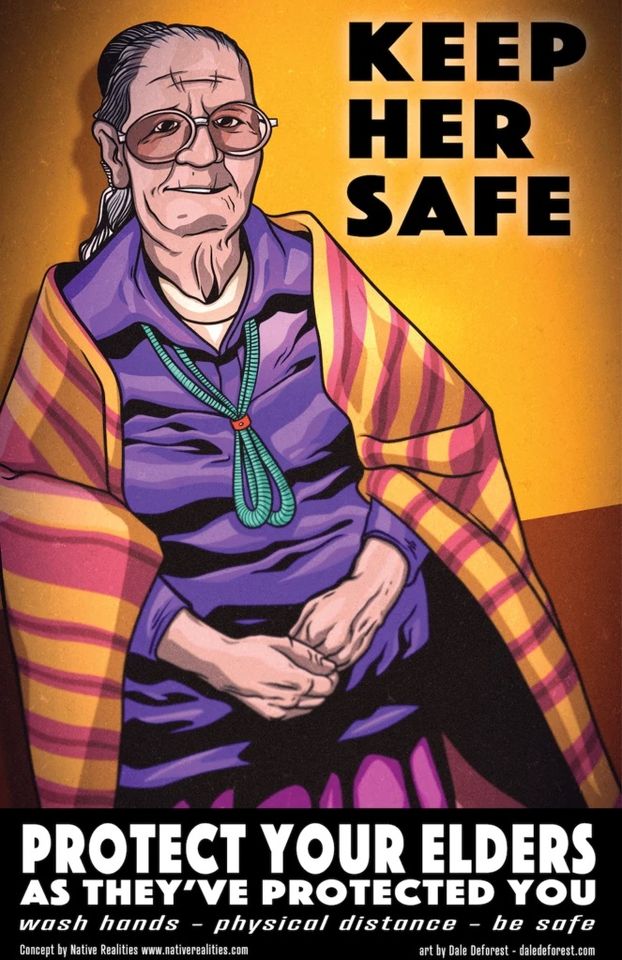
Protecting elders. Being a true warrior.
These are some of the messages behind a series of posters created by Indigenous comic book publisher Native Realities Digital. Lee Francis IV, CEO and founder of Native Realities and creator behind the annual Indigenous Comic Con in Albuquerque, New Mexico, wanted the series to address some of the things he kept seeing on social media about Indigenous people downplaying the COVID-19 pandemic.
|
|
|
|
|
|
The Coeur d’Alene Tribe, whose headquarters is in northern Idaho, is incorporating culture into fitness programs. The tribe has created an exercise routine — called “Powwow Sweat” — based on traditional dancing. The program features a series of workout videos that break down six traditional dances into step-by-step exercise routines. |
|
|
|
Reaching Social Security During COVID-19 |
During COVID-19, the Social Security Administration will continue to provide help to beneficiaries. While offices are not providing walk-in services, Social Security will continue to provide ongoing benefits and vital services via telephone and online services. Individuals can speak with a representative by calling their local Social Security office or the National 800 Number, 1-800-772-1213. Local office phone numbers can be found online with the Social Security Office Locator.
Social Security has many secure and convenient online services. Most of Social Security business can be done online, however, many people still rely on phone or in-person help. If beneficiaries have a critical situation a representative cannot help with via phone or online, individuals may be able to schedule an appointment. |
|
|
|
COVID-19/Emergency Preparedness Guide for Kinship Families and Grandfamilies |
“Kinship Families and Grandfamilies” are families in which children are raised by their grandparents, other extended family members, or adults with whom they have a close family-like relationship. Currently, there are an estimated 2.7 million children in grandfamily/kinship households without parents in the home. Under normal circumstances, these families face significant challenges — health, wellbeing, financial, and legal — to name a few.
During emergencies, including natural disasters or pandemics, these challenges are magnified for Kinship Families and Grandfamilies. Recognizing this, the Advisory Council to Support Grandparents Raising Grandchildren developed a COVID-19/Emergency Preparedness Resource Guide for Kinship Families and Grandfamilies. It contains helplines and hotlines, tips for “staying connected” in an emergency, resources for health care and social service providers, and COVID-19 resources for kinship family and grandfamily caregivers, general COVID-19 information from the federal government. |
|
|
|
 |
2020 Census is Crucial for Tribal Members |
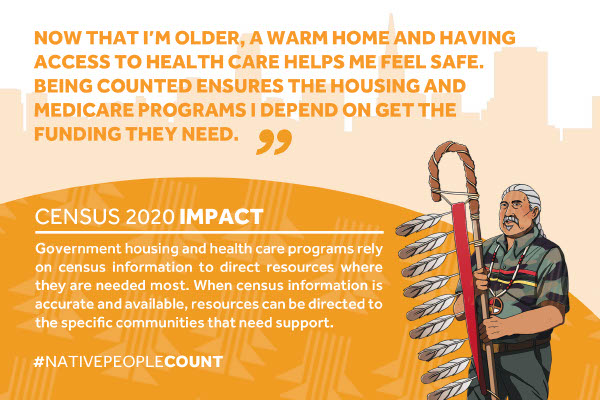
The 2020 Census has been extended to October 31. The census is an opportunity to provide a better future for our communities and future generations. A complete and accurate count of American Indians and Alaska Natives throughout the United States contributes to better planning and decision-making for Indian Country and helps determine how billions of dollars in federal funding is distributed to communities and tribes for programs and grants.
Every uncounted Native person means losing over $30,000 per person over 10 years and fewer services for our communities. Census data is the basis for the federal funding allocations of more than $675 billion annually, of which $1 billion is dedicated to Indian Country. These funds are used to build tribal housing and make improvements, maintain and construct roads and provide employment and training programs. NICOA wants to make sure Indian Country is accurately represented in the upcoming decennial count and encourages tribal communities to support the 2020 Census.
|
|
|
|
5 Recent Tribal Newsletters |
|
|
|
Over 1.5 Million American Indians Aren’t Registered to Vote |
In many close races in recent years, the margin of victory has been less than half of a percent. In these places the Native vote makes all the difference. While the American Indian population in the United States is relatively small at about 2 percent of the general population, in many states and districts, Native voters make up a sizable portion of eligible voters.
The Native vote could influence the outcome of many elections, as long as they register to vote, hold candidates accountable for their positions, and turn out to vote on election day. Let the candidates know that the Native vote is strong and you, along with your network of tribal citizens and advocates, have been watching and listening to the commitments made to tribal nations on the campaign trail, and also, to the commitments made to those who oppose tribal rights.
|
|
|
|
Native Women's Equal Pay Day on October 1 |
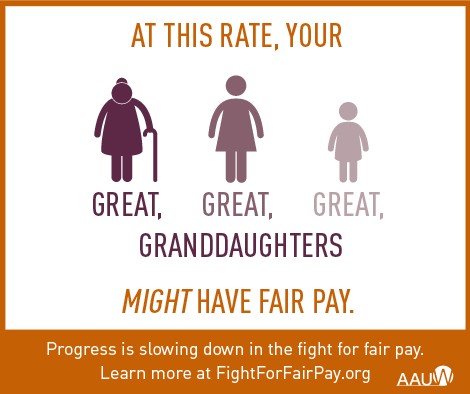
Equal Pay Day for all women should be on December 31, but it’s not. The average woman must work far into the next year to earn what the average white man earns the previous year.
American Indian women earn approximately $.57 cents on the dollar of white, non-Hispanic men (based on 2019 data). This is a $.1 cent decrease from last year.
This year Native Women’s Equal Pay Day falls on October 1 — that’s the day that the wages of American Indian and Alaska Native women catch up to the money white men were paid in 2019 (the exact day differs year by year). It took about 22 months for Native women to earn what white men were paid in 12 months alone — that’s 10 extra months of labor.
Equal Pay Day is an opportunity to draw attention to the gender pay gap and to call for legislative action and other solutions, including American Association of University Women’s salary negotiation workshops, to curb this pervasive problem. You can also promote the equal pay of Native women by voting for equity-based legislation, supporting Native leadership and inviting Native women to the table when making policy decisions.
|
|
|
|
Indigenous Peoples' Day on October 12 |
Last year, for the first time, Columbus Day was officially “Indigenous Peoples’ Day” in our nation’s capital. The District of Columbia joined Wisconsin, Maine, Vermont, New Mexico and South Dakota, who also made the switch that year. One by one, cities and states across the United States are beginning to publicly replace Columbus Day with Indigenous People’s Day. Even Columbus, Ohio does not observe its namesake’s holiday.
Indigenous Peoples’ Day is a holiday celebrated on the second Monday of October in many parts of the U.S. This date is significant because it coincides with the federal observance of Columbus Day and is seen by many as a counter-celebration to Columbus Day or an anti-Columbus Day holiday.
The observation of Indigenous Peoples’ Day counters false historical narratives embedded within the celebration of Columbus Day. It recognizes that Native people are the first inhabitants of the Americas, including the lands that later became the U.S. And it urges Americans to rethink history. On this day, people are encouraged to remember and celebrate the many Native people who have traditionally lived and currently live in the U.S and its territories.
|
|
|
|
Tribes Sue South Dakota Over Voting Rights |
The Rosebud Sioux Tribe, the Oglala Sioux Tribe, and the voting rights group Four Directions filed a federal lawsuit against South Dakota state agencies this month for failing to offer voter registration services through state agencies serving the public, as mandated by the National Voter Registration Act (NVRA).
The lawsuit alleges that the state’s agencies didn’t provide ample opportunities to register to vote or update voter registration information at places like motor vehicle and public assistance offices in areas near American Indian reservations. Federal law requires the agencies to help people register to vote at those kinds of offices, including ones that provide public assistance or serve people with disabilities. The complaint documents a steep drop in voter registration applications from public assistance agencies in recent years, and other clear evidence of non-compliance with the NVRA.
The violations described in the complaint include failure to provide voter registration applications to persons during all public benefits transactions covered by the NVRA, failure to update applicants’ voter registration address when they report a change of address to public benefits agencies, and failure to provide voter registration services to persons who lack either a social security number or driver’s license.
|
|
|
|
Montana Tribes Challenge Ballot Collection Law |
A lawsuit filed by the Montana American Civil Liberties Union against Montana Secretary of State Corey Stapleton made its first appearance in Yellowstone County District Court this month, alleging a 2018 state voter law restricts American Indians’ access to the polls.
The suit was filed on behalf of Montana American Indian voter advocacy groups and tribes, including Western Native Voice, Montana Native Vote, Native American Rights Fund, Assiniboine and Sioux tribes on the Fort Peck Reservation, Crow Tribe, Blackfeet Nation, the Fort Belknap Indian Community and Confederated Salish and Kootenai Tribes on the Flathead Reservation.
The Montana ACLU asked the court to overturn the Montana Ballot Interference Prevention Act. The ACLU argues that the law limits access to voting on Montana’s reservations. The law restricts the advocacy groups from collecting ballots from reservation residents who may otherwise have to drive an hour or more to drop off their ballot. In the past, voter advocacy groups would pick up ballots from people across the reservation leading up to election day.
The law makes it so that one person may only drop off up to six ballots per election to a polling place. Plaintiffs said vote organizers collected about 85 ballots each in previous elections.
The law also institutes a fine of up to $500 for bringing ballots to the post office on behalf of relatives or neighbors. It defines a “family member” as “an individual who is related to the voter by blood, marriage, adoption or legal guardianship,” but that definition is incompatible with American Indian family structures, which include extended family and community members, the plaintiffs said.
|
|
|
|
U.S. House Advances PROGRESS for Indians Act |
A bipartisan bill to allow American Indian tribes to become more self-reliant passed the U.S. House of Representatives last week, clearing a path for it to be signed into law by President Donald Trump.
The Practical Reforms and Other Goals To Reinforce the Effectiveness of Self-Governance and Self-Determination (PROGRESS) for Indian Tribes Act of 2019 passed the House by a voice vote. The legislation amends the Indian Self-Determination and Education Assistance Act of 1975 to streamline the Department of Interior’s process for approving self-governance contracts and annual funding agreements for Indian programs.
If signed into law, the PROGRESS for Indian Tribes Act would align the processes used by the Department of Interior to be similar to the processes used by the Indian Health Service. Under current law, each tribe seeking a new compact or renewal of an existing compact or funding agreement must use two different negotiation processes.
The bipartisan legislation will assist approximately 400 tribes that currently participate in the Self-Governance program to streamline and bring down the costs associated with the administration of programs, according to W. Ron Allen (Jamestown S’Klallam Tribe) chair of the Self-Governance Communication and Education Tribal Consortium.
|
|
|
|
Roasted Turnips and Winter Squash With Agave Glaze
- 2 pounds turnips, trimmed if needed, then cut into 1-inch chunks
- 1 small butternut squash or 2 delicata squash (about 2 pounds total), unpeeled, halved, seeds and membranes scraped away, then cut into 1-inch chunks
- 2 tablespoons sunflower oil
- 2 tablespoons chopped fresh sage
- 2 teaspoons coarse sea salt
- 2 tablespoons light agave nectar
- ¼ cup toasted sunflower seeds
Heat oven to 425 degrees. Line 2 baking sheets or roasting pans with parchment or foil. In a large bowl, toss the turnips and squash with the oil, sage and salt. Divide the mixture between the 2 baking sheets, then spread in an even layer.
Transfer to the oven on the middle and lower shelves, and roast for 20 minutes, stirring the vegetables and rotating the baking sheets halfway through. Reduce the heat to 400 degrees and continue to roast until tender and caramelized, another 10 to 20 minutes, stirring and rotating again halfway through.
Remove from the oven and brush with the agave. Return to the oven and cook until the vegetables appear glossy, 2 to 3 minutes. Serve with sunflower seeds scattered on top.
|
|
Tepary Beans With Chile-Agave Glaze
- 1 cup dried white tepary beans
- 1 cup dried brown tepary beans
- 1 tablespoon sunflower oil
- ½ small yellow onion, thinly sliced
- 3 tablespoons light agave nectar
- 1 tablespoon New Mexico Hatch chile powder or chipotle powder, plus more for garnish
- Sea salt
- 2 teaspoons whole fresh oregano leaves
Place the white and brown tepary beans in a large bowl. Add enough water to cover by 4 inches and let soak overnight at room temperature.
Drain the soaked beans, discarding the liquid, and transfer the beans to a large pot with a tight-fitting lid. Add enough cool water to cover the beans by about 4 inches. Bring to a boil over high heat, then lower the heat, cover and simmer gently, stirring occasionally, until the beans are tender, about 1 1/2 to 2 hours. Reserve 1 cup of the bean cooking liquid, then drain the beans.
In a large, deep skillet, heat the oil over medium. Add the onion and sauté until translucent, about 3 minutes. Add the cooked beans and the reserved bean cooking liquid, the agave and the chile powder. Cook, stirring occasionally, until the liquid has reduced to a glaze, about 10 minutes. Season with salt to taste. Divide among bowls, sprinkle with additional chile powder and top with oregano.
|
|
|
|
The National Indian Council on Aging, Inc. (NICOA) is a not-for-profit 501 (c)(3) charitable organization. Please consider adding NICOA to the charities you support.
NICOA needs your financial support as the advocacy and political work we do for our elders is not free. Grants that have helped fund NICOA are under threat in Washington, D.C., but you can help.
Your financial support will go directly to support our mission to improve health, social services and economic wellbeing for all American Indian and Alaska Native elders. Donations are tax deductible.
|
|
|
|
|
|
|
|