In the newsletter
- Welcome from SIG Chair
- Publication Award
- Featured Article
- ISBNPA 2025 update
-
e- and mHealth SIG Webinar
- Recent e- & mHealth Publications
| | | |
|
Dr. Amanda Staiano, PhD, MPP, MS
Associate Professor, Population and Public Health Services
Director, Pediatric Obesity & Health Behavior Laboratory at Pennington Biomedical Research Center, USA
| |
|
Welcome to Our November 2024 Newsletter
Hi e-&mHealth SIG members! We are excited to announce the winner of the 2023 Publication of the Year Award. Scroll down to find out!
In this newsletter you’ll also find a highlight of a new systematic review led by Dr. Ben Singh and written by members of the e-&mHealth SIG, as well as important deadlines for ISBNPA 2025 Annual Meeting. We also include a link to the recording of our October webinar on equity considerations in the design of mobile apps to promote physical activity and nutrition.
Spread the word about our SIG by encouraging colleagues to sign up to receive our newsletters here. On behalf of co-chair Dr. Claire Gough and our full e-&mHealth SIG committee, we look forward to connecting with you virtually this year and then next year at ISBNPA 2025 in New Zealand!
| | | |
|
Publication award 2023
We are pleased to announce the winner of the 2023 Publication of the Year Award:
| |
Authors: Christina Alexandrou*, Hanna Henriksson, Maria Henström, Pontus Henriksson, Christine Delisle Nyström, Marcus Bendtsen and Marie Löf
Nominated by: Johanna Sandborg
LINK TO FULLTEXT
We received many fantastic submissions, and after a tough deliberation process, the winner was selected by a committee based on the following three criteria:
· Scientific Rigor in e-/m-Health Research
· Innovation in Digital Health for Behavior Change
· Impact on Health Behavior and Public Health Outcomes
Congratulations to Dr. Alexandrou and team for their important contributions to the e-&mHealth field!
| | | |
Featured Article: written by e-&mHealth SIG Members | |
|
Let’s meet the first author of the following featured article, recently published in npj Digital Medicine, and learn more about his interests:
Dr. Ben Singh, PhD
LINK TO BIO
Research Fellow, University of South Australia
Dr. Singh is a Research Fellow at the University of South Australia, focusing on research in physical activity and digital health. His research focuses on promoting active lifestyles, exploring the benefits of physical activity, and examining how digital technologies—such as wearable activity trackers and mobile apps—can encourage and sustain physical activity.
| | | |
 |  | |
What are the key findings from this paper?
This paper found that eHealth and mHealth interventions are effective in improving several key lifestyle behaviors. These findings suggest that digital interventions are not only effective across various health behaviors but also applicable to diverse populations, with subgroup analyses showing consistent results across different age groups and health statuses. The scalability and accessibility of these tools make them valuable for public health efforts, offering practical solutions for promoting sustainable behavior change. Overall, eHealth and mHealth interventions provide a promising avenue for addressing key health challenges and integrating lifestyle changes into routine healthcare.
How did the paper idea come up?
The idea for this paper stemmed from the increasing global focus on eHealth and mHealth interventions as tools to promote healthier lifestyles and tackle public health challenges. With the growing use of mobile apps, SMS-based programs, and web platforms, researchers and policymakers needed a comprehensive understanding of their effectiveness. Given the fragmented evidence across multiple studies and domains (e.g., physical activity, diet, sleep), the team identified a gap in summarizing this evidence at a higher level. A meta-meta-analysis was chosen as the best method to synthesize findings across multiple systematic reviews and offer insights into these digital interventions’ impact on health behaviors.
What tips do you have for future researchers who would like to engage in this topic?
- Explore emerging digital platforms: The field is evolving rapidly with AI-based apps and wearables. Future researchers could investigate newer technologies or personalize interventions based on user preferences.
- Incorporate diverse populations: Subgroup analyses are valuable but can be underpowered. Ensure that populations of different ages, health statuses, or socioeconomic backgrounds are adequately represented to enhance generalizability.
- Consider sustainability and behavior maintenance: Look at how interventions support long-term change, as maintaining behavior beyond the initial intervention period remains a challenge.
- Plan for interdisciplinary collaboration: Work with experts across fields (e.g., digital health, behavioral science, public health) to gain deeper insights and produce more impactful research.
What did you learn from this paper that will inform your future work?
- Interventions have meaningful impacts but require refinement. While e- and mHealth interventions showed statistically significant improvements, the effect sizes, though promising, suggest room for optimization. Future work could explore ways to enhance engagement and personalization to further increase effectiveness.
- Variety in intervention types is key. The findings revealed that different digital tools—mobile apps, web-based programs, and SMS—are all effective across various behaviors. This reinforces the need for flexible approaches that cater to individual preferences and contexts.
- Importance of practical and scalable solutions. This study confirmed that digital interventions can be widely accessible and scalable, aligning with public health goals. Future research will explore how these tools can integrate with routine healthcare services to provide continuous support.
- Need for long-term follow-up. The findings emphasize the importance of studying the sustainability of behavior change. In future projects, more longitudinal research is planned to determine how these interventions impact health behaviors beyond the immediate trial period.
- Potential for personalized interventions. A next step could be developing adaptive digital interventions that tailor recommendations based on user feedback or real-time data from wearable devices.
Would you like to be featured in the next newsletter? Let us know! Email: emhsig.isbnpa@gmail.com
| | | |
|
e- and mHealth SIG Webinar:
App Co-Design: Equity Considerations for Digital Health
Did you miss the webinar? See the recording here:
https://isbnpa.org/sig/october-2-2024-1300-utc-sig-e-and-mhealth-webinar-app-co-design-equity-considerations-for-digital-health/
Speakers:
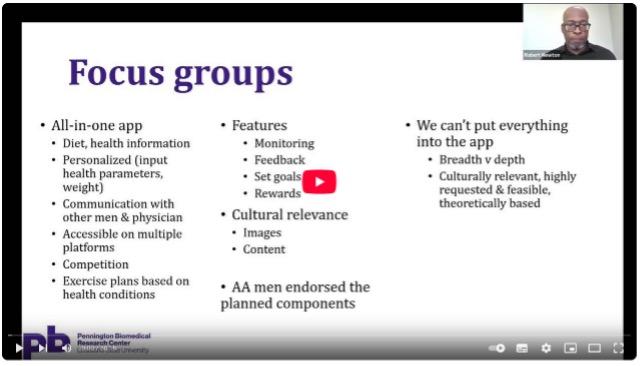
Dr. Robert Newton, Pennington Biomedical Research Center
Dr. Mavra Ahmed, University of Toronto
Moderator: Dr. Amanda Staiano, Pennington Biomedical Research Center
Abstract
Co-design engages end users from the start to develop health promotion apps that are acceptable, feasible, and effective. This approach is especially important for health equity to best support individuals from under-represented or minoritized backgrounds. This webinar will use a health equity lens to highlight two lines of research that have successfully used co-design for physical activity and nutrition promotion. Dr. Robert Newton, Professor at Pennington Biomedical Research Center, will present a series of studies that used co-design to develop an app-based physical activity promotion program for African American men in the USA. Dr. Ahmed, Fellow at the University of Toronto, will present on equity considerations in nutrition app development and co-design for digital technology to monitor food environments in Canada. There will be time for audience questions and engagement to share best practices and successful strategies for co-design in app-based health interventions.
| | | |
Recent e-&mHealth Publications
Management of Chronic Diseases
- Singh, B., et al., A systematic umbrella review and meta-meta-analysis of eHealth and mHealth interventions for improving lifestyle behaviours. NPJ Digit Med, 2024. 7(1): p. 179.
- Nguyen, V., et al., The Role of Digital Health Technology Interventions in the Prevention of Type 2 Diabetes Mellitus: A Systematic Review. Clin Med Insights Endocrinol Diabetes, 2024. 17: p. 11795514241246419.
- Shi, B., et al., Assessing the Effectiveness of eHealth Interventions to Manage Multiple Lifestyle Risk Behaviors Among Older Adults: Systematic Review and Meta-Analysis. J Med Internet Res, 2024. 26: p. e58174.
- Stowell, M., et al., Digital interventions for self-management of prediabetes: A scoping review. PLoS One, 2024. 19(5): p. e0303074.
Diet & Nutrition
- Bennett, R., et al., The potential influence of the digital food retail environment on health: A systematic scoping review of the literature. Obes Rev, 2024. 25(3): p. e13671.
- Pala, D., et al., Smartphone applications for nutrition Support: A systematic review of the target outcomes and main functionalities. Int J Med Inform, 2024. 184: p. 105351.
- Schaafsma, H.N., et al., The impact of smartphone app-based interventions on adolescents' dietary intake: a systematic review and evaluation of equity factor reporting in intervention studies. Nutr Rev, 2024. 82(4): p. 467-486.
- O'Connor, H., et al., Digital preconception interventions targeting weight, diet and physical activity: A systematic review. Nutr Diet, 2024. 81(3): p. 244-260.
Physical Activity and Sedentary Behavior Interventions
- Tong, H.L., et al., The Use of Mobile Technologies to Promote Physical Activity and Reduce Sedentary Behaviors in the Middle East and North Africa Region: Systematic Review and Meta-Analysis. J Med Internet Res, 2024. 26: p. e53651.
- Fiedler, J., et al., Just-in-Time Adaptive Interventions for Behavior Change in Physiological Health Outcomes and the Use Case for Knee Osteoarthritis: Systematic Review. J Med Internet Res, 2024. 26: p. e54119
- Bernstein, E.E., et al., Lessons and Untapped Potential of Smartphone-Based Physical Activity Interventions for Mental Health: Narrative Review. JMIR Mhealth Uhealth, 2024. 12: p. e45860.
- Parés-Salomón, I., et al., Effectiveness of workplace interventions with digital elements to reduce sedentary behaviours in office employees: a systematic review and meta-analysis. Int J Behav Nutr Phys Act, 2024. 21(1): p. 41.
Don't see your recent publication listed? Let us know! Email: emhsig.isbnpa@gmail.com
| | | |
Stay up to date: Follow us!
Keep up to date on recent e- & mHealth publications and happenings within the SIG by following us on our various platforms.
Twitter: @ISBNPA_emh
Feel free to tag us and we will try to share your publication as well!!
| |
| | |
|
Spread the Word!
Encourage your colleagues to sign up for our SIG newsletter!
You or your colleagues can join this mailing list by updating your membership profile and adding the SIG to your preferences; or by sending an email to executivedirector@isbnpa.org. Click here for more details.
| | | |
|
2024 SIG Committee Members
- Chair: Amanda Staiano (USA)
- Co-Chair: Claire Gough (Australia)
- Immediate Past Chair: Mavra Ahmed (Canada)
- Secretary: Bridve Sivakumar (Canada)
- Membership: Zenong Yin (USA)
- Social Media: Irina Timm (Germany), Katie Spring (USA), Xin Chen (USA)
- Newsletter: Jasmine Petersen (Australia), Ben Singh (Australia), Hannes Baumann (Germany), Janis Fiedler (Germany)
- Events/Awards: Maria Vasiloglou (Switzerland), Joan Dallinga (Netherlands), Shariwa Oke (USA)
- Past Chairs: Andre Muller (Singapore), Camille Short (Australia)
- Fellows: Carol Maher (Australia), Corneel Vandelanotte (Australia)
| | | | | | |