Elmo Peeler Note-for-Note Piano Transcriptions
|
|
|
Today is the first day of May - and time again for my monthly newsletter, to keep you informed of recent transcriptions and other news of the last month.
This month I've finished two brand-new transcriptions of one of rock-and-roll's historic classics - "Slippin' & Slidin'".
Why two? The first is Little Richard's original recording - a powerful, driving piano part, straight out of the 1950's (1956).
And the second is young Billy Preston's great organ version - one of the best Hammond B-3 instrumentals ever - recorded the month that Billy turned 18!
Plus, a challenging - and beneficial - new finger exercise inspired by an Albert Ammons riff.
BTW, to make sure that my email doesn't end up in your Spam folder, please add me to your Contact list and/or mark my email as "Not Spam".
Note that every Title Heading is clickable.
Elmo Peeler
|
|
|
ALL of the Sheet Music listed on my website has been personally transcribed by me, and guaranteed to be note-for-note perfect.
Whether you:
-
have a cover band and want to get your keyboard parts exactly correct,
-
are a professional who wants to study the styles of rock's greatest keyboard players, or
-
are a hobbyist that wants to learn how to play pop/rock and great piano music,
...these note-for-note transcriptions will prove extremely helpful.
And as always, if you ever need any help, just drop me a note at: elmo@manymidi.com
|
Plus Billy Preston's Wonderful B-3 Organ Version
|
|
 |
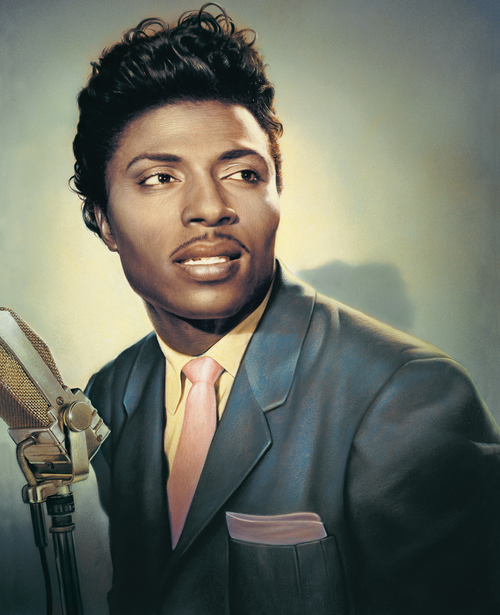
Little Richard - High Energy 1950's Piano
|
|
Little Richard was born Richard Penniman and raised in Macon, Georgia, one of twelve children in a very religious family.
Richard sang in church at an early age, and was very influenced by gospel performers, including Mahalia Jackson and his favorite, Sister Rosetta Tharpe.
Richard's mother recalled that he was "always musical" and that when he was young, he would always "beat on the steps of the house, and on tin cans and pots and pans, or whatever, while singing." He was so quick at learning to play the saxophone that he was allowed to play with the high school's marching band immediately.
When Little Richard was 14, his favorite singer, Sister Rosetta Tharpe, heard him sing and asked him to open for her at a Macon all-gospel concert - his first paid public performance. He sang gospel songs, as secular music, considered "the Devil's music", was forbidden in his home.
|
|
|
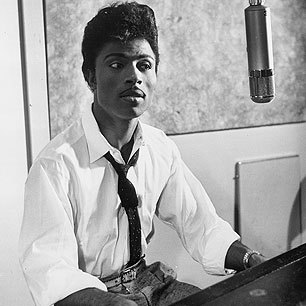
Little Richard - In the Studio
|
His father, a church deacon who owned a nightclub and bootlegged moonshine, ordered Richard, in his mid-teens, to move out of the family home, because of his early signs of homosexuality. He was taken in by a white family who owned a club in Macon, where Richard eventually began performing and honing his talent.
Richard started recording in 1951 at age 19, but as of 1955 had not yet had a hit. Lloyd Price, who had written and recorded the #1 R&B hit "Lawdy Miss Clawdy", suggested that Richard send a two-song demo to Price's label, Specialty Records. Art Rupe, the owner of Specialty, teamed Richard with producer 'Bumps' Blackwell, and nine months later "Tutti-Frutti" was a smash hit.
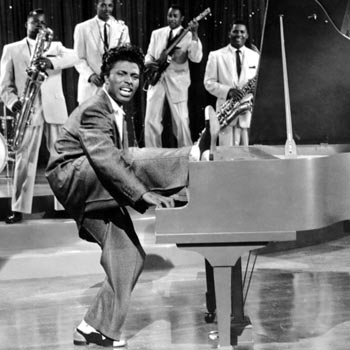
Richard's electrifying piano style used jackhammer-fast triplets - both octaves and chords - and often his Right Hand would descend the keyboard in clusters. As a piano-player, he was very much for real.
|
|
|
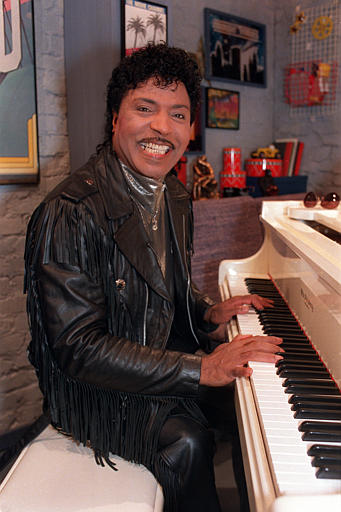
Little Richard with his best friend
|
|
Over the next three years he churned out 18 hit singles, including
"Slippin' and Slidin'", "Ready Teddy", "The Girl Can't Help It", "Lucille", "Jenny, Jenny", "Long Tall Sally", and "Good Golly Miss Molly".
However, by 1957 Richard had quit rock-and-roll and began performing only gospel music. In 1964 he resumed playing rock until 1977, when he again retreated into gospel-only performances.
In 1985 Richard returned to rock performing and accepted a role in the film
Down and Out in Beverly Hills. He and Billy Preston wrote the faith-based rock-and-roll song,
"Great Gosh A'Mighty" for its soundtrack.
A high-energy rocker, "Great Gosh A'Mighty" contains many of the same elements of his earlier dynamic hits: a droning, pounding Left Hand, a driving, mid-register Right Hand, and occasionally using the high registers for pneumatic-hammer-fast octave triplets and runs.
Years later, in 1994, Little Richard and Lloyd Price appeared together on the
Sally Jesse Raphael TV Show, and performed
"Lawdy Miss Clawdy" together - Price's song whose success had made both their careers possible. Price's original recording used Fats Domino on piano, but Richard's more driving piano style brings a new level of energy to "Miss Clawdy".
And, of course, Little Richard's driving piano style is certainly on display in his original 1956 recording of
"Slippin' and Slidin'".
If you haven't heard it in a while, listen to it here on YouTube.
My Little Richard transcriptions:
plus, Leon Russell's song about Little Richard:
|
|
|
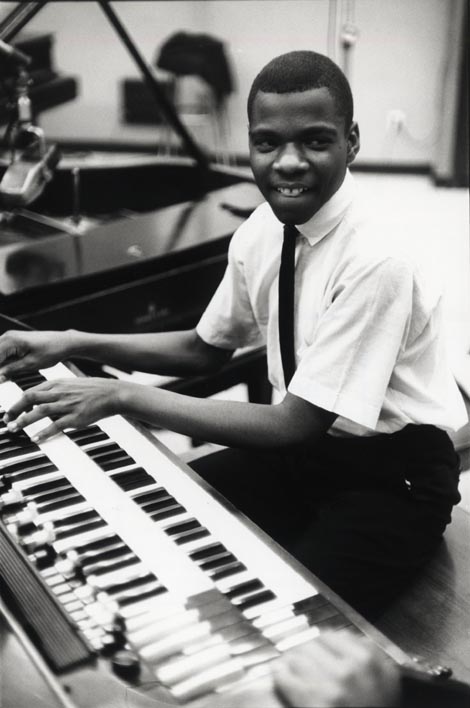
Young Billy Preston, Genius of the B-3
|
Born in 1946 in Houston, Texas, Billy Preston moved to Los Angeles as a child w
it
h his mother, a stage actress - for whom twenty years later he would write "You Are So Beautiful". A child prodigy with perfect pitch, Billy started playing piano while sitting on his mother's lap and was entirely self-taught.
Although he'd never had a music lesson, by age ten Billy was playing organ onstage, backing gospel singers such as Mahalia Jackson, James Cleveland and Andrae Crouch.
At 11 Preston appeared on an episode of Nat King Cole's TV show singing the Fats Domino hit "Blueberry Hill" with Cole. He also appeared in St. Louis Blues, a 1958 movie about W. C. Handy starring Nat 'King' Cole, Ea
rtha Kitt and Cab Calloway; Preston played Handy at a younger age.
In 1962, Preston joined Little Richard's band as an organist, and it was while performing in Hamburg that he met the Beatles. In 1963, he played the organ on Sam Cooke's Night Beat album and released his own debut album, 16 Yr Old Soul, for Cooke's SAR label. In 1965, he released the album The Most Exciting Organ Ever (which includes "Slippin' and Slidin'") and performed on the rock and roll show Shindig! In 1967, he joined Ray Charles' band.
Following this exposure, several musicians began asking Preston to contribute to their sessions, including the Beatles, seve
n years after meeting him while playing with Little Richard.
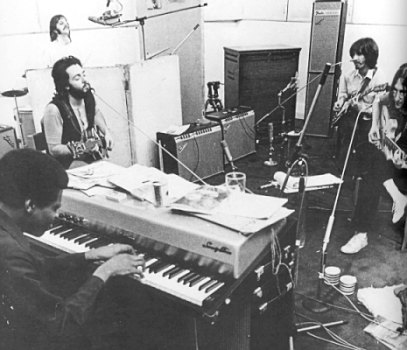
He played on several of their songs, including "Get Back", "Don't Let Me Down", "Something", "Let It Be" (the organ part), and "I Want You (She's So Heavy)".
|
|
|
| Billy Preston, the "Fifth Beatle" |
|
During the "Get Back" sessions Lennon suggested that Preston join the Beatles, even using the term "Fifth Beatle", but the idea was dismissed by the others
.
Billy Preston was the only artist to receive joint credit on a Beatles single. Preston also accompanied the band on electric piano for its rooftop concert, the group's final public appearance.
From 1970, Preston played keyboards (including piano, organ, clavinet and various synthesizers) for the Rolling Stones, sometimes alongside pianists Nicky Hopkins and Ian Stewart, on their albums Sticky Fingers, Exile on Main St. (which includes "Shine a Light")
, Goats Head Soup, It's Only Rock 'n Roll and Black and Blue.
Although credited to usual Stones writers Mick Jagger and Keith Richards, "Shine a Light" was largely a Mick Jagger-Leon Russell composition. Mick began writing the song in early 1968 when the Stones still had guitarist Brian Jones as a member. The song was originally titled "Get a Line on You" and dealt with Jones's ever-worsening addiction to drugs and his detachment from the rest of the band.
After Jones' death in 1969, the song resurfaced. Following revisions by Jagger, it was recorded again in July 1970 as
"Shine a Light". A third recording at London's Olympic Sound Studios in December 1971 resulted in the final version of the song released on
Exile on Main St.
|
|
|
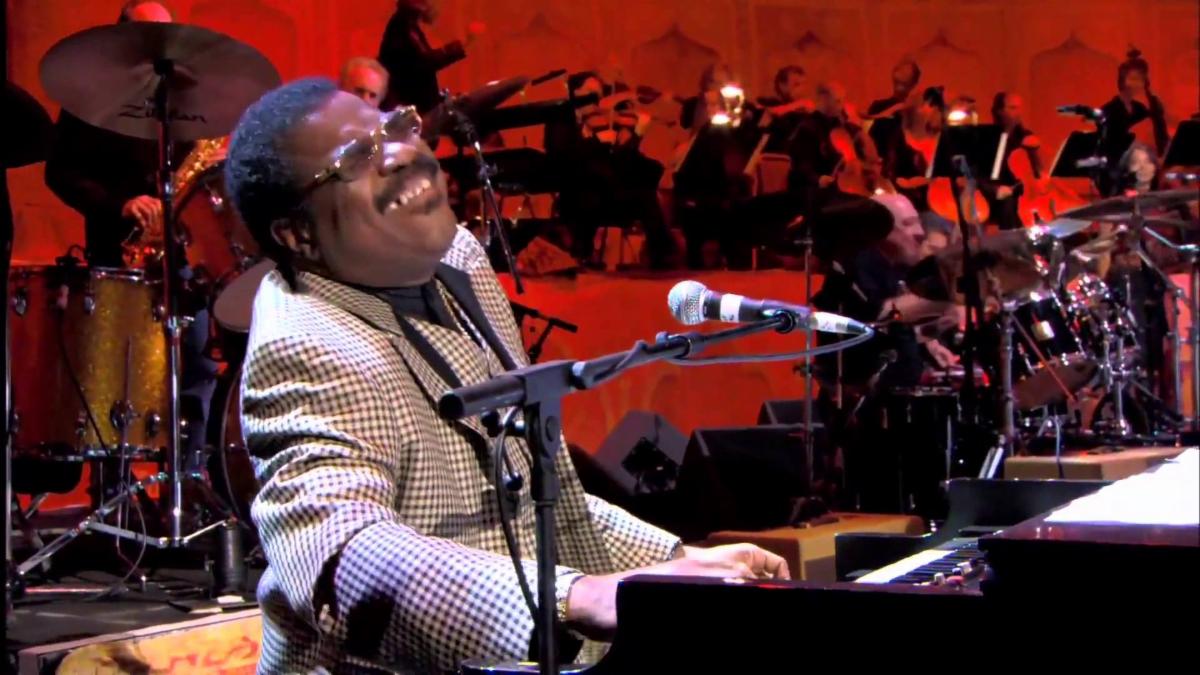
Billy Preston at play |
As the band's primary touring keyboardist from 1973 to 1977, he also
performed as a support act with his own band (including Mick Taylor on guitar) on their 1973 European tour.
In 1974, along with Bruce Fisher, one of his regular songwriting collaborators in the 1970s, he composed one of Joe Cocker's biggest hits, "You Are So Beautiful". On October 11, 1975, he was the first musical guest on Saturday Night Live's premiere episode.
Although the Stones and Preston parted company in 1977, mainly due to a disagreement over money, Billy continued to play on solo records by Stones members like
Mick Jagger's Wandering Spirit, and made appearances on the band's Tattoo You and Bridges to Babylon albums.
Billy Preston was certainly one of the most gifted musicians in the history of rock-and-roll, bringing rock organ-playing to a new level. His instrumental version of "Slippin' and Slidin'" shows off many of his extraordinary B-3 techniques: his extremely 'fat' chords, 'crushed' notes, grace notes, tremolos, his amazing glissandi, etc. If you haven't heard this special recording, listen to it
here.
Here are my Billy Preston transcriptions:
Plus, here are my Billy Preston-related exercises:
|
Little Richard & Billy Preston - Both Versions
Note-for-Note Accuracy
Occasionally I'll transcribe a really historic recording. This month is special - there are two.
Not only have I transcribed Little Richard's piano part from his original 1956 smash hit record, "Slippin' and Slidin'", but also I've finished Billy Preston's own instrumental version of it, chosen because it is one of Billy Preston's best B-3 organ instrumentals.
Little Richard's attention-getting piano octaves kick-off his 1956 "Slippin' & Slidin'", setting the tone from the very beginning of an uptempo rhomp through ten 12-bar phrases, only four of which are vocal.
The other six sections of Little Richard's recording are instrumental, either piano or sax/piano, ending with driving high-register repeated chords (with some good accents - all notated, of course). This piano track is pure R&B/R&R history. There'll never be another Little Richard.
Nor another Billy Preston. I chose this track not because of any commission but because it has been a favorite of mine since I first heard it at age 15. I could hardly believe the sounds that he was getting out of the organ, having never heard glissandi like his, and the hugely 'fat' chords he was able to achieve on his B-3. I've been dying to pick it out so that I myself could study his style in detail; this has been a "Holy Grail" recording to me - and now that it's done, it is just as amazing as I'd thought.
Starting at the very beginning with a growling, ascending palm glissando, Billy Preston uses the song to showcase his amazing bag of B-3 tricks, including his extremely 'fat' chords, 'crushed' notes, grace notes, tremolos, his amazing glissandi, etc. No one could make a B-3 'talk' like Billy Preston.
If you'd like to incorporate some of Billy's techniques into your own playing, his organ instrumental of "Slippin' and Slidin'" is an excellent place to start. Superior organ playing.
(listen to Little Richard's "Slippin' & Slidin'"
here)
(listen to Billy Preston's "Slippin' & Slidin'"
here)
|
Inspired by an Albert Ammons Riff in "Boogie Woogie Stomp"
|
|
|
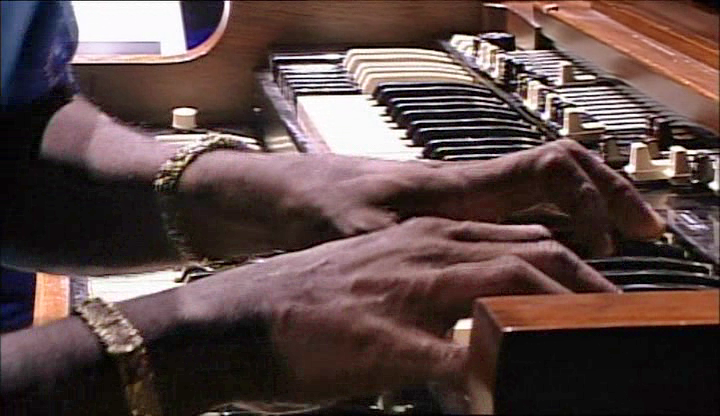
| Billy Preston's hands |
|
My new exercise this month addresses the most important finger movement in piano-playing, i.e., the "thumb-under" movement, where the thumb passes under the 3rd or the 4th finger. It's very important to be able to execute it evenly and fluidly, without any break or 'hop'.
This exercise is for strengthening and improving the control of the "thumb-under" movement in the Right Hand as the thumb passes under the 4th finger and as the 4th finger passes over the thumb.
It was inspired by a riff in Albert Ammon's "Boogie Woogie Stomp", which is included at the very end.
It is in four sections, with fingering:
A) sets forth the basic exercise.
B) is where the added 'twist' (challenge) comes in; the highest note is taken up an octave, thus helping one's leaps.
C) adds the thumb-under-the-3rd-finger movement.
D) adds the 'twist' of taking the highest note up an octave, again helping to improve the accuracy of one's leaps.
The four sections are comprised of six 2-bar phrases, each of which is an exercise of its own. After mastering all six phrases, then all six can be played sequentially, i.e., back-to-back as notated, without pausing.
(BTW, if you need other good, effective technical exercises, please check out
the other 74 exercises available.)
|
What Recording Would You Like To See Transcribed?
'Custom' (to-order) transcriptions can be expensive because of the time required. And when a recording is particularly long and/or complex, the expense can be too much for one person.
if you'd like to suggest a recording for 'crowdfunding'.
My 'CrowdFunded' transcriptions to-date:
|
Feeling a bit cooped up? Not getting out a lot these days? Why not use the extra time to dust off and improve your keyboard skills?
Use these uncertain times to explore the music that you've always wanted to.
By means of Skype lessons, I can coach you and help you to improve your technique, your rhythm, your knowledge of music theory, and to develop relative pitch.
I've had the good fortune to have
toured the world playing keyboards and arranging/conducting for these Rock and Roll Hall of Fame Artists:
- The Beach Boys
- Rod Stewart - All 'Unplugged' concerts
- Ricky Nelson - Stone Canyon Band
And I've also won classical piano competitions performing Beethoven,
Rubinstein a
nd
Saint-Saens' Piano Concerti. See me playing here. "Josie's Boogie" is quite the virtuoso dramatic mino
r-key showpiece; check out the ascending double-octave run at the ending... :)
Thanks to the internet, I can help you play piano better - rock or classical, by ear or by note.
Perhaps all you need is just an hour on Skype discussing rock keyboards.
If you'd like to improve, drop me a note
at
info@manymidi.com. Tell me three things:
1) Your musical background
2) Where you are currently, musically-speaking
3) Your musical goals
My students include members of:
- Weezer (Rivers & Brian)
- Vampire Weekend (Ezra & newest addition, Greta)
- Incubus (Mike)
- The Strokes (Nick)
- Rooney (Robert)
- Jason Schwartzman ("Mozart in the Jungle")
- Courteney Cox
|
|
|
|
|