A regional resource for Cape & Islands climate activists
August 9, 2021
|
|
The IPCC delivers its starkest warning about the world’s climate
Observations of changes now taking place make the science more accurate, but not more reassuring
Science & Technology | The Economist, Aug 9, 2021
AT A KEY moment in the film “Jaws”, police chief Martin Brody, having known that a shark attack was possible, witnesses one actually happen. The director, Stephen Spielberg, underlines the transformative nature of Brody’s shock with a shot which makes inspired use of a camera technique called a “dolly zoom”. Nothing on screen actually moves. But Brody’s guilty face seems to rush towards the audience, taking up more and more of the frame. At the same time his surroundings, rather than being displaced, are revealed more fully.
The report released by the Intergovernmental Panel on Climate Change on August 9th, the first part of the IPCC’s sixth assessment report (AR6), presents the spectacle of the possible becoming actual in a similarly unnerving way. The focus on the risk of continued warming makes it starker than ever before; meanwhile the detail with which the changes already under way can now be seen broadens the context in which that challenge is seen.
The oncoming dread registers yet more clearly than it did in the IPCC’s previous major assessment, AR5, published in 2013-14. Read more.
|
|
Film
What is net zero?
Targets that are easier set than done
The Economist, July 31, 2021
Companies, countries and even celebrities have started setting “net zero” targets to combat climate change. Theoretically, the concept is simple—balance greenhouse gas removal with greenhouse gas emissions, so that the overall net emissions are zero. Yet with no real global consensus as to who is responsible for emissions, and with new technologies to offset carbon in their infancy, achieving net zero will prove to be a Herculean task. Watch the film.
|
|
Guest Commentary
Proposed Machine Gun Range: Let’s Play 'Twenty Questions'
By Frederick S. Lane, The Sandwich Enterprise, July 30, 2021
The Massachusetts Army National Guard has proposed a multi-purpose machine gun range on Camp Edwards, part of Joint Base Cape Cod. The outline seems rather straightforward: install eight-firing lanes, clear-cut 170 acres of trees, create a 5,000-acre danger zone to collect projectiles and build support facilities.
But the 15,000 acres of Camp Edwards has been governed for the last two decades by Chapter 47 of the Massachusetts Laws of 2002. This law only permits military activity “compatible with the natural resource purposes of water supply and wildlife habitat protection.” The water supply here is the sole-source aquifer under Camp Edwards that supplies the drinking water for 150,000 Upper Cape residents plus visitors.
There remain many unan-swered questions about the Guard’s proposal. Perhaps it’s time to play “Twenty Questions” with the Guard’s leaders. This is an old parlor game and radio show from the 1940s and 1950s. Then, the answers were constrained, as in “animal, vegetable or mineral” and simply yes or no. Here we seek broader answers. Read more.
|
|
Baker Expresses Environmental, Safety Concerns About Proposed Machine Gun Range
By Eve Zuckoff, CAI, July 23, 2021
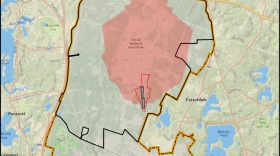
The red outline on this map of Camp Edwards shows where the Army National Guard is proposing an eight-lane machine gun range. The surface danger zone, where projectiles could land, is highlighted in pink.
Gov. Charlie Baker said his administration has questions about the environmental and public safety impacts of a proposed machine gun range on Joint Base Cape Cod, in his first public comments about the project.
“That project certainly has to go through a series of reviews and there’s going to be a very significant and aggressive outreach program,” he said during a news conference Thursday. Read more.
|
|
Falmouth Sets Public Meeting on Proposed Machine Gun Range — Whether or Not Guard Officials Attend
By Eve Zuckoff, CAI, July 28, 2021
The red outline on this map of Camp Edwards shows where the Army National Guard is proposing an eight-lane machine gun range. The surface danger zone, where projectiles could land, is highlighted in pink.
A public meeting has been scheduled for next month to allow Falmouth residents to share their thoughts on a proposed machine gun range at Joint Base Cape Cod — whether or not base officials are present.
The meeting, tentatively set for Thursday, August 26, at 6 p.m., at Falmouth High School, will be an opportunity for residents to share their thoughts with state lawmakers and the Select Board, before it takes a formal position on the proposed range.
Nancy Taylor, vice chair of the Falmouth Select Board, said local lawmakers decided this week to schedule the meeting without first confirming whether Guard officials are available that evening. The decision was driven, Taylor said, by a feeling of frustration and need to get the ball rolling. Read more.
|
|
'A sense of urgency': Cape Cod action needed on climate change, commission maps a plan
By Doug Fraser, Cape Cod Times, July 30, 2021 (Photo credit: Eric Williams, Cape Cod Times)ie
BARNSTABLE — Even in the middle of a global pandemic, climate change forced its way onto media front pages over the past year with record heat, droughts, water shortages and unprecedented flooding.
"It's not so much that climate change itself is proceeding faster than expected — the warming is right in line with model predictions from decades ago," said climate scientist Michael Mann of Pennsylvania State University in a July 26 Reuters article. "Rather, it's the fact that some of the impacts are greater than scientists predicted."
With nearly 600 miles of sandy coastline, Cape Cod is particularly vulnerable to climate change impacts. Last week, the Cape Cod Commission released its climate change action report that lays out how the region can reduce its greenhouse gas emissions and adapt to a world undergoing massive and rapid change. Read more.
|
|
An electric jet start-up just signed a $1 billion deal with a commercial airliner
By Sam Shead, CNBC, August 2, 2021 (Photo credit: Lilium)
Lilium, a German start-up making electric jets that can take off and land vertically, has announced plans to sell 220 of its vehicles for up to $1 billion to Brazilian airliner Azul.
The two firms said on Monday that they plan to build an eVTOL (electric vehicle takeoff and landing) aircraft network across Brazil between now and 2025.
“The aircraft we’re planning to launch will do 175 miles an hour,” Alex Asseily, Lilium’s chief strategy officer, told CNBC on Monday. “The range will be 155 miles.” The aviation industry is under intensifying pressure to look at new ways of powering their carriers as policymakers publicly acknowledge the necessity of transitioning to a low-carbon society. Read more.
|
|
Partner Spotlight - Vineyard Wind
|
|
Vineyard Wind Secures Project Labor Agreement
By Michael Bates, North American Wind Power, July 20, 2021
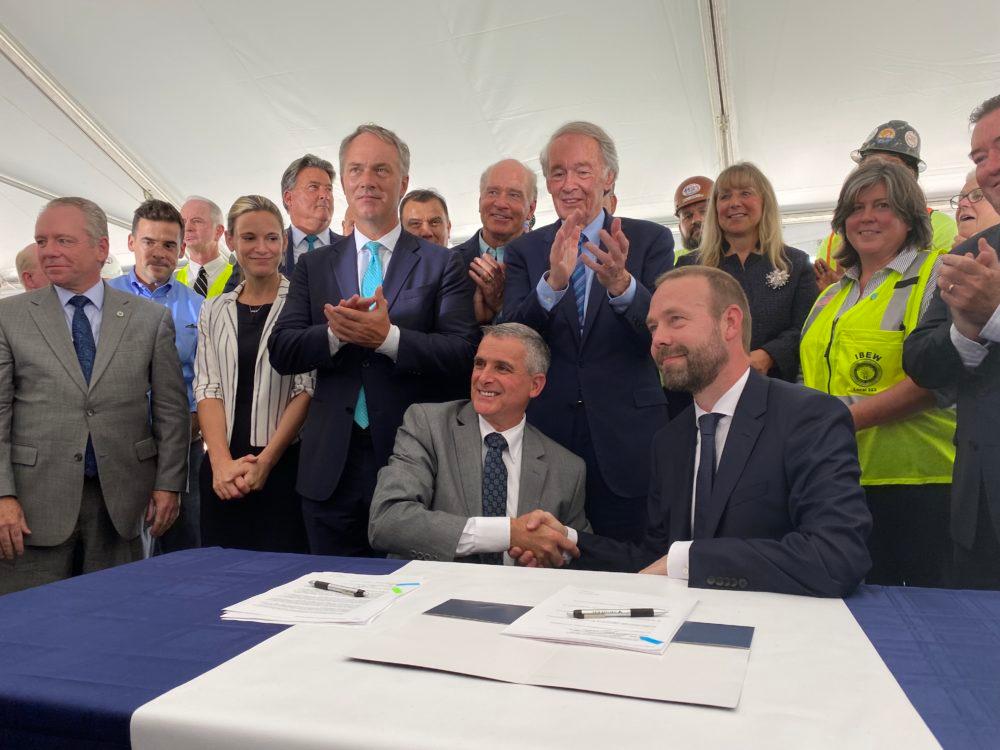
As planned, Vineyard Wind and the Southeastern Massachusetts Building Trades Council have secured what they say is the first project labor agreement (PLA) for an industrial-scale offshore wind project in the U.S.
According to the partners, the agreement ensures “fair, family-supporting wages and thorough workplace protections” for the workers who will be constructing the Vineyard Wind 1 offshore project. The PLA also ensures that there will be “talented and skilled” laborers available during construction to meet the project’s needs and deliver Vineyard Wind 1 on schedule. Five hundred union jobs are expected to be created.
“The signing of this PLA is the culmination of our long-standing promise to the working people of Massachusetts,” says Vineyard Wind’s CEO, Lars T. Pedersen. “We now have an agreement in place that will make sure local residents on the South Coast, Cape and Islands, can reap the greatest possible benefit from this new and growing industry. And beyond that, it’s a commitment to make sure we have a diversified workforce that represents the communities where we work, so that we can open the doors of opportunity as wide as possible.”
Frank Callahan, president of the Massachusetts Building Trades Council, says, “The men and women of North America’s Building Trades Unions are the best trained, most highly skilled and most productive workforce in the world. They get the job done right while earning family-sustaining wages and benefits that provide them a secure place in America’s middle class.” Read more.
|
|
Energy & Built Environment |
|
DOE Moves to Ensure Dishwashers, Washers, and Dryers Don’t Guzzle Energy and Water
By Ben Somberg, CEEE.org, August 3, 2021
Washington, DC — A Department of Energy (DOE) proposed rule announced today would ensure that all new dishwashers, clothes washers, and dryers meet federal energy and water efficiency standards set years ago. The proposal, if finalized, would effectively undo two rules issued last year by the previous administration that could allow certain models to use unlimited energy and water.
The 2020 rules created separate “product classes” for dishwashers and clothes washers and dryers that have a short cycle as the “normal” cycle, effectively absolving such models of the need to meet existing energy and water standards. These models could use unlimited energy and water because DOE has not set a standard for them. Fortunately, no major manufacturer has created a model so far to exploit the loophole and many publicly opposed the 2020 rules.
“This was a silly but dangerous loophole that could be exploited to make products that waste wild amounts of energy and water, and it’s good that they’re closing it,” said Andrew deLaski, executive director of the Appliance Standards Awareness Project (ASAP). Read more.
|
|
The time is now to prove they can go beyond just bland emissions reduction pledges.
By Jamie Beck, Fast Company, June 7, 2021
Two years ago Mark Carney, then-head of the central bank of England called into question the very existence of corporations that don’t adhere to the steep emissions reductions required to limit warming to 1.5C: “Those that fail to adapt will cease to exist.” Since then, the continuing rise of emissions has led to mounting pressure on companies—from employees, regulatory bodies and activist investors like the recent success of investor activism at ExxonMobil. Carney’s prophecy may soon be coming to pass. Is it possible for corporations to be part of the transformational change required, or will they remain complicit in the status quo?
You could be forgiven for thinking that business was already leading the way on climate. During the past four years of climate denial in the White House, attention shifted to corporations to carry the mantle of leadership. And since it was largely useless to engage with the Trump White House on climate policy, companies expressed their climate ambition through promises—signing pledges and making public commitments targeting a year in the future when they would finally stop pouring planet-warming gases into the atmosphere. These often followed a tired formula: “X company commits to achieving net-zero planet-warming emissions by y decades from now.”
But our atmosphere hasn’t seen returns on these promises: of the one-fifth of the world’s largest companies that have set a net zero target, the vast majority are nowhere near actually meeting them and very few have set interim targets to keep them honest. And while these lofty proclamations are being made— to great fanfare at international climate conferences—these same corporations are delaying and opposing climate action through side doors. Read more.
|
|
The Recycling Myth
Big Oil's Solution for Plastic Waste Littered with Failure
By Joe Brock, Valerie Volcovici and John Geddie, Reuters, July 29, 2021
In early 2018, residents of Boise, Idaho were told by city officials that a breakthrough technology could transform their hard-to-recycle plastic waste into low-polluting fuel. The program, backed by Dow Inc, one of the world’s biggest plastics producers, was hailed locally as a greener alternative to burying it in the county landfill.
A few months later, residents of Boise and its suburbs began stuffing their yogurt containers, cereal-box liners and other plastic waste into special orange garbage bags, which were then trucked more than 300 miles (483 kilometers) away, across the state line to Salt Lake City, Utah.
The destination was a company called Renewlogy. The startup marketed itself as an “advanced recycling” company capable of handling hard-to-recycle plastics such as plastic bags or takeout containers – stuff most traditional recyclers won’t touch. Renewlogy’s technology, company founder Priyanka Bakaya told local media at the time, would heat plastic in a special oxygen-starved chamber, transforming the trash into diesel fuel. Read more.
|
|
The professor who assigns value to nature — then persuades world leaders to save it
Gretchen Daily is a pioneer in the field known as “natural capital.” Using science and software, she shows stakeholders why it benefits everyone to prioritize conservation.
By Tik Root, The Washington Post, Illustration by Stef Wong, July 30, 2021
Colombia’s Gulf of Morrosquillo is home to thousands of mangroves. Their roots arc downward into salty seawater while their limbs climb upward — a mesmerizing entanglement of branches and leaves.
But the mangroves must compete with hotels, resorts and other financial ventures in the tourist-dependent area, which spans 325 miles of Caribbean coastline. One study found that between 1960 and 2011, the mangrove population in Colombia dropped by more than half, largely due to human activities such as development or trash dumping.
The burgeoning tourist destination of Rincón del Mar, for instance, is one of many towns along the gulf that was built on land cleared of the trees. And because there is no central garbage collection system, people’s wrappers, bottles, bags and other refuse often end up in the mangroves that still stand. Read more.
|
|
The Darker Side of Tree-Planting Pledges
Campaigns to plant millions of trees have become popular urban responses to climate change. But many have fallen far short of their goals.
By Feargus O'Sullivan and Linda Poon, Bloomberg CityLab, July 30, 2021
The plan launched to great fanfare in 2015. Copenhagen would plant 100,000 new trees in the Danish capital by 2025. Like many similar tree-planting pledges, the commitment was pitched as a key prong of its plan to reduce carbon emissions.
But six years later, many of the saplings have already withered and died.
“People bash into them with bikes and cars,” says Sandra Hoj, an urban tree campaigner in the city, “and they often don’t have proper protection.” The bark gets slashed, or they get poisoned in the winter because the municipality has put salt on the roads instead of some alternative that’s safe for the trees. "Meanwhile, the city is still replacing some beautiful mature trees with tiny little twigs, which die, are replanted, and then die again,” says Hoj.
Copenhagen’s record doesn’t necessarily stand out as especially bad: The city points out that its tree-planting schemes have increased Copenhagen's canopy cover by 1.5% since 2015.
|
|
Climate XChange State Climate Policy Network seeks state peer reviewers
The Climate XChange's State Climate Policy Network (SCPN) is a consortium of more than 15,000 advocates, policymakers, business leaders, economists, and scientists — all working to advance effective and equitable climate policies in their state. The network is rapidly growing and expanding across the country, with members across all 50 states, including hundreds of state legislators and executive branch officials.
SCPN is building out an ambitious new policy dashboard, which tracks the occurrence of 35 different state climate policies across all 50 states. Policy topics include climate governance, environmental justice, electricity, buildings, transportation, industry, agriculture and conservation, and adaptation and resilience. Before launching this project, the Climate XChange wants to double and triple check that they are portraying every state correctly.
If you are willing to take 30-40 minutes to peer review draft policy data for your state, please email Noa Dalzell at ndalzell@climate-xchange.org.
|
|
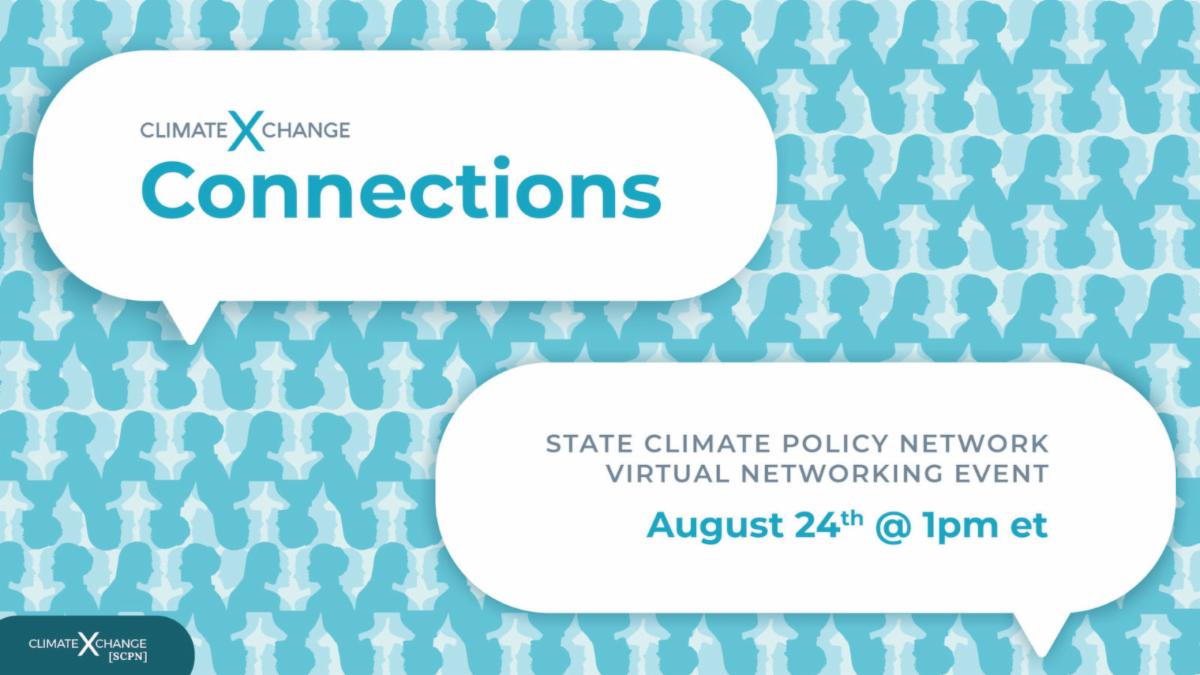
Climate XChange Connections:
A State Climate Policy Network Virtual Networking Event
Tuesday, August 24
1:00 pm - 2:00 pm
Are you looking for employment or volunteer opportunities in the climate space? Are you hoping to connect with like minded individuals on a research initiative? Or, are you simply interested in building up your network and getting to know climate advocates working across different states and sectors?
For the first time ever, Climate XChange will be hosting a State Climate Policy Network Virtual Networking Event, where students, advocates, policymakers, business leaders, academics, and everyone in between will join us for an informal hour of getting to know one another and connecting to advance the climate movement. Read more.
|
|
Association of Climate Change Officers offers live online CC-P® Prep Programs
Late Summer 2021 Cohorts
|
|
Have You Heard the News?
Our annual conference — Net Zero 2021 — is coming back bigger, better, badder...and virtually! Mark your calendars for Friday, October 29, 2021.
|
|
|
|
|
We are an all-volunteer 501(c)(3) organization whose mission is to reach carbon neutrality — or net zero — on Cape Cod and the Islands of Massachusetts by enhancing communication, collaboration, and activism among organizations, programs, and individuals committed to mitigating the climate crisis. We depend upon the generosity of our stakeholders to conduct our work. All donations are tax deductible as allowed by law.
|
|
The Climate Action Alerts newsletter is compiled and crafted by Fran Schofield. If you've got a climate story from your home, school, workplace, town or organization, please be in touch! And don't forget to share this action alert with your friends and suggest they subscribe here.
|
|
|
|
|
|
|