|
Market Navigator for the Quarter Ending March 31, 2026
Presented by Austin Fearon
Markets dropped in March as rising concerns about the ongoing hostilities in the Middle East weighed on investors. Rising energy prices and interest rates during the month challenged bond returns, and both domestic and foreign stocks ended the quarter in the red.
1. Beyond the Headlines: Markets Fall to End Quarter
2. Fixed Income Update: Rising Rates Create Headwinds
3. Geopolitical and Economic Update: War with Iran Takes Center Stage
4. Looking Ahead: Shifting Risks
Beyond the Headlines: Markets Fall to End Quarter
Markets fell in March, driven by rising geopolitical uncertainty due to the ongoing war in Iran. The S&P 500 fell 4.98 percent in March, which led to a 4.33 percent decline for the quarter. The story was similar for the Dow Jones Industrial Average, which dropped 5.20 percent in March and 3.19 percent for the quarter. Technology stocks were hit especially hard during the quarter, as rising concerns about the disruptive nature of AI weighed on technology companies to start the year. The Nasdaq Composite fell 4.68 percent in March and 6.96 percent for the quarter.
These disappointing returns came despite improving fundamentals. Fourth-quarter earnings season recently wrapped up, and the results were impressive. As of March 20, with 100 percent of companies having reported actual earnings, the average earnings growth rate for the S&P 500 was 13.2 percent. This is well above analyst estimates for an 8.4 percent growth rate at the start of earnings season. The better-than-expected results were widespread, as all 11 sectors saw earnings growth beat expectations for the quarter. Over the long run, fundamental factors drive market performance, so these solid results were good news for investors.
While fundamental factors were supportive in March, technical factors were challenging. All three major U.S. indices ended the month below their respective 200-day moving averages. This marks the first time that all three indices have finished a month below trend since April of last year, when we were contending with the fallout from the Liberation Day tariff announcements. The 200-day moving average is a widely monitored technical signal, as prolonged shifts above or below this level can signal shifting investor sentiment for an index.
International stocks underperformed in March, with the MSCI EAFE Index down 10.29 percent for the month while the MSCI Emerging Markets Index lost 13.03 percent. International stocks performed well in January and February compared to domestic stocks; however, the large sell-off in March brought both indices into the red for the year. The MSCI EAFE Index lost 1.24 percent for the quarter while the MSCI Emerging Markets Index was down 0.10 percent.
Fixed Income Update: Rising Rates Create Headwinds
Even bonds were down in March, due to rising interest rates and inflation concerns. The 10-year Treasury yield rose from 3.97 percent at the end of February to 4.30 percent by the end of March. Short-term rates also rose notably for the month and quarter. The Bloomberg Aggregate Bond Index lost 1.76 percent in March and 0.05 percent for the quarter. The Bloomberg U.S. Corporate High Yield Index fell 1.18 percent for the month and 0.50 percent in the quarter.
The rising interest rate environment in March was primarily driven by the ongoing war in Iran and concerns about the impact of hostilities on global trade and inflation. Energy prices rose notably in March and could remain high for the foreseeable future, which in turn could lead to further inflationary pressure. Short-term interest rates rose during the month as traders pared back expectations for interest rate cuts from the Federal Reserve.
At the conclusion of the March Federal Open Market Committee meeting, Fed chair Jerome Powell indicated the Fed will remain data dependent when setting monetary policy at upcoming meetings. He also mentioned it is far too early to say how the war will impact prices and the Fed’s decision-making going forward.
The Takeaway
· Rising interest rates were a headwind for bonds to end the quarter.
· Traders pared back expectations for interest rate cuts due to rising energy prices.
Geopolitical and Economic Update: War with Iran Takes Center Stage
The continued war in Iran was the primary news story throughout the month, and rapidly developing headlines grabbed investor attention and led to choppy returns. The month served as a good reminder that markets face a variety of risks that can unexpectedly develop at any time. While the initial reaction to the strikes at the end of February was muted, markets swung throughout March on war-related headlines and updates.
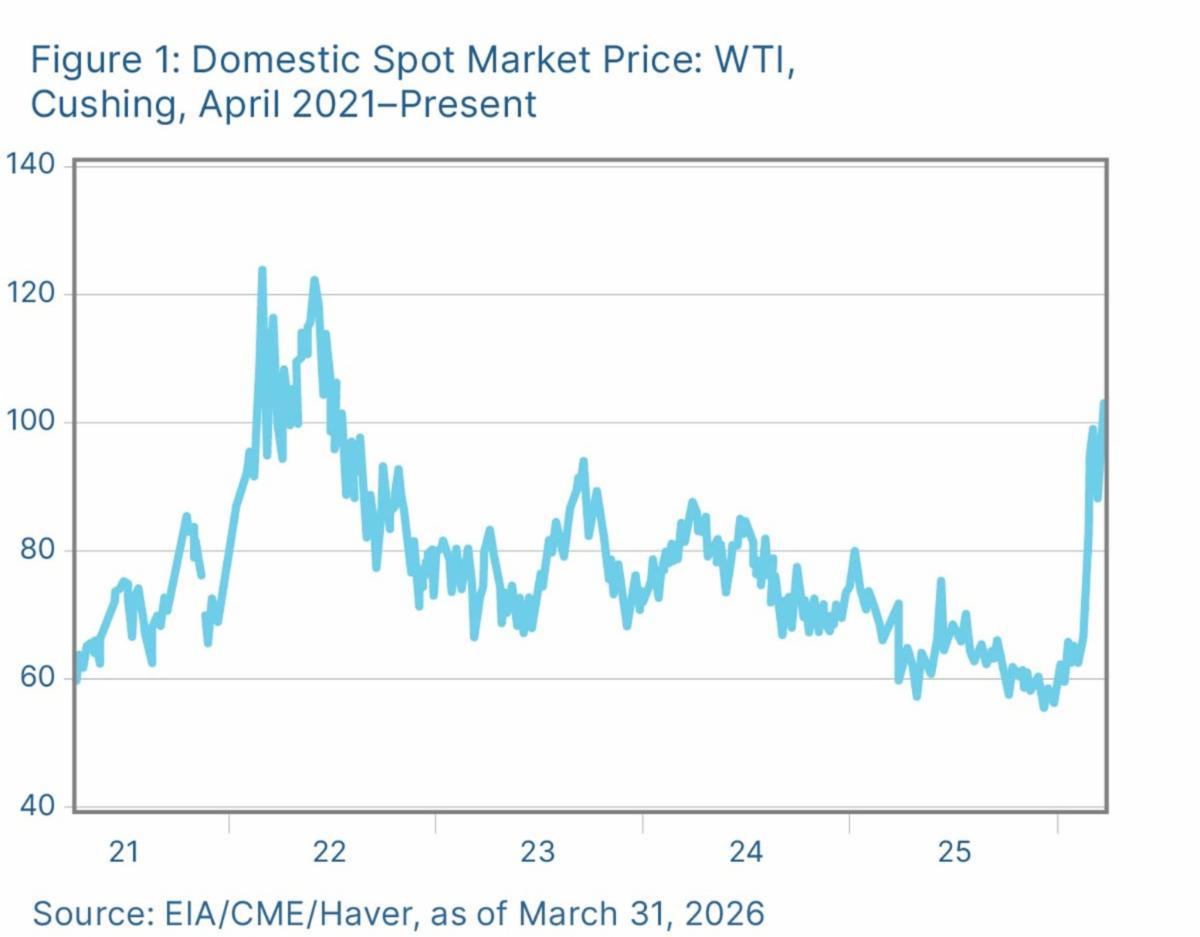
Energy prices remained high and volatile throughout March, with rising crude oil prices in the spotlight. As seen in Figure 1, domestic oil prices rose to over $100 a barrel toward the end of the month, which is the highest we’ve seen since 2022 following the Russian invasion of Ukraine. If higher energy prices persist, this would likely serve as a headwind for future economic growth and lead to rising inflationary pressure.
|