Your Monthly News & Updates | |
| |
Dear Medfield Historical Society Members and Friends,
Spring is in full swing, and there's a flurry of activity across Medfield's historic sites–including our own museum – as teams build, repair, refresh, and prepare for the 2025-26 season. Major capital projects top the list for all, whether it's new construction, roof replacements, basement waterproofing, or window and building repairs.
We know all too well that it isn't enough to save a historic property – funding and volunteer efforts are perpetual needs that come with stewardship responsibilities. We're especially grateful that current capital projects have been made possible by legislative earmarks, grants and/or generous donors, plus the support of the town.
In the weeks ahead, the Medfield Historical Society Museum will be closed in June for repairs, and open by appointment only in July and August. The Portal will also be published as its usual single summer issue. In the meantime, the board will continue recruiting volunteers, reviewing bylaws, reorganizing the museum collection, and planning for programs, partnerships and community engagement.
We have much to look forward to! If you'd like to schedule a museum visit, or learn how to get more involved with the Society, just email us. In the meantime, thank you for your continued support.
Chris McCue Potts
Interim Co-President
| | Amelia De Hoff Awarded Medfield Historical Society Scholarship | | |
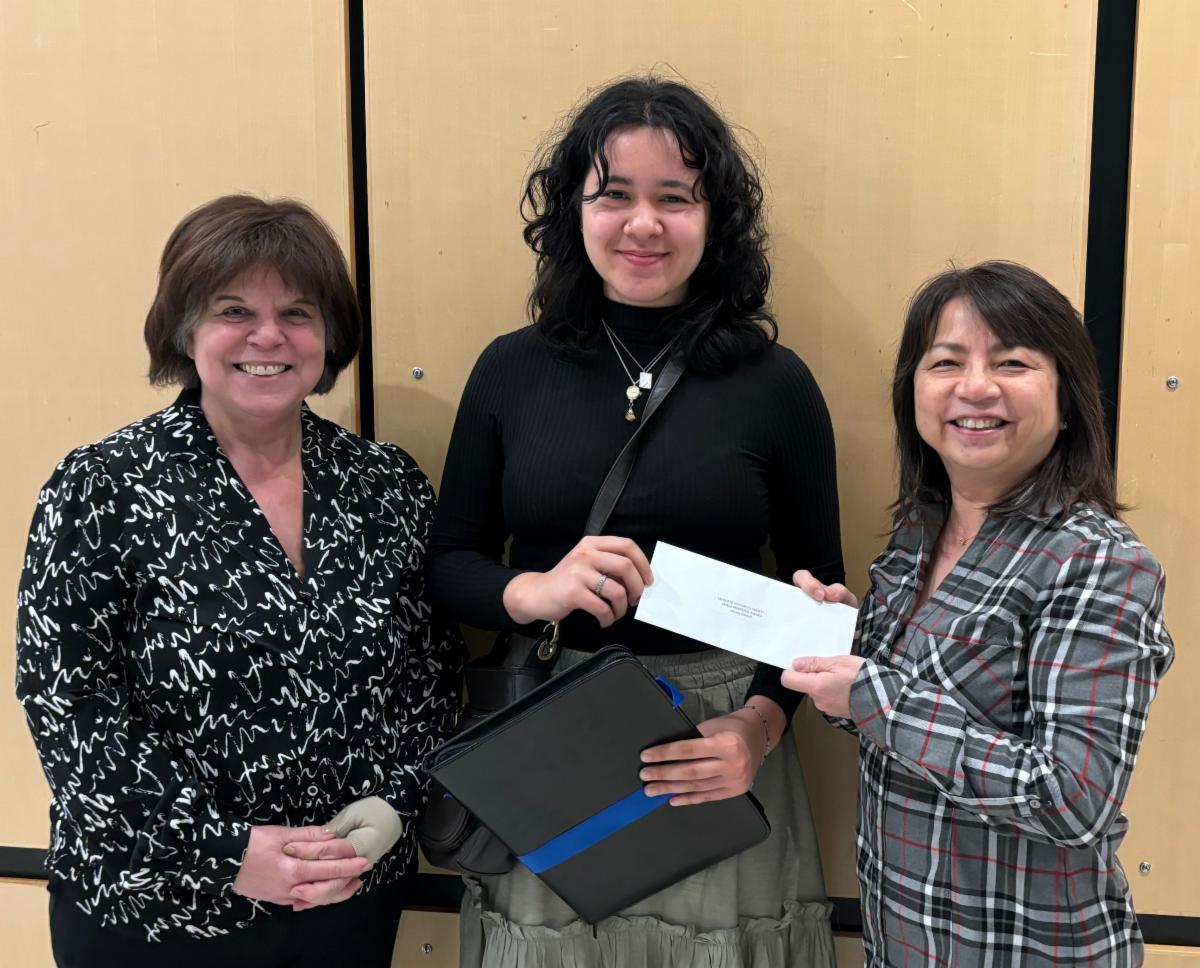
Amelia DeHoff was awarded the Medfield Historical Society Scholarship in Memory of Adam Opiela for 2025 at the Medfield High School Senior Recognition on May 22. The award is given to a student who exhibits distinction in the study of, interest in, and passion for the subject of history, and who also demonstrates community involvement. Adam’s father, Joe Opiela, made the presentation.
Adam was the first winner of the Historical Society scholarship given to a Medfield High School senior in 2009. He majored in history at Trinity College and earned a Master’s degree in Education from the University of Texas. He was teaching middle school social studies in the Austin, Texas school district when he was diagnosed with stage four young-onset colorectal cancer in 2021.
Amelia was chosen for the scholarship by the history faculty and school counselors. Her teachers report that she is a passionate and dedicated student, and consistently performed at a high level in her History courses due to diligent preparation and study methods.
Further, they cite her analytical writing skills as exceptional, stating she is able to effortlessly synthesize primary sources and historical context into compelling arguments. Amelia’s intellectual curiosity led to a thought-provoking project on female leadership in the American Revolution for one of her courses.
A brilliant overall student and musician, Amelia has been named a National Merit Scholarship Commended Student and is also a member of the National Honor Society. She was chosen for the Massachusetts Music Education Association’s All-State Band for four years, gives youth clarinet lessons, and has worked with Medfield elementary and middle school students to help develop their musical skills. In addition, she volunteers to help address hunger with Empty Bowls.
Amelia will be attending Smith College in fall and will major in Biology within an Education track.
| | Pictured left to right: Adam’s mother Nancy Opiela, Amelia DeHoff, and Society Interim Co-President, Yumi Jones. | | Society Hosts 8th Graders | | |
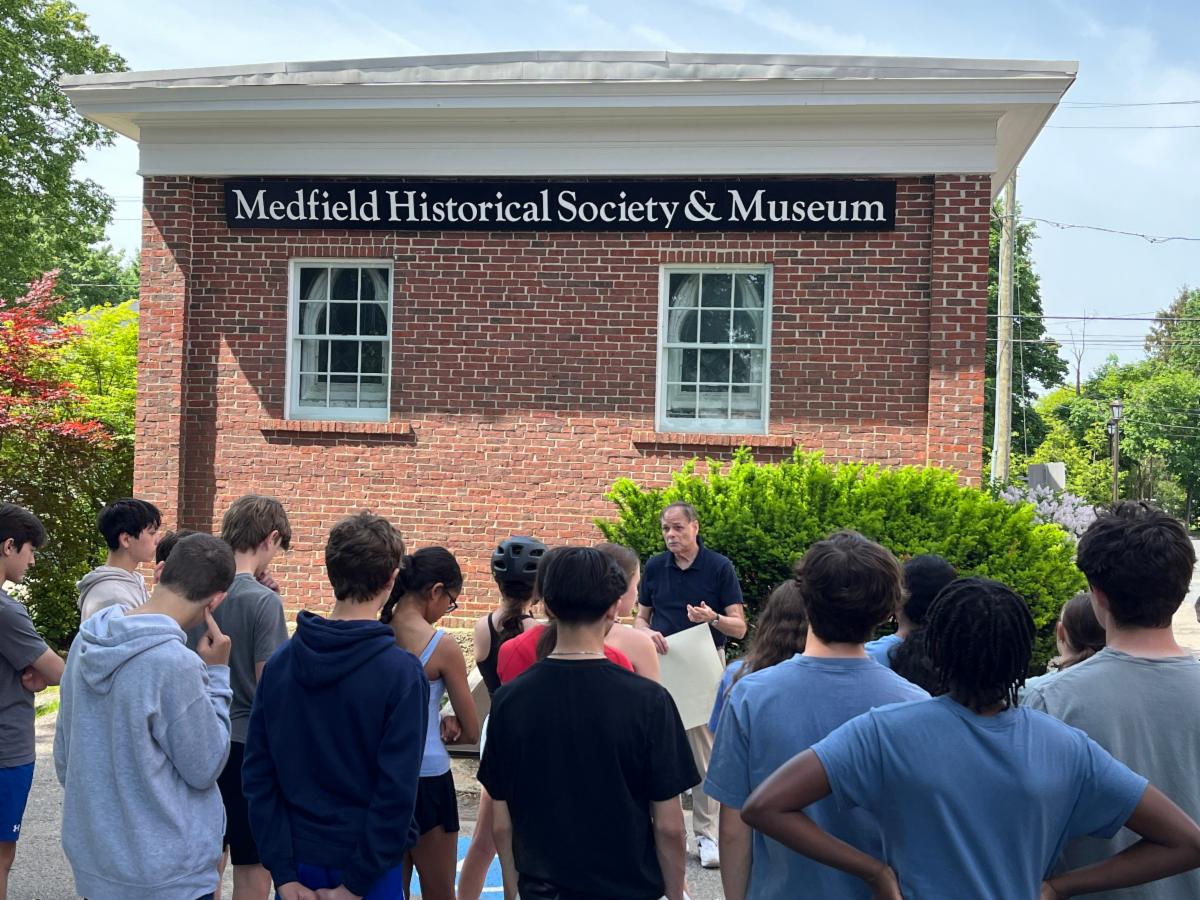
A large contingent of 8th graders from Blake Middle School recently cycled over to Medfield Historical Society to learn about its mission. The stop was one of several around town the students made as part of a bicycle tour tied to their civics curriculum and organized by social studies teachers. More visits are expected this week.
Greeting the students was MHS board member and retired Superior Court Judge Tom Connors who talked about the role history plays in civics, and what the Society does to preserve, promote, and share Medfield history. Using local examples to illustrate the civics connection, he provided information about the straw hat factory, Medfield State Hospital and King Philip’s War.
In addition to the Society, the students also visited Medfield Public Library, Town House, Department of Public Works and Medfield Police and Fire to learn about the various departments. A visit to the Rail Trail was also part of the itinerary, with Medfield police officers joining in the bike trip to help with road safety.
| | Capital Improvements Underway at the Historical Society | |
June marks a major step forward in preserving and protecting the Medfield Historical Society’s building, as several critical capital improvements are underway. Please note: the Society will be closed for the month of June while this work is in progress.
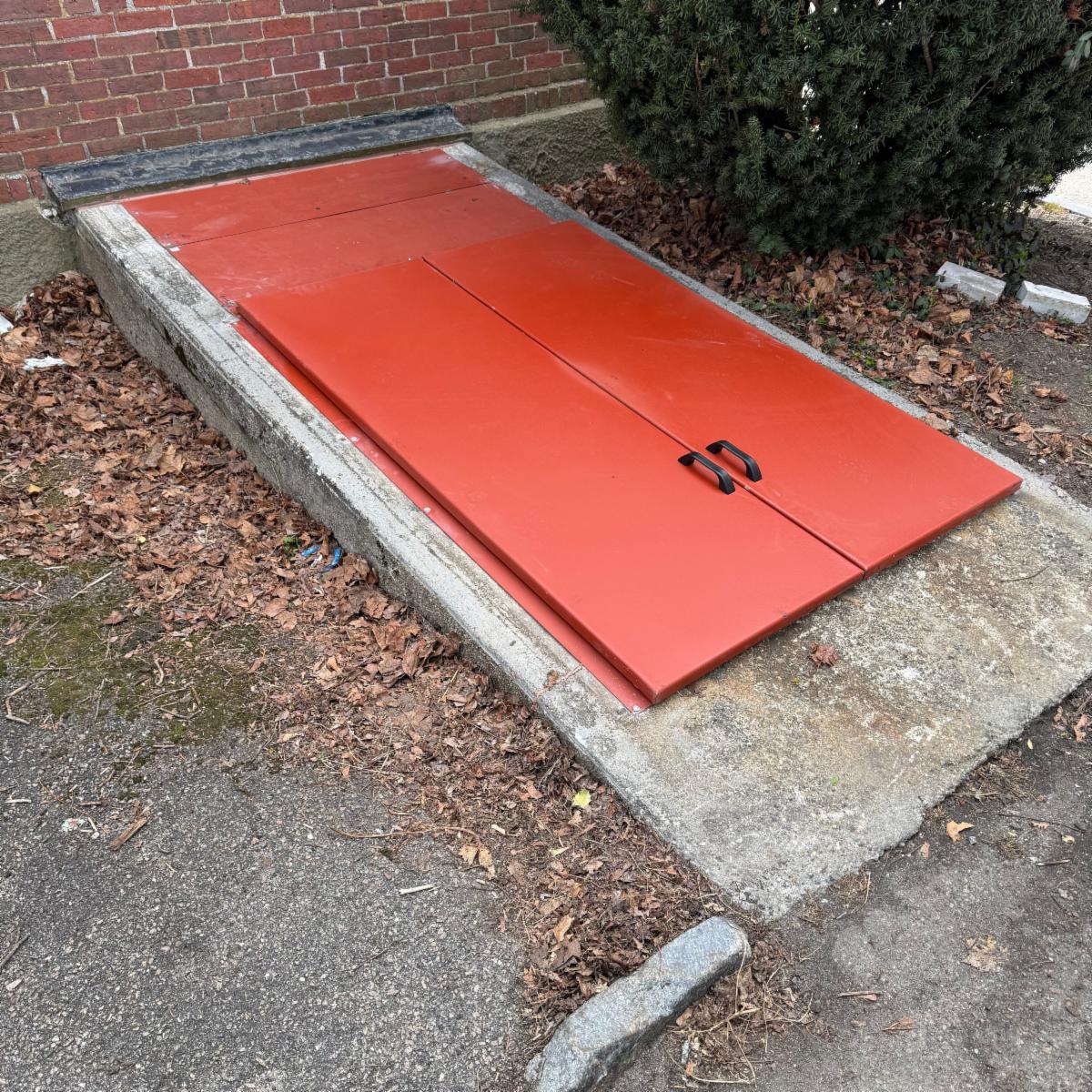
After damage caused to the bulkhead in February, a brand-new one has now been installed and painted, restoring both function and appearance. Preparations have also begun for the installation of a sump pump, which required carefully packing papers, boxing artifacts, and moving furniture to the non-construction side of the basement. Ahead of the pump installation, carpenters will remove the bottom steps of the staircase leading to the basement to allow access.
The electrical work currently underway will power the new sump pump, and once installed, a fully updated gutter and drainage system will follow—redirecting rainwater away from the building and protecting our foundation from future damage. In the process of preparing the space, some intriguing historical materials were brought upstairs for closer review, including an entire drawer of Medfield bicentennial memorabilia—now being explored as we look ahead to our 375th anniversary. These improvements are vital to preserving our collection and ensuring the long-term health of our historic building.
| | Ebenezer Granville Babcock: A Soldier's Letters, Part II | | |
by Norma Vogel
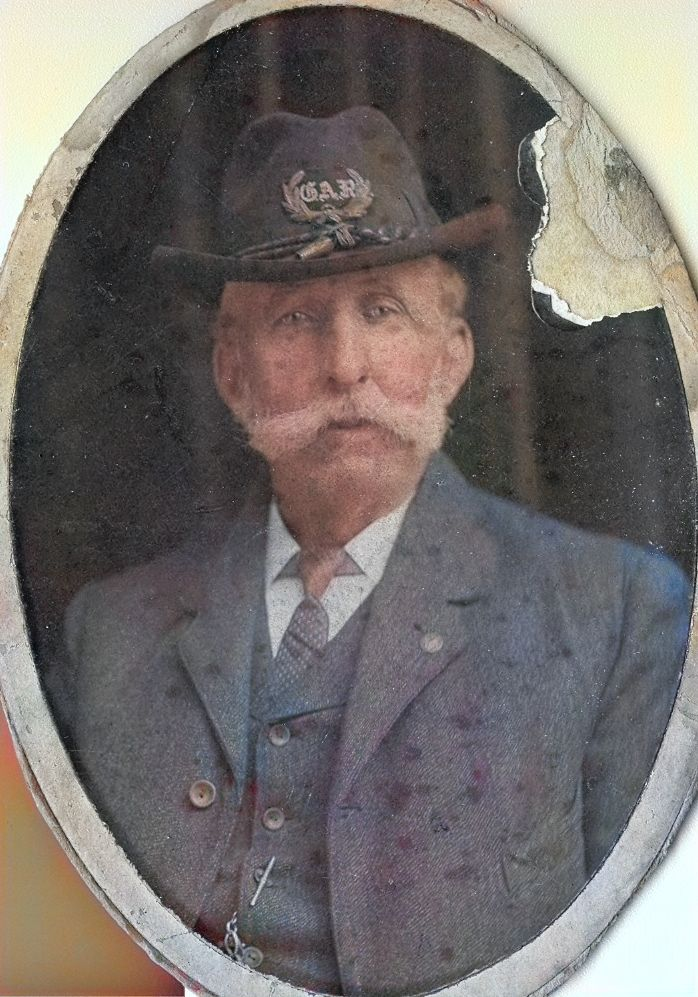
In Part 1 of this story, I wrote that I was thrilled to be able to read, touch, and hold some of the letters of Civil War soldier Eben Granville Babcock III (1843-1917). As I begin Part 2, I wish to reiterate that this is meant as a human story, not written by an expert in battles and troop movements; I am learning as I go, and loving every moment of it. This young man’s growth, concern for his family, and longing for home are more interesting to me than encyclopedic facts. I frequently stop to research as I go through these letters, and the more I know, the more there is to learn.
Babcock was one of twenty-nine Medfield men who answered President Lincoln's call for 15,000 men to enlist in the Union Army in 1862. Part 1 tells of his earlier experiences as a soldier, as told through letters to his mother, Mary Whitney Babcock. We will return to these later in this article, but let us not overlook the one surviving letter to his father (especially so close to Father's Day).
| | Eben Granville Babcock III | | |
Ebenezer Giles Babcock (1793-1876) was a farmer, and at the time of this letter he was 71 years old, his son 19. Ebenezer and Mary had eight children, of whom Eben was the seventh; only three-year old Annie remained at home on Pleasant Street in Medfield. As a reader, I was struck by the difference between this one letter to Father and the several letters to Mother. I would say the young Babcock seems much less comfortable in conversation with his father. The tone is deferential due to his father's age; the word choice more formal, the subject matter limited to farming, fishing and the weather. Even the handwriting is different from the letters to Mary, with carefully-formed letters done in ink rather than blunt pencil, as if the son felt the need to make this letter more legible than most. It is touching to read the young man’s hope that his father will still be there when he gets home.
I Wish I was at Home to Help You Plant and Get the Hay
Camp Lookout Valley, April 12th 64:
Dear Father,
I will write you a few lines to let you know that I am well and hope you are the same. I am very sorry you are so lame, I wish I was at home this summer to help you plant and get the hay. I hope you will stand the weather 16 months longer so I shall have a look at you once more. I hope you will write me a few lines in the next letter mother sends. Abby wrote me a letter and said she wanted you to come up there after planting and stay a good while. We have fine weather around here, the peach & pear trees are all in bloom and what farmers there is (sic) around here are planting. There is some fine land around here for corn and potatoes, especially along the banks of the Tennessee River. It is about a mile from the camp to the river. It is a good deal longer than the Charles River. The band went a fishing (sic) in it the other day, caught some pout and white perch, the pouts were very large and whiter than any I ever caught. I don't think of any news to write so I will close now. Tell Annie I am very much obliged to her for the Almanac but I can't understand it yet.
From your Affectionate son, E. Granville Babcock
I Told Them to Write to the Selectmen Immediately; Cheer Up; Two Fine Hens
While the soldier's story gets a bit more color from the father's letter, it is really the mother's letters that carry the story. We know that Eben was honorably discharged, but his military career nearly took a troublesome detour, and he turned to Mary – and the Medfield Board of Selectmen! – to straighten things out.
Our collection of letters includes one from the Adjutant General's Office of Massachusetts to Mary Babcock, part of some ongoing correspondence about a major error on the Army's part: Eben had been erroneously counted as a deserter on June 19, 1863. On November 30, a Mr. Nehemiah Brown wrote to acknowledge that Mary had sent in some exculpatory evidence on her son's behalf; "I have written to the Commanding Officer giving him the facts which you stated in your letter, and asking him to correct his rolls. As soon as he does so, I will issue a certificate of the fact." Eben himself seems to take this undoubtedly stressful situation in stride and with good humor, writing to Mary on November 21, "I received another letter from (illegible) Infantry today, so I wrote...to the Captain and set it straight. I told him to write to the Selectmen immediately...well you haven't seen me home yet have you?"(Note: In 1863, the Medfield Selectmen were Benjamin Shumway, George M. Smith, and Jeremiah R. Smith.)
Read more>>
| | Forgotten Verses: Medfield Poems by Acclaimed Author Resurface | | |
Found tucked away on a shelf in the Society museum basement last week is a six-page booklet, “Medfield Poems,” by Anita Trueman Pickett, published in 1927 by The Alliance of the First Parish Church (as stated on the booklet). It was discovered while boxing up files and other items in preparation for repair work.
Locally, Anita served as First Parish Minister from 1926 to 1928, but she was also nationally recognized for her talents. The Unitarian Universalist History and Heritage Society (UUHHS) notes, “At an uncommonly early age, she was an established and respected public speaker, poet, author, ardent Single Tax advocate, and preacher of ‘Free Thought’ philosophy.”
UUHHS also provides a partial list of renowned individuals with whom Anita associated, including Clarence Darrow, William Jennings Bryan, Clara Barton, Helen Keller and Annie Sullivan, Susan B. Anthony, William James, and Alexander Graham Bell.
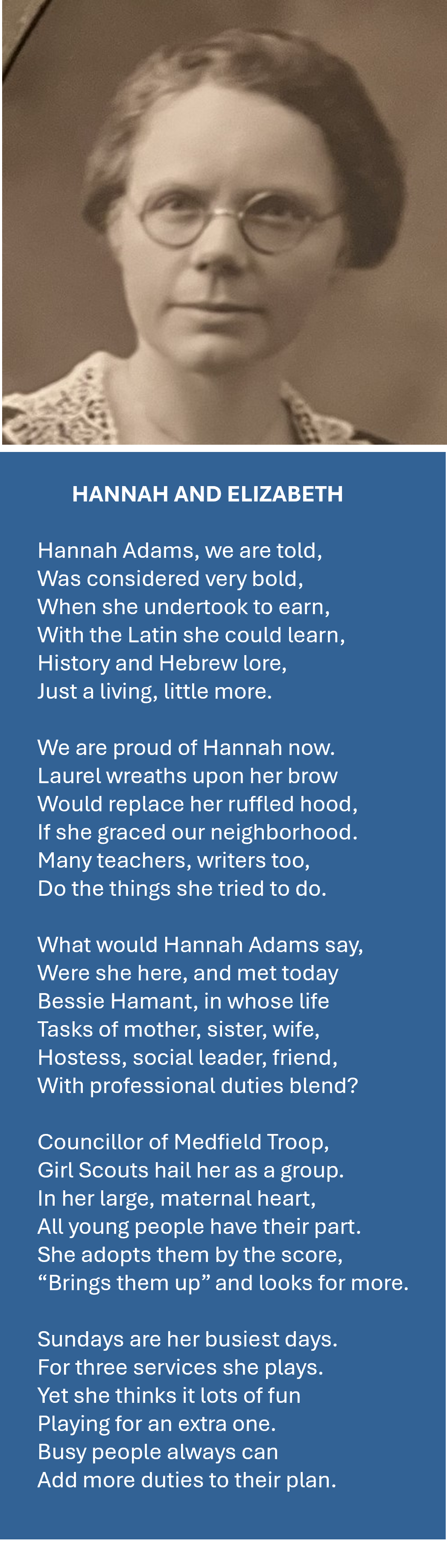
Each one of the poems recently discovered provides a glimpse of Medfield through Anita’s eyes. For this issue of The Portal, we share “Hannah and Elizabeth” in which Bessie Hamant is compared to Hannah Adams, the first woman to make a living as a writer in America. Bessie Laverty Hamant (1880-1944) was the wife of Daniels Hamant, a descendant of one of Medfield’s original 13 settlers, Francis Hamant. They lived in the family homestead at 7 Philip St., with one section built in 1652, and another in 1810. The historic home still exists.
___
Click here for a short biography from UUHHS about Anita Trueman Pickett, a trailblazing Unitarian minister, poet, and speaker known for her early advocacy of progressive causes and Free Thought. Mentored by notable figures, she co-led congregations with her husband in Massachusetts and continued preaching and writing well into retirement, leaving a legacy of courage and reform.
| | Remembering Alice Goodsell | | |
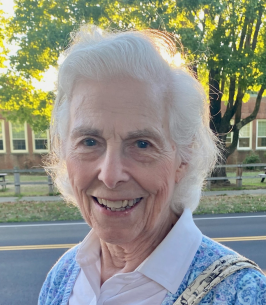
Alice Goodsell of 1 Prentice Place, Medfield, died March 11, still sharp and engaged at age 93. She was a much-loved long-time historical society member and a knowledgeable and enthusiastic volunteer at the Peak House, at the society building on Pleasant Street, and at society presentations and events like the summer Strawberry Social, Medfield Day, and the Peak House Pantry Sale.
Alice lived in a house that looked from the outside like a typical “colonial” built in the 1990s. But inside there were many beams that had been part of the Lowell Mason birthplace. Thomas, the first Mason in Medfield, settled here in 1652 and was killed in King Philip’s attack and burning in February 1676. Tilden is unclear on the exact location of Thomas’s house. However, Tilden indicates that several succeeding generations of Masons lived in a house on North Street which was at various times added onto but then split apart, with one part being moved to Adams Street, and then, in 2010, to the present location on Green Street near the swim pond.
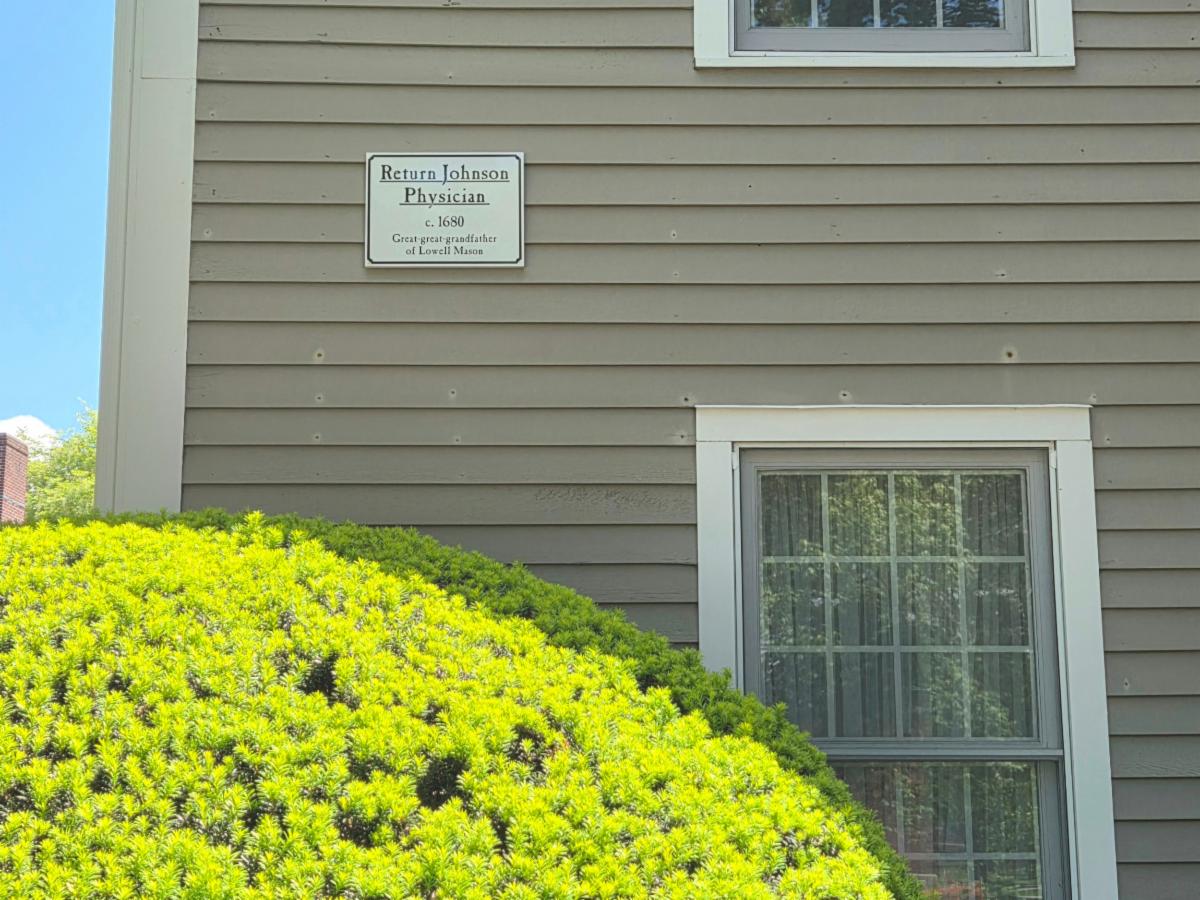
Alice was especially pleased a few years ago when she and the historical commission agreed the most appropriate wording for her new house sign was “Return Johnson, Physician, c.1680, great-great-grandfather of Lowell Mason.”
(Colonial-era parents sometimes gave their children names that seem funny today. Boys’ names in the Mason line ran from Asa and Barachias to Zechariah…but also included George, Joseph, and John…and Johnson, who was Lowell’s father. But a quick Google search failed to turn up anyone else named Return.)
Alice is survived by a son, two daughters, and seven grandchildren.
Here’s a link to Alice’s obituary.
| | Alice's home with the house sign acknowledging Return Johnson. | | People and Places of the Past | | Big Shot: A Memoir and Brief History of the Life and Times of Joseph L. Marcionette | | |
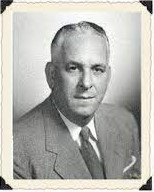
by the late Tim Flaherty
My fond recollections of Joseph Marcionette, who always insisted being called Joe, go back to 1952 when I was just about 5 years of age. Joe and my grandmother, Marguerite lived up on Farm Street in Medfield very close to the town of Dover. He was actually my step-grandfather, my father's step-father. I happily remember Joe taking me and my older brother Todd, then 8 years old, to Lord's Department Store. It was the old Lord's before they made it into what the modernized store eventually became. As young children, Joe brought us up the isles where the toys were. While Joe would be talking to Ray Lord or Bill Kelly, he would buy each of us whatever toy we wanted.
Whenever my parents were going to return late from a night out at a concert, they would have Todd, my sister Deirdre, and I stay overnight at their home on Farm Street. That house was very spacious with a big spiral staircase and large bedrooms along with an elegant dining and living room. The house wasn't actually “kid proof,” but it sure did have a fun and adventurous appeal. The kitchen was quite large and back then we would sometimes dine there for our Thanksgiving Day dinner. Of course Joe would always sit at the head of the table, while Marka, a nickname given to our grandmother, sat at the opposite end with my mom and dad seated to the right and left along with the kids. There was the aroma of the turkey with stuffing along with mashed potatoes and gravy with a vegetable like carrots, and string beans along with creamed onions. Cranberry sauce rounded out the meal with all the other fixings and our grandmother, Marka baked apple and pumpkin pies for dessert along with many glasses of milk.
Read more >>
| | | | |