Advance Your Skills at
ASIPP’s Hands-On Workshops
| | |
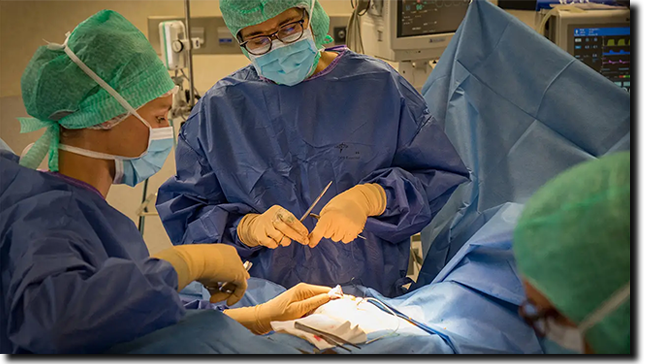
Join ASIPP this August at the Medical Education & Research Institute (MERI) in Memphis, Tennessee for three hands-on educational workshops:
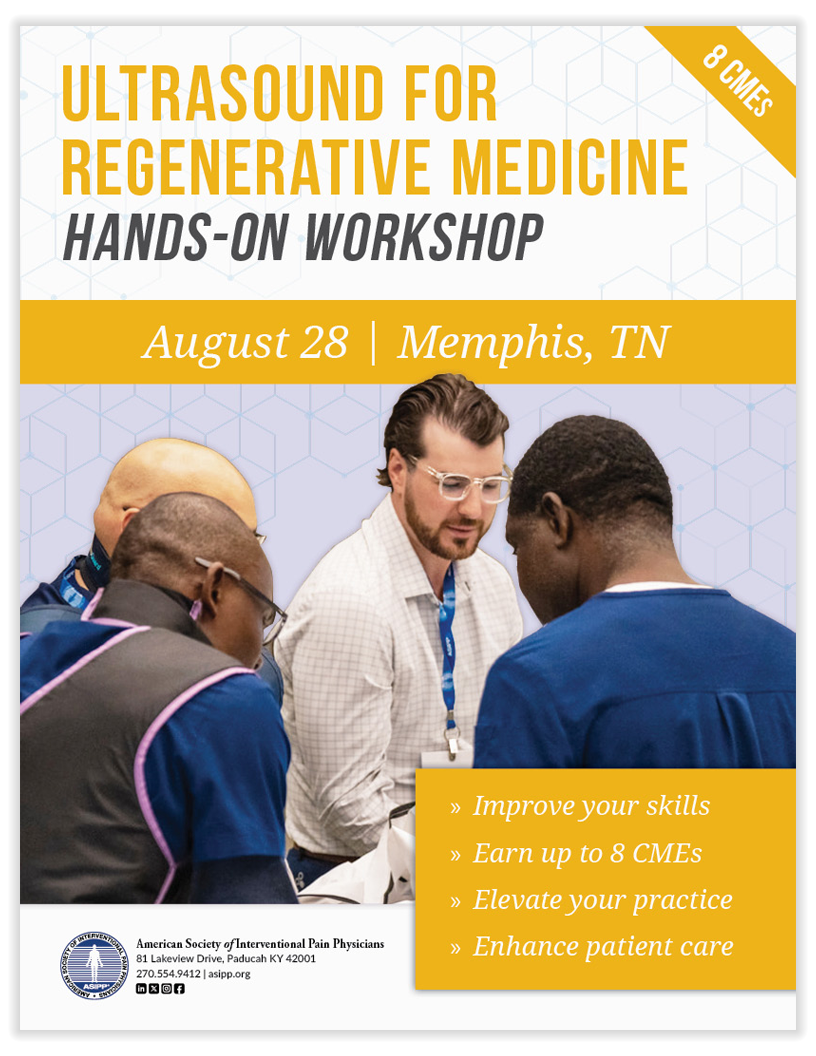
- Ultrasound for Regenerative Medicine Hands-On Workshop
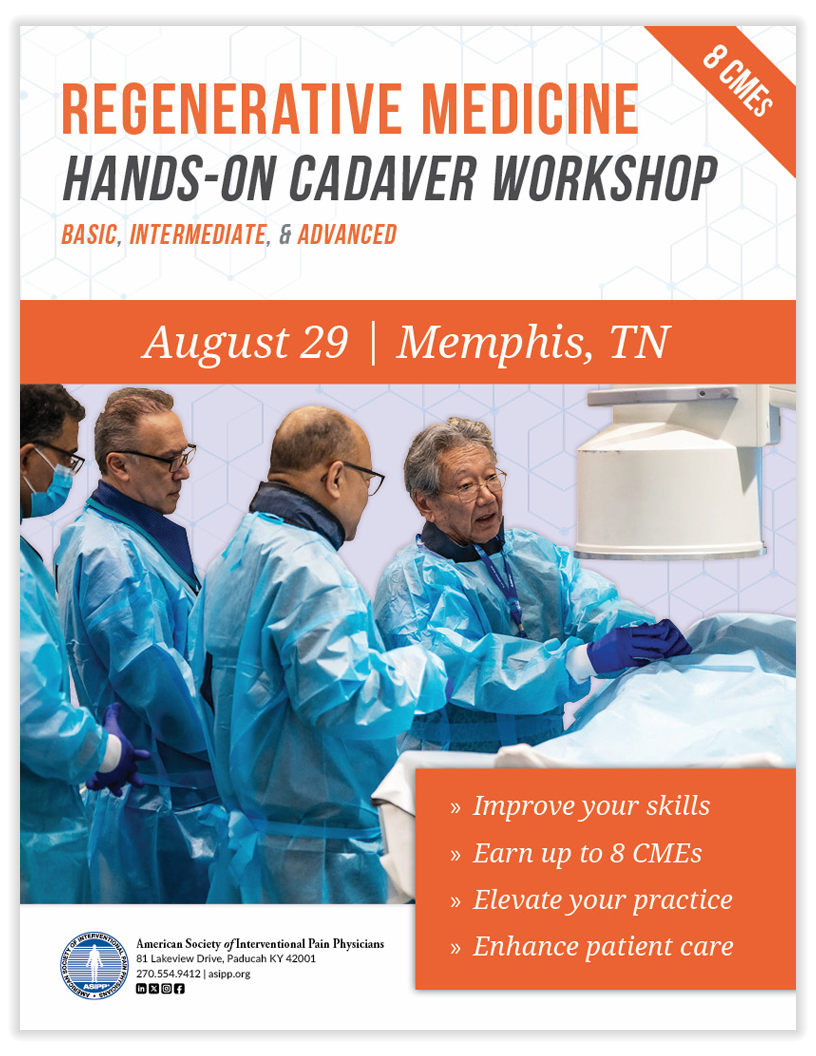
- Regenerative Medicine Hands-On Cadaver Workshop
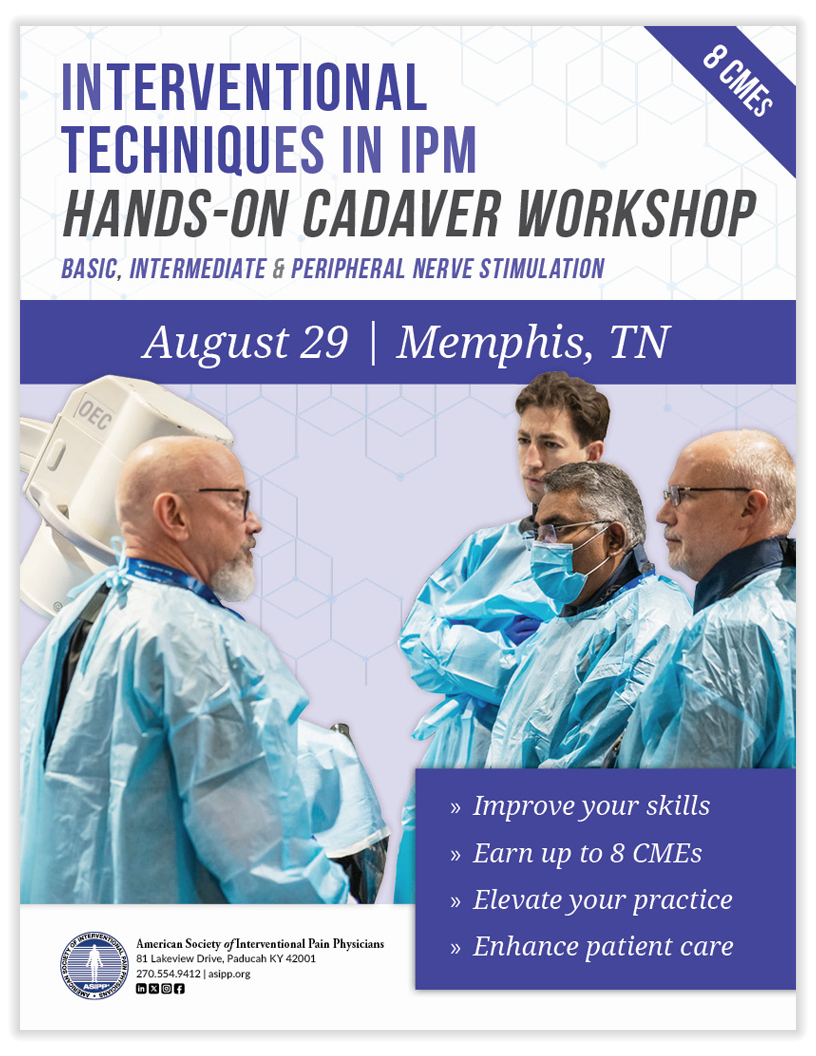
- Interventional Techniques in IPM Hands-On Cadaver Workshop
- Peripheral Nerve Stimulation Hands-On Workshop
- Intradiscal Nucleus Pulpous Procedure Hands-On Workshop
Each workshop offers attendees the opportunity to earn 8 CME credits while participating in practical, hands-on instruction. Attendees who participate in the Friday workshop and one Saturday workshop may earn up to 16 CMEs.
ACCOMMODATIONS
The Westin Memphis, Beale Street
170 Lt. George W Lee Ave, Memphis, TN 38103
901-334-5900
Click Here to Book Your Room
Cut-off date for special room rates: August 13, 2026.
In order to ensure you receive the discounted room block rate of $189 plus tax per night let the hotel know you are with the ASIPP workshops.
Space is limited for these workshops.
Early registration is encouraged.
| | | |
FRIDAY, AUGUST 28
Ultrasound for Regenerative Medicine Hands-On Workshop
Earn 8 CMEs while gaining practical ultrasound experience focused on regenerative medicine applications.
| | | |
SATURDAY, AUGUST 29
Regenerative Medicine Hands-On Cadaver Workshop
(Basic, Intermediate, & Advanced)
Earn 8 CMEs in this cadaver workshop with hands-on instruction covering regenerative medicine techniques across varying experience levels.
| | | |
SATURDAY, AUGUST 29
Interventional Techniques in IPM Hands-On Cadaver Workshop
(Basic, Intermediate & PNS)
Earn 8 CMEs in this workshop focused on interventional pain management techniques and peripheral nerve stimulation applications.
| | |
Meal timing may be an underused tool
For decades, nutrition counseling in diabetes care has focused primarily on one question: What should patients eat? But a growing body of evidence suggests another question may be clinically important as well: When should patients eat?
Human metabolism follows a circadian rhythm that influences insulin sensitivity, glucose tolerance, beta-cell responsiveness, and energy metabolism across the day. In the morning, metabolic efficiency is generally higher. As the day progresses, glucose tolerance declines and postprandial responses often worsen.
Yet, many patients consume their largest meals in the evening or eat across prolonged daily time windows extending from early morning into late night. From a circadian perspective, this pattern may create a mismatch between food intake and underlying metabolic biology.
Accumulating evidence suggests this mismatch matters.
Click here to read the full article.
| | |
ASIPP is proud to launch our Resident and Fellow Mentorship Program. This initiative is designed to connect trainees with experienced pain physicians to foster professional growth, provide guidance, and strengthen the future of our specialty.
Each mentor would be paired with one to two trainees, but can take more if interested. Trainees will be responsible for initiating introductions and arranging at least one to two video calls per year. These sessions will provide opportunities for mentees to seek advice on clinical decision-making, career planning, research opportunities, and professional development.
We believe that your experience, expertise, and insight can have a lasting impact on the next generation of pain physicians. By volunteering as a mentor, you will play a critical role in shaping the future of our field and ensuring that ASIPP continues to cultivate excellence in interventional pain medicine.
If you are interested in serving as a mentor, please confirm your participation by filling out the appropriate form below.
| | |
The American Society of Interventional Pain Physicians (ASIPP) has sent formal letters to CMS Administrator Dr. Mehmet Oz; Representative, Chairman of the House Energy and Commerce Health Subcommittee; Representative James Comer, Chairman of the House Oversight Committee; and Senator Bill Cassidy, Chairman of the Senate Health, Education, Labor, and Pensions (HELP) Committee.
The letters raise concerns regarding several Medicare policies that may affect independent physician practices and patient access to care, including proposed reductions to practice expense reimbursement, implementation of the Ambulatory Specialty Model (ASM), and physician payment reductions associated with assumptions regarding artificial intelligence-driven efficiencies.
In order to resolve the multitude of issues and protect independent practices into the future, ASIPP is requesting that the following changes are made in the upcoming proposed rule:
- Modification of Practice Expenses of 6 to 11% Cuts for Independent Physicians by Adding a Modifier to Identify Independent Physicians.
- Ambulatory Specialty Model (ASM) – Which is an Unproven Concept Leading to Major Access Issues and Cuts to be Removed as it also Conflicts with ACCESS (Advancing Chronic Care with Effective, Scalable Solutions) Model and WISeR (Wasteful and Inappropriate Service Reduction) Model, and Elimination of Inconsistent ASM Specialty Model Program.
- Reversal of Efficiency Cuts of 2.5% as There is No Efficiency as Studies Show that AI May Help if at All, 20 Seconds Per Note.
In addition, ASIPP sent letters to all relevant committee members in both the House and Senate, including members of the Senate Finance Committee and the Health, Education, Labor, and Pensions (HELP) Committee, as well as members of the House Energy and Commerce Committee and the House Ways and Means Committee.
ASIPP remains committed to advocating for policies that preserve independent medical practices, protect patient access to care, and promote a sustainable physician payment system.
Copies of the letters are available below:
• Letter to CMS Administrator Dr. Mehmet Oz
• Letter to Representative Brett Guthrie
• Letter to Representative James Comer
• Letter to Senator Bill Cassidy
| |
ASIPP is pleased to announce the launch of the Regenerative and Longevity Medicine Section!
This section reflects the growing importance of regenerative and longevity medicine—fields dedicated to restoring health, enhancing vitality, and extending the healthy years of life. From stem cell therapies and tissue engineering to gene therapy and orthobiologics, these disciplines are transforming the way we approach pain management and age-related decline.
Section membership offers:
- Access to ASIPP’s physician database and future data registry
- Opportunities for certification and continuing education
- Section-exclusive resources and updates
No additional cost for ASIPP members!
| |
Glucosamine tied to faster progression in people with established neurodegeneration
| |
Can a clinician who has been struck off in one country still practice in another? Recent cases suggest the answer can be yes. At the core of the problem is weak cross-border communication, especially limited access to the European Union’s Internal Market Information System (IMI), which is designed to share disciplinary actions among member states.
The most recent example involves Abdel Nacer Alem, a cardiologist struck off the French Medical Council, who was convicted in 2024 by the Judicial Court of Aix-en-Provence in France for sexually assaulting 14 patients in Salon-de-Provence, a town in the Provence region of southern France. He continues to practice in Belgium today, as reported by the daily La Provence and Le Monde.
In fact, in March 2024, Alem appeared in court as a free man. Fourteen women, aged between 47 and 75 years, had filed civil suits. Between 2017 and 2018, Alem had sexually assaulted complainants in his office, where he practiced 3 days a week in Salon-en-Provence.
Click here to read the full article.
| | |
Apply now for one of the following 2026 dates:
June 27, July 25, September 26, October 24, November 14,
& December 12
Four (4) hour virtual exam
- ABIPP Path – Combined CCPM/ CSM Exam
For those with subspecialty in Pain Medicine
Two (2) hour virtual exam
- ABIPP Competency Exam in IPM
For those without primary board certification
Two (2) hour virtual exam
- ABIPP Competency Exam in Regenerative Medicine
Two (2) hour virtual exam
- Controlled Substance Management Competency Exam
Two (2) hour virtual exam
- Documentation, Coding, Compliance, Practice Management Competency Exam
Two (2) hour virtual exam
August 28, 2026
- ABIPP Part II Oral and Practical Examination
Topics that will be covered:
Caudal epidural injections; Lumbar interlaminar epidural injections; Lumbar/sacral transforaminal epidural injections; Cervical epidural injections; Thoracic epidural injections; Lumbar/sacral medial branch and L5 dorsal ramus blocks; Cervical medial branch blocks; Thoracic medial branch blocks; Lumbar/sacral facet joint nerve radiofrequency neurolysis; Cervical medial branch radiofrequency neurolysis; Thoracic medial branch radiofrequency neurolysis; Sacroiliac joint injections; Cervical sympathetic blocks; Lumbar paravertebral sympathetic blocks; Intercostal nerve blocks; Lumbar discography; Celiac plexus blocks (not Splancnic nerve blocks); Percutaneous epidural adhesiolysis; Spinal cord stimulation lead placement
| |
Large randomized trial reassures that transfusion reduction doesn't come at thromboembolic cost
| | |
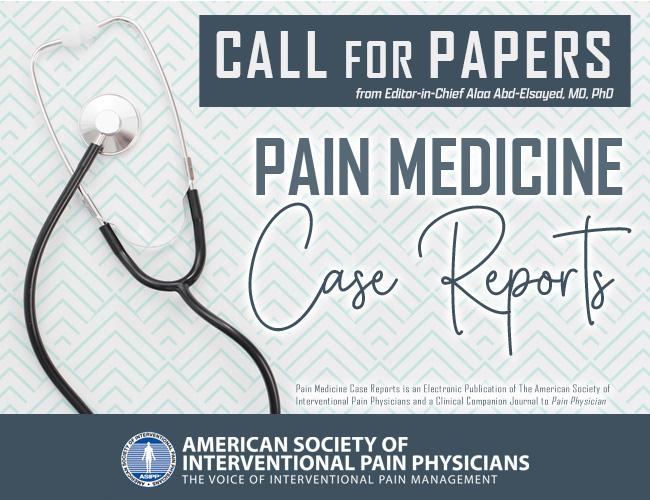
Pain Medicine Case Reports (PMCR) and Editor-in-Chief Alaa Abd-Elsayed, MD, PhD would like to invite you to submit case reports and case series to the PMCR journal. Your article will be published free of charge.
Open access journals are freely available online for immediate worldwide open access to the full text of published articles. There is no subscription fee for open access journals. Open access journals are no different from traditional subscription-based journals: they undergo the same peer review and quality control as any other scholarly journal.
Interested in becoming a member of the PMCR Editorial Board?
Editorial board members are asked to review 2-6 manuscripts per year. Please submit your most up-to-date CV to sgold@asipp.org for consideration.
For more information or to submit your articles, click here.
| | |
We are excited to announce that Pain Medicine Case Reports (PMCR) journal (eISSN 2768-5152) has been accepted for inclusion in MEDLINE and PubMed, the prestigious bibliographic database of the U.S. National Library of Medicine. PMCR, a companion publication to the prestigious Pain Physician journal by ASIPP, joins its counterpart in achieving indexing in both MEDLINE and PubMed, marking ASIPP’s dual presence in these renowned databases.
The inclusion of PMCR journal in MEDLINE signifies a higher level of selectivity, as MEDLINE consists of the top 5,200 biomedical journals. This indexing also means that articles from PMCR will be searchable using NLM Medical Subject Headings (MeSH terms) and other metadata.
The selection for MEDLINE follows a rigorous evaluation process by reviewers from the Literature Selection Technical Review Committee (LSTRC). According to their criteria, the scientific quality of a journal’s content is the primary factor considered for indexing.
We extend our congratulations to the Pain Medicine Case Reports Editor-in-Chief, Deputy Editor-in-Chief, Journal Team, and Editorial Board for this achievement, which underscores the significance and excellence of this esteemed journal.
| | | | |
Laxmaiah Manchikanti, MD, Emilija Knezevic, Nebojsa Nick Knezevic, MD, PhD, Mahendra Sanapati, MD, Alan D. Kaye, MD, PhD, Vinita Singh, MD, Ramarao Pasupuleti, MD, Mittal S. Prajapati, MD, Navneet Boddu, MD, and Joshua A. Hirsch, MD
| | |
Fei Wang, MD, Yihao Zhu, MM, Megchan Ou, MD, Zhongyu Shi, PhD, Mengxue Liu, PhD, Fei Peng, PhD, and Tao Zhu, MD
| | HEALTH POLICY PERSPECTIVE | | |
Brian E. Bernhardt, MD, Alan D. Kaye, MD, PhD, and Laxmaiah Manchikanti, MD
| | |
Laxmaiah Manchikanti, MD, Vidyasagar Pampati, MSC, Mahendra Sanapati, MD, Mittal S. Prajapati, MD, Vinita Singh, MD, Nebojsa Nick Knezevic, MD, PhD, Alan D. Kaye, MD, PhD, Amol Soin, MD, Alaa Abd-Elsayed, MD, and Joshua A. Hirsch, MD
| | | | |
|
ASIPP is in collaboration with Curi Medical Liability Program
Since this malpractice insurance program officially launched in November 2018, ASIPP has signed up hundreds of providers with an average savings of 30%. This is professional liability insurance tailored to our specialty and will stand up for us and defend our practices.
Curi is a full-service advisory firm that serves physicians and their practices. Their valued advice is grounded in your priorities and elevated in your outcomes. They are driven by a deep understanding of your specific circumstances in medicine, business, and life. To read a few important points to keep in mind about the program, including discounts, administrative defense, cyber coverage, aggressive claims handling, and complimentary risk management CME activities, visit our website.
| | |
IMPORTANT UPDATE
SPR is happy to announce an important update regarding Humana Medicare Advantage. As of May 1, Humana is now recognizing SPRINT as a PNS therapy. Previously, SPRINT was categorized as PNT (Percutaneous Nerve Stimulation), which allowed denials on the grounds that the therapy fell outside the NCD.
Additional details are as follows:
Payer: Humana Medicare Advantage (click here to view policy)
Policy Title: Peripheral Nerve Stimulators
Policy changes: SPRINT no longer misclassified as PNT and is now appropriately classified as PNS. Humana is applying the Noridian Medicare LCD criteria to ALL PNS devices – Including SPRINT PNS!
Effective Date: 5/1/2025
Click here to view a PDF of the official policy update.
| | |
|
Group Purchasing Organization Offer Better Pricing and Creates Added Value
ASIPP has formed a partnership with Henry Schein and PedsPal, a national GPO that has a successful history of negotiating better prices on medical supplies and creating value-added services for independent physicians. Working with MedAssets, PedsPal provides excellent pricing on products like contrast media that alleviate some of the financial pressures you experience today.
Learn More
For updated information concerning tariffs on products, click here.
| |  |
|
ASIPP, Fedora Healthcare Solutions Partnership
ASIPP offers our members the benefit of a unique revenue cycle management/ billing service.
We have received a tremendous amount of interest in the ASIPP billing and coding program.
Click here to learn more about the negotiated rate for practices and more!
| | |
Like and Follow ASIPP® on Facebook, X, LinkedIn,
and YouTube for the most up-to-date news
related to you, your practice, and your patients!
| | | | |