2020 will not be easily forgotten. Its' been a year of struggle, filled with challenges for each of us personally, financially, and felt practice-wide. "Time” for all of us was severely distorted. With so much time hunkered down at home, it seemed the year would never end. Yet in clinic, at least for us at CRA, time felt compressed, never having enough of it to move many patients through safely. Over the months, social distancing proved how important fellow human beings are to one another’s mental health. Yet, conversational distance puts all our health at risk. To put it lightly, it's been one interesting year.
However, marking the year-end, we can all be grateful for how we responded to our world being upended – facing deep uncertainty, we also witnessed deep collaboration between practices, and managed to continue to support each other. On behalf of the CRA Physicians, thank you for finding the courage to show up for your patients every day. Your patients praise your abundance of empathy and high-level care, even when your own tank was running on empty.
We have a lot to look forward to in 2021 and are incredibly thankful for you, your team, and your practice. THANK YOU — from everyone at Colorado Retina — for the sacrifices you make, every day and especially during this pandemic. Your dedication and commitment deserve our deepest gratitude. Your service to our shared patients' continues to save sight, making a difference in the lives of many. We're thankful for you, our collaborative parters who helped us get through this past year, and will continue to drive through the next as we rise out of the global pandemic together.
We wish you and your family a safe, healthy, and happy holiday season and hope the new year brings joy and cause for celebration.
|
|
UPCOMING EVENTS
CE/CME ACCREDITED VIRTUAL COURSES
|
|
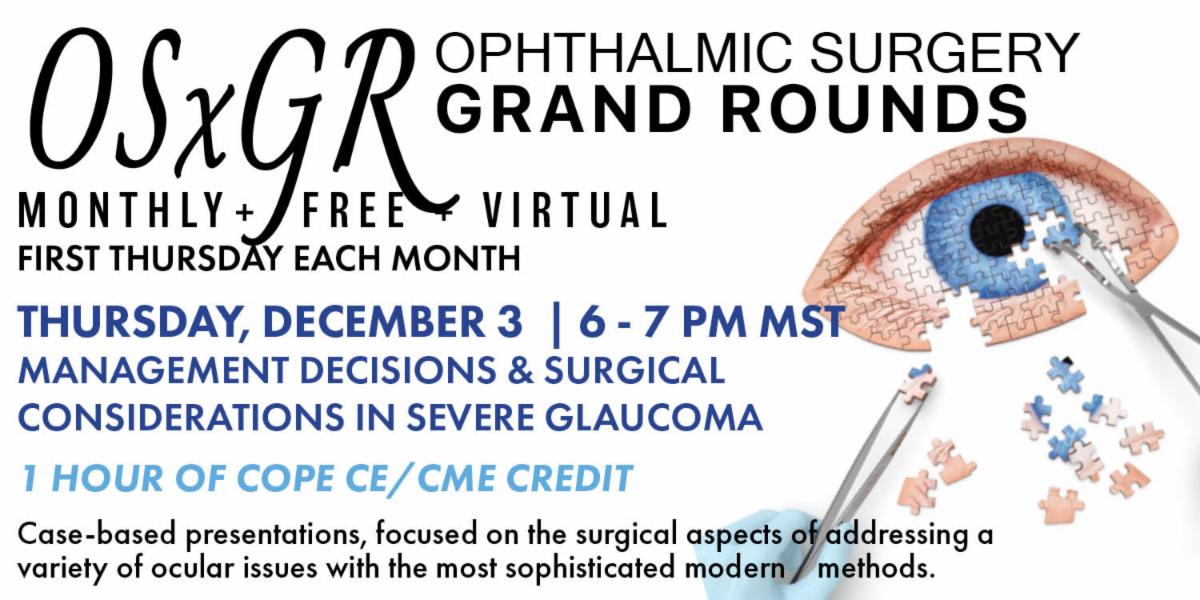
OPHTHALMIC SURGERY GRAND GROUNDS (OSxGR) |
|
ANNUAL 2021
MILE HIGH MASTERS
OF RETINA
Sunday, February 28, 2021
8:00 AM - 10:30 AM MST
Virtual Retina Education Meeting
|
|
|
2021 will be Colorado Retina’s, Mile High Masters of Retina 11th year of programming and first ever time taking it to a virtual platform. Mile High Masters brings together an educational and networking forum for physicians, optometrists, surgeons, academicians, clinicians, researchers, students and support staff mainly in the fields of optometry and ophthalmology.
This is a FREE mini-conference which offers COPE CE/CME credit to all licensed optometrists and physicians in attendance. The course will be taught by our retina specialists of Colorado Retina Associates and include lectures on a variety of retina, tumor and uveitis topics and complex cases. Attendees will learn about the best and most innovative diagnostic and treatment approaches in retinal surgery and care, as well as the optimal timing of referrals.
TENTATIVE SCHEDULE:
7:30 Early admission into the exhibit hall + event platform
8:00-8:25 Session #1: Effects of Pregnancy on the Eye + When Medical Treatments Cause Uveitis
8:30-8:55 Session #2: Gene vs Stem Cell Therapy + Referring for Choroidal Nevus
9:05-9:25 Keynote Speaker: Sunil Srivastava, MD - Complexities of Uveitis
9:35-10:00 Session #3: Intro to Floaters + Emergent and Subacute RD Repair
10:05-10:30 Session #4: Risk Review for RVO/CSCR + Review of Plaquenil & Elmiron Screening
10:30-11:00 Exhibit hall, Q&A tables, and networking lounge to remain open
Upon conclusion of this activity, participants will be able to evaluate current approaches to the diagnosis and management of common retinal conditions. Review when and how quickly to refer patients. As well as be able to examine situations to help prevent malpractice situations.
Accreditation: 1 Hour of COPE Live CE Credit / 1 AMA PRA Category 1 Credit™
Registration will open mid December 2020. Please check our website for further updates.
|
|
PRACTICE UPDATES
WHAT'S NEW AT COLORADO RETINA ASSOCIATES
|
|
HOW TO REFER A COVID PATIENT FOR RETINAL CARE
On behalf of Colorado Retina's COVID-19 Response Team, please see below for our up-to-date COVID-19 protocols.
As we look forward to continuing success in keeping our staff and patients safe, we would like to offer the following guidelines regarding patient entrance into our clinics. While each situation is unique, the following scenarios should offer some direction:
-
Patient is ACTIVELY COVID POSITIVE with or without symptoms
-
Emergent/urgent retinal issue
- Refer patient directly to the UCHealth Sue Anschutz-Rodgers Eye Center ASAP
-
Non-emergent/urgent retinal issue
-
Patient can be seen by a CRA physician in our clinic if: 2 negative Covid tests > 24 hours apart OR cleared by their PCP with note
-
Patient has been recently EXPOSED to a COVID positive person
-
Emergent/urgent retinal issue
- Refer patient directly to the UCHealth Sue Anschutz-Rodgers Eye Center ASAP
-
Non-emergent/urgent retinal issue
- Patient must wait 14 days and be without symptoms before they can enter our clinics
HOW TO REFER to UCHealth Sue Anschutz-Rodgers Eye Center:
For COVID-positive patients who require urgent retinal care call 720-848-2020.
Please note, we continue to offer virtual video, HIPAA-secure Telemedicine appointments by request only for established, non-urgent patients who wish to safely hold their follow-up visit with their physician from from their own home. To schedule or inquire, direct patients to call our main line at (303) 261-1600.
Due to the number of increasing COVID-19 cases in Colorado, we may be reaching out to reschedule your patients' non-urgent appointment in order to ensure our clinics stay COVID-free. Thank you for your patience as we continue to navigate through these next few months.
|
|
HOLIDAY BASKETS FOR SENIORS FOOD DRIVE
With COVID still sweeping the nation, much of the senior population will be spending the holidays in isolation this year, without the company of their families.
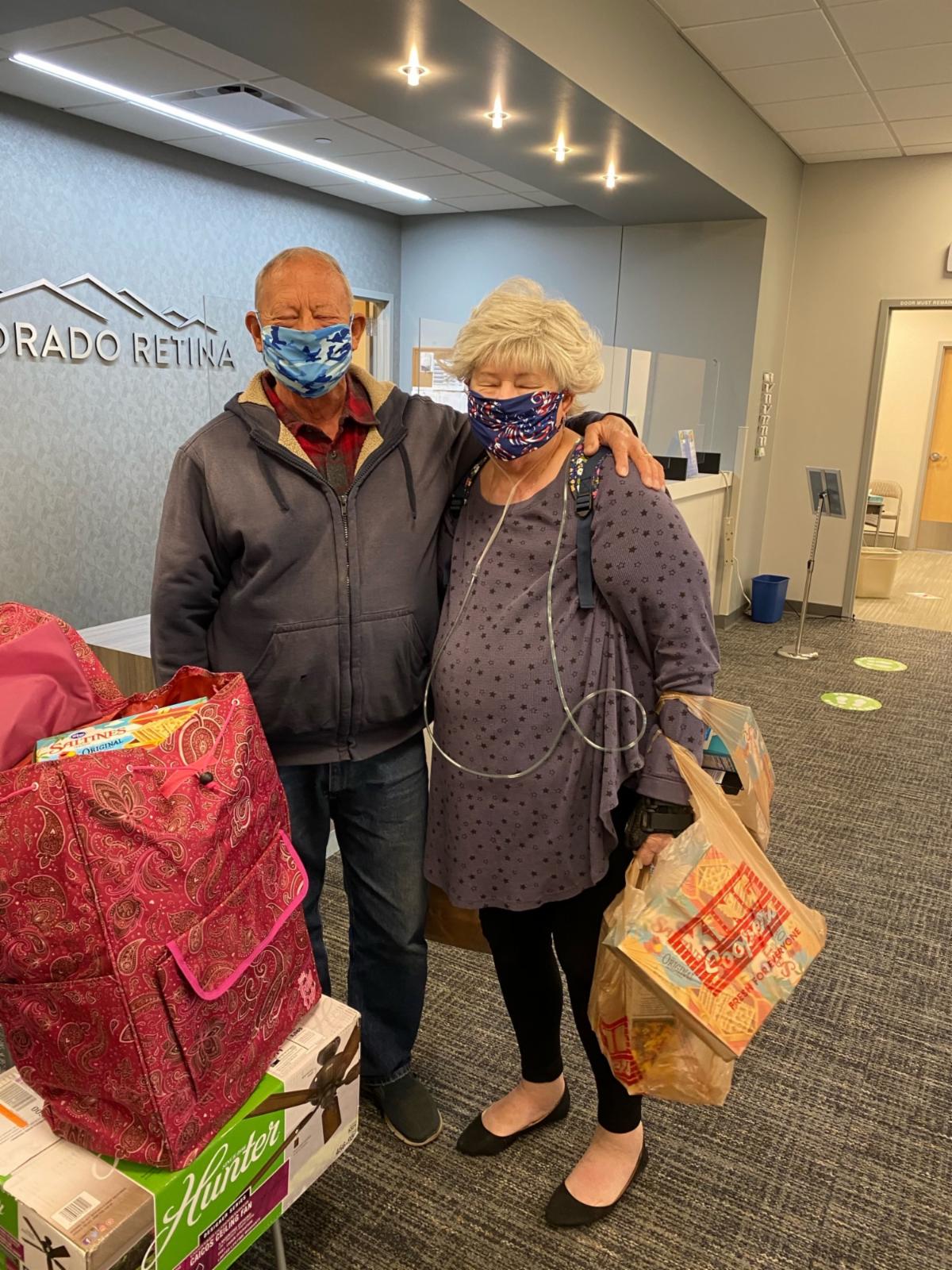
As part of our commitment and connection to Colorado's seniors we partnered with the Colorado Gerontological Society (CGS) for their annual Holiday Basket Project. Our in-clinic donation food drive is well underway, providing low-income seniors a holiday gift basket filled with essential groceries, a present, and hygiene kit. We've been completely overwhelmed by your outpouring of support and donations and have almost adopted FIFTY SENIORS!!
With that being said, we know many of you want to volunteer with your families to support our community - here's your chance! To participate as a volunteer, you, your family or your practice representatives will be responsible for delivering baskets to the senior(s) on Saturday, December 19th. To practice social distancing, you will drive through the Colorado Gerontological Society parking lot at 1129 Pennsylvania, Denver and volunteers will put basket items in your trunk. You will get the name(s) of your pre-assigned seniors to make drop-offs to before you leave the parking lot. You will leave the basket on the front porch or in the apartment/care facility lobby. The senior will come pick up the basket after you call them to let them know its' been delivered.
When you sign up to drive, choose your time slot between 9am-2pm on 12/19 in which you wish to deliver the basket(s). Indicate how many seniors you wish to deliver to, we ask you do 2-3 drop offs. Drop-offs will be coordinated to ensure you drop off in your home neighborhood, or along your route home. The baskets will be completely pre-built for you by the Colorado Retina team, just note you're on our team in the comment section. If you would rather build your own basket with your family, that is totally fine too!
Thank you for helping us provide food security, holiday cheer, and meaningful social connection to the in-need elderly this holiday season!
|
|
|
CASE OF THE MONTH
REAL CASES OF YOUR REFERRED PATIENTS
|
|
DETACHED MACULA AROUND A MACULAR HOLE
AUTHOR: NANCY CHRISTMAS, MD
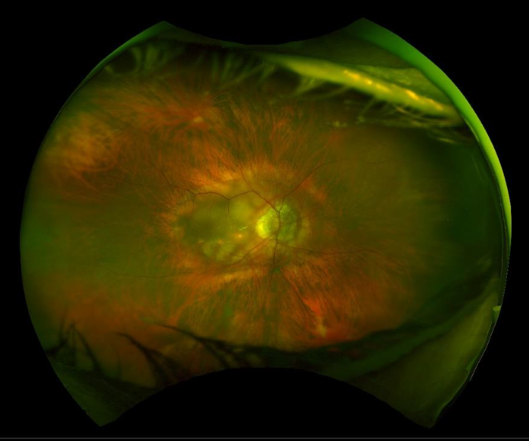
JF is a 79 year old man who was a high myope of around -20 prior to his cataract surgery a couple of years prior to presentation. He presented complaining of decreased vision for over 6 months in his right eye measuring 20/200.
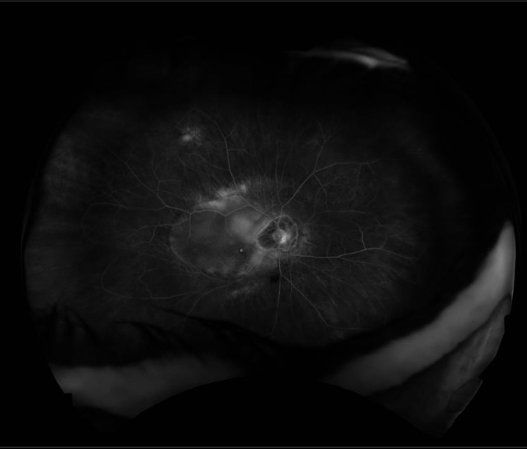
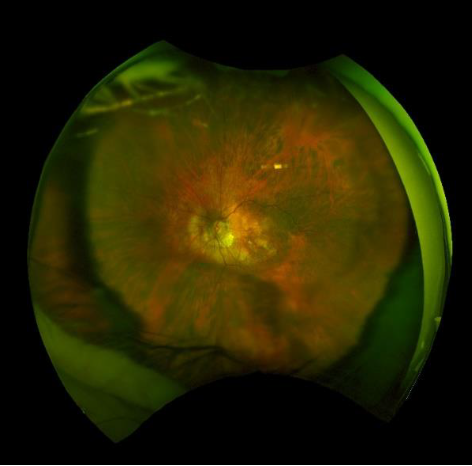
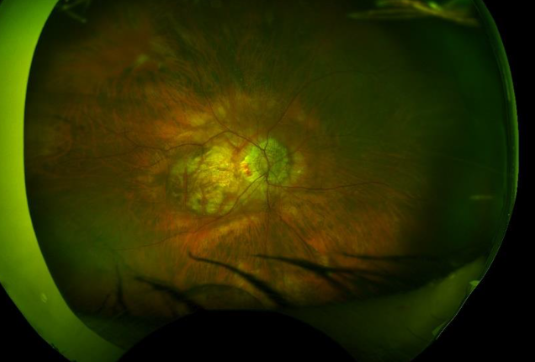
On examination he had peripapillary atrophy, macular atrophy and subretinal fluid around a small macular hole that pooled on fluorescein angiography in the large staphyloma. The entire macula was detached around the macular hole.
|
|
|
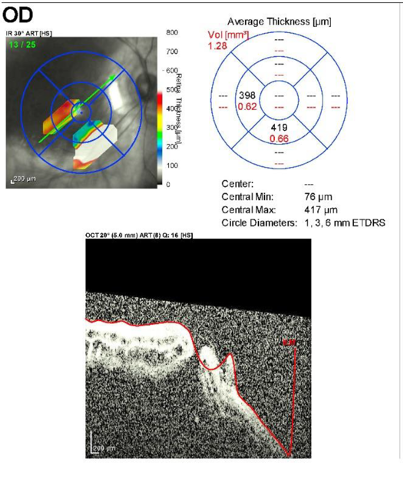
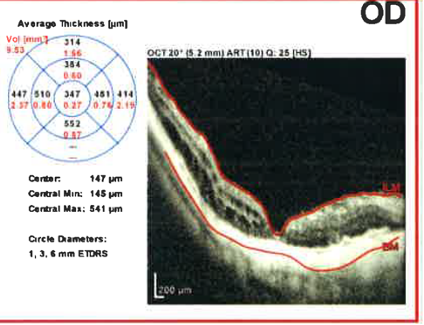
On OCT of the right eye, the full-thickness macular hole (arrow) with localized detachment of the macula in the large staphyloma was seen.
There was enough fluid that the RPE was not visualized on this scan.
|
|
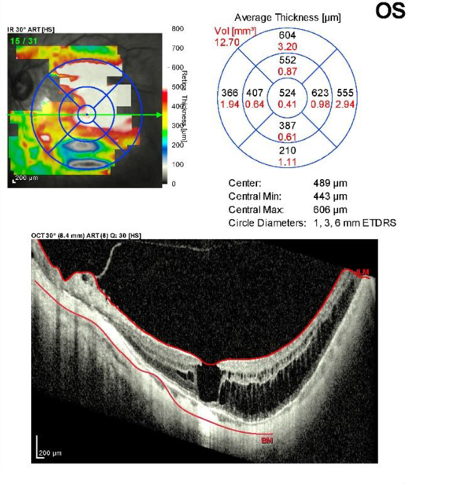
His left eye had peripapillary atrophy with a staphyloma, macular schisis, atrophy involving the fovea and lamellar hole. |
|
He underwent pars plana vitrectomy, inner limiting membrane peel, and silicone oil placement (instead of gas since he lived at high altitude) in the right eye to try to close the hole and reattach the macula.
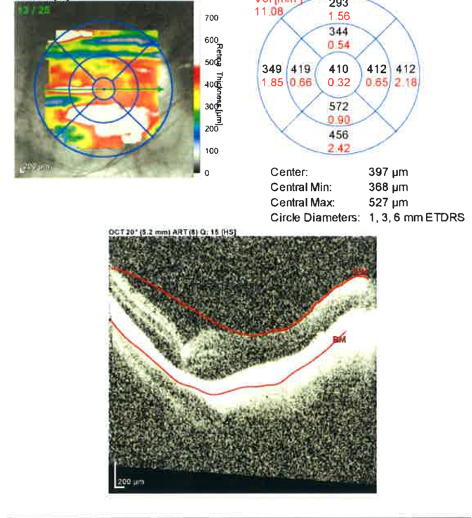
Initially, the hole was closed on OCT immediately after face down positioning.
|
|
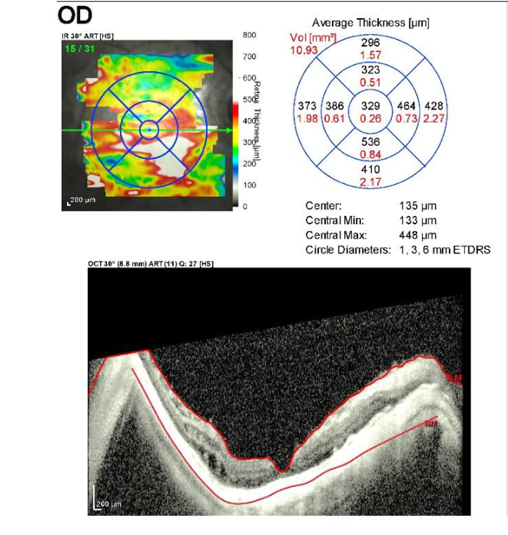
However, the macular hole soon reopened with re-accumulation of subretinal fluid in the macula a few weeks later.
It was decided to leave the oil in longer. The patient continued to sleep on his side. Over months, the hole started to close and stayed closed. The macular schisis also improved in that eye.
|
|
Over a year later, the silicone oil was removed and the hole remains closed with BCVA of 20/100.
|
|
FEATURED NEWS ARTICLES
PRESS RELEASES & RESOURCES FROM OUR VITREORETINAL SPECIALISTS
|
|
MICROSOFT'S SEEING AI PROJECT
"SAQIB SHAIKH ON TECHNOLOGY & INCLUSION: CREATING AN AI FUTURE WITH POSSIBILITIES FOR ALL"
|
This article is not authored by a Colorado Retina physician, but in the inspirational spirit of the holiday season, we think it's well worth the feature!
Saqib Shaikh lost his sight at the age of seven, fell in love with computers as a schoolboy and grew up to become a top software engineer with an inspirational mission.
Standing at the intersection of artificial intelligence (AI) and inclusive design, he believes we can create intelligent machines to empower millions of people around the world with disabilities to achieve more and live enhanced lives. The knowledge gained from targeting and solving the problems of those with special needs, he says, can only drive technological innovation that benefits everyone across society.
Saqib has had a lifelong relationship with advancing digital technology. At a school for children who are blind or with low vision, he learned self-reliance and developed a burning sense of curiosity. As a 10-year-old, he was given a rudimentary talking PC, and that led him to learn how to program. His intellectual romance with computer science blossomed at university where he doggedly overcame all sorts of day-to-day challenges on campus to graduate top his class with a master’s degree in AI.
A dozen or so years ago, Saqib joined Microsoft and quickly proved his prowess as an engineer by helping to create products, services, and apps that many of us use every day, like Bing and Cortana.
His quest nowadays is to create greater accessibility and inclusion – to level the playing field for everyone. As the driving force behind Microsoft’s Seeing AI project, he is exploring how AI can enable people who are blind or with low vision to achieve more with freedom and confidence.
His team launched the Seeing AI app in 2017, giving those who cannot see a new way to understand the world through the cameras on their smartphones. Since then, it has helped customers with more than 10 million tasks. A user merely points his or her phone, and the app vocally says what it sees. It might be in a room, on a street, in a mall, or an office – customers are using the app in all sorts of situations. With facial-recognition technology, the app can name friends and acquaintances, describe physical appearances of people and even predict their moods. It can read printed text in books, newspapers, menus, and signs aloud. It can even identify banknotes.
Saqib currently works and lives in London and now speaks to national audiences about how technology has helped him realize his potential and how it promises to improve the lives of everyone – and not just those disabilities.
Article by, Geoff Spencer - Microsoft Asia Writer
Microsoft Features: 30 January, 2019
|
|
|
A 2020 UPDATE ON VITRECTOMY SYSTEMS
THE VITRECTOMY LANDSCAPE
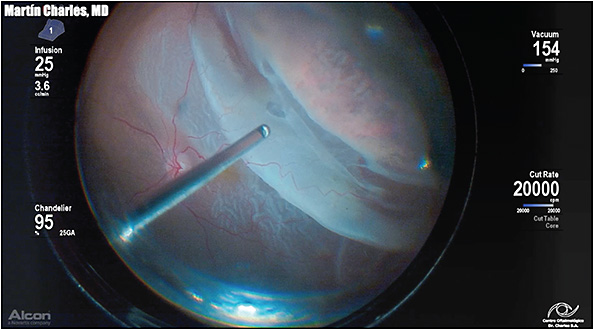
Vitrectomy system technology has been improving at a rapid rate in recent years, much like smartphones and smart watches. New features that were once the stuff of dreams are becoming the norm. Here, experienced surgeons share their impressions of the current vitrectomy platforms from Alcon, Bausch + Lomb, and DORC. While safety and efficiency are the primary goals, each system has a slightly different approach, yet all 3 systems share much in common. Just as in other areas of health care where the patient experience is paramount, in vitrectomy systems it is the user experience for both physician and surgical staff that is the gauge of success.
All 3 platforms use dual-cutter technology, first introduced by DORC, for improved efficiency and safety by removing vitreous faster while reducing vitreoretinal traction. Higher cut rates may augment the dual-cutter probes, although ever-increasing cut rates may hit a point of diminishing returns. The new frontier is fluidics, increasing flow through the cutter tip with infusion systems better able to keep pace with higher rates of aspiration.
Smaller is not always better, as we have learned over the years since the introduction of 27-gauge instruments. But hindrances, including reduced flow, diminished lighting and visualization, and overly flexible instruments, are all improved in the newest generation vitrectomy systems. Such upgrades may cause vitreoretinal surgeons to take a new look at 27-gauge surgery, because these enhancements are making this smaller gauge surgery comparable to the larger gauges to which surgeons are accustomed.
Surgeons and staff need an easy interface to perform surgery while minimizing distraction and delays. Fortunately, all 3 systems have easier-to-navigate control panels, foot pedals, and setup processes.
For specifics of each system, view the full article to read specifics of each system and reviews by expert vitreoretinal surgeons.
Featured vitrectomy systems:
- ALCON HYPERVIT AND ULTRAVIT VITRECTOMY WITH THE CONSTELLATION PLATFORM
- BAUSCH + LOMB STELLARIS ELITE PC SYSTEM
- THE DORC EVA SYSTEM
|
Seen in: Retinal Physician, November 1, 2020
|
|
|
CLINICAL RESEARCH
UPCOMING AND ACTIVE FDA-APPROVED CLINICAL RESEARCH TRIALS
|
|
Our in-house clinical research department is currently enrolling trials in the therapeutic areas of diabetic edema and retinopathy, wet and dry macular degeneration and uveitis AND we're involved in cutting-edge genetic therapies! |
PAGODA The First Diabetic Macular Edema Phase 3 Trial of the Port Delivery System with Ranibizumab
|
Colorado Retina Research Department is currently enrolling for Genentech/Roche phase 3 clinical trial investigating the Port Delivery System with ranibizumab (PDS) in people with diabetic macular edema (DME). The PDS is an investigational first-of-its-kind refillable eye implant designed to continuously release a customized formulation of ranibizumab over a period of months. Pagoda is a phase 3, multicenter, randomized, active-comparator, non-inferiority study that will evaluate the efficacy, safety and pharmacokinetics of the PDS for the treatment of DME. Patients DME will be randomized to receive either the PDS 100 mg/mL refilled at fixed 6-month intervals or monthly intravitreal injections of ranibizumab 0.5 mg. The primary endpoint of Pagoda is the change in Best-Corrected Visual Acuity (BCVA) from baseline averaged over weeks 48 and 50. The PDS is an investigational drug delivery system that includes an implant, ancillary devices, and ranibizumab. The PDS allows continuous delivery of ranibizumab and thus is intended to reduce the burden of frequent eye injections by allowing people with DME to potentially go several months before needing a refill of the implant, and to address under-treatment that could lead to vision loss. |
PAVILION Investigating PDS in Diabetic Retinopathy (DR)
|
Colorado Retina is excited to participate in Genetech’s phase 3 trial to evaluate the Port Delivery System with ranibizumab to treat diabetic retinopathy in patients without diabetic macular edema. PDS is a permanent refillable eye implant, approximately the size of a grain of rice, which continuously delivers a customized formulation of ranibizumab over a period of months. Pavilion is a phase 3, multicenter, randomized study that will evaluate the efficacy, safety and pharmacokinetics of PDS for the treatment of DR in people without diabetic macular edema. Enrolled patients with DR will be randomized to either the PDS arm with fixed 9-month refills or to the comparator observation arm. Patients in the comparator arm will be eligible for the PDS implant at month 16 and will receive refills every nine months. The study is also designed to see how PDS impacts disease control, visual acuity and anatomic outcomes compared to observation alone with the end goal of providing DR patients with the same favorable outcomes as current effective therapies but with only one treatment every 9 months. |
Please contact Colorado Retina's Research Department for more information about screening, eligibility or clinical research related questions.
|
|
|
COLORADO RETINA ASSOCIATES, P.C.
MAIN PHONE: (303) 261-1600
FAX: (303) 261-1601
|
|
|
|
|
|
|