Weekly update from the National Housing Conference | | News from Washington | By Brittany Webb | | |
Defining “institutional investor” drives bill introductions
Two bills have been introduced to limit institutional investors from buying single-family homes in response to White House pressure to ease housing affordability struggles, most recently through comments during the State of the Union address. President Trump has frequently criticized the role of institutional investors in the housing market, asking Congress to codify a ban, though such actors only make up 3% of the total housing market. As part of an Executive Order banning purchase activity, Trump tasked his advisors with writing a definition for the term institutional investor. Last week, a memo from the administration offered a definition of an entity owning more than 100 single-family homes.
Senators Josh Hawley (R-Mo.) and Jeff Merkley (D-Ore.) introduced the Homes for American Families Act alongside an update to the HOPE for Homeownership Act. Together, the bills would prohibit large institutional investors from purchasing single-family homes, townhomes, and condominiums and impose tax changes on funds with $50 million or more in assets. The legislation defines “institutional investor” as having $150 million in assets or more.
Meanwhile, Senate Democrats, led by Banking Committee Ranking Member Elizabeth Warren (D-Mass.), also introduced the American Homeownership Act. This legislation seeks to end tax breaks and benefits for Wall Street-backed landlords, bolster antitrust enforcers, and further reinvest savings into increasing the supply of affordable housing. The bill includes specific exemptions for owners of Low-Income Housing Tax Credit properties, entities that build new multifamily housing, and allows five years of tax benefits to entities that build single-family homes. It takes a more limited approach to “institutional investor,” defining them as owning just 50 single-family homes.
The bills enter a broader discussion of overall affordability challenges as the House and Senate consider the Housing for the 21st Century Act and the ROAD to Housing Act, respectively. Lawmakers are expected to attempt to add some version of institutional investor limitations to these broader housing packages through the amendment process.
| | | |
Hear from top housing, policy, and media voices
at NHC's Solutions for Housing Communications
On April 8, 2026, the National Housing Conference will convene housing communications leaders from across the country for Solutions for Housing Communications at the National Press Club in Washington, D.C.
Panel discussions will spotlight strategies for clearly communicating complex and technical housing issues, working effectively with housing reporters, and understanding how technology and AI are reshaping public discourse. Sessions will also highlight the power of intergenerational storytelling, best practices for communicating before, during, and after natural disasters, and practical tools to help participants engage confidently across media platforms. Panelists and speakers include:
-
Michael Butchko, Vice President of Business Intelligence, NeighborWorks® America
-
Julian Glover, Senior Advisor for Communications, Marketing, and Education, National Fair Housing Alliance
-
Victoria Guida, Economics Correspondent, POLITICO
-
Rodney Harrell, Vice President of Family, Home and Community, AARP
-
Katy O'Donnell, Reporter, Bloomberg News
-
Tobias Peter, Senior Fellow and Codirector of the AEI Housing Center, American Enterprise Institute
-
Kate Rodgers, Chair and Policy Director, Student HOMES Coalition
-
Rachel Siegel, Reporter, The Washington Post
-
Sipho Simela, Founder and CEO, Matrix Rental Solutions
-
Zoé Valentín, Media Relations Manager, UnidosUS
-
Caitlin Vannoy, Director, Legal Advocacy, National Association of REALTORS®
Members of the media receive complimentary registration.
Please contact kbeigay@nhc.org for more information.
| | |
FHFA faces FOIA lawsuits over fraud investigation records
The Federal Housing Finance Agency (FHFA) is facing multiple Freedom of Information Act (FOIA) lawsuits from nonprofits and journalists seeking records tied to its fraud investigations and enforcement activity. The Campaign for Accountability (CfA) filed suit in federal court in Washington, D.C., alleging the agency failed to comply with a FOIA request seeking a report allegedly prepared by FHFA Director Bill Pulte concerning Federal Reserve Chair Jerome Powell. According to the complaint, the report was allegedly sent to U.S. Attorney Jeanine Pirro before her office issued subpoenas to the Federal Reserve (Fed) and Powell related to his Senate testimony about a $2.5 billion renovation of the Fed’s headquarters. CfA argues FHFA does not have jurisdiction over the Fed and is asking the court to compel the agency to produce the records after it failed to respond within FOIA’s statutory deadline.
“Bill Pulte and the FHFA do not have jurisdiction over the Fed or its Chairman, so the public has a right to know how Pulte abused his position to push the president’s vendetta,” said CfA executive director Michelle Kuppersmith in a statement. “Since the FHFA has neither provided the memo nor explained why it has not, CfA is asking the court to compel the agency to produce it.”
The lawsuit comes amid broader scrutiny of FHFA’s investigative activity. Requests seeking investigative reports, internal emails discussing fraud, and records related to the agency’s fraud tip line remain pending. In court filings, FHFA said it identified 186 pages of investigative reports from its Office of Inspector General, approximately 13,000 pages of potentially responsive internal emails discussing fraud, and roughly 9,234 pages related to fraud tips, noting it could take over a year to review materials. The Democracy Forward Foundation, National Review, and an independent reporter have also filed FOIA lawsuits. The disputes follow heightened tensions between the Trump administration and Powell over monetary policy and the Fed’s building renovation project.
| | | |
Senate Democrats urge banking regulators to maintain disparate impact
A group of Senate Democrats sent letters to federal regulators at the Office of the Comptroller of the Currency, the Federal Deposit Insurance Corporation, and the National Credit Union Administration asserting the importance of disparate impact in lending after the regulators removed disparate impact references from their bank supervisory activities in response to an executive order from the Trump Administration.
“Removing disparate impact liability from these documents will significantly weaken longstanding civil rights safeguards and make it easier for financial institutions to discriminate against borrowers on the basis of protected characteristics such as race and gender. Your agencies must immediately reinstate the use of disparate impact analysis to ensure examiners can use the full set of tools at their disposal to uncover and act on instances of discrimination in financial services,” wrote the group. “Removing disparate impact ties examiners’ hands and makes it much harder to uncover discrimination by banks, credit unions, mortgage originators, and other lenders. Discrimination often goes undetected unless independent entities conduct an analysis that reveals discrimination after the consumer received a loan.”
| |
HUD rolls back 30-day notice of eviction, encourages work requirements
The U.S. Department of Housing and Urban Development (HUD) announced that it is rolling back its rule requiring a 30-day notice of eviction to be provided to tenants in HUD-funded housing for nonpayment of rent. The new rule, which will go into effect 30 days after publication in the Federal Register, seeks to align with existing regulations for project-based rental assistance in a unified standard. It will impact over two million households and was met with enthusiasm from many industry representatives and disappointment from tenant advocates who supported such universal tenant protections. Notices of termination for nonpayment of rent will return to a range from 5 days to 30 days for HUD programs dependent on state and local laws.
“The COVID-19 pandemic is long over, and HUD regulations will now reflect that reality. Today, we are giving HUD-subsidized property managers the flexibility to enforce policies that best serve their constituencies. This deregulatory action advances HUD’s mission of cutting red tape, promoting local flexibility, and increasing housing affordability by recognizing the case-specific needs that exist across rural, tribal, and urban communities,” said HUD Secretary Scott Turner.
HUD also issued a proposed rule that encourages Public Housing Agencies (PHAs) and owners of HUD-supported multifamily housing properties to impose work requirements and two-year or longer time limits on housing assistance payments. The rule specifies targeting non-elderly and non-disabled households and further exempts households receiving assistance under certain specialty programs for veterans, previous foster care recipients, and family unification.
While the rule does not impose requirements on PHAs to establish such limitations, it expands the opportunity for PHAs to do so themselves, even if they are not part of the Moving-to-Work (MTW) program that historically has operated with such programs. Outcomes of MTW programs are mixed, with many advocate groups arguing that two years is not sufficient time for a person to increase their income in the normal economic environment, potentially increasing homelessness rates. Further, the impact on households with children and childcare obligations is a frequent concern.
| | | |
Mortgage rates drop below 6%
Freddie Mac reported that the 30-year fixed-rate mortgage averaged 5.98%, the first time since September 2022 that the 30-year rate has fallen below 6%. The rate was down from 6.01% the previous week and 6.76% a year ago.
“For the first time in three and a half years, the 30-year fixed-rate mortgage dropped into the 5% range, falling even lower than last week's milestone,” said Sam Khater, Freddie Mac’s Chief Economist, adding that the rate decline combined with an increase in homes for sale could draw more buyers into the spring homebuying season.
Analysts say the drop offers a potential thaw in a housing market that has been largely frozen since rates peaked at just under 7.8% in October 2023. Lower rates can translate into hundreds of dollars in monthly payment reductions, but economists caution that affordability challenges remain as home prices stay elevated, and supply constraints persist. While a rate below 6% may encourage some buyers who have been waiting on the sidelines, experts note that sustained improvement in housing activity will depend on expanding supply alongside easing borrowing costs.
| | | |
Home price appreciation varies starkly by region
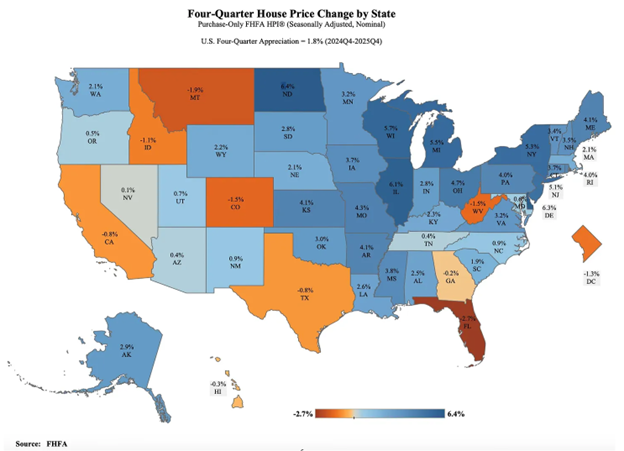
Calculated Risk reports that FHFA’s House Price Index shows U.S. house prices rose 1.8% between the fourth quarter of 2024 and the fourth quarter of 2025, highlighting pronounced regional disparities. The sharpest appreciation is concentrated in parts of the Upper Midwest and mid-Atlantic states like North Dakota, Wisconsin, Illinois, Michigan, and Delaware. Prices fell in nine states and the District of Columbia, with especially notable declines in Florida, Montana, Colorado, and West Virginia, suggesting that several pandemic-era boom markets are now undergoing mild corrections.
| | |
A commentary piece from the Terner Center for Housing Innovation titled “Pathways to Support Mixed-Status Immigrant Families Receiving Federal Housing Assistance” examines the threat posed by a proposed HUD rule that would make the roughly 20,000 mixed-status immigrant households currently receiving federal rental assistance wholly ineligible, forcing families to choose between separating or losing their subsidy entirely. The post outlines a range of responses available to state and local governments and community organizations, including rental assistance, legal aid, and outreach through trusted community partners, along with best practices for implementing those supports quickly and equitably.
A report from the American Enterprise Institute (AEI) finds that the bigger the factory in a community, the bigger the housing problem. The analysis states that among mega-projects with 5,000 or more anticipated jobs, 67% received a D or F grade for housing preparedness to actually house those workers. Recognizing that it is logical for large sites to need large swaths of land, the piece highlights how considering this pattern and improving correlation between large factories and housing development can better serve economic goals of communities.
A new blog post from the Government Accountability Office (GAO) summarizes a new report finding that nonbank mortgage companies now originate and service the majority of federally backed mortgages and subsequently pose potential risks to housing market stability. The report notes that due to their reliance on short-term credit lines, credit can dry up in an economic downturn. GAO found that both Ginnie Mae and FHFA have gaps in how they verify financial data, assess short-term credit risks, and model stress scenarios, and offers recommendations for closing those gaps.
A press release from Citi announces its Blueprint for Housing Opportunity Initiative, a $60 billion, five-year commitment to create and preserve at least 250,000 affordable housing units nationwide through financing for acquisition, construction, rehabilitation, and long-term affordable housing. The Citi Foundation will also deploy $50 million in philanthropic grants to nonprofits addressing housing challenges, and Citi says it will advocate for policy tools like the Low-Income Housing Tax Credit to help expand housing supply. The commitment includes a $1 million grant supporting the Center for Affordable Housing Lending, the research partner of the National Association of Affordable Housing Lenders (NAAHL).
| | The National Housing Conference is a diverse continuum of affordable housing stakeholders that convene and collaborate through dialogue, advocacy, research, and education, to develop equitable solutions that serve our common interest. | | Defending Our American Home since 1931 | | Copyright © 2024. All Rights Reserved. | | | | |