e-Newsletter | September 17, 2021 |
|
On Monday, October 11, 2021, the Museum of Old Newbury presents the Race and Slavery in New England Symposium at The Governor’s Academy, 1 Elm Street, Byfield, Mass. Writers and historians will explore the lives and work of Black New Englanders and abolitionists through a fresh examination of the historical record and recent research.
|
|
Part II: Alexander Livingston meets Charles Delin in Amsterdam
In last week’s newsletter, we met Alexander Livingston, whose portrait sparked ongoing questions about his life. Read that article here.
|
|
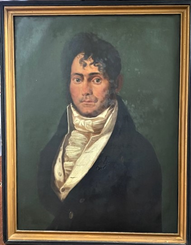
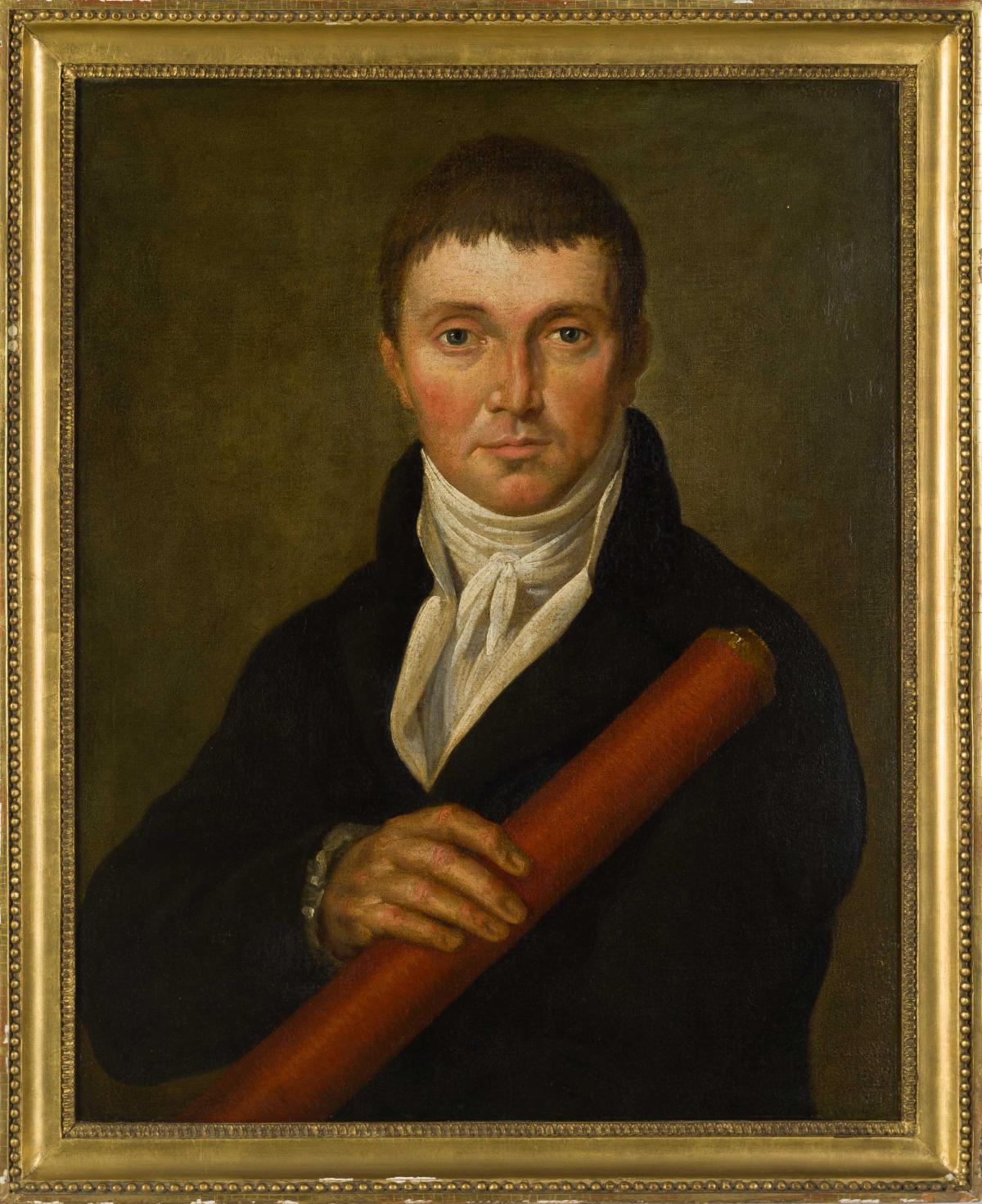
Alexander Livingston's portrait joins nine other Delins in the collections of the Museum of Old Newbury, including Nicholas Lattime & Caleb Cushing, shown below. |
|
This week, we look at the painting itself, as well as the painter, with hearty thanks to Collections Committee Member Monica Reuss, and additional research by yours truly, Executive Director Bethany Groff Dorau.
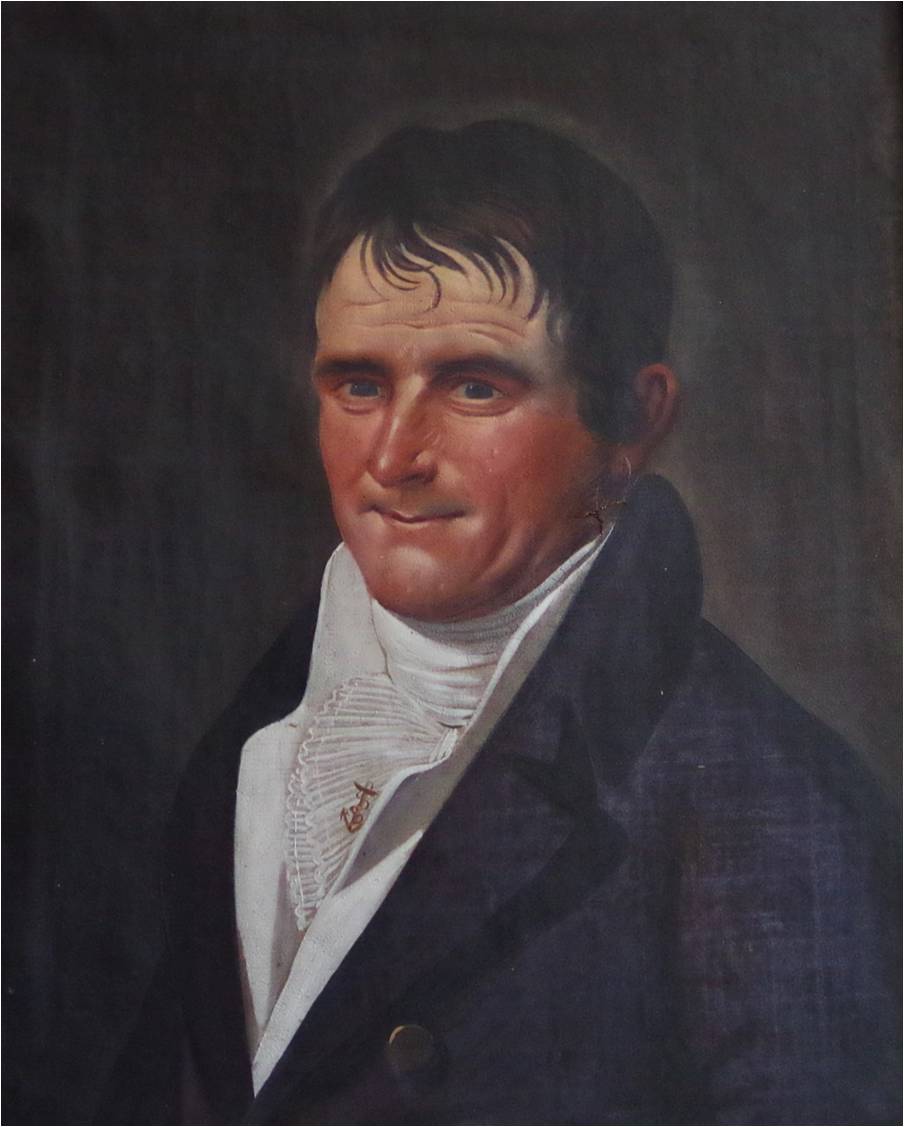
The portrait of Alexander Livingston is like nothing I have seen before, in my limited experience of early 19th century portraiture.
The hair is tousled and loose, the skin is swarthy and the fringe of a beard is rendered in detail.
It was these details that captured Monica Reuss’ attention when she first “met” Livingston, declaring, delightedly, “Oh, I think that’s a Delin!” Miraculously, thanks to an exhibition held in 1985 here at the
Museum of Old Newbury and several other paintings by the artist, I knew who Delin is, or was.
|
|
Charles (Carolus) Delin (1756-1818) was a Dutch artist with an affinity for Newburyport mariners. He was born in 1756 into a family of French-speaking Walloons, bi-lingual residents of a region of Europe inhabited by Flemish and French-speaking people. The first half of his career took place in Maastricht where he was a popular painter of Dutch and northern German subjects. The second half of his career began in the late 1790s when he moved to Amsterdam, a major northern European port, during a period coinciding with the annexation of the Austrian Netherlands by Napoleonic France. Delin, who was academically trained, likely painted this portrait in Amsterdam, after he moved from Maastricht and opened a coffeehouse. |
|
Nicholas Lattime (1777-1822) by Charles Delin. From the collections of the Museum of Old Newbury. |
|
Caleb Cushing (1770-1820) by Charles Delin. From the collections of the Museum of Old Newbury.
|
|
In the years following 1800, Delin’s career as a port painter reached its peak. The coffeehouse he operated served as a natural gathering place for seamen and Americans soon became his major source of patronage. This was particularly true of the years leading up to and during the War of 1812, when America’s conflicts with Britain diverted many American ships to the European continent. Because their time in port was limited, Delin developed a formulaic approach to these portraits: canvases were limited to a small number of standard sizes; sitters were generally depicted in bust-length and posed in a three-quarters turn toward the viewer. Rather than painting his subjects in uniform, all but a few of Delin’s sitters wear dark waistcoats with white frilled shirts, stocks and ties, their hair tousled with bangs in the modified Classical “Brutus” style popular in Napoleonic France.
Because the portraits were painted quickly and with a minimum of modeling (shading the features and figure to produce the illusion of dimensionality), this group of Delin’s portraits (Newburyport mariners) appear to be done in a “naïve” folk art style. It is thought this simpler style was particularly appealing to Americans, who may not have been as familiar as their European counterparts with more sophisticated portraiture. Speed and simplicity of execution would also have meant the portraits were relatively inexpensive.
Delin’s market was further fueled by word-of-mouth through familial and community networks. The great majority of his American subjects, whose ports of origin have been identified, hail from the eastern coast of Massachusetts, with Newburyport representing a striking number of examples, far more than Salem, Gloucester or Nantucket. Interestingly, few if any Boston subjects are known. As of this date, the Museum of Old Newbury’s collection includes ten examples of Charles Delin’s portraits of mariners.
This portrait is thought to have been painted between 1810 and 1815, aligning with the years that Livingston is known to be living in, and sailing out of, Newburyport. It is larger, and therefore would have been more expensive, than his standard smaller size. Livingston is depicted in an almost half-length pose, turned slightly to the left, looking directly at the viewer. He wears his hair with a curly forelock, a fringe of beard frames his face.
There is still a great deal to learn about Alexander Livingston’s origins, his uneven career and early death, but there is something magnificent about his face. Thanks to Deborah and Donald Chesnut, you will soon be able to “meet” him yourselves. In the meantime, take a moment to think of this young Newburyport mariner, strolling down an Amsterdam street to a coffeehouse to sit for his portrait.
Editor's note: to learn more, see Peter Benes, Charles Delin: Port Painter of Maastricht and Amsterdam, Catalogue of an Exhibition of Portraits of American Seacaptains by Charles Delin held at the Cushing House Museum, Newburyport, Massachusetts, Historical Society of Old Newbury, 1987.
|
|
Woman on the MOON
A Roll in the Hay...a blog by Bethany Groff Dorau
Last week, the first load of winter hay arrived at the Poore Farm, my West Newbury home that is also a sanctuary for 19 farm animals with a variety of entertaining backstories. A hulking young man backed his truck up to our storage shed, and my husband James and I scrambled to keep up as he tossed fifty-pound bales of fragrant first-cut grass hay for us to stack (but isn’t all hay just grass, you ask? Oh, you just wait…). We have just enough to feed our sanctuary animals for two months.
We are lucky to have sufficient summer grazing for our massive Belgian draft horse, Chief, but nine months of the year, he eats two ten-dollar bales of hay every day. It is our single largest expense.
|
|
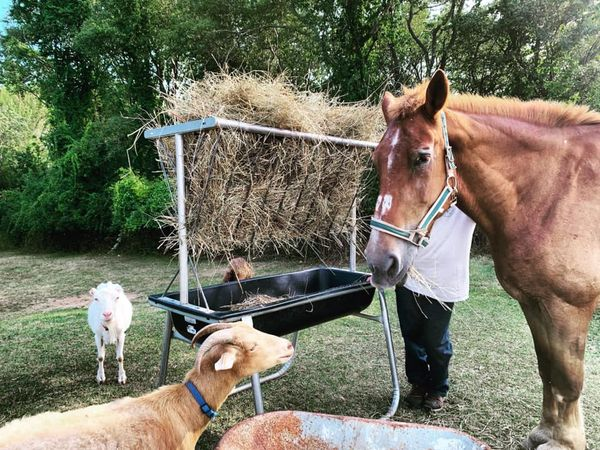
Chief, the 18.3 hands high Belgian draft horse, eating the author out of house and home. (Courtesy image.) |
|
Walk into any feed store, and one is presented with a vast array of hay products. It is steamed, pelleted, cubed, chopped, made of timothy, alfalfa, Bermuda, orchard grass. Older horses can have their hay delivered in a soupy mash, mixed with beet pulp and molasses. There is special hay for rabbits and chinchillas. As with so many foodstuffs in our industrialized world, hay is international, highly processed, packaged and specialized. The winter hay I just bought came from upstate New York. Last year’s spring haul was from Alberta, Ontario. Land is so valuable, and therefore grassland so scarce in Essex County, that we do not grow enough hay to feed our resident animals. |
|
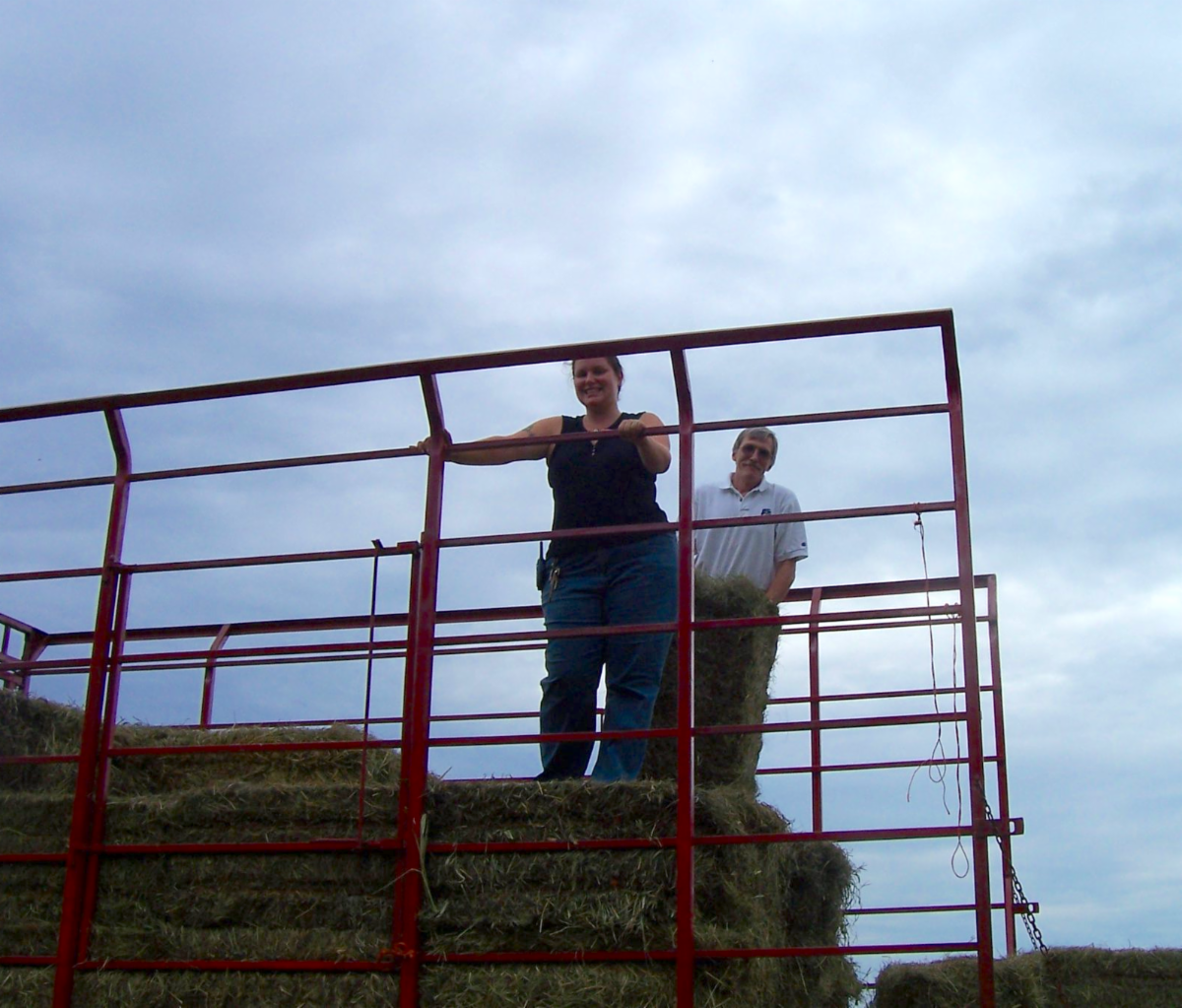
The author and friends harvesting hay at the Spencer-Peirce-Little Farm, Newbury, Mass. (Courtesy image.) |
|
But hay is everything, or it was. It is the reason we are here. We may think of Puritan New England as an entirely religious enterprise, and that is not untrue, but human motives are always complicated. For many of the early European settlers of Newbury, the lure of profit was equally, if not more, alluring than spiritual purity. Newbury was founded as a stock-raising enterprise, and the stock that could be the most profitable, cattle and sheep, required vast amounts of hay. Hay, the mixed meadow grasses that can be dried and fed during the many months of the year when grazing is sparse, relies on cleared fields. There were some cleared areas along the coast, the result of Native American agricultural practices, but most of Newbury was wooded.
Find an ax. Go outside. Take down one big tree, stump and roots and all, using nothing but that ax, unless your neighbor has an ox, and then maybe you can borrow him. Now imagine doing this to hundreds of trees and bushes, chopping and burning and pulling. Wait a year. Pull up anything you missed. Wait another winter. Maybe, if you are lucky, your cows and sheep get their first mouthful of grass, or you get your first hay, the following year. But not here in Newbury. For lo, God hath given us the salt marsh. Not a tree in sight. Magical, nourishing marsh hay, year one. We survived the first winter, the starving time, and there was much rejoicing.
Hay was so important to the survival of the community that its theft, even by accident, as in the case of an escaped cow or horse that munched a neighbor’s stash, shows up in the court record. Marsh and meadow hay land was listed separately in estate inventories, along with quantities of stored hay. In the inventory of Newbury’s Thomas Millward, who died on September 2, 1653, taken by Percival Lowell, Richard Lowle and Anthony Somerby, “twelve akers of salt marsh,” “five akers of salt marsh,” and “three akers of meadow” fed his “five cowes, three oxen, three calves, halfe of two yearlings, halfe a mare, halfe a horse and halfe of seaven ewes and a ram.” He had no hay stored up – perhaps his final illness meant that he had not yet been able to mow his fields.
|
|
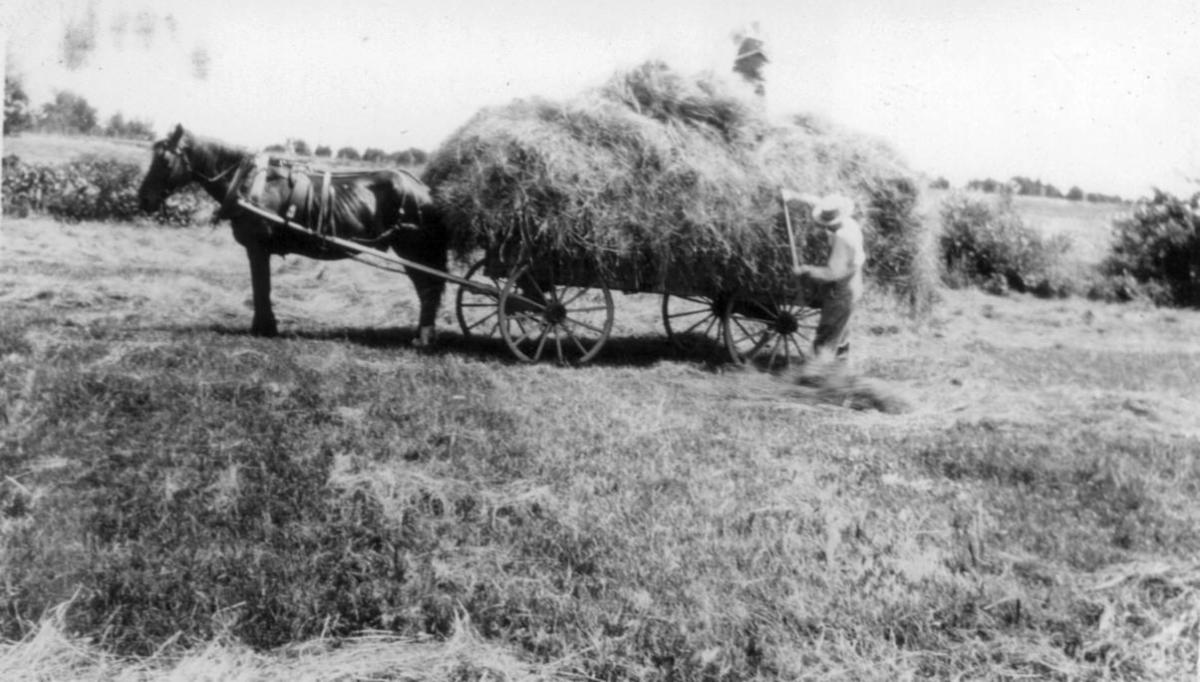
Haying on the Poore Farm, circa 1930. Pictured is the author's great-uncle Raymond and great-grandfather Philip Poore. (Courtesy image.) |
|
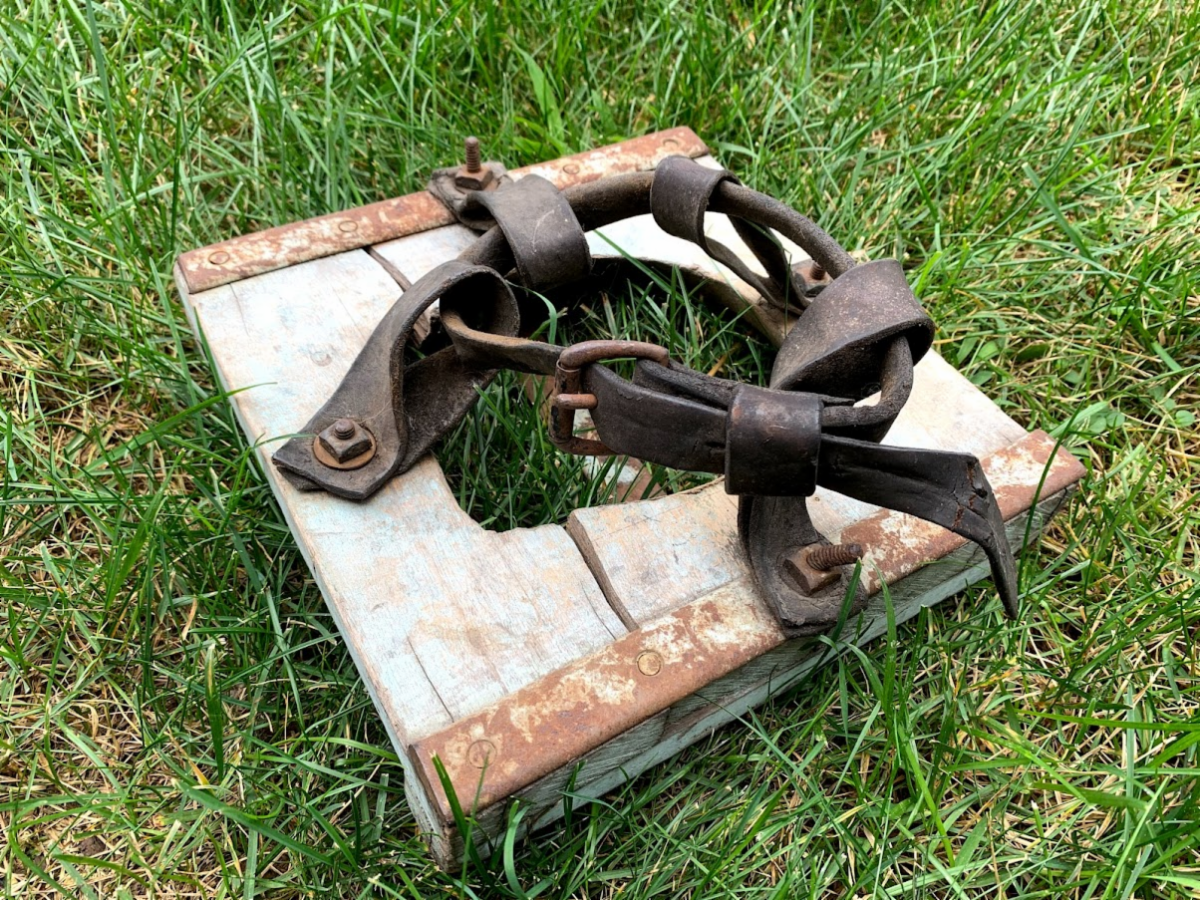
Over time, the unique conditions needed to harvest and store marsh hay shaped the landscape and traditions of this community. Hay was piled up on staddles, stout posts driven into the marsh and shaped to withstand wind, rain and snow. Special shoes were made for the horse and ox teams who traversed the marsh, iron and wood contraptions that strapped to the animals’ feet and helped prevent them from sinking into the bog. Pungs, hay wagons with wide sled runners, slid across the grass in the summer and the ice in the winter. Channels were cut for transportation and drainage. Camps sprang up on high ground in the marsh, and all the best and worst impulses of a community played out there; theft, romance, cooperation, bullying, drinking, even murder, but that is a story for another time. |
|
This early 20th century bog or marsh horseshoe was attached to the hoof with leather straps. (Courtesy image.) |
|
As cities grew, the gas stations of their time were the Haymarkets, where fuel for the literal horsepower of the residents was brought in from the surrounding countryside. An aside – I was forty-four-years-old before I realized that haymarkets were literally markets for hay, which is why they are in every major old city in the world. Hay is embedded in language, culture, ritual, art. We “roll in the hay.” We “make hay while the sun shines.” We “hit the hay,” “cut a swath,” find needles in haystacks.
Years ago, when my friendship with James was turning to something else, I wooed my love with hay words. I had been asked to give a talk on salt marsh hay and did a deep dive into the language of hay, archaic words and modern turns of phrase, all linked to the humble dry grass that changed the world. When he mentioned that the Ipswich Brewery (now removed to Brewery Place) was located on Hayward Street, I sent him the information I had gathered on the role of the hay warden in early Ipswich. He was intrigued. Every day thereafter, I sent him a new word, a thinly veiled love note.
There was medkniche, the reward given to the warden who weighed your hay, just as much hay as he could lift as high as his knee with his middle finger. There were placks and rickles, names for different shapes of haystacks. He replied by suggesting that Plack and Rickle would be perfect names for our first team of oxen, and that is when I knew he was meant for me.
There is heartbreak, too, in the language of hay. We briefly separated in that first year, and I went into deep mourning for the loss of my true love (insert mournful madrigal here). The morning after our tearful farewells, I sent him the last hay word.
- Aftermath: the period immediately following a usually ruinous event, from the 14th century meaning “after the mowing.”
It felt like I felt – empty and over, my crop reaped and taken off. It was not until many years later that I returned to this word, to find that I had it all wrong. Cue Merriam Webster. “The original aftermath came after the math or mowing: it was historically the crop of grass cut, grazed or plowed under after the first crop of the season from the same soil.”
And eleven years later, despite many mowings, our grass still grows.
Editor's note: Inconsistencies in spelling of names, etc., are from the historical record and not a typographical error.
|
|
Learn about upcoming programs, register, find Zoom links and catch up on previous presentations here. All of our virtual programs are free, however donations are gratefully accepted to help defray speaker fees.
|
|
October Programs
Race and Slavery in New England Symposium
The Governor’s Academy, 1 Elm Street, Byfield, Mass.
Writers and historians will explore the lives and work of Black New Englanders and abolitionists through a fresh examination of the historical record and recent research. Register here.
|
|
The Zealy Daguerreotypes: Research, Writing and Collaboration
Virtual Event
Ilisa Barbash, curator of visual anthropology at Harvard’s Peabody Museum of Archaeology and Ethnology, will discuss the research and work behind the production of the book To Make Their Own Way in the World: The Enduring Legacy of the Zealy Daguerreotypes (Aperture/Peabody Museum Press 2020), which features essays by prominent scholars from the disciplines of history, anthropology, art history and American studies.
The book is a profound consideration of some of the most challenging images in the history of photography: 15 daguerreotypes of Alfred, Delia, Drana, Fassena, Jack, Jem and Renty—men and women of African descent who were enslaved in South Carolina. Made in 1850 by photographer Joseph T. Zealy for Harvard professor Louis Agassiz, the daguerreotypes were rediscovered at the Peabody Museum in 1976. This talk will highlight some of its various topics, including the identities of the seven people depicted in the daguerreotypes, the close relationship between photography and race in the 19th century, and the ways contemporary artists have used the daguerreotypes to critique institutional racism in the 20th and 21st centuries.
|
|
Puzzle Me This...
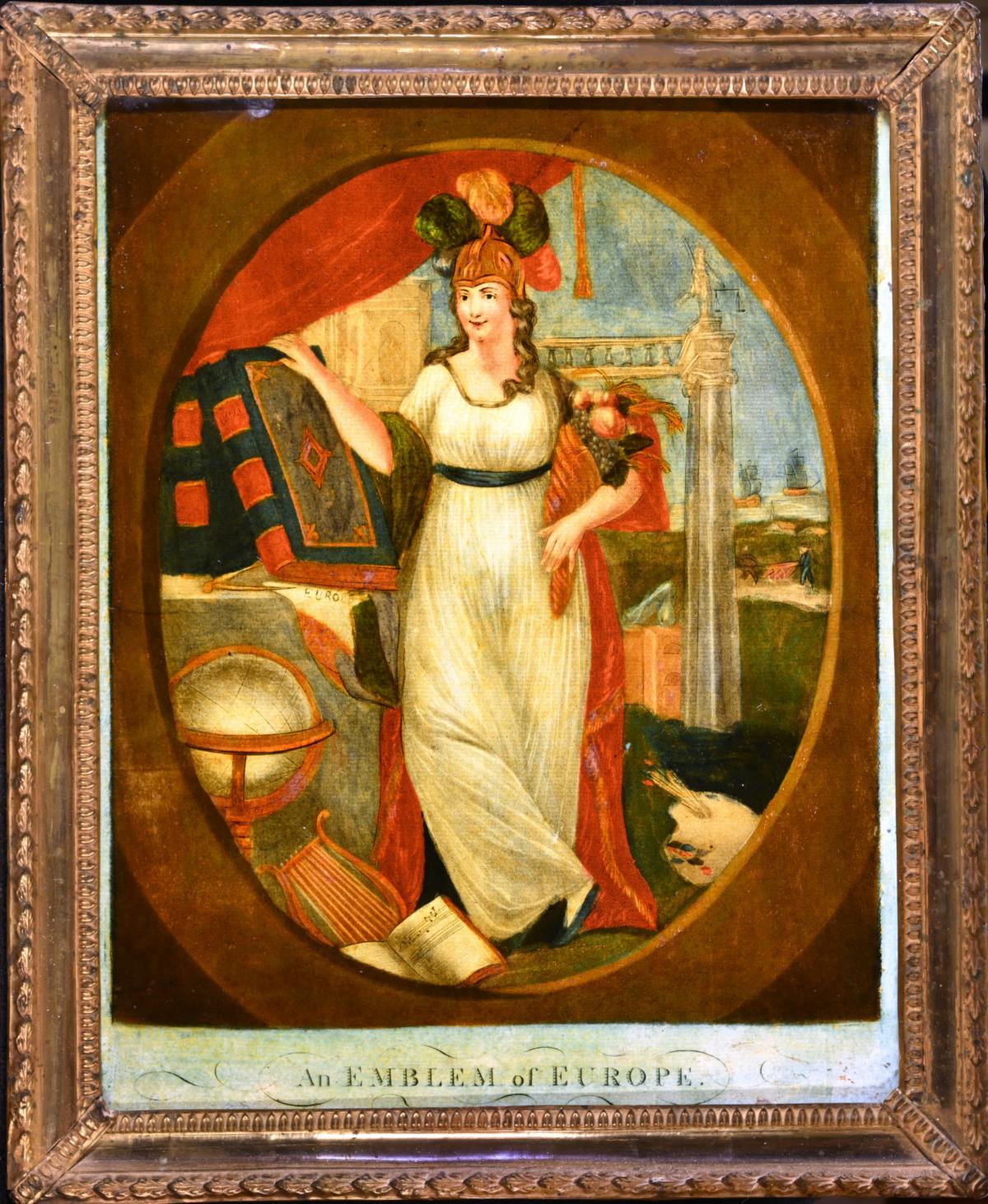
Emblems of the four continents have appeared in myriad forms since the 1500s. They represented the known world through allegorical figures, usually female, garbed in Greek or Roman attire.
The Emblem of Europe, shown here, is an example of églomisé (reverse painting on glass), dating circa 1800, and probably made in London. The image represents a society of empire building and commerce. Note the symbols of learning, prosperity and culture through the portrayal of books, a map of Europe, a cornucopia, a globe, a sheet of music, a lyre and a painter's palette. Two ships appear in the background.
From the collections of the Museum of Old Newbury. Photo credit: Bob Watts.
Click on image to begin.
|
|
Something is Always Cooking at the Museum
Ah, the cranberry. New England's quintessential fruit of the evergreen dwarf shrub that raw is very tart, but when cooked takes on a slightly sweet and luscious flavor. Alice Goodwin Robert's version is simple and delicious.
Cranberry Nut Loaf
2 cups all-purpose flour
1 cup sugar
1 1/2 teaspoon baking powder
1/2 teaspoon baking soda
1 teaspoon salt
3/4 cup orange juice
1/4 cup shortening
1 tablespoon grated orange rind
1 egg
1/2 cup chopped nuts
1 cup fresh cranberries, halved
Sift dry ingredients; cut in shortening. Combine orange juice and rind with well beaten egg. Pour all at once into dry ingredients, mixing just enough to dampen. Carefully fold in cranberries and nuts. Spoon into greased loaf pan. Bake at 350ºF for 1 hour, until crust is golden brown or until inserted toothpick comes out clean.
|
|
During this difficult period of COVID-19, we rely on your support more than ever. We continue to develop new, online programs for you to enjoy and keep us connected and look forward to in-person events as protocols for safety loosen. We hope, if you are able, that you will consider a donation to the museum. Thank you for your continued support.
|
|
Museum e-Newsletter made possible through the
generosity of our sponsors:
|
|
|
Museum of Old Newbury
98 High Street
Newburyport, MA 01950
978-462-2681
|
|
|
|
|
|
|
|