- Our June Featured Grower - Rod and Judi Kucera
- Klamath Cattlewomen Association Donation to KID
- 2026 Irrigation Season Update
- NEW - DROUGHT PROGRAMS - 15 June Deadline
- Klamath Basin ALERT: Grasshopper Sightings
- Sign K.I.D.'s petition for Title Transfer
- D-System Improvement Plan - Approved
- The NEPA Double Standard
- Upcoming Events
- What We are Reading (and you should too)
- Opportunities
|
| | K.I.D. Featured Grower - Rod & Jodi Kucera | |
Rod & Jodi Kucera: Stewardship from Soil to Suds | |
For over half a century, the Kucera name has been woven into the fabric of the Klamath Basin. Long before the first pint was poured at Mia & Pia’s, the family built a life around the rhythms of the Klamath Irrigation District.
Local entrepreneurs Don and Nancy Kucera operated the ND Dairy Farm, a "cash flow dairy" that was unique for its time. While other operations waited on long payment cycles, the Kuceras delivered Grade A Raw Milk to stores every day, serving communities from Medford to Bend and Lakeview. Their motto, “Only cream tops our milk,” reflected a commitment to quality that remains the foundation of the Kucera family's work today.
The Great Transformation
In 1986, a federal "Whole-herd Buyout Program" prompted a major shift for the family. Don and Nancy, then in their mid-50s and "scared to death of getting a job" working for anyone else, decided to pivot. They opened a small pizzeria in Keno in 1987 before moving to the current Klamath Falls location in 1988.
During this era, Rod Kucera began investigating micro-brewing as a way to honor the family’s agricultural roots. Throughout 1996, Rod personally repurposed the dairy's original equipment and hardware for brewing, crafting his first beer that year and becoming the first brewery in Klamath County.
The Power Couple: Innovation & Grit
In 1997, Jodi and Rod Kucera officially launched Mia & Pia’s Pizzeria and Brewhouse. For nearly three decades, this power couple has continued to innovate in a crowded market, facing competition from chain restaurants and giant beer companies by leaning into their unique identity.
Jodi and Rod have succeeded by prioritizing human connection over modern convenience. They famously avoided online ordering and third-party delivery services until very recently, with Jodi noting that they are "not techno-enthusiasts" and prefer the face-to-face contact with customers who often become lifelong friends.
The Strength of the Network
The Kuceras often credit their longevity to the power of networking—a lesson they learned early on when a licensing issue threatened to shut down their video lottery games. By calling on their local connections, they quickly pivoted, securing a brewery license that solved the problem and opened new doors. As Rod reflects, "Knowing people and working with people will open up many doors".
From repurposing an old agricultural harrow to hold "Mug Club" mugs to advocating for the Klamath Irrigation District, every corner of their business is a tribute to the ingenuity of a Klamath farming family.
Rooted in the Basin
Today, Rod and Jodi remain steadfast advocates for the region, understanding that the success of local businesses—be they farms or brewhouses—depends on the responsible management of the resources that define the Basin.
Their parting advice to the next generation of entrepreneurs reflects their own journey: “Having drive and passion are wonderful things, but you also need to use your brains”. By blending the grit of the dairy with a modern entrepreneurial vision, the Kuceras continue to bring "homegrown notoriety" to Klamath Falls.
| | | |
Klamath County Cattlewomen's Association
K.I.D. provides a huge thank you for supporting the return to local control
| |
Klamath Irrigation District Extends Heartfelt Thanks to Klamath County CattleWomen for Generous Donation
KLAMATH FALLS, OR — The Klamath Irrigation District (K.I.D.) extends its deepest gratitude to the Klamath County CattleWomen (KCCW) for their recent, generous contribution toward securing the future of local agriculture.
The Klamath County CattleWomen have stepped forward with a substantial donation of $3,200. These funds represent a portion of the proceeds from their recent annual dinner event (the Ranchers Gala); these donated funds were explicitly donated to K.I.D. to support the ongoing costs of restoring local control over our regional water management strategy.
Standing Strong for Basin Agriculture
The organization's vital role in the community was recently spotlighted in the podcast feature, “EP66 Guardian of the Grasslands: Keri Brookshire on Education, Advocacy, and Cattlewomen Culture.” As women in the agricultural industry, KCCW consistently strives to be a powerful voice for our local beef producers.
The group's mission is built upon three core pillars:
-
CELEBRATE: Honoring the rich heritage of ranching, showcasing western life, and building community connections.
-
ADVOCATE: Acting as a fierce voice for the beef industry, local ranchers, and the economic viability of Basin agriculture.
-
EDUCATE: Fostering community awareness through incredible initiatives like the Farm to School programs, the Klamath County Farm Expo for local 4th graders, and hosting essential Q&A sessions during legislative tours to highlight the region's unique water, environmental, and ranching issues.
Beyond their advocacy for water rights, KCCW is deeply rooted in our community’s future, providing extensive scholarships to Basin graduates pursuing agricultural degrees and contributing thousands of dollars annually to youth programs, including the 4H & FFA Bred Heifer Sale.
Driving the Mission Forward
The $3,200 donation will be directly utilized to bolster the ongoing efforts required to restore decision-making power back into the hands of the local community. Grassroots support from vital organizations like KCCW reinforces the shared commitment across the Basin to protect long-standing agricultural heritage and water management autonomy.
"We are incredibly humbled and energized by the unwavering support of the Klamath County CattleWomen," said Gene Souza, Executive Director of the Klamath Irrigation District. "Their dedication to advocating for local beef producers and Basin agriculture is inspiring. This generous donation from their annual dinner helps provide the critical resources needed as we work to bring back true local control over our water management strategies."
The Klamath Irrigation District extends a sincere thank you to Keri Brookshire, the leadership and board of the Klamath County CattleWomen, and everyone who attended and supported their fundraising efforts. Together, we are ensuring a resilient future for Klamath Basin agriculture.
To learn more about the Klamath County CattleWomen, their community programs, or the annual Ranch Run, please visit their official website at https://www.klamathcountycw.org/. For inquiries regarding the Klamath Irrigation District’s ongoing efforts toward restoring local water control, please contact the K.I.D. office.
| | 2026 Irrigation Season Update | |
Klamath Basin facing water shortage | Water managers in the Klamath Basin are working to stretch limited water supplies through the summer as fire season approaches and drought conditions worsen. The Bureau of Reclamation is only allowing access to 221,000 acre-feet of water for the Klamath Project this year. Federal policy conditions set by the previous administration will not allow for any more water to be delivered, even if we have a wet fall. | | | |
2026 Water: Why It's Short - and What You Can Do
This is a shortage year, and our patrons deserve a straight account of why — and what comes next. Three forces put us here:
-
Poor federal policy (Biden-era). The framework Reclamation used to inform 2026 operations was built by the prior administration. Reclamation's delayed, conflicting direction left the Klamath Project with less than half of what was actually stored for agriculture, and far below what our contracts allow.
-
False assumptions. Reclamation's 2026 Operations Plan relied on hydrology assumptions that did not hold. When reality diverged, the result was disappointment across districts at yet another failed plan.
-
Western-wide drought. The whole West is dry. Below-normal inflows to Upper Klamath Lake compounded with little to no snow pack amplified the policy failures and tightened an already-short supply.
KID and Tulelake Irrigation District have already changed operations to stretch the water we have as far into the season as possible — and there are programs that pay you to help. Your place in line, the rules that protect your account, and every deadline are laid out in one place.
What you can do:
1) Enroll in a DRA program before 15 June that reduces your demand for surface water if it meets your on-farm plan.
2) Follow your responsibiities in Section 2-2 of the K.I.D. policy for water management (2025-01-09_WATER-DELIVERY-POLICY_Updated.pdf.) Policies will be strictly enforced - See Section 3.
3) Share information with K.I.D. and across your social media platforms with your comments and impacts of the Biden-era policy.
4) Stay informed and engaged. Information changes rapidly.
Key dates:
Apply to a DRA program by June 15.
If the DRA program does not work for your on-farm plan, contact KID to learn about our SWAP; enroll in the KID SWAP before June 11 for maximum benefits
Read the full 2026 Water Supply Update Below
| 2026 Water Supply Update - Klamath Irrigation District | This notice reflects information as understood by the Klamath Irrigation District as of June 2, 2026, and is subject to change as conditions, forecasts, and program terms are updated. It does not modify any contract, water right, or legal obligation. | | | |
NEW!!!!
Updated Drought Programs
Applications DUE 15 June at 5pm
| |
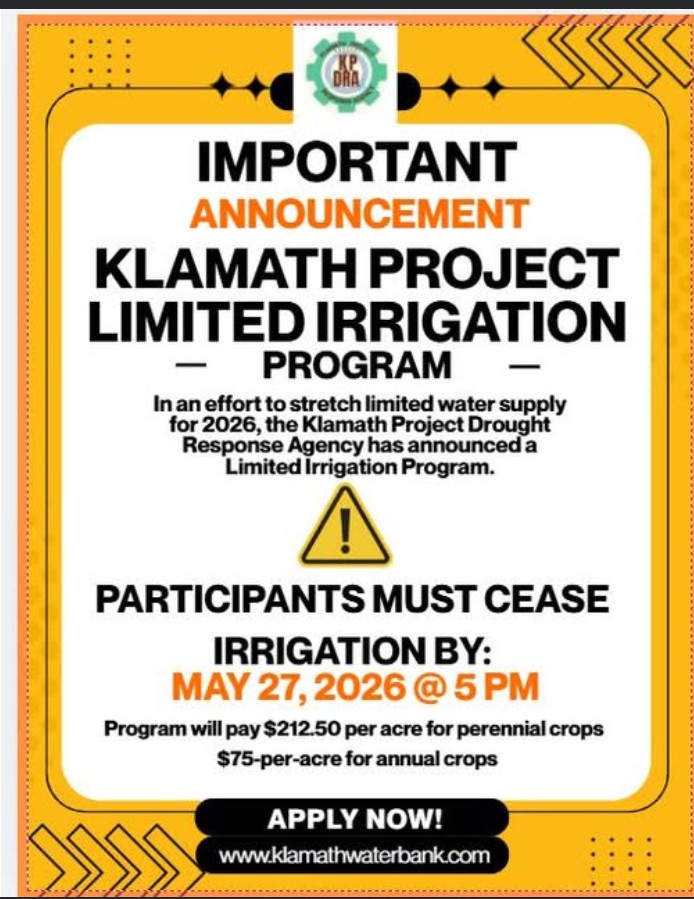
Klamath Project Drought Response Agency
2026 Programs: APPLY BEFORE 15 June at 5pm
2026 ASSISTANCE PROGRAM - NO IRRIGATION
2026 ASSISTANCE PROGRAM - LIMITED IRRIGATION
In an effort to stretch limited water supply for 2026, the KPDRA announced a Limited Irrigation Program. You may be eligible for this program if NO surface water is applied to the parcel from May 27, 2026 at 5:00 pm through October 31, 2026. You can download the application under the "file downloads" subsection of this website. Applications are due June 15th at 5:00 pm. Please review the program policy for more information. If you have any questions, please contact us at (541) 630-0752 or info@klamathwaterbank.com.
FIVE-YEAR ASSISTANCE PROGRAM - DEMAND REDUCTION
The KPDRA is now accepting applications for its Five-Year Program (2026-2030), which is intended to reduce demand for irrigation water by providing financial assistance to eligible agricultural producers who agree to refrain from applying irrigation water to designated parcels during each Program Year.
FOR ASSISTANCE IN COMPLETING AN APPLICATION, PLEASE ATTEND OUR IN-PERSON WORKSHOP: June 10th, 9AM - 4PM (Location: Walt Wilson Hall - 365 Klamath Falls-Malin Hwy, Merrill, OR 97633)
| | | KID Surface Water Abatement Program (SWAP) - Klamath Irrigation District ONLY | |
Klamath Irrigation District implemented a pilot 2026 SWAP for those who may not be eligible for other Klamath Project DRA programs.
Submit your application before June 11 for the top rate. Early signers earn an extra $15 per acre - bringing you up to the maximum rate the Board approved on May 27. The Board meets June 11 to review enrollment.
| | | | Klamath Basin Alert: Grasshopper Sightings | |
Grasshoppers Hatching Near Lower Klamath Lake Road, Moving North Into Farmlands
A highly concerning agricultural threat is developing right in our backyard. Large-scale grasshopper hatchings have been observed at the Lower Klamath National Wildlife Refuge, with heavy concentrations around Lower Klamath Lake Road. Field reports show these populations are actively migrating north, directly threatening irrigated farmlands within the Klamath Reclamation Project.
With local water cutbacks, fallowed fields, and dry conditions shaping this year's growing season, our fields are extremely vulnerable. When natural rangeland forage dries up early, grasshoppers move rapidly toward green, irrigated crops.
Why This Matters to Our Farms
Grasshoppers are voracious feeders that do not discriminate between crops. If they establish a foothold in our agricultural zones, the economic damage can be swift:
-
Forage & Equine Feed: They can strip a field to the dirt, consuming every blade of grass. Even if a crop is partially salvageable, the physical presence and contamination left by grasshoppers destroy the high-quality marketability required for premium equine feed.
-
Leafy Greens & Vegetables: Grasshoppers skeletonize and contaminate leafy vegetables, making them completely unfit for market sale.
Early Detection and Abatement is Crucial
Timing is everything. Control measures are most effective when grasshoppers are still small nymphs (immature, wingless grasshoppers) before they develop wings and scatter across large distances.
The Oregon Department of Agriculture (ODA) flags an "economic threshold" at 8 or more grasshoppers per square yard. If your scouting reveals populations reaching or exceeding this density, immediate mitigation and area coordination are strongly advised.
No Ability to Report to the ODA
Community tracking is our best resource for a coordinated defense. The ODA previously mapped these outbreaks to understand pressure zones and help coordinate assistance programs.
Unfortunately, the Oregon Department of Agriculture reporting portal is closed this year due to lack of funding. Reporting is unlikely to resume until it is too late. The September E-Board may be the first opportunity to address the reporting issues.
If you spot heavy hatching or moving populations on or near your property, please log it immediately and send to K.I.D.
You can find up-to-date program information, tracking maps, and direct reporting links here:
👉 ODA Grasshoppers and Mormon Crickets Project Page
Keep a close eye on ditch banks, field borders, and roadsides over the coming days. If you see something, say something—protecting the Klamath Project's harvest this season depends on all of us staying vigilant.
| | Sign K.I.D.'s Petition for
Title Transfer | |
In the video below, Congressman Cliff Bentz asks Reclamation Commissioner Scott Cameron about the status of the Klamath Irrigation District's five-year request for Title Transfer, as well as other related issues.
Reclamation continues to claim that Dingell Act Title Transfer for K.I.D. is hampered by unidentified Project debt. Since our last newsletter, we understand that there has been some progress in identifying whether there is a debt. Rumor has it there may actually be a credit.
|
Transfer the Title to K.I.D.,
Finish the Mission:
Demand the Federal Government Honor Its Legal Obligation to Klamath Farmers
| |
In 1905, President Roosevelt established the Klamath Reclamation Project. Following World War I and World War II, the federal government invited returning veterans to homestead this land — promising them water rights in exchange for their labor and service. These families built the irrigation infrastructure from the ground up.
In 1965, the farmers of the Klamath Irrigation District fully repaid every dollar of construction costs to the federal government. For 60 years, they have been the rightful, equitable owners of this system in every sense except on paper.
For over 20 years, the Bureau of Reclamation has subjected these 1,200 family farms to severe water restrictions and shutoffs in an attempt to recover endangered fish species.
The fish have not recovered. The farms are going bankrupt.
Both outcomes are a failure of federal management.
The Dingell Act is unambiguous: the Bureau of Reclamation is mandated to transfer the title of fully repaid Reclamation projects to local irrigation districts. This project qualifies.
Title Transfer will restore local control to the farmers who built and paid for this system without altering a single existing water right or environmental law.
This is not a political request. It is a legal demand.
Sign below to add your voice.
| | | | D System Improvement Plan - NRCS Approved | |
A Message of Gratitude to Our Partners
Partnership and Perseverance: Thank You to Our Modernization Team
A 104-year infrastructure agreement does not happen overnight, nor does it happen without dedicated allies who understand that true conservation is locally led. As the Klamath Irrigation District celebrates the finalization of our D System Infrastructure Modernization Project contract, we want to extend a sincere thank you to our partners at the USDA Natural Resources Conservation Service (NRCS) and the incredible team that carried this heavy load alongside us.
In particular, we owe a tremendous debt of gratitude to former NRCS Chief Aubrey Bettencourt. Before stepping down, Chief Bettencourt brought a relentless "farmer-first" vision to the agency, grounding federal programs in the practical realities of Western water management. As a third-generation farmer who previously oversaw water and science policy at the Department of the Interior, she immediately recognized that piping and lining our historic canals wasn’t just an engineering project—it was a vital lifeline for our agricultural community.
We also want to recognize the critical boots-on-the-ground leadership from our state and regional partners, specifically thanking NRCS Oregon State Conservationist Greg Becker and Damon Brosnan, alongside Gary Diridoni of NRCS Oregon. Their collective dedication and local insights were instrumental in keeping communication open and helping navigate the unique complexities of our basin.
Closer to home, this milestone would have been entirely out of reach without the relentless dedication of the Farmers Conservation Alliance (FCA). We want to personally thank FCA Executive Director Julie O'Shea, as well as David Mueller and Raija Bushnell, for their exceptional project management, technical expertise, and steadfast support throughout this grueling process. Their team worked tirelessly to help us navigate the dense web of paperwork and strategy required to move this project forward.
Thanks to this collective leadership and the dedicated team at NRCS, our district has finally signed the formal "2026_NRCS_Final_Agreement_KID". To be clear: this agreement does not automatically hand us a check. What it does do is officially secure our eligibility to apply for a 75% federal cost-share program, unlocking the door to pursue up to $17.1 million in federal funding for our local infrastructure. This agreement lays the groundwork for a total potential project budget of $22,807,000, creating the framework to structurally secure our water system for generations to come.
We look forward to working with incoming NRCS Chief Buckley and the agency's leadership to build on this solid foundation, and we thank Aubrey Bettencourt, Greg Becker, Damon Brosnan, Gary Diridoni, Julie O'Shea, David Mueller, Raija Bushnell, and the FCA for their steadfast advocacy in getting us across this critical starting line.
| |
Moving Century-Old Dirt:
The Absurdity of the Federal NEPA Gauntlet
| |
It is official. Following an exhaustive, three-year Environmental Assessment (EA) that cost hundreds of thousands of dollars, the final signature has been inked on our new agreement. But while we are celebrating a hard-fought step forward, we must call out the exhausting, flawed federal regulatory process that forced us to spend years proving that modernizing 1883 infrastructure—surrounded by farmland that is already routinely turned over—won't break the environment.
Ever wonder why a brand-new federal project can breeze through a Categorical Exclusion (CE) while our century-old conservation efforts are dragged through a grueling, budget-busting review? It comes down to a bureaucratic double standard.
The NEPA Double Standard
The Bureau of Reclamation routinely issues swift CE Checklists (CECs) for activities that fit strictly within federally championed "safe zones"—such as routine operations, minor maintenance, or new agency initiatives.
Don't believe us? You can track their ongoing stream of exemptions directly on the Bureau of Reclamation's KBAO NEPA Project Details Website.
Yet when local districts try to modernize historic infrastructure by piping or lining sections of existing canals, the regulatory environment becomes adversarial. The agencies argue that altering the footprint of "old dirt" carries potential cumulative impacts. Instead of recognizing that saving water is inherently good for the environment, the government forces a system-wide overhaul into a full NEPA Environmental Assessment to insulate itself from litigation.
A Failure of Policy Delivery
This bottom-up bureaucracy remains locked in a defensive crouch. Secretary’s Order 3446 explicitly directs federal offices to cut red tape, reduce administrative burdens, and accelerate the delivery of Western water projects. Despite this mandate, our requests for district-wide CEs and our efforts toward title transfer have met silence.
Rather than using common-sense efficiencies to fast-track water security, bureau employees cite the basin’s complex historical conflicts to justify multi-year compliance delays.
We shouldn't have to spend three years and immense local capital just to get permission to ask for infrastructure modernization on our own historical footprint. While we successfully navigated the gauntlet to unlock this eligibility, the broader federal process (at least in Klamath) remains fundamentally broken—prioritizing defensive paperwork over immediate, common-sense conservation.
How the NEPA Pathways Diverge
The contrast in regulatory paths depends heavily on whether a project is federally championed or locally driven:
| | | Review Pathway | Typical Timeline | Financial Cost | Applied To | | Categorical Exclusion (CE) | Days to Weeks | Minimal | Federally operated facility repairs, routine maintenance, or specialized new federal initiatives | | Environmental Assessment (EA) | 1 to 3+ Years | Hundreds of Thousands | Local infrastructure modernization (lining and piping canals) and title transfer on historic footprints | | |
What You Can Do: Recommended Actions for Our Readers
The red tape we just endured highlights why federal environmental compliance needs common-sense reform (See Congressman Cliff Bentz comments on this issue later in this issue). If you want to help us push back against the bureaucracy holding back Klamath Basin water security, here is how you can take action:
-
Contact Your Federal Representatives: Reach out to your U.S. Senators and Congressional Representatives. Urge them to support legislation that mandates automatic Categorical Exclusions (CEs) for irrigation efficiency improvements within existing, historical agricultural footprints.
-
Demand Accountability under SO 3446: Write to the Secretary of the Interior and Bureau of Reclamation leadership. Demand that they fully enforce the directives of Secretary’s Order 3446 by expanding system-wide CEs for local irrigation districts rather than forcing routine modernization into multi-year reviews.
-
Stay Informed and Vocal: Review the federal project approvals yourself on the Bureau of Reclamation's NEPA Portal. Understanding this double standard is the first step toward changing it. Share these facts with neighbors to ensure our water community remains united.
| |
K.I.D. Board of Directors Meeting - 11 June at 1pm | |
Next Board of Directors Meeting -
11 June at 1pm
The Klamath Irrigation District, described in Article 1, Section 1 of the By-Laws of the Klamath Water Users Association, was officially named in 1905. The District was formally established as a special government district after the popular vote in 1917.
| | | | | |
KWUA 10 June Board of Directors Meeting - 2pm
KWUA is scheduled to host thier June Board of Directors meeting on 10 June at 2pm in the KWUA Board Room
Read the latest KWUA updates here
| | |
DRA Application Assistance - 10 June
PLEASE ATTEND THE IN-PERSON WORKSHOP: June 10th, 9AM - 4PM (Location: Walt Wilson Hall - 365 Klamath Falls-Malin Hwy, Merrill, OR 97633)
Read More...
| | | What We Are Reading (and you should too) | |
Klamath Marsh National Wildlife Refuge | |
Klamath Marsh National Wildlife Refuge wetlands are primarily wet meadows with some open water wetlands. This natural plant community is maintained by a program of cattle grazing, haying and prescribed fire to create fall and spring feeding habitat for waterfowl and sandhill cranes.
The U.S. Fish and Wildlife Service announced a 30-day public comment period for a draft Compatibility Determination for haying and grazing at Klamath Marsh National Wildlife Refuge in Oregon. Grazing and haying have been ongoing refuge uses that were determined to be compatible uses in 2010 when the Service issued the Final Comprehensive Conservation Plan (CCP) and Environmental Assessment (USFWS 2010).
The CCP provided a detailed framework and clear limitations on how prescribed grazing and haying would be used to achieve habitat management objectives. The Service is reviewing the CCP as required under the statute (16 U.S.C. 668dde(1)(A)(iv) and 602 FW 3.15) and will amend or revise it if necessary (602 FW 3.16). In accordance with Service Policy 602 FW 2.11H, we are now re-evaluating these refuge uses.
The proposed refuge uses of haying and grazing are detailed in the Draft Compatibility Determination, available for public review on https://www.fws.gov/refuge/klamath-marsh.
We ask stakeholders, tribes and the public to submit their comments and information relevant to the refuge project proposal via email to FW8PlanComments@fws.gov by Friday, July 3 at 11:59pm PT.
| | | |
Klamath Falls Fish and Wildlife Office’s 2025 sucker recovery efforts
The Klamath Falls Fish and Wildlife Office (KFFWO) provided a short summary of the successes the hatchery and recovery programs experienced in 2025 in addition to a FAQ section to address a few of the questions we’ve asked over the past year.
There were also some challenges in 2025, but the team and partners employed creative and adaptive strategies to overcome those challenges and prevent similar occurrences in the future.
Read More...
| |  |
Cutting Red Tape and Reducing Consumer Costs at Reclamation Construction Projects
On November 20, 2025, the Secretary of the Interior signed Secretary’s Order 3446, “Cutting Red Tape and Reducing Consumer Costs at Reclamation Construction Projects.”
This Order initiates a transformative shift in how federally funded Reclamation projects are delivered across the West.
This partner-led model is designed to:
- Accelerate project delivery
- Reduce administrative burdens
- Lower costs for water and power users
- Maintain federal oversight and accountability
Learn more...
| | |
Congressman Bentz questioned the U.S. Forest Service Chief, Tom Schultz, in the Natural Resources Committee regarding the state of our federal forests and the outlook for this year's fire season.
During the hearing, Congressman Bentz asked Chief Schultz if the Forest Service is prepared for the upcoming fire season. Chief Schultz assured us that the Forest Service is and currently has increased firefighting staffing levels in preparation.
Congressman Bentz also raised concerns regarding litigation delays and asked whether ESA and NEPA-related challenges are hindering hazardous fuels reduction and active forest management projects. Chief Schultz responded that a variety of factors contribute to project delays and noted that the agency is looking for ways to do more under existing authorities but could benefit from assistance from Congress.
As a follow-up, Congressman Bentz requested continued engagement from the Forest Service during this fire season and to inform him if Congress can provide any additional help in keeping fires small and under control throughout this fire season.
See Congressman Bentz’s questioning below:
| |
It's Time to Make the Endangered Species Act Work Better for Recovery | PERC | |
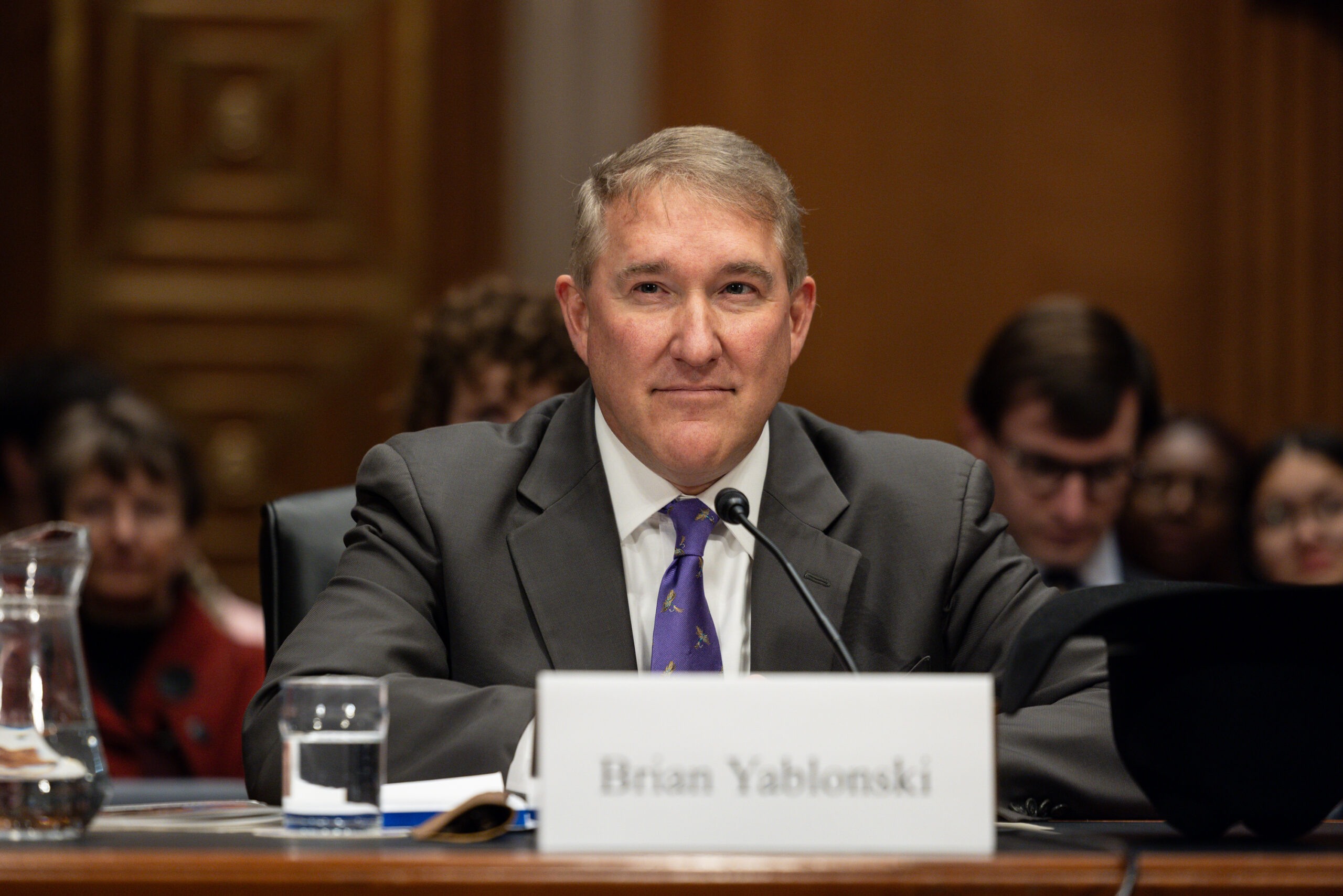
At a hearing before the U.S. Senate Committee on Environment and Public Works on the challenges and opportunities of implementing the Endangered Species Act (ESA), PERC CEO Brian Yablonski delivered a clear message: preventing extinction is not the same as recovering species, and it’s time for policy to reflect that reality.
More than 50 years after the ESA’s passage, the law has succeeded in one important respect—99 percent of listed species have avoided extinction. But recovery, the ESA’s ultimate goal, has remained elusive. Just 3 percent of listed species have fully recovered. Yablonski’s testimony highlights a central challenge: the regulatory tools that help prevent extinction are often the very ones that hinder recovery.
Drawing on decades of experience and PERC’s research, Yablonski outlined a better path forward, one rooted in incentives, local leadership, and collaboration. Instead of relying solely on top-down regulations, policymakers should reward recovery progress with incremental regulatory relief, empower states and landowners as conservation partners, and reduce litigation that diverts resources away from on-the-ground recovery efforts.
| | | E&E News: Bipartisan ESA reform evolves in Senate | |
Senators are projecting optimism about changes to the Endangered Species Act, although agency staffing levels could be a point of contention.
"Contrary to popular belief, I think there are many bipartisan avenues to explore for improving the implementation of the Endangered Species Act," said subcommittee ranking member Adam Schiff (D-Calif.).
| | | |
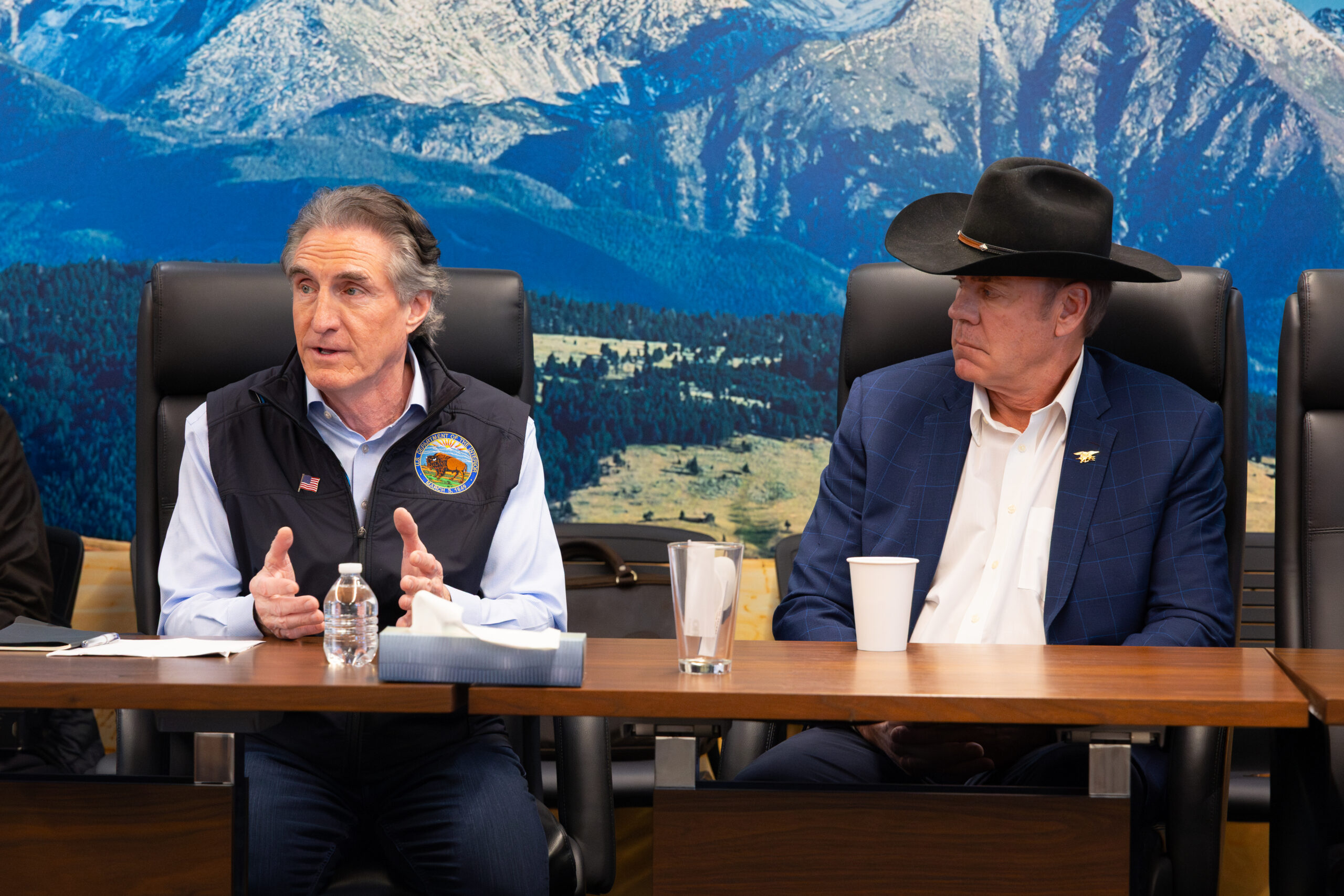
Secretary of the Interior Doug Burgum, Rep. Ryan Zinke meet with conservation leaders in Bozeman | |
Secretary Burgum invited specific input, asking participants what they cared about and what his department could tangibly help move forward. He encouraged organizations to stay engaged with the Department of the Interior and to bring forward real, solution-oriented ideas that could be implemented.
| | | |
USDA Confirms Presence of New World Screwworm in the United States | Animal and Plant Health Inspection Service | |
USDA APHIS confirms New World screwworm in a Texas calf; immediate containment, surveillance, and sterile fly release are underway to protect livestock.
| | | Rebuilt Klamath Hatchery reopens to public after years of delays - The Bulletin | |
The Oregon Department of Fish and Wildlife has reopened Klamath Hatchery to the public after a more than five-year recovery and rebuilding effort following the 2020 Two Four Two Fire. [...]
| | | |
Trinity River has a salmon fishing season | |
After three years of no fishing for fall chinook salmon, Trinity River fishermen will see a chance to keep a salmon.
| | | |
Nestled On The California-Oregon Border, The Cascades' 'Everglades Of The West' Is A Birdwatching Haven - AOL | |
On the California-Oregon border, this large wetland region offers birdwatching along the Pacific Flyway, marsh and forest habitats, and bald eagle sightings.
| | | |
Klamath River Juvenile Salmon Health Monitoring Update - June 1, 2026 | |
The California-Nevada Fish Health Center (Center) works collaboratively with the Service's Arcata Fish and Wildlife Office (AFWO) and the Karuk and Yurok tribes to monitor the prevalence of Ceratonova shasta infections in juvenile salmon in the Klamath River. The Center coordinates this annual monitoring project, provides laboratory support, and generates an annual summary report for the study.
| | | |
A Parasite Is Infecting Nearly Half the Young Salmon in the Klamath River - Active NorCal | |
The first detailed health data on juvenile salmon in the post-dam Klamath River is in, and the numbers are concerning.
| | | |
Felice Pace shares via email...
Klamath River Folks,
Well as I predicted, the removal of PacifiCorp's Klamath River dams has not fixed the Klamath River's water quality as new data show and an article at this link reports. That's because the dams were never the main cause of the Klamath River's water quality impairments. The main cause remains agricultural discharges from irrigators in the Upper Klamath River Basin and in the Shasta and Scott Subbasins.
The basin-wide flow assessment which is needed to responsibly set flows and irrigation diversion amounts has not been undertaken and, apparently, is not a priority for tribal governments or fishermen (otherwise they would push for this assessment which could be done quickly and cheaply using existing data).
This is a sad thing for me; I do not understand why my former allies do not see a basin-wide flow assessment as a priority. Can one of you explain that to me?
The federal Klamath Irrigation Project and non-federal irrigation in the Upper Basin discharge too much highly polluted irrigation water back into the Klamath, especially via the Klamath Straits stream (which Ag folks call, and treat like, a "drain". Much of that pollution can be easily prevented using detention ponds for irrigation return flows. Those can remove 1/2 of the pollution load. But greedy federal irrigators refuse to utilize this BMP; they want to farm 100% of the land.
This is in spite of many millions of your taxpayer money being gifted to the Upper Basin's irrigators by the federal government, including paying for them to unsustainably extract groundwater for irrigation.
Privatizing benefits and socializing costs is socialism. In the USA we have socialism for agricultural producers and capitalism for the rest of us. I support socialism but only if it is applied equally to all Amnericans. Otherwise, let's get these "fiercely independent" irrigators off the public tit.
If your job includes protecting and restoring the Klamath
River, please tackle the River's biggest problem, that is, pollution from irrigated agriculture in the Upper Basin, Shasta and Scott. Don't believe that taxpayer funding has fixed the problem because, as the data on water quality shows, that is a lie.
Felice Pace
White Salmon, WA 98672
707-954-6588
https://www.paceonearth.com/
Previous work from Felice pace is available at Felice Pace
| | |
Klamath Irrigation District responds
Dear Mr. Pace and Klamath River Community,
We became aware of a recent email highlighting your concerns about Klamath River water quality. We share your commitment to a healthy river and productive basin. However, several assumptions in your message do not align with the best available science, historical context, or current monitoring data. As stewards of the Klamath Reclamation Project, we believe the path forward lies in accurate information, practical solutions, and collaboration—not in assigning blame to one sector.
The Natural “Kidney” of the Basin
Historically, Lower Klamath Lake and its vast surrounding marshes—more than 88,000 acres of wetland—functioned as a natural kidney for the Klamath River system. These wetlands absorbed phosphorus and other nutrients from upstream waters, filtered sediments, moderated temperatures, supported immense wildlife populations, and contributed to groundwater recharge. Cool spring flows re-entering the river below Keno are better than warm, bathtub-like surface water
While we agree that the development of the railroad dike fundamentally altered this natural filtration capacity by limiting water access to the marshlands, we believe the later draining and development for agriculture and refuge management attempted to restore function. Today, the remaining wetlands and agricultural lands in the Lower Klamath and Tule Lake areas continue to provide important treatment functions. Research on constructed and managed wetlands consistently shows they can remove substantial portions of nitrogen and phosphorus through settling, plant uptake, microbial processes, and soil storage—often 50% or more depending on design and flow conditions.
Agriculture as Part of the Solution
Klamath Drainage District (KDD), which manages lands around Lower Klamath Lake, accounts for nearly 10% of all organic farming acres in Oregon. Many producers here use practices that align with both food production and environmental stewardship. Far from being the primary source of impairment, well-managed agricultural lands and refuge wetlands act as a treatment train: crops uptake nutrients, soils retain them, and managed wetlands further polish the water before it returns to the river.
Timing matters greatly—under current federal management policies, the greatest return flows occur during late-winter/early-spring drainage periods when many of the nutrients have settled or been absorbed, rather than peak irrigation season when, due to poor federal policy, have forced us to recirculate the water to the refuges or farmland instead of returning the treated water to the Klamath River. Flow proportion, actual daily loads, and measured conditions must be evaluated case-by-case rather than assumed.
Post-Dam Removal Reality and Naturally Occurring Factors
Recent monitoring by our neighboring tribes, which you chastise and call out, shows measurable improvements in the lower river, including reductions in toxic algae, certain heavy metals, and nutrients, and better temperature and dissolved oxygen profiles in many areas, contrary to your claims.
Many of the parameters of water quality measurement—phosphorus, nitrogen, biochemical oxygen demand, pH, and chlorophyll-a—are largely naturally occurring in the Klamath Basin due to its volcanic geology and soils. The Project does not create these constituents; responsible management helps control their movement while producing food on lands that once formed part of the historic wetland complex.
A Practical, Multi-Benefit Path: Tule Lake Flow-Through
Rather than focusing solely on restrictions, we are advancing solutions that improve water quality while supporting the full range of basin values. Flow-Through is one such approach, actively developed in partnership with irrigation districts, refuges, and agencies.
This concept routes water from Upper Klamath Lake through the existing Project delivery system, agricultural lands (where crops and soils provide initial nutrient uptake), Tule Lake National Wildlife Refuge sumps (providing critical habitat for endangered Lost River and shortnose suckers), and Lower Klamath National Wildlife Refuge wetland units (the core treatment stage). Water is then returned to the Klamath River via the Klamath Straits Drain—cleaner with reduced nutrient loads.
Modeling indicates individual wetland units or series configurations can achieve substantial nutrient reductions.
Additional benefits include:
- Reduced risk of avian botulism through continuous flow rather than stagnant conditions.
- Groundwater recharge helping address subsidence.
- Stable habitat for suckers and migratory birds along the Pacific Flyway.
- Support for agricultural communities that remain essential to the regional economy.
Complementary work is also underway on in-channel spawning and rearing habitat improvements for suckers in the lower Lost River below Anderson-Rose Dam, targeting documented historical areas with appropriate substrate, depths, and velocities.
Moving Forward Together
Mr. Pace, we agree that a comprehensive basin-wide assessment of flows, water quality, and natural background conditions would be valuable. We also agree that all sources—including tributaries such as the Shasta and Scott—deserve attention. The Klamath Irrigation District and our partners stand ready to participate in data-driven discussions.
Blaming “greedy federal irrigators” or suggesting agriculture should be removed from the public ledger ignores the reality that the Project was built to reclaim land, produce food, and support wildlife refuges. It also overlooks the $100s millions invested in conservation, efficiency, and habitat projects over the years.
The Klamath Basin does not have to choose between a healthy river and productive agriculture or vibrant refuges. Projects like Flow-Through demonstrate how the same infrastructure can deliver multiple benefits: improved water quality for fish, better conditions for wildlife, groundwater support, and sustainable farming.
We invite constructive dialogue based on shared facts and shared goals. The river, the fish, the birds, the farms, and the communities all deserve solutions that work with the landscape rather than against it.
| | |
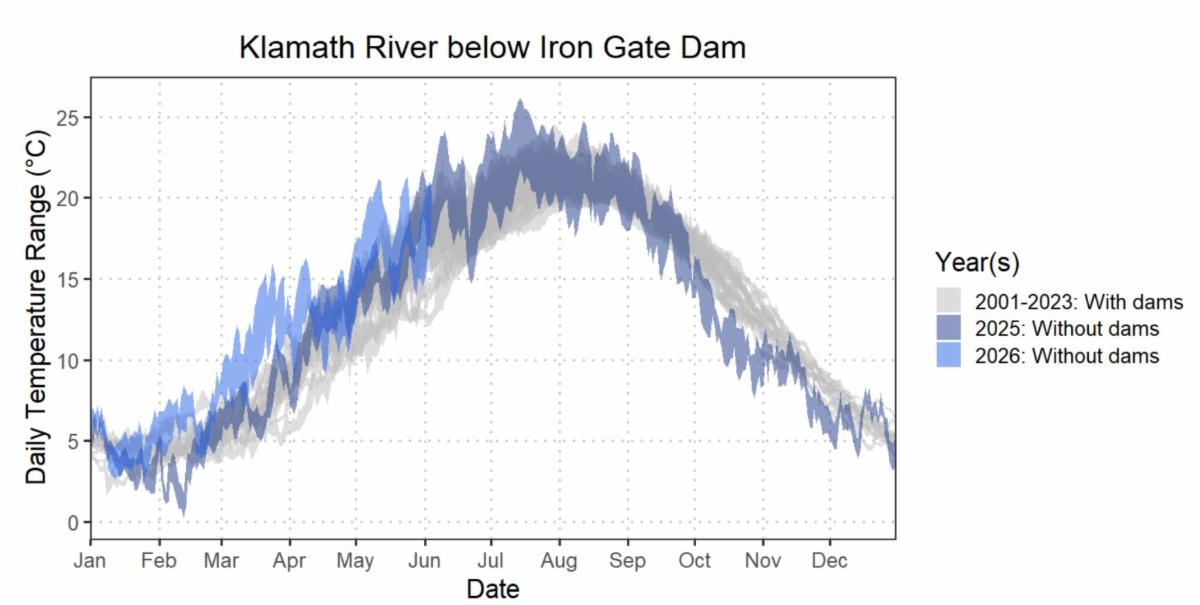
2026 C.shasta and Klamath Water Temps - Klamath Irrigation District |
The Facts on Spring Flows and Young Salmon
Each spring, we hear that large river releases are needed to protect juvenile salmon from disease. This year's monitoring tells a more specific story. The chart below puts three things on one timeline: when the wild young Chinook leave the river, how warm the water gets, and how the C. shasta infection rate climbs.
| | | |
|
This Issue
Lakeside Farms Grows Endangered Fish
Refuge Report
Species Spotlight - Yellowlegs Sandpiper
Saturday Bird Walks - KBAS
Event Calendar
Guest Articles Wanted
| | | |
KWUA Seeks Deputy Director - KWUA | This role functions as the organization's second-in-command and plays a key role in ensuring continuity of leadership, coordination among member districts and | | | |
KWUA Seeks Water Resources Project Manager - KWUA | The Klamath Water Users Association (KWUA) is seeking a motivated, organized, and solutions-oriented professional to serve as Water Resources Project Manager. | | | | | | |