Productivity: A Key Contributor to U.S. Stock Performance


Hello Kevin,


At Lighthouse Wealth Partners, we value ongoing communication in an effort to provide investors with key economic reporting and market insight to help guide your investment decisions. This week our focus shifts to examining factors contributing to the strength of U.S. markets--- especially in comparison to other countries over the past 30 years. The data is presented in collaboration with Modelist Investments and Research. We hope you appreciate the insights and thank you for your continued faith and trust in our firm


What causes one country’s stock market to outperform others? Over longer periods (more than five years), higher relative earnings growth is the primary driver. Earnings are influenced by two main factors: revenue growth and profit margins. Countries with higher GDP growth, or those fostering a culture that advances and supports innovation foster greater opportunities for growth. Companies capable of generating demand where it previously did not exist (consider Apple for example) are well positioned to outperform.


If the indexes of different countries experience identical revenue growth, but one country’s margins are expanding due to more efficient use of capital or labor, that country will see faster earnings growth over time.


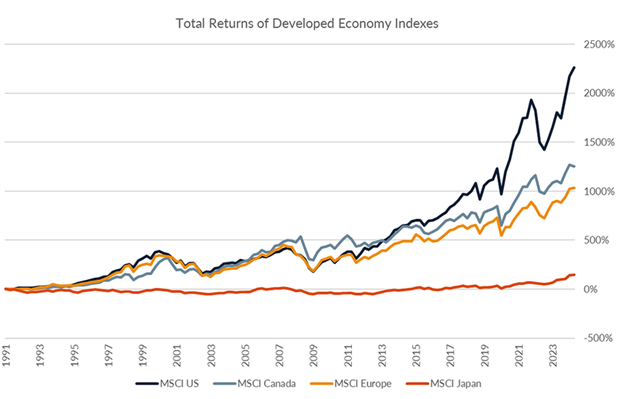
With that in mind, let’s examine the relative performance of developed countries over the past 30 years. The chart below shows the performance of the United States compared to Canada, Europe, and Japan since 1991 in local currency. We’ve purposely removed the influence of the U.S. dollar to avoid distorting the relative return picture. While the dollar impacts U.S. investors' overseas returns, it can obscure the comparison of stock market performance. Since 2010, the U.S. has vastly outperformed its developed-market peers.


Total Returns of Developed Economy Indexes

Source: Modelist Investments Research - Data - Bloomberg


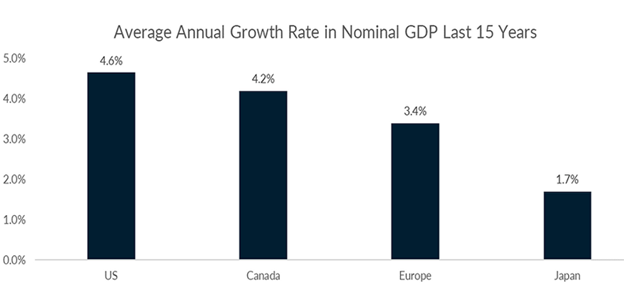
Certainly, revenues and growth tell part of the story. Since the Great Financial Crisis, North America—and the U.S. in particular—has enjoyed stronger nominal growth compared to Europe and Japan. 


A reminder that “nominal” GDP accounts for current market prices without factoring in deflation or inflation, meaning it tracks general changes in an economy's value over time. In contrast, “real” GDP factors in inflation and accounts for the overall rise in price levels, so it's more accurate for calculating a country's current state of economic health. The chart below examines the average annual growth rate in nominal GDP over the past 15 years.

Source: Modelist Investments Research - Data - Bloomberg

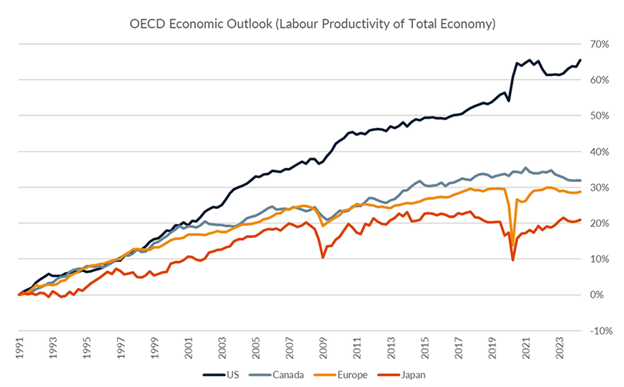
In addition to higher revenue growth and a robust culture of innovation and entrepreneurship, another key factor that has boosted U.S. performance is greater relative efficiency. The chart below shows productivity data for the U.S., Canada, Europe, and Japan. Since 1991, the U.S. economy has become 30–40% more productive than its developed-market peers. Small differences in productivity can add up significantly over time.

Organisation for Economic Cooperation and Development

OECD Ecomomic Outlook - Labor Productivity of Total Economy

Source: Modelist Investments Research - Data - Bloomberg

Summary -

In summary, the U.S. stock market has outperformed its developed-market peers for several reasons. The U.S. hosts the world’s largest capital markets and has a culture of entrepreneurship that has transformed our daily lives. These factors are harder to quantify but have contributed to stronger earnings growth. While faster relative growth has played an important role in earnings growth, the most identifiable metric has been the U.S.’s relative increase in efficiency. U.S. productivity and competitiveness have outpaced other developed markets considerably over the last 15 years or more. While this trend is not guaranteed, it should be noted that productivity and economic efficiency are partly driven by technological development and there’s potential for the trend to be sustained. The much-anticipated AI-driven productivity boom serves as an example and investors will be watching to see how it materializes, but for now, its epicenter remains firmly in the United States.

What is the OECD - Organisation for Economic Co-operation and Development?


"The Organisation for Economic Co-operation and Development (OECD) is a group of 38 member countries that discuss and develop economic and social policy. OECD members are typically democratic countries that support free-market economies. The OECD was established on Dec. 14, 1960, by 18 European nations, plus the United States and Canada." (Source:Investopedia)

Stock market graph business   forex trading and candlestick analysis investment indicator of financial board display double exposure money price stock chart exchange growth and crisis money concept


Weekly Market Recap


Market Closing -

Friday, October 4th


Major Indexes

MKT Open 9/30/24

MKT Close 10/4/24

1 Week Change

Year to Date

1 Year Comparison

SPX-S&P 500

5,726.52

5,751.07

+0.42%

+21.19%

+33.48%

NASDAQ

18,069.83

18,137.85

+0.37%

+21.94%

+35.04%

MSCI EAFE

2,497.70

2,455.00

-1.70%

+9.26%

+21.01%

AGG-Bonds

101.44

99.96

-1.45%

+1.13%

+11.73%

TNX - 10 Yr Treasury

3.790%

3.981%

+5.03%

+0.30%

-16.78%

DOW

DJI

42,289.75

42,352.75

+0.14%

+12.74%

+26.77%


4000 Spring St

Racine WI 53405


Phone: 

262-884-8890


OFFICE HOURS:


Mon. - Thur.

8:00 AM - 5:00 PM


Friday:

8:00 AM - 1:00 PM

Facebook  LinkedIn
Learn More About Us
Contact Us
LWP Privacy & Disclosure Statement
X Share This Email
LinkedIn Share This Email

Disclosures - Advisory Persons of Thrivent Advisor Network provide advisory services under a “doing business as” name or may have their own legal business entities. However, advisory services are engaged exclusively through Thrivent Advisor Network, LLC, a registered investment adviser. Lighthouse Wealth Partners and Thrivent Advisor Network, LLC are not affiliated companies. Please click the tab above or visit our website www.lhwealth.com for important disclosures.


The material presented includes information and opinions provided by a party not related to Thrivent Advisor Network. It has been obtained from sources deemed reliable; but no independent verification has been made, nor is its accuracy or completeness guaranteed. The opinions expressed may not necessarily represent those of Thrivent Advisor Network or its affiliates. They are provided solely for information purposes and are not to be construed as solicitations or offers to buy or sell any products, securities, or services. They also do not include all fees or expenses that may be incurred by investing in specific products. Past performance is no guarantee of future results. Investments will fluctuate and when redeemed may be worth more or less than when originally invested. You cannot invest directly in an index. The opinions expressed are subject to change as subsequent conditions vary. Thrivent Advisor Network and its affiliates accept no liability for loss or damage of any kind arising from the use of this information.


Lighthouse Wealth Partners often communicates with its clients and prospective clients through electronic mail (“email”) and other electronic means. Your privacy and security are very important to us. We make every effort to ensure that email communications do not contain sensitive information. We remind our clients and others not to send us private information over email. If you have sensitive data to deliver, we can provide secure means for such delivery. If you have received an email from us in error, we ask that you contact the sender and destroy the email and its contents. Lighthouse Wealth Partners does not accept trading or money movement instructions via email.