|
El Dorado Water NEWStream
March Edition
| | A Word from Our General Manager, Rebecca Guo | | |
We’ve been busy here at home - we held our second regional Plenary - this one focused on the West Slope, which served as a kickoff for our West Slope Water Blueprint. We also hosted a briefing at the State Capitol for legislative staff members about the importance of our headwaters and the challenges they face. Both events inspired great dialogue, and these conversations are helping to shape a coordinated, forward-looking approach to water management in our region, grounded in shared priorities around water supply reliability, watershed health, and climate resilience. We’re encouraged by the strong engagement from our partners and look forward to building on this momentum in the months ahead.
Last month I also joined the Association of California Water Agencies’ DC Conference. We had productive conversations with federal agencies and congressional staff advocating for federal investment to support water resiliency and forest management in El Dorado County. Our watersheds have been devastated by wildfires, in particular the Caldor and Mosquito fires, and active forest management and community resilience projects are urgently needed to prevent future risks, as these forests are where our water supply originates and are an integral part of our rural communities.
| | |
A New View of Water Value: Valuing Water Supply from the
Upper American and Cosumnes River Watersheds
| | |
The headwaters region of the American and Cosumnes Rivers supports both regional and statewide water supplies, helping sustain the world’s fifth‑largest economy through an interconnected system of reservoirs, conveyances, and water management facilities. One of the most striking aspects of these watersheds is the cascading value that the water provides. This water benefits much of California through water supply, recreation, fishery and riparian habitat, water quality, hydropower generation, and more.
Although the value of source watersheds is widely acknowledged in concept, quantifying their tangible economic value is less known. That is why we took a new approach to valuing water supply originating from these headwaters by looking at California’s water transfer market and end-users' actual costs. Results conservatively estimate that water originating from these watersheds has an estimated long-term average value exceeding $1 billion per year!
This analysis provides downstream decision-makers with essential information that is typically unavailable when evaluating investments in their source watersheds. This data is critical for making informed management and investment decisions in a region that provides on average nearly 3 million acre-feet of water that is delivered across the state.
| | |
Lunch & Learn: Understanding How Our
Headwaters Impact All Californians
| | | | |
We recently hosted a briefing at the State Capitol about the importance of our headwaters, the challenges they face, and how headwaters-related policy and funding considerations impact people, farms, businesses, and the environment throughout the state.
Kyle Greenspan, Research Associate, Public Policy Institute of California, Water Policy Center, discussed the importance of implementing measures to reduce wildfire severity, protect water resources, and limit wildfire damage. Rebecca Guo discussed the economic value of the headwaters and shared findings from an EDWA study that found that the upper American and Cosumnes River watersheds are a natural capital asset with a nearly $15 billion annual value.
Brittany Covich, Policy & Outreach Division Chief, Sierra Nevada Conservancy, talked about the need to build regional capacity and partnerships to accelerate the pace and scale of forest restoration in the headwaters region, and Paul Mason, Vice President of Policy & Incentives, Pacific Forest Trust, described the issue as a long-term commitment. He emphasized that “this isn't something that we can fix in a year or two. It's going to take decades of sustained investment and effort. But it's an investment that we have to make. The cost of doing nothing is just too high.”
Read the summary of our headwaters briefing here.
| | |
Headwaters Connect Recognized as an
Investment-Ready Landscape
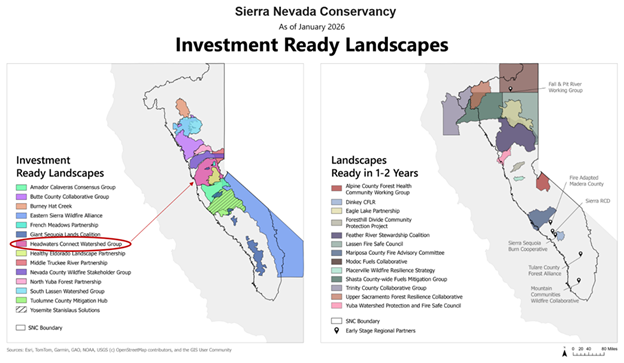
| Exciting news - The Sierra Nevada Conservancy (SNC) has designated Headwaters Connect as one of 14 Investment-Ready Landscapes in its most recent regional assessment. Headwaters Connect is a collaborative watershed group where we work together to enhance the sustainability and health of the headwaters of the American and Cosumnes Rivers. As convenor of Headwaters Connect, we were honored to work with SNC on this effort and share information about the collaborative. This is a huge milestone and reflects years of planning and coordination to develop a portfolio of actionable landscape-scale projects with measurable benefits. | | We also encourage you to check out the new Headwaters Connect website, which has great information about how the collaborative is bringing together partners from different interests, as well as varying roles and responsibilities, to envision and implement landscape-scale management projects that have lasting impacts. | | Pathways to Resilience: Managing Water for the West Slope | | |
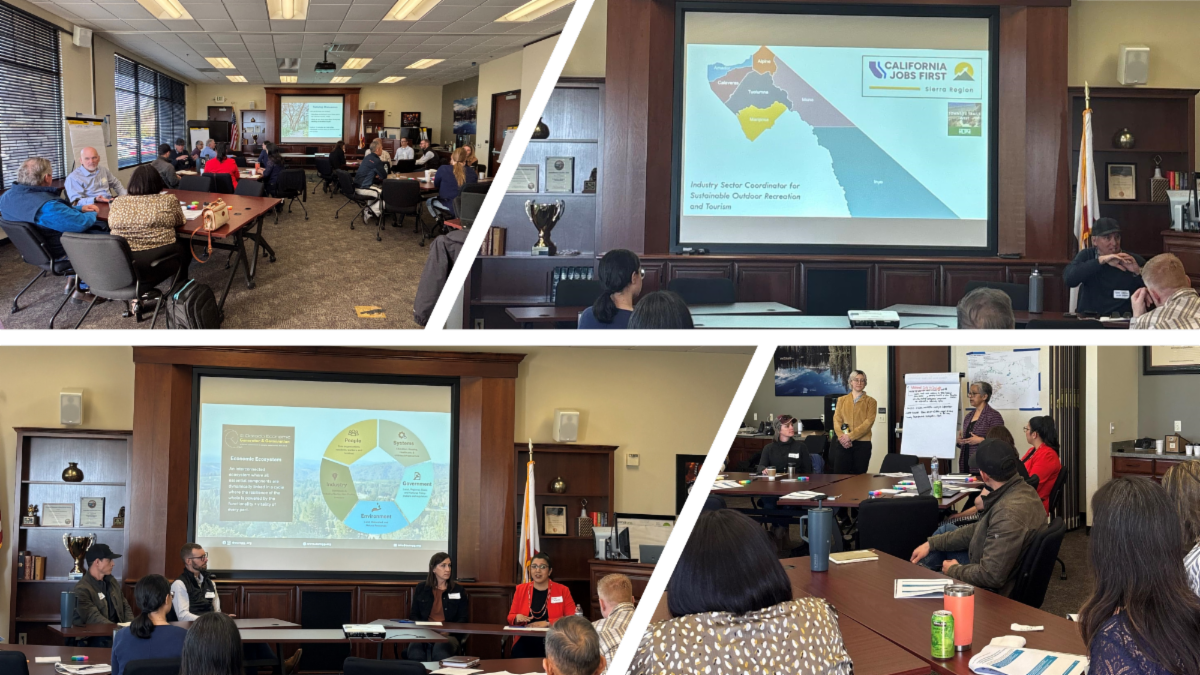
Regional leaders, local businesses, farmers, and community organizations recently gathered for our regionally focused Plenary session, “Pathways to Resilience: Managing Water for the West Slope.” The meeting marked an important step in kicking off the West Slope Water Blueprint, a long-term roadmap to guide water supply, water quality, stormwater, groundwater management, and infrastructure planning across the county.
The Plenary established a shared understanding of economic development as the foundation for water resources planning. Panelists representing agriculture, healthcare, local government, and community development emphasized the need for collaboration and common goals. Attendees shared their perspectives about the key characteristics of sustainable economic growth, which include having cohesive, complementary goals, prioritizing quality of life over quantity of growth, boosting connection to reduce silos, and bringing all voices into conversation. Together, the discussions underscored a shared theme: building resilience requires collaboration, coordinated planning, and a strong connection between water management, land use, and economic development.
Read the recap of our Plenary here.
| | | | |