Our Jaw Shape May Foretell Risk for Temporomandibular Disorders | |
|
The following article appeared in NIDCR News
https://www.nidcr.nih.gov/news-events/nidcr-news/2024/our-jaw-shape-may-foretell-risk-temporomandibular-disorders
Pain and clicking in the jaw, tenderness in the chewing muscles, and recurring headaches can all be signs of jaw problems called temporomandibular disorders (TMDs). TMDs are a group of more than 30 conditions that can cause pain and dysfunction in the jaw joints, chewing muscles, and nearby tissues.
TMDs affect 5% to 10% of the U.S. population and occur twice as often in women than men. Studies show that a complex interplay of biological, psychological, and social factors drive TMDs, but how exactly remains unclear. Symptoms can often appear suddenly and vary widely among patients. Without a clear understanding of the underlying causes, it’s hard for clinicians to diagnose and treat TMDs effectively.
Now, aided by artificial intelligence (AI), scientists show that the shape of the jawbone itself might affect a person’s likelihood of developing a TMD. The NIDCR-funded study, published in JCI Insight, may help explain why TMDs are more common in women and people with certain forms of overbite.
The team set out to compare 3D scans of jawbones from people with and without TMDs. They were looking for structural differences that could help distinguish people with TMDs from people without them. Initially, the scientists attempted the task manually, comparing the images one by one.
"But our brains and eyes have limitations," said first author Shuchun Sun, Ph.D., of Clemson University and the Medical University of South Carolina. "We cannot see complex patterns in a lot of the 3D geometry on a computer screen, so why not use AI to help?"
The team developed an AI tool that scanned 3D jaw images from 40 people with TMDs and 40 without. It identified three areas of the lower jawbone that were shaped differently in people with TMDs.
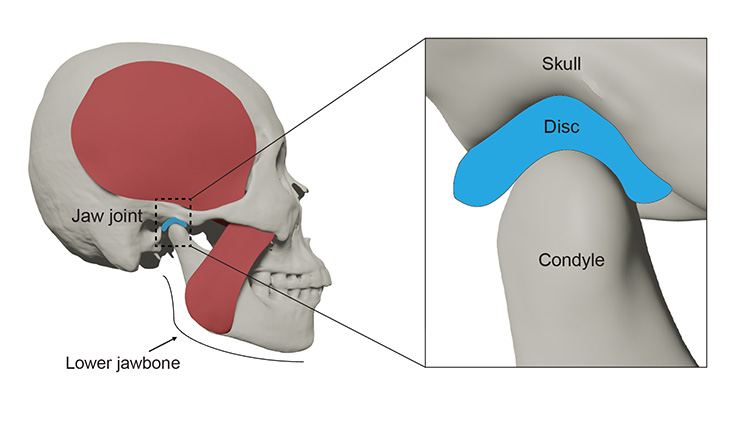
Most notably, patients with TMDs had overall smaller lower jawbones. They also had smaller and flatter condyles, the rounded ends of the lower jawbone that fit into a cup-like hollow in the lower skull to form the joint.
The researchers found that a smaller or flatter condyle, the rounded end of the lower jawbone that forms part of the jaw joint, is linked to TMD risk.
| |
|
The team then developed computer programs to simulate how these differences might affect how the jaw moves and functions. They used head scans from eight men and eight women who had passed away and did not have TMDs. The computer program predicted that people with smaller lower jawbones would need to put more force on the joint to achieve the same bite strength as people with larger jaws.
"A flat condyle has less surface area to distribute the force evenly, so simple tasks like chewing can strain the joint," said senior author Hai Yao, Ph.D., of Clemson University and the Medical University of South Carolina.
The computer program also predicted that people with smaller jaws may have less oxygen and nutrients available for energy production in the cartilage of the jaw joint. They may also be more likely to have higher levels of molecules associated with muscle fatigue. The results offer an explanation as to why women and people with certain forms of overbite — both of whom tend to have smaller jaws — may be more likely to develop TMDs.
These findings give researchers a starting point from which to explore whether the same mechanisms are at play in animals and humans. With more research, the scientists also hope that the AI tool may one day aid clinicians’ ability to diagnose TMDs and offer insights into treatment.
The team would like to use the same method to investigate other contributors to TMDs. These include features of the chewing muscles, inflammation levels, psychological stress, and pain perception. The method could also be useful for understanding other complex muscle and skeletal problems in the knee and spine.
“TMDs are very complex. It’s very difficult to predict the disease progression and how patients respond to treatments,” said Dr. Yao. “Patients need better diagnosis and personalized treatment, and AI is a powerful tool that can help us.”
| |
A New Model for Temporomandibular Joint Disc Replacement | |
|
A recent study was published in the Journal of Tissue Engineering and Regenerative Medicine. It explores using goats as a model to test replacements for damaged discs in the temporomandibular joint (TMJ)—the joint that connects the jaw to the skull. It focuses on using a scaffold made from a pig's small intestine to act as a temporary framework that the body can transform into new tissue.
Two methods of implantation were tested:
1. Full Removal: The entire TMJ disc was replaced with the scaffold. This caused the scaffold to shift out of position, leading to poor results.
2. Partial Removal: Only part of the disc was replaced, allowing the scaffold to be anchored better. This method led to the scaffold staying in place and integrating well, forming tissue similar to the original TMJ disc.
The goat model is ideal for this research because their TMJ closely resembles that of humans, and they chew extensively, providing a realistic test of durability. The findings provide insights into developing better TMJ disc replacements for humans, potentially avoiding severe joint damage and improving patient outcomes.
Read more about this study: https://www.sciencedirect.com/science/article/pii/S0266435624005059
| |
A New Injectable Gel Offers Hope for People with Osteoarthritis | |
|
Temporomandibular joint osteoarthritis (TMJOA) is a condition affecting up to 16% of the population, causing pain, limited jaw movement, and difficulty chewing. Despite its prevalence, current treatments, such as hyaluronic acid (HA) injections, only ease symptoms and fail to promote long-term cartilage repair. Researchers have now developed a groundbreaking solution: a minimally invasive injectable gel that can reduce inflammation and encourage cartilage regeneration.
The Problem
In TMJOA, the cartilage that cushions the jaw joint breaks down, worsened by ongoing inflammation. This inflammation triggers the release of harmful enzymes and proteins that further destroy cartilage, creating a vicious cycle that prevents healing. While some experimental treatments have shown promise, they are often expensive, complicated, or unsuitable for widespread use.
The Breakthrough Solution
The team behind this study created a hydrogel made from tilapia-derived type I gelatin and hyaluronic acid (HA)—two natural materials already known for their compatibility with human tissues. This gel is not just easy to inject but also has multiple beneficial effects:
1. Reduces Inflammation
- The hydrogel inhibits the release of enzymes and inflammatory molecules that destroy cartilage.
- It alters the immune response, encouraging healing instead of ongoing damage.
2. Encourages Cartilage Regeneration
- It interacts with key immune cells, such as macrophages and T cells, to create a healing environment.
- The hydrogel mimics the structure of natural cartilage, making it easier for the body to repair damaged tissue.
3. Cost-Effective and Practical
- Unlike other treatments, this gel is affordable to produce and easy to administer, making it a potential option for broader clinical use.
How It Works
In laboratory and animal tests, the gel demonstrated remarkable results:
In Rats with TMJOA
- The hydrogel reversed inflammation and restored damaged cartilage in the jaw joint.
- It promoted the development of M2 macrophages (associated with healing) and Th2 T cells, both of which help repair tissues.
Lab Tests
- The gel successfully reduced harmful enzymes and inflammatory markers while protecting cartilage cells.
What This Means for Patients
This study is an exciting step forward for TMJOA treatment. Unlike current therapies which focus on short-term symptom relief, this injectable gel has the potential to address the root causes of the condition—stopping inflammation and regenerating damaged tissue.
If future clinical trials in humans confirm these results, this hydrogel could revolutionize TMJOA care, offering a simple, effective, and accessible treatment option for millions of people.
This innovative approach could represent a major shift in how we treat joint diseases—not just in the jaw but potentially in other parts of the body.
Source: A mini-invasive injectable hydrogel for temporomandibular joint osteoarthritis: Its pleiotropic effects and multiple pathways in cartilage regeneration
| |
Exploring the Link Between the Temporomandibular Joint and Irritable Bowel Syndrome: What the Research Says | |
|
A 2024 study published in the Journal of Clinical Medicine reviewed the connection between temporomandibular joint (TMJ) disorders and irritable bowel syndrome (IBS), two conditions that cause significant discomfort and often coexist. TMJ disorders affect the jaw joint, leading to pain, difficulty chewing, and jaw clicking or locking, while IBS impacts the digestive system, causing symptoms like abdominal pain, bloating, and irregular bowel habits.
The review highlights that TMJ disorders and IBS may share common underlying factors, including chronic pain, heightened stress responses, and inflammation. Both conditions are also more common in individuals experiencing anxiety or depression. Researchers suggest that these shared biological and psychological factors could explain why TMJ and IBS often occur together.
Understanding this connection is important for developing more effective treatment approaches. Healthcare providers could consider both conditions when diagnosing and managing patients with either TMJ disorders or IBS, ensuring more comprehensive care.
This research underscores the need for further studies to explore how these conditions are linked and how treatment strategies can target both to improve patients' overall quality of life.
Source article: https://www.researchgate.net/publication/386409628_Association_Between_Temporomandibular_Disorders_and_Irritable_Bowel_Syndrome_A_Scoping_Review
| |
Facing the Challenges of TMD Care: A Call for Patient Protection | |
|
In their recent article, published in *CRANIO®*, Drs. Daniele Manfredini and Steven Bender explore the complex ethical and professional responsibilities involved in treating temporomandibular disorder (TMD) patients. As the prevalence and complexity of TMD rise, healthcare providers face significant challenges in balancing patient care, informed consent, and comprehensive management. This article underscores the weight of these responsibilities and advocates for supportive frameworks to aid practitioners in safeguarding patient well-being.
The Professional Burden of Protecting TMD Patients
One of the most significant and impactful lessons that all pain practitioners experience beginning early in their careers is that the psychological and social burden of pain can be overwhelming for many individuals. Orofacial pains, and most specifically temporomandibular disorders (TMDs), are certainly no exception, to the point that an evaluation of a patient that does not include a psychosocial assessment cripples the basic principles of the most appropriate management strategies based on the biopsychosocial model of pain.
While models for a multidimensional evaluation of TMD patients have been recommended for decades, and included in some diagnostic schemes since the early ‘1990’s, an earlier review showed that a standardized psychosocial evaluation (i.e., “Axis II”) was included in only a handful of papers describing the prevalence of TMDs. The predominant focus on physical diagnoses seems to remain unchanged even over the last 10 years, as witnessed by a simple keyword search in Medline with the terms “Temporomandibular Disorders” AND “DC/ TMD Axis II” that identified just 35 citations since 2014. Interestingly, this is the same year of the publication of the Diagnostic Criteria for Temporomandibular Disorders (DC/TMD), which are seen by many researchers as the currency value to assess TMD patients.
Click here to read the full article
| |
TMJ TedTalk by Suzie Bergman | |
In this Talk, a unique perspective emerges from a healthcare professional who not only treats Temporomandibular Disorders (TMD) as a dentist but also lives with the condition herself. Through her journey, Dr. Bergman reveals the often-overlooked complexities of TMD and advocates for a more integrated approach to healthcare. By sharing her story, she highlights the critical need for a holistic model that better serves patients with complex, interconnected conditions. Dr. Bergman is a researcher and devoted dental practitioner, passionate about improving healthcare outcomes for patients. She has three decades of experience spanning clinical care, post-doctoral education, research, advocacy and infrastructure for patients suffering from temporomandibular disorders (TMDs). Dr. Bergman is a Selection Chairperson, Advisor, Honorary Program Faculty Member, and Fellow of the TMJ Foundation’s online fellowship program, FTMJF. She lectures internationally as a tenured instructor for McGann Postgraduate School of Dentistry and Progressive Orthodontic Seminars. Dr. Bergman is a visiting scholar at Oregon Health Science University in the department of Neurosurgery, where she is a co-investigator in research surrounding the differential diagnosis of Trigeminal Neuralgia and TMDs. This talk was given at a TEDx event using the TED conference format but independently organized by a local community. | |
University of Pennsylvania - 10th International TMJ Interdisciplinary Research Meeting | |
|
This program - to be held on April 26–27, 2025 - will provide a unique opportunity for bioengineers, clinicians and scientists to discuss the challenges presented by temporomandibular joint disorders and to devise strategies to address those challenges. The meeting will be held in Philadelphia on the University of Pennsylvania campus.
Education objectives include:
- Provide recommendations to the NIDCR TMJD Program on novel scientific approaches and critical research topics that will advance the field.
- Establish a benchmark for current treatments and scientific knowledge.
- Bring outside perspective from experts in areas pertinent to TMJ research.
More information can be found at: https://www.dental.upenn.edu/continuing-education/international-tmj-interdisciplinary-research-meeting-2025/
| |
Research Studies Recruiting TMJ Patients | |
|
Online Focus Group for Young Adults
Researchers at Stanford University and Vanderbilt University are looking for participants 18-24 years old who have experience with chronic pain to gather their feedback on a research project aiming to help youth monitor their pain at home. This will be a one-time, 2-hour virtual meeting hosted via Zoom. Participants will be asked to provide feedback on the upcoming project and recruitment ideas. Meeting participants will NOT be asked to participate. The meeting will take place early to mid-March 2025. If you are interested and want to learn more, visit: https://redcap.link/simons.
| |
|
Patients living in San Francisco, CA Area Needed - Study Evaluating Low-Intensity Focused Ultrasound for Targeted Modulation of Pain Circuits in Chronic Pain
This research study seeks to evaluate a non-surgical, non-drug, wearable therapy using Low Intensity Focused Ultrasound Stimulation (LIFUS) of the deep brain to alleviate pain in patients with chronic pain. Conducting this research study will enable further development of a novel wearable device to allow in-clinic or at-home use for pain reduction. This technology is already being used in multiple studies for other conditions. LIFUS is a form of non-invasive brain stimulation that uses sound waves (the same form of energy used in fetal ultrasound imaging during pregnancy) to target and alter activity in areas of the deep brain. As LIFUS is highly precise, it can accomplish this task without impacting the surrounding brain tissue.
Click here to view the informed patient consent.
Eligibility: This study may be an option if you are:
- Experiencing chronic pain (persisting for at least 3 months)
- 22 to 80 years old
- Able to undergo a brain MRI
- Able to visit trial location in San Francisco
The study is in Mission Bay (San Francisco, CA) and includes 3 required visits and some optional visits. Each visit will take less than 2 hours and be completed at least a week apart. Participants will be compensated $50 per visit. The researchers are very flexible with scheduling and can schedule visits for weekends and outside of work hours. More information is available at: https://www.attuneneuro.com/
| |
|
Central and Peripheral Factors in Temporomandibular Disorder
Researchers at Emory University in Atlanta are in need of TMJ patients to participate in their study. They are investigating people who experience chronic pain in the head and/or face in everyday life. They are using unique tests to find out how the brain processes chronic and acute pain messages and will observe patients to see how pain and sensory processing differs in TMD. Click here to view the informed consent form for this study. Contact Daniel Harper, PhD (Principal Investigator) at 404-727-7789 or daniel.harper@emory.edu with any questions and to participate.
| |
|
Impact of Daily Physical Activity and Chronic Musculoskeletal Pain Survey
A research team from the Faculty of Rehabilitation Sciences of Hasselt University in Belgium is investigating the relationship between the intensity of daily physical activity and chronic musculoskeletal pain. They will be looking at fibromyalgia, chronic temporomandibular disorder, osteoarthritis, chronic neck pain, chronic shoulder pain, and chronic low back pain. The study involves an online survey which will take approximately 50 minutes to complete. More details and a link to the study is available at: https://uhasselt.qualtrics.com/jfe/form/SV_etl78e58y2YeUDQ
| |
University of Minnesota In-Person Study
For those of you in the Twin Cities, Duluth, Rochester, or nearby areas, a researcher working with the University of Minnesota is looking for participants to collect data as an early step toward development of a new medical device. There is one brief in-person meeting required, but the researcher can travel to meet you if you are interested. Please see below for details.
"Have you been diagnosed with TMD/TMJ Pain, Chronic Low Back Pain, and/or Painful Peripheral Neuropathy? Has your pain lasted for more than 3 months with an average daily pain intensity in the past week of ≥3/10 and at least one instance of pain ≥6/10 in the past week? If so, please contact groenke@umn.edu for more information regarding possible participation in an ongoing, at-home research study seeking to learn more about how the body responds to different pain levels. There is a $20 gratuity payment following successful completion of the study."
| |
|
University of Connecticut School of Dental Medicine Study Conducting a Research Study on TMJ Pain
This federally funded research project provides non-surgical treatments to persons with pain in the area of the TMJ. The purpose is to test a new treatment approach. All volunteers will get an x-ray of the face and
will receive a splint (a mouth guard), plus non-steroidal anti-inflammatory drugs (like Advil) and weekly monitoring, as well as additional instruction in coping and managing the pain of temporomandibular dysfunction (TMD).
Those eligible for participation must meet the following conditions:
• TMD-related pain for at least 3 months.
• Must live in proximity to UConn Health, Farmington, CT, to allow for treatment, monitoring of progress, and follow-ups.
To view the patient consent form, click here. Call 860-679-2745 for more information or visit https://health.uconn.edu/dental/patient-services/oral-and-maxillofacial-surgery/tmj-treatment/
| |
|
West Virginia University Study
This research aims to explore the experiences of sexual minority (e.g., lesbian, gay, bisexual, asexual, queer, etc.) young adults (ages 18-24) with chronic pain in the healthcare system.
To participate, you would complete surveys online (~45 mins) once. You may have the option to complete a confidential Zoom interview (~60 mins) with a member of the study team. You would receive a $15 gift card for completing the surveys and a $20 gift card if you complete the interview.
To see if you are eligible and to request more information about the study, please complete this form: https://redcap.wvctsi.org/redcap/surveys/?s=HM8X444KY8C8RRRW This study is being conducted by Cecily Conour, MS, and Kevin Larkin, PhD, and IRB approval is on file through West Virginia University.
| |
NIH Grant Opportunities for Researchers | |
|
Notice of Special Interest: Women’s Health Research
https://grants.nih.gov/grants/guide/notice-files/NOT-OD-24-079.html
The National Institutes of Health (NIH) is issuing this Notice of Special Interest to highlight interest in receiving research applications focused on diseases and health conditions that predominantly affect women, or are female-specific. National Institute on Deafness and Other Communication Disorders (NIDCD)
- Expanding the understanding of sex differences impacting hearing loss, balance disorders, taste and smell abnormalities, voice disorders, speech, and language disorders.
- The prevalence, incidence, and natural history of hearing loss, balance disorders, taste and smell abnormalities, voice disorders, speech disorders, and language disorders in women.
- The physiological and psychological factors that contribute to the development or progression of communication disorders in women.
- The impact of communication disorders on women’s overall health and well-being.
- Improving the understanding of inherited or acquired hearing, balance, taste, smell, voice, speech, and language disorders that affect women disproportionately to inform treatments.
- The development and evaluation of interventions or treatment strategies, including pharmacological, behavioral, social, surgical and technology-driven approaches, for preventing, mitigating, or treating conditions impacting women in NIDCD mission areas.
Notice of Special Interest (NOSI): Translating Biomaterials-Based Technologies to Commercially Viable Products
https://grants.nih.gov/grants/guide/notice-files/NOT-EB-24-001.html
The purpose of this Notice of Special Interest (NOSI) is to invite NIH Small Business Innovation Research (SBIR) and Small Business Technology Transfer (STTR) applications focused on advancing paradigm-shifting biomaterials-based technologies leading to commercialized products. Additionally, this NOSI aims to generate private-sector interest and engagement in the development of innovative and emerging biomaterials-based technologies of biomedical and clinical relevance with high commercialization potential.
Notice of Special Interest (NOSI): Maternal Health and the Dental, Oral, and Craniofacial Development of their Children
https://grants.nih.gov/grants/guide/notice-files/NOT-DE-23-005.html?utm_medium=email&utm_source=govdelivery
The National Institute of Dental and Craniofacial Research (NIDCR) is issuing this Notice of Special Interest (NOSI) to encourage research on prenatal environmental and physical stressors experienced by women during pregnancy that affect their child's dental, oral, and craniofacial (DOC) tissues through altered maternal physiology. The purpose of this NOSI is to support research elucidating the impact of maternal, environmental, nutritional, pharmaceutical, and/or infectious exposures upon the developing and formed oral and craniofacial complex.
| |
The TMJ Association is the ONLY patient advocacy organization fighting for the best science that will lead to a greater understanding of Temporomandibular and related disorders and treatments that will help and not harm patients.
We cannot change the face of TMJ without YOU. Make a tax-deductible contribution today! Your contribution is more than a donation. It is how we will ensure that TMJ patients have a voice — through education, patient support and advocacy.
We cannot do this important work without you! Thank you for your generosity.
| |
|
About The TMJ Association ... Changing the Face of TMJ
The TMJ Association, Ltd., is a nonprofit, patient advocacy organization whose mission is to improve the quality of health care and lives of everyone affected by Temporomandibular Disorders (TMJ). For over 35 years, we have shared reliable information on TMJ with people like you. We invite you to visit our website, www.tmj.org.
| |
|
The TMJ Association, Ltd., P.O. Box 26770, Milwaukee, WI 53226
info@tmj.org | www.tmj.org
The TMJ Association, Ltd., is a nonprofit 501(c)(3) tax-exempt organization.
Copyright © 2025. All Rights Reserved.
| | | | |