REMINDER: YOUR SUBMISSIONS ARE ENCOURAGED | |
|
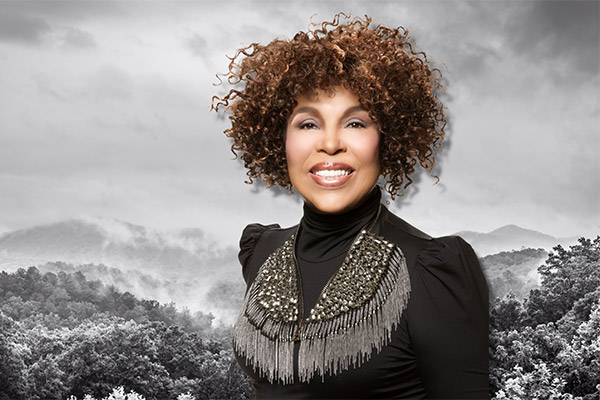
1. This week, the world of music lost the great Roberta Flack, singer of one of my favorite songs, Killing Me Softly With His Song.
2. In Around Town, the Tucson Community Tennis Program is having a Special Fundraiser on March 20th at Flower Child. The restaurant will donate 30% of its sales that evening to the TCTP. I plan to attend.
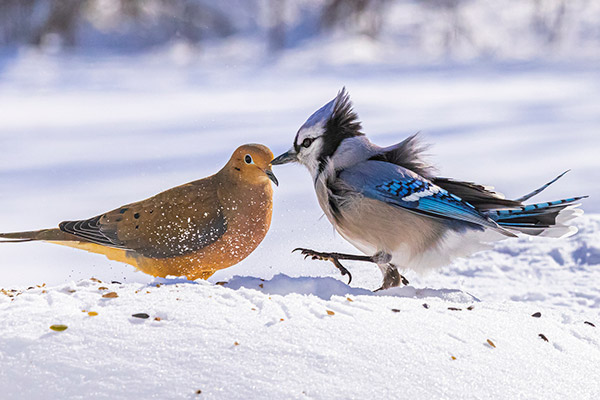
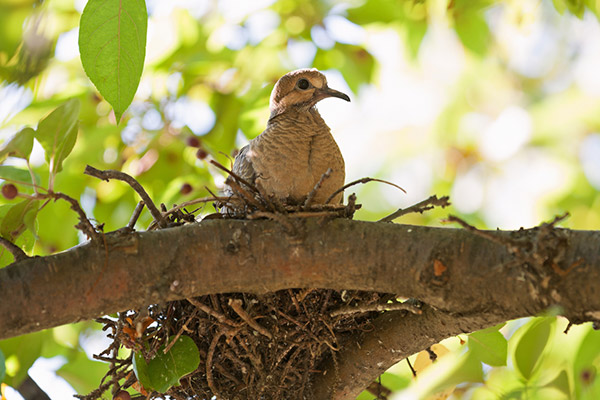
3. Spring is in the air, and so are the mourning doves; I'm starting to see their nests appear like springtime buds in my trees almost overnight.
4. I've been in Aspen, where it's still avalanche season. If you're getting out into the mountains during the winter months, practice avalanche safety, prepare, and heed local avalanche warnings
5. In Travel, I have a sampling of iconic European landmarks from the Parthenon to one of several Stonehenges that you can visit here in the USA.
6. In Wellness, I have a new article from Sensitive & Specific on new research into our immune system that uses machine learning (AI) to analyze B and T cell receptor coding sequences to deliver insight into immune system health.
| |
Now, to this week's Flock. | |
1. In Memoriam: Roberta Flack, 2.10.1937 – 2.24.2025 | |
Jazz, soul, and R&B singer Robert FLack succumbed to ALS this past Monday at the age of 88. The six-time Grammy winner recorded chart-topping hits in the 70's, 80's & 90s. Before her recording career, she taught music at Washington, D. C. junior high schools. Later, she devoted extensive time to the Roberta Flack School of Music, based in New York and attended by students between ages 6 and 14. Her 1973 hit, Killing Me Softly With His Song, is one of my favorite songs. | |
Killing Me Softly singer Roberta Flack dies aged 88 | |
From: BBC, By: Mark Savage, February 24, 2025 | |
|
The R&B singer Roberta Flack, best known for the hits The First Time Ever I Saw Your Face and Killing Me Softly With His Song, has died at the age of 88.
"We are heartbroken that the glorious Roberta Flack passed away this morning, February 24, 2025," said a statement from her representatives.
"She died peacefully surrounded by her family. Roberta broke boundaries and records. She was also a proud educator."
Flack had previously announced in 2022 that she had motor neurone disease, and could no longer sing.
Born in North Carolina and raised in Arlington, Virginia, the musician started out as a classical pianist. She gained a full school scholarship to Howard University aged just 15. Her classical training led her into teaching, but at night she'd accompany opera singers on piano, singing pop standards during the breaks.
"Through music we understand what we are thinking and feeling. No matter what challenge life presents, I am at home with my piano, on a stage, with my band, in the studio, listening to music. I can find my way when I hear music."
– Roberta Flack
| |
Roberta Flack - Killing Me Softly With His Song | |
2. Around Town: TCTP Special Fundraiser
| |
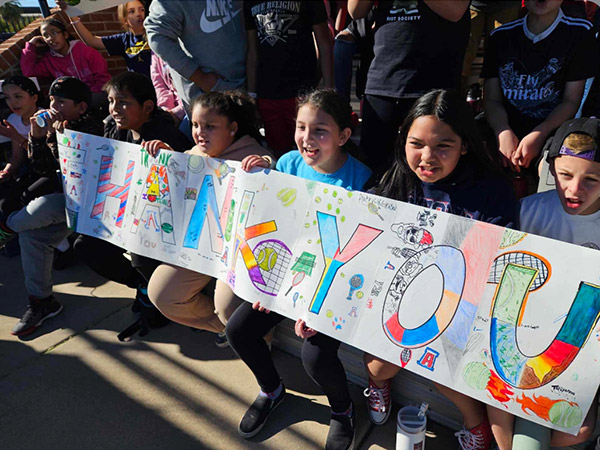
As you know, we all love TCTP. I have featured the great work of the non-profit Tucson Community Tennis Program several times in this newsletter. The TCTP brings tennis instruction to underserved schools in Tucson. The TCTP also teaches strategic thinking, teamwork, and sportsmanship by introducing elementary through high school students to tennis. Participants in the program display this with their courteous appreciation of the support they receive from the community. Here's your chance to support them by having a dinner out. Please make your reservations now. Hope to see you there. | |
3. Birds: Mourning Doves are Nesting | |
Mourning doves are early nest builders. Seeing mourning dove nests pop up is a prelude to spring, with nest building beginning as early as January and February in warmer southern regions of the country and March in cooler northern states. | |
Mourning Dove Nesting Habits | |
Most birds spend several days, to as long as two weeks getting their home just right. But a pair of mourning doves can quickly throw together a loose platform of sticks in just a few hours. The construction may be finished in a single morning or spread over a couple of days. The male is prone to interrupting the work to pursue the female. A flimsy nest mourning dove nest is made of pine needles, twigs and grass. | |
4. Natural Disasters: Avalanches | |
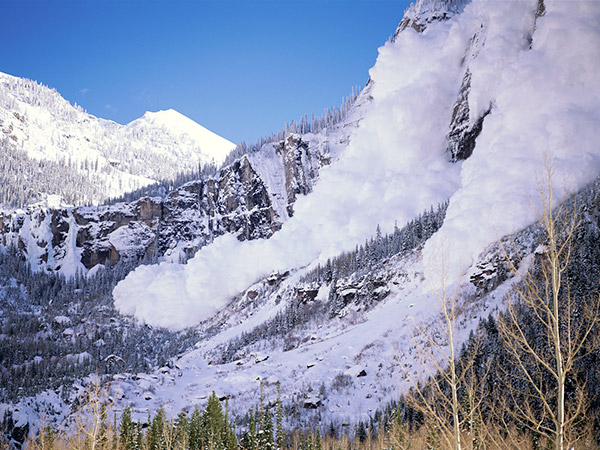
I've been in Aspen for the last couple of weeks, and it is still avalanche season here, with over 500 reported in Colorado in the past month. The avalanches are always happening here in the Roaring Fork Valley. Mountaineers, hikers, backpackers, skiers, and snowmobilers, beware! Learn avalanche safety and how to spot avalanche warning signs. If you're going into the backcountry in winter, ensure you have essential rescue tools: a shovel, transceiver probe, and, better yet, an avalanche airbag pack. Most of all, heed avalanche forecasts and warnings. | |
|
An avalanche is a rapid flow of snow down a hill or mountainside. Although avalanches can occur on any steep slope given the right conditions, certain times of the year and types of locations are naturally more dangerous. While avalanches are sudden, there are typically a number of warning signs you can look for or feel before one occurs. In 90 percent of avalanche incidents, the snow slides are triggered by the victim or someone in the victim's party. Avalanches kill more than 150 people worldwide each year. The National Weather Service provides current weather conditions and forecast information to regional avalanche forecast centers that in-turn issue avalanche forecasts. Avalanche warnings and special advisories are included on NWS websites and broadcast over NOAA Weather Radio. Refer to your local avalanche center for current snowpack conditions!
How to Stay Safe
1. Know the three factors required for an avalanche:
- Slope - Avalanche generally occur on slopes steeper than 30 degrees
- Snowpack - Recent avalanches, shooting cracks, and “whumpfing” are signs of unstable snow.
- Trigger - Sometimes it doesn’t take much to tip the balance; people, new snow, and wind are common triggers.
2. Determine if you are on or below slopes that can avalanche
3. Find out if the snow is stable
4. Get the Advisory: Refer to your local avalanche center for current snowpack conditions!
5. Get the gear...and learn how to use it! Have these three avalanche safety essentials in your pack:
- Transceiver: so you can be found if covered by the snow
- Shovel: so you can dig out your partner
- Probe: so you can locate someone who has been covered by the snow
Avalanche survival rates plummet after about 15 minutes for victims who do not die from trauma. Saving your partner is up to you! Practicing realistic scenarios beforehand is essential.
Avalanche warning Signs
The following are a few of the warning signs of unstable snow and possible avalanches:
- You see an avalanche happen or see evidence of previous slides.
- Cracks form in the snow around your feet or skis.
- The ground feels hollow underfoot.
- You hear a "whumping" sound as you walk, which indicates that the snow is settling and a slab might release.
- Heavy snowfall or rain in the past 24 hours
- Significant warming or rapidly increasing temperatures
- You see surface patterns on the snow made by the force of strong winds. This could indicate that snow has been transported and deposited in dangerous drifts that could release.
| |
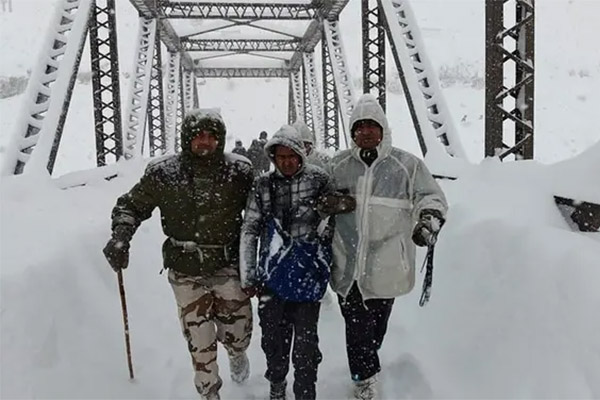
Avalanche danger is not limited to backcountry enthusiasts. Construction and road crews are often at high risk. Just on the last day, a construction crew in the Indian Himalayas. My thoughts and prayers go out to the victims and those attempting their rescue. | |
Over 20 missing after avalanche in Indian Himalayas: rescuers | |
Rescuers were racing against time to search for more than 20 construction workers missing after an avalanche in India's Himalayan state of Uttarakhand on Friday following heavy snowfall, the army said. | |
|
Disaster relief teams dug for hours through heavy snow after the avalanche hit a construction camp in Chamoli district, burying the workers under snow and debris.
"The avalanche rescue operation of the Army continues unabated despite harsh weather conditions and continuing snow," the Indian Army said in a statement on X.
Fifty-seven workers were initially trapped, but 22 managed to escape to the nearby temple town of Badrinath while 10 were rescued, it said, leaving 25 still unaccounted for.
Army doctors at the site performed life-saving surgeries on those critically injured in the incident, the army added.
| |
5. Travel: Iconic European Monuments in the USA
| |
Start planning your summer road trip; you can visit many of Europe's iconic landmarks without leaving the USA. See a full-scale reproduction of Athen's Parthenon in Nashville, Tennessee, a half-scale version of the Leaning Tower of Pisa in Niles, Illinois, The actual London Bridge disassembled and reconstructed in Lake Havasu, Arizona, and one of several Stonehenges throughout the country. About three years ago, I visited the actual Stonehenge with my hubby, I. Michael Kasser; the air was thick with spiritual vibrations. You can walk the Stonehenge trails or take a tour bus. It's a must-do. | | |
|
|
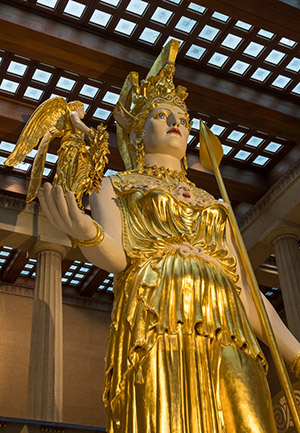
The Parthenon
Nashville, Tennessee
The Parthenon stands proudly as the centerpiece of Centennial Park, Nashville's premier urban park. The re-creation of the 42-foot statue Athena is the focus of the Parthenon just as it was in ancient Greece. The building and the Athena statue are both full-scale replicas of the Athenian originals.
Originally built for Tennessee's 1897 Centennial Exposition, this replica of the Parthenon in Athens, Greece serves as a monument to what is considered the pinnacle of classical architecture. The plaster replicas of the Parthenon Marbles found in the Naos are direct casts of the original sculptures.
Nashville.com
| | |
|
|
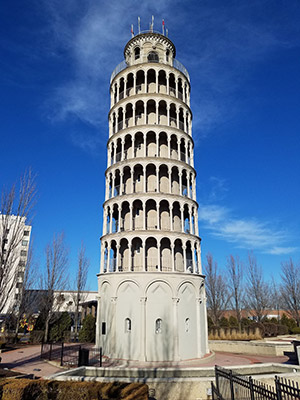
Leaning Tower of Niles
Niles, Illinois
Robert Ilg, a successful businessman, built a 22-acre park, Ilgair Park, during the 1920s with two large outdoor pools, which needed to be supplied by a large outdoor water tank. Ilg was concerned about preserving the natural beauty of the area and decided to build a replica of the Leaning Tower of Pisa to conceal the water tower.
The tower would be half the size of the original in Pisa: 94 feet tall, 28 feet in diameter, leaning 7.4 feet, and would be built with reinforced concrete. Construction began in 1931 and was completed in 1934.
The Village of Niles
| |
|
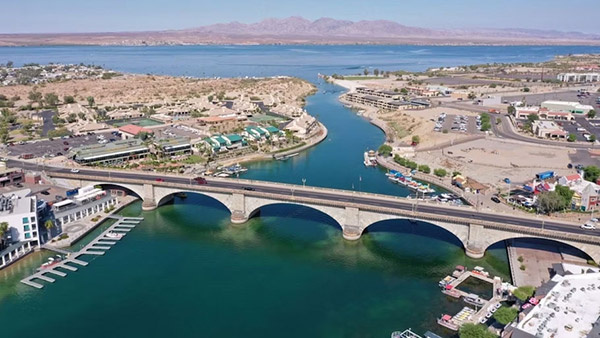
The London Bridge
Lake Havasu City, Arizona
In the 1960s, Robert P. McCulloch, Sr. was an inventor and entrepreneur who had great success in the boat motor and chainsaw markets. In need of a body of water to test the motors, McCulloch moved his company from land-locked eastern California to the Lake Havasu area. He purchased a 26-square-mile parcel of raw desert along the lake's eastern shore.
McCulloch wanted to grow his tiny company town into a thriving city and tourist destination. His friend Cornelius Vanderbilt “C.V.” Wood, who was known for designing Disneyland, planned and developed the new community. A vigorous marketing campaign in the freezing Midwest drove sales of residential lots in the sunny desert.
Go Lake Havasu
| |
|
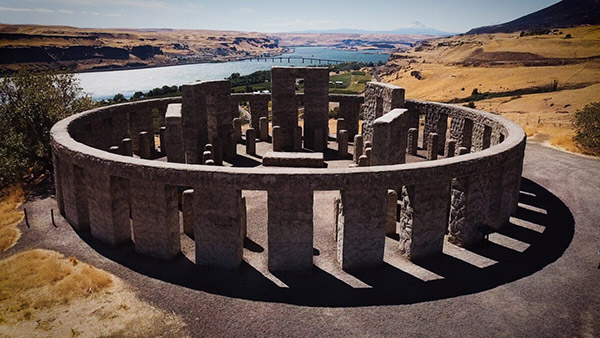
Maryhill Stonehinge Memorial
Maryhill, Washington
Near the town site of Maryhill, Washington, three miles east of Maryhill Museum of Art, stands a full-scale replica built by museum founder Sam Hill.
Erected as the nation’s first WWI memorial and dedicated in 1918 to the servicemen of Klickitat County, Washington, who died in the service of their country during the Great War, Hill’s Stonehenge Memorial is a monument to heroism and peace.
Hill erroneously believed that the original Stonehenge was constructed as a place of human sacrifice. Concluding there was a parallel between the loss of life in WWI and the sacrifices at ancient Stonehenge, he set out to build a replica on the cliffs of the Columbia as a reminder of those sacrifices and the “incredible folly” of the war.
Guided by leading authorities on archaeology, astronomy, and engineering, Hill combined their knowledge to duplicate, as nearly as possible, the original size and design of the ancient Neolithic ruin in England.
Maryhill Stonehinge Memorial
| |
|
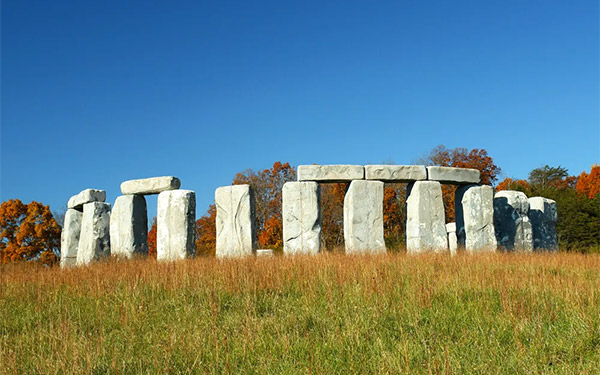
Foamhenge at Cox Farms
Centreville, Virginia
Come one, come all to the marvelous Foamhenge! Foamhenge is our famous full-size Stonehenge replica made entirely of styrofoam.
Originally created by artist Mark Cline of Enchanted Castle Studio in 2004, Foamhenge made its debut at Cox Farms in 2017. Before then, it proudly stood in Natural Bridge, VA.
Foamhenge at Cox Farms
| |
|
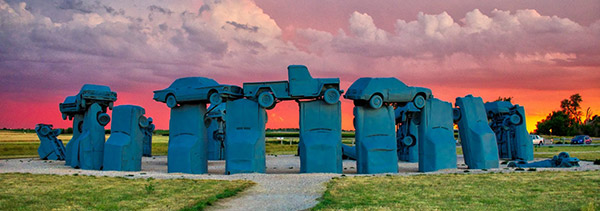
Carhenge
Alliance Nebraska
In the summer of 1987 Jim Reinders, with the help of family members, built a replica of Stonehenge just north of Alliance along Highway 87. Carhenge consists of thirty-eight American-made automobiles, all painted gray, with dimensions and layout to mimic Stonehenge. Carhenge is now preserved and owned by the Friends of Carhenge. Additional automobile sculptures have been added to the site as part of the “Car Art Reserve.”
Nebraska State Historical Society
| |
6. Wellness: Sensitive & Specific Newsletter
| |
I have another new article from Sensitive & Specific: The Testing Newsletter. In this week's article, Mara and Liz look at promising new research aimed at better understanding our immune system by examining B and T cell receptor coding sequences using machine learning (AI) to speed up the data analysis of such large data sets. Subscribe to the newsletter here. | |
Unlocking the immunome: Using B- and T-cell analysis to diagnose disease | |
From: Sensitive & Specific: The Testing Newsletter, Volume 11, Issue 9 By Mara G. Aspinall and Liz Ruark, February 27, 2025 | |
|
Back in July 2024, Eric Topol published a lament. Our immune system is critical “for protecting us against infections and major diseases such as cancer,” he wrote, “yet we have no informative clinical test to get at it.” To develop such tests - ones that would give clinicians useful information about the immune system that they could act upon - we need to know more about the genes and proteins that collectively make up the immune system. In other words, as Topol said, we need an immunome.
The immunome has enormous diagnostic potential, because written within it are the details of every battle our bodies are facing now and have ever faced in the past. Those battles may have been fought with objects (physical injury), microbes (infection), or itself (autoimmune disease). Inexpensive sequencing has given us the data that we need to define the functional immunome, but the problem is that the volume of raw data is enormous. Without AI, the task of analyzing it all is simply too big. Thus, the immunome remains incompletely understood.
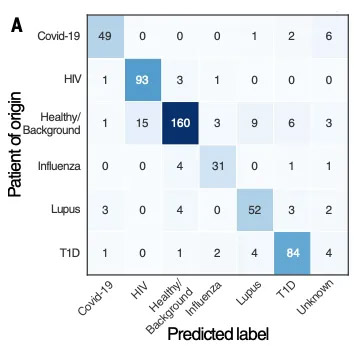
This week, Science published a study that gives us the beginning of what Topol (and the rest of us) have been looking for. Researchers looked at how the sequences coding for receptors on B and T cells differed between healthy and sick people. As Science explained in its Editor’s Summary of the paper, B- and T-cell receptor populations “change after exposure to pathogens, after vaccination, and in response to . . . autoimmune conditions.” Using machine learning, the researchers were able to use differences in B- and T-cell sequences to distinguish healthy people from folks who were vaccinated or had certain diseases (HIV, COVID, flu, lupus, type 1 diabetes). And their accuracy was impressive, at about 98% (see extract of Figure 2 here).
| |
COMMENTARY: If (when?) these techniques mature, they will enable a fundamental paradigm shift in pathogen diagnosis. From a research perspective, they will enable greater focus on the specific elements of the immune system that we need to understand better. In the clinic, the first step may become an immunome test to find out what exactly the immune system is currently fighting, and how successful it promises to be with or without possible treatments. | |
|
credit: NASA, ESA,STSci, and hubble Space Telescope
Out of this Wwhirl: The Whirlpool Galaxy (M51) and companion galaxy
| |
These Flock regulars are always here for you: | |
Don't Be Shy: Share Your Stories! | |
I'm looking forward to sharing more of your personal stories - oral, written, or otherwise, as we enter our third year. I'd so love to present them to The Flock, hit a mailbox below to share your story. | |
Subscriptions & Idea Submissions
Reminder: Your submissions are always welcomed. | |
|
Feel free to forward this email to a friend. If this was forwarded to you and you would like to receive your very own Flock Newsletter, you can sign up here. If you have any questions or suggestions for future Flock resources, don't hesitate to contact me.
Your fan and friend,
Beth
| | |
The information and materials contained or referenced in this newsletter are for informational purposes only and not intended to be a substitute for professional medical advice, diagnosis, or treatment. Always consult a physician or other qualified medical professional with any questions you may have regarding a medical condition or treatment and before beginning a new health care regimen. Do not disregard professional medical advice or delay seeking medical advice or care based on anything contained in this newsletter. | | | | |