|
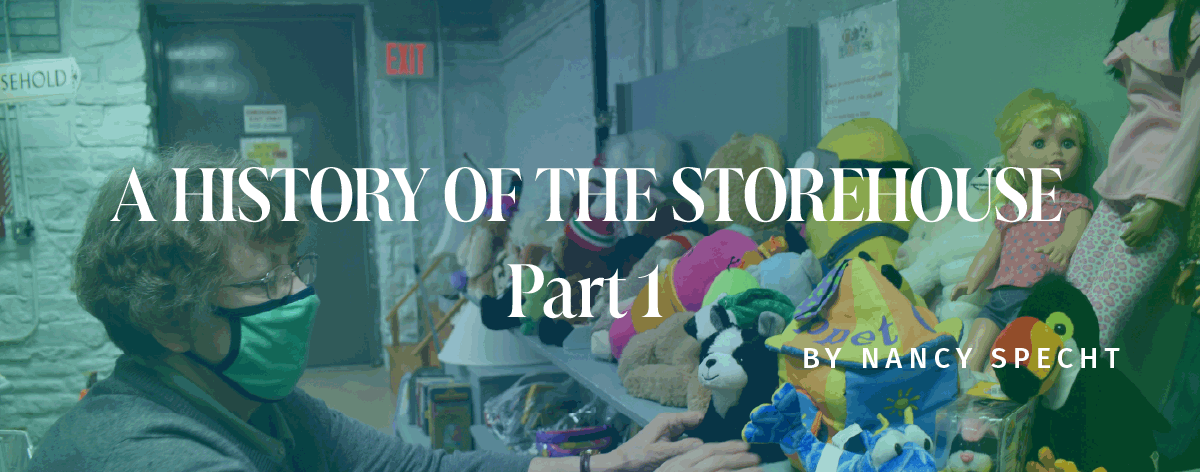
A History of the Storehouse — Part 1
On an bright and sunny morning earlier this summer, eight longtime Storehouse volunteers gathered in 1050 for lunch and a conversation about their years of service. Their memories, shared below, offer a rich picture of the Storehouse's history and spirit.
Origins
The Storehouse began in 1964 as a small closet operation in 1010 (where the Community Outreach Center currently operates), born out of the community needs that followed the riots of that year. (The Day Care ministry also grew out of this same period.) In its earliest days, the Storehouse offered clothing only.
Its founding members were Dolly Rugg, Jean Billington, Ada Finley, Donna Steele, and Mary Morin.
The Storehouse remained in 1010 until 1984–85, when it relocated to the basement of 1050 (the church offices). With the move came an expanded mission: alongside clothing, the Storehouse began offering housewares and bed linens to clients in need.
Voices from the Volunteers
Diane Donatelle recalls that Nancy Davidow first contacted her about the need for Wednesday evening coverage to help sort donated clothing.
Barb Zerkel remembers volunteering for sorting duty and being told, for three weeks running, that there wasn't enough donated supply to need her help. In the fourth week, Virginia Cadle reached out to let her know she was needed after all. Barb, Donna, and others — many of whom still held day jobs — gathered on Wednesday evenings to sort and prepare clothing for distribution.
Also active in the Storehouse during this period were Peggy Lyons and Florence Kerr, the latter instrumental in washing and repairing donated clothing.
How Donations Were Gathered
In the early days, the Storehouse relied on Sunday morning announcements and word-of-mouth to let the congregation know which items were needed. Once the Storehouse moved to 1050 in 1984–85, a large donation container was placed near the chute in that building, making it easy for people to drop off items.
By this time, the Storehouse was so well known in the community that referrals came directly from social service agencies, and many new clients heard about the ministry from others who had already been helped. Items the Storehouse couldn't use were passed along to other organizations, including the Salvation Army — a partnership that continues today.
Donations often peaked during seasonal changeovers, which occasionally required the Storehouse to pause intake for a time so that volunteers could properly sort and manage what was already on hand.
A Six-Day Operation
The Storehouse operated six days a week, including Saturdays, with different teams of volunteers covering different shifts. Ruth Vanderlinden and Lani Anderson recall working Wednesdays, covering the 12–3 and 3–5 shifts.
A washer and dryer in the basement of 1050 were in constant use, as volunteers worked to wash, dry, repair, sort, and stage items for distribution. In the earliest years, clients could simply walk in for service; today, clients are encouraged to make appointments so they can receive more personal attention and support.
Ruth recalled that long-time volunteers trained newcomers as they joined, passing down knowledge and practices from one generation of volunteers to the next. Volunteers also worked alongside the church's youth — including confirmands — helping them learn to prepare and sort clothing for distribution.
Today, Storehouse volunteers come not only from Asbury First but from across the broader community — people who heard about the ministry and wanted to help. Barb Zerkel remembers mentoring a young man from the community, Chris, over several months. Student groups also visit regularly to learn firsthand what the Storehouse provides to clients in need.
|