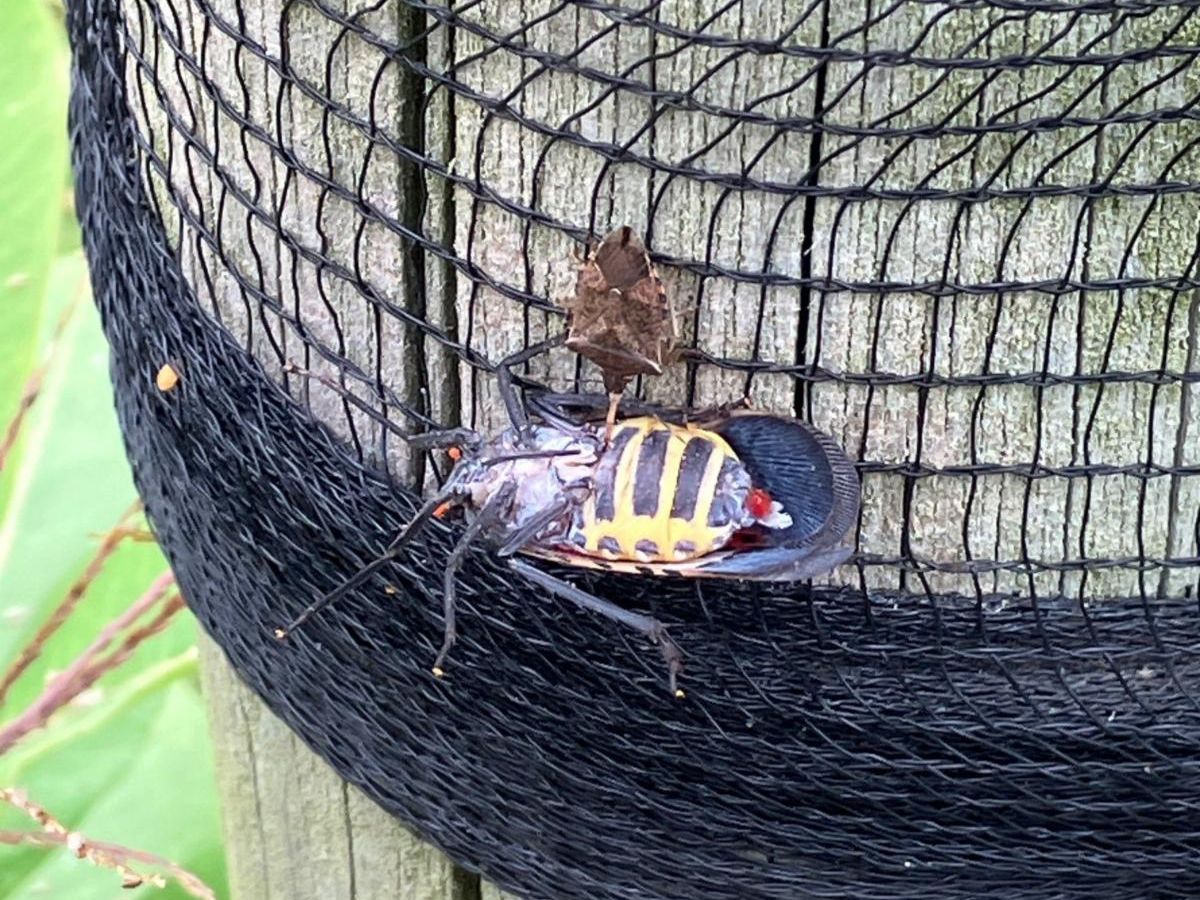
A stinkbug feasting on a spotted lanternfly.* | | GRAPEVINE GENETICS: THE FINAL FRONTIER | | |
September is the best time to enjoy the majestic beauty of our vineyards. Regardless of your preference—wine, raisin, table or juice grapes—Mother Nature has provided a variety of berry shapes, sizes, colors, aromas and flavors to enjoy. The diversity of grape varieties results from the differences in their genetic code. Some of those differences evolved naturally, by virtue of pollen on the wind. Others were ushered in by grape breeders, eager to improve varieties for the betterment of the grape and wine industry.
For the members of the National Grape Research Alliance (NGRA), unlocking the genetic code of grapevines represents one of our most prized and promising research objectives.
NGRA is committed to strengthening the competitiveness of the US grape industry by establishing national research priorities and obtaining the funding necessary to conduct the work required to achieve them. Grapevine genetics is at the top of those priorities. We’re proud to have supported VitisGen and its two successor projects, which have provided molecular markers and other tools needed to create new grape varieties with improved disease resistance. The advances provided by VitisGen are significant, but more research is needed to address challenges such as emerging pests, environmental extremes and water scarcity.
The genetic improvement of plant materials offers a long-term, sustainable solution to these problems. It is therefore important to understand recent advances in grapevine genetics research. This was our goal when organizing the NGRA Grapevine Improvement Workshop, presented with and at the Department of Viticulture & Enology at UC Davis, on November 5, 2025. The workshop will bring together research scientists from around the world to provide updates on advancements in grapevine genetics and the development of improved grape varieties and other tools for grapevine improvement. View the program and register here.
In the title of this column, we refer to grapevine genetics as the “final frontier,” in a nod to one definition of “frontier” as the farthermost limits of knowledge or achievement in a particular field. We consider genetics our final grape research frontier. Of the 30,000 genes typically found in a grapevine, only a handful have been fully characterized for their function. This knowledge provides the foundation for grapevine improvement, and the characterization of wild species is likely to be particularly useful for discovering new genes for important traits.
Commodity crops like corn and soybean have benefitted significantly from the characterization of their genomes, allowing plant breeders to identify the genes responsible for improved yield, disease resistance and other traits and incorporate them into new varieties. In contrast, the functional genomics of grapevine—that is, the link between grapevine genes and their function—is largely uncharted.
Functional genomics requires a multidisciplinary approach to linking grape variety genotypes—their genetic make-up determined by DNA sequencing—with their phenotypes—observable traits such as yield, berry color or disease resistance—which require careful measurement. This work is necessary to discover the genes responsible for grapevine pest and disease resistance, fruit development and composition, tolerance to environmental factors such as heat, cold and drought, and other important traits.
Attendees of our Grapevine Improvement Workshop will hear recent advances in grape genetics and biotechnology from leading US and international researchers. Topics include a review of grape genetic diversity, the genetic control of grape adaptation to environmental stresses, innovations in traditional breeding methods and the use of digital tools to assist with variety improvement. There also will be presentations on new gene discovery, precision breeding techniques and the application of RNAi for disease control, as well as an industry panel on the genetic improvement of commercially available horticultural crops using precision breeding techniques.
The formal development and selection of improved grapevine plant materials, both fruiting varieties and rootstocks, has been ongoing for hundreds of years. These efforts intensified following the introduction of phylloxera to Europe in the mid-1800s, as the need for pest resistant rootstocks became essential to the survival of the European wine industry. Traditional plant breeding methods have resulted in new and improved rootstocks and grape varieties currently in commercial use. And the work continues.
Table grapes offer an excellent example of how genetics can transform an industry. Traditional breeding methods have resulted in dramatic increases in table grape productivity and enhanced fruit quality attributes such as seedlessness, berry size, berry shape, color and flavor. It also has expanded market timing and improved post-harvest storage quality. These improvements have led to a steady increase in per-capita table grape consumption in the US over the last three decades. They also have led to the establishment of private breeding programs and wildly popular proprietary table grape varieties like Cotton Candy. Raisin and juice grapes have benefitted significantly from genetic improvement, too. The future impact of grapevine variety improvement via genetics appears limitless.
| | |
The members of NGRA are dedicated to advancing genetics and other solutions for the future growth and sustainability of the US grape industry. Please join us in November to explore this exciting final frontier and learn how it could shape the vineyard of the future.
—The Grapevine Improvement Workshop Organizing Committee
| | |
*ABOUT THE IMAGE
NGRA President Donnell Brown happened to spot this spined soldier bug (a species of stinkbug) feeding on a spotted lanternfly in an infested Pennsylvania vineyard in October 2024. Turns out, they’re one of a few natural predators for SLF! Learn more in the Research Focus story below.
| | Our Inventory of Funded Grape Research Is Back! | | |
2025 has been a weird year for grape research funding. Shifts in the federal landscape knocked out the USDA grant programs that have fueled agricultural science for decades. We wondered whether and how funding for grape research had been faring this year. So, with the help of our UC Davis intern Diego DeCarlo, we reinstated our inventory of grape research funded via grant programs at regional, state and federal levels to create a comprehensive snapshot into the ways scientists in America are working to advance the grape and wine industry through science. The good news is, they still are!
Our new spreadsheet documents all the grape research that’s been funded in 2025. It features a colorful new design, with helpful categories, running tallies and sorting capabilities. But it’s a work in progress. As before, we’ll ongoingly update this resource as grant programs announce their awards, as we gain more information about published awards and as we learn of funding programs we may not have known of before. If you have a tip, hit reply and let us know!
| | Register for the October 15 NVEELC Meeting | | |
NGRA proudly supports the National Viticulture and Enology Extension Leadership Community (NVEELC), which regularly gathers viticulture and enology extension and industry outreach specialists for professional development, best-practice sharing, research and regional reports, collaboration and dialogue on the unique challenges in V&E extension. The goal? To lift up, connect and support the vital extension function for the American grape and wine industry.
If you work in an extension or outreach (non-sales) role, register now for the next NVEELC Virtual Meeting on October 15, 2025. Hear reports from the Midwest and Northeast Regions and learn about the latest research and extension efforts to combat the spotted lanternfly. See the agenda and sign up!
| | Farm Security Is National Security | | The National Farm Security Action Plan, unveiled by the USDA in July 2025, is a comprehensive strategy to elevate US agriculture as a national security asset. Its seven key goals are to: restrict foreign ownership of American farmland, enhance the resilience of agricultural supply chains, protect the U.S. nutrition safety net from fraud, defend agricultural research and innovation, ensure “America First” in all USDA programs, safeguard plant and animal health, and protect critical agricultural infrastructure. The plan includes banning sales of farmland to Chinese nationals and other foreign adversaries, “clawing back” land already purchased by hostile nations, and canceling deals with entities from countries of concern. | | Federal Report on Drinking Is Withdrawn | The Trump administration this month moved to defund a federal committee called the Interagency Coordinating Committee on the Prevention of Underage Drinking (ICCPUD) and shelve its controversial Alcohol Intake and Health report, which warned that even one drink a day was dangerous to human health. It was one of two reports on alcohol commissioned to inform the US Dietary Guidelines. The other report, from the National Academies of Science, Engineering and Medicine (NASEM), appears now to be the prevailing report. It acknowledges that, “while binge drinking and alcoholism are dangerous, moderate drinking reduces all-cause mortality—your overall risk of death,” Wine-Searcher reports. “In a nutshell, while moderate drinking raises your risk of several types of cancer, notably breast cancer, it also reduces your risk of heart disease, which is the number-one killer of Americans.” The new guidelines were expected to be released in August. | | The California Association of Winegrape Growers (CAWG), an NGRA member-organization, this month announced its annual Awards of Excellence, naming Stuart Spencer, Executive Director of the Lodi Winegrape Commission, also an NGRA member-organization, as its 2026 Leader of the Year. The Leader of the Year Award recognizes an individual whose record of exceptional leadership has benefited California’s wine industry. “Stuart has shaped many of Lodi’s most transformative initiatives,” CAWG’s press release reports. “He represents more than 750 growers farming 85,000 vineyard acres and supports over 80 wineries.” Jackson Family Wines of Sonoma County also is recognized as 2026 Grower of the Year. The awardees will be honored at CAWG’s Awards of Excellence Reception on January 27, 2026, during the Unified Wine & Grape Symposium. | | University of Tennessee Builds a V&E Team | | |
The University of Tennessee Institute of Agriculture is introducing a new team of professionals to serve the state’s growing grape and wine industry. Within the Department of Plant Sciences, two new faculty members will build on the outstanding legacy of Extension fruit and nut crops specialist David Lockwood, who helped establish Tennessee’s commercial grape growing and winemaking 50 years ago and remains involved post-retirement to guide the new recruits.
Pierre Davadant is the new assistant professor of viticulture; his newly created position is 75% focused on research and 25% teaching. Pierre’s research will focus on identifying grape varieties adapted to Tennessee’s climate and developing vineyard practices that reduce frost risk, control fungal diseases, manage vine vigor, and improve fruit and wine quality. Thanks to his appointment, for the first time ever, students with an interest in viticulture will be able to take a course entirely related to grape production.
Note that Pierre is recruiting a Viticulture Research Technician to assist in applied and fundamental viticulture research projects. Learn more and apply by October 17, 2025.
Annie Vogel is a new assistant professor and UT Extension commercial fruit specialist, covering grapes and other fruit crops. She has statewide responsibilities for developing a comprehensive educational program in commercial fruit production and provides a vital link between researchers and growers.
A third member of the team is to be added in January 2026 when the university anticipates hiring its first fermentation sciences faculty.
| Walter (Walt) Mahaffee, research plant pathologist at the USDA-ARS Horticultural Crops Research Unit in Corvallis, OR, and Courtesy Professor in the Department of Botany and Plant Pathology at Oregon State University, was awarded this year’s Lee M. Hutchins Award by the American Phytopathological Society. The award recognizes excellence in publishing on basic or applied aspects of diseases of perennial fruit plants. Walt’s “significant and sustained contributions to original research on grape powdery mildew over the past decade, as documented in his series of papers in APS journals and tangible benefits to the winegrape industry, are unmatched,” says the award announcement. “The value of these contributions makes Walt Mahaffee a most deserving recipient of the Lee M. Hutchins Award.” Nominations for the Society’s 2026 awards are being accepted through December 1, 2025. | | WSU’s Thomas Henick-Kling Has Retired | | In June, Professor of Enology Thomas Henick-Kling retired from Washington State University; he remains a professor emeritus in the Department of Viticulture and Enology. Hired at WSU in 2009 as a professor and director of its burgeoning V&E program, Thomas secured approval for a new undergraduate degree and established the Ste. Michelle Wine Estates WSU Wine Science Center on the WSU Tri-Cities campus. WSU reports that, “Throughout his successful, 46-year career, Thomas Henick-Kling has contributed many impactful research findings, advised wine industry members, taught wine microbiology and winemaking classes, and helped plan and launch wine science centers at three universities,” Cornell, Charles Sturt University and WSU. Thomas “came to WSU with a bold sense of what was possible and worked tirelessly to make it happen. His impact will continue to be felt in the students he has mentored and the infrastructure he helped build,” says WSU V&E Department Chair Jean Dodson Peterson. | | Wine Spectator Wine Education Center Opens in Napa Valley | | Earlier this month, the Wine Spectator Wine Education Center opened on the campus of Napa Valley College. The 7,000-square-foot facility more than doubles classroom and training space for the College’s Viticulture and Winery Technology program, expanding opportunities for education, training and career development in the wine industry, including certificates and degrees in Viticulture, Winemaking, Wine Marketing and Sales, Winery Management, Vineyard Management, and Wine Laboratory Technician. The ribbon-cutting ceremony on September 4 represented the completion of Phase I of the Napa Valley College Wine Education Complex and beginning of Phase II, the construction of the Hospitality Training Center. | | UC ANR Receives $15.1M to Accelerate Agtech Innovation | | |
UC ANR Innovate, the innovation program of UC Agriculture and Natural Resources, was awarded $15.1 million to launch the state’s first coordinated agricultural innovation network, spanning agtech and food systems investments designed to strengthen competitiveness and resilience across the state. This statewide effort will align research, industry and community partners across nine regions, ensuring that breakthroughs in one part of the state can be shared quickly and equitably across all of California agriculture. It also lowers the risk of bringing new technologies to market by incorporating field trials, farmer feedback and targeted innovation grants, while equipping growers and workers with the skills to adopt them.
“This award allows us to do something California has never done before: build a single, statewide engine for agricultural innovation,” said Gabriel Youtsey, chief innovation officer at UC ANR. “We will be able to seamlessly connect researchers, entrepreneurs, farmworkers and industry across major farming regions, moving ideas from the lab to the field faster than ever, and ensuring that every farmer—from small specialty growers to large scale producers—benefits from the tools needed to stay competitive.”
| | |
Researchers ID Bugs with a Taste for SLF
By Amy Duke, Penn State
| | |
Insect predators found in the United States could help keep spotted lanternfly populations in check while potentially reducing reliance on chemical control methods, according to a new study conducted by researchers at Penn State.
Led by Penn State entomologists and published in Arthropod-Plant Interactions, the study evaluated the effectiveness of various insects in potentially controlling spotted lanternfly populations. The invasive pest, first detected in the US in 2014, has spread across at least 18 states, causing significant damage to vineyards, orchards and nurseries.
The study revealed that spined soldier bugs—a predatory stink bug native to North America known for preying on various agricultural pests—and Carolina and Chinese mantises were particularly effective in feeding upon spotted lanternflies. Conserving and promoting these natural predators could provide sustainable and strategic natural control against this destructive pest, the researchers suggested.
“Our study shows that several native and naturalized predators can consume spotted lanternflies effectively,” said researcher and doctoral candidate Anne Johnson, who co-led the study with Kelli Hoover, professor of entomology. “By leveraging natural enemies already in the environment, we hope to develop a sustainable, low-impact approach to managing this invasive species that will complement other control methods.”
Current management efforts rely heavily on insecticides, which pose risks of resistance development and unintended harm to beneficial organisms. Biological control, which relies on natural enemies to regulate pest populations, presents a more sustainable alternative for long-term spotted lanternfly management, Anne said.
In the spotted lanternfly’s native range of southeastern Asia, several predators, including parasitic wasps, keep the pest in check. However, importing and releasing new species as a control measure requires numerous environmental impact studies—currently underway by USDA and university researchers—and regulatory approval. Both can take years, Kelli said. Other predator species, especially those in the US, could offer an extra control layer. However, the researchers wondered if the situation might be more complex than it seems.
“The spotted lanternfly’s ability to sequester toxins from its preferred host, the tree of heaven, raises concerns about its vulnerability to predators,” Kelli said. “We hypothesized that the spotted lanternfly might harness the tree’s bitter-tasting chemical compounds as a defense mechanism that could protect it against predation.”
The pair tested 10 generalist predators—spined soldier bugs, praying mantises, wheel bugs, lady beetles and lacewings. In the experiments, predators were placed in enclosures with either 25 lanternfly nymphs or 10 adults for up to one week. Among the tested predators, the spined soldier bugs and two praying mantis species were the most effective at reducing lanternfly populations in controlled settings, regardless of the lanternflies’ life stage. Eight-spined soldier bugs, which hunt and attack prey as a group, consistently consumed all lanternflies—regardless of life stage—within three to four days. Additionally, the scientists observed that the predators would consume spotted lanternflies whether they had fed on tree of heaven or alternative host plants.
“By conserving and encouraging populations of these beneficial insects, we may be able to reduce the use of chemical controls,” Anne said.
The study builds on earlier community science initiatives documenting native insects preying on spotted lanternflies. From 2020 to 2022, Anne invited the public to share photos of birds and insects feeding on spotted lanternflies via Facebook. She received nearly 2,000 reports, giving scientists clues about which predators to evaluate.
While the research is promising, the team stressed that more work is needed. Forthcoming field experiments will help determine the efficacy of predators against spotted lanternflies in an open system without enclosures.
“While these insects could help keep spotted lanternfly populations in check someday, their impact may be limited by consistent presence of sufficient prey and the use of insecticides that can also kill these generalist predators,” Kelli said. “Therefore, they should be considered part of a broader integrated pest management strategy, rather than a standalone solution.”
This story was lightly edited from the original, “Natural Insect Predators May Serve as Allies in Spotted Lanternfly Battle,” by Penn State’s Amy Duke, published on March 17, 2025, on the Penn State website.
| | |
AFRI Foundational and Applied Science
USDA-NIFA’s Agriculture and Food Research Initiative (AFRI) provides funding for fundamental and applied research, education and extension/outreach projects in the food and agricultural sciences. There are 37 funding priorities in the six AFRI program areas:
- Plant health and production and plant products
- Animal health and production and animal products
- Food safety, nutrition, and health
- Bioenergy, natural resources, and environment
- Agriculture systems and technology
- Agriculture economics and rural communities
Application deadlines vary by program, with the earliest on October 2, 2025.
There are two noteworthy changes to the AFRI request for applications for FY26:
- A new cross-cutting program area priority, called “Rapid Response to Emerging and Re-emerging Pest and Disease Events Across Food and Agricultural Systems,” has been added. Applications for this program will be accepted on a continuous basis.
- A Mentoring Plan is now required for all AFRI grant applications for projects that involve any type of education, training, or mentoring of students or other individuals. (Workshop grants, equipment grants and sabbatical grants are excluded from this requirement.)
California DPR Sustainable Pest Management Grants Program
To support the transition to safer, more sustainable pest management (SPM) practices in California, this Department of Pesticide Regulation (DPR) program annually funds projects that advance SPM practices through integrated pest management research, knowledge, tools, outreach and implementation. Projects should focus on reducing impacts to public health or the environment from pesticides of high regulatory interest. Of particular interest are proposals addressing weed management, rodenticide use, fumigant use and the use of pesticides that are of high regulatory interest. Apply by October 14, 2025.
Farm Robotics Challenge
The Farm Robotics Challenge invites undergraduate and graduate student teams to design, prototype and field-test robotics and AI-driven solutions to tackle real challenges facing modern agriculture. The Challenge is organized by UC ANR Innovate, the innovation arm of University of California Agriculture and Natural Resources, in partnership with the AI Institute for Next Generation Food Systems. The competition unfolds across several stages, beginning with the registration period starting in August, followed by a team formation and proposal research phase through October. Project proposals must be submitted by October 30, 2025.
Penn State Center for Plant Excellence Grants
Penn State Extension and the university’s Center for Plant Excellence are offering a new opportunity for Pennsylvania’s plant industries. For the first time, $125,000 in grant funding is available to support projects that provide practical solutions for growers, businesses and workers in the field. Funding priorities include building and training the plant industry workforce, addressing invasive species and plant health problems, strengthening business operations and resilience, and increasing visibility and consumer connection for local products. Eligible applicants include growers, agricultural businesses, researchers, nonprofit organizations, educators and students whose work supports Pennsylvania’s plant industries. Applications are due November 6, 2025.
Washington Wine Research Grants
Pre-proposals are now being accepted for two competitive research grant programs in Washington. The Washington State Wine Commission offers short-term, one-year demonstration grants and intermediate grants of one to four years. The Washington State Grape and Wine Research Program, administered by WSU, also funds viticulture and enology research. The deadline for both programs is November 7, 2025.
| | |
Applying for a grant? Request a letter of support!
NGRA is pleased to provide letters of support for research projects that directly address our industry research priorities. Request a letter via our online request form at least two weeks prior to the grant deadline (or any internal deadline you may have). Requests are reviewed and approved by NGRA Research Committee leadership, so processing times may vary.
|
| |
So Many Spotted Lanternflies Are out Right Now, You Can See It on Radar
September 11, 2025 | Washington Post
“A giant swarm of spotted lanternflies is literally clouding the radar over the Mid-Atlantic,” meteorologist Matthew Cappucci reports. There are so many SLF over DC, Maryland and Virginia that, on the weather radar, it looks like precipitation. Other than the fact it’s not raining, how can you tell it’s SLF on the radar? The invasive insects can surf air currents as high as 3,000 feet, and their shape and movement distinguish them from weather patterns. Still, an umbrella might be in order.
Robot Matches Humans in Scouting for Vineyard Diseases
September 8, 2025 | Phys.org
Grape pathologist Katie Gold and applied roboticist Yu Jiang, both of Cornell AgriTech, collaborated to create—and continue to improve—the PhytoPatholoBot, an autonomous robot that scouts for grape diseases in vineyards in near-real time with accuracy on par with highly trained human scouts. It promises to one day help track and manage economically important diseases like downy and powdery mildew with minimal labor and more targeted, sustainable use of treatments.
Does Crop Thinning Really Lead to Better Wine?
September 8, 2025 | SevenFifty Daily
To thin or not to thin, that is the question. The answer? It’s complicated. Among the viticulturists quoted here, Oregon State’s Patty Skinkis advises grape growers to simply set aside the belief that, in all cases, low yield equals higher quality, and to instead consider the particulars of their growing site to determine their target yield. This might mean accounting for vine age and site and climatic variables,” and vineyard design. The answers, she says, “won’t be the same for every cultivar across the world.”
Active Wildfires Consume Over 755,000 Acres Across the US
September 4, 2025 | NRCS
According to the USDA’s Natural Resources Conservation Service, as of September 4, 63 large wildfires covering more than 755,000 acres were burning in the US, with grape-growing states California and Washington each battling 13 blazes. To date this year, 47,413 wildfires have burned more than 4.17 million acres, compared to the 10-year average of 41,932 fires burning 5.7 million acres.
Developing Cold-Hardy Grapes with 23andMe Technology
September 4, 2025 | Sustainable Winegrowing Podcast
University of Minnesota grape breeder Soon Li Teh reveals that the deep freeze of winter is only one part of the motivation for northerly grape growers to seek out cold-hardy grape varieties. Killing spring frosts can tip off a disastrous growing season whose losses become clear at harvest. He’s using DNA tools to speed up the process of traditional breeding, “rely(ing) on American grape species to help us achieve cold hardiness and also disease resistance,” he says.
Farm of the Future Sows Digital Seeds
September 2, 2025 | Cornell Chronicle
The Cornell Lake Erie Research and Extension Laboratory (CLEREL) vineyard in Portland, NY, is Cornell’s first living laboratory for precision viticulture, autonomy and sustainability. “There is a lot of environmental variation on a farm,” says CLEREL Director Terry Bates. “It used to be you’d set machines at a particular rate and just go, a ‘one-size-fits-all’ approach” to farming. As a pioneer in precision viticulture, he says, now we’re “using ag sensors, soil sensors and canopy sensors in order to spatially map the variability in the vineyard” to make management more efficient and sustainable.
Scouting the Spotted Lanternfly to Halt Vineyard Invasions
September 2, 2025 | USDA Tellus
At the Appalachian Fruit Research Station in Kearneysville, WV, entomologist Tracy Leskey and team are studying several ways to combat spotted lanternflies, including a new idea: can kaolin clay deter SLF from grapevines? “Insects do not like to walk on this material as it sticks to them, and it can block their spiracles and mouthparts,” Tracy says. Other strategies they’re studying are: tracking infestations to build better spray schedules; scouting for a fungus that kills SLF’s preferred host, tree of heaven; and monitoring foraging ants as a way to determine SLF’s spread within an area.
Warming Winters Bring Deadly Grape Disease to Virginia Wine Country
September 2, 2025 | 13News Now
Vineyards across Virginia are now under threat of Pierce’s disease as the state’s winters aren’t cold enough to kill the leafhoppers that vector it. “Areas once thought safe, including the Shenandoah Valley, are now reporting outbreaks of Pierce’s disease years ahead of predictions. ‘Six years ago someone told us we wouldn’t see Pierce’s here for 50 years,’ one vineyard owner is quoted. ‘And guess what? They had it this year.’”
Grape Field Day Covers Mealybugs, Rootstocks
September 1, 2025 | Good Fruit Grower
At Washington State University’s annual grape field day in July, grape mealybug, a vector of grapevine leafroll virus, figured prominently. Attendees learned to distinguish the pest from thrips and how to use monitoring traps to time sprays. They also learned that WSU’s Decision Aid System (DAS), which helps Washington growers plan tasks such as spraying and frost control, will be updated this winter to include the developmental stages of grape mealybug.
Opening New Doors in Design on the Texas High Plains
September 1, 2025 | Wine Business Monthly
In a 2024 survey in partnership with Ethnifacts, Wine Market Council reported that younger consumers are looking for more context clues when making wine purchase decisions. With “a color code…to better identify wines similar to the style (consumers) enjoy,” an informative new label format from Texas producer Messina Hof leads the way. Innovations in label design could not only help consumers choose wines they’re likely to like but also give a leg up to varieties (including newly developed grapes) wine drinkers have never heard of.
Australia Prepares To Launch DNA-Based Clonal ID for Grapevines
August 29, 2025 | Food and Beverage Industry News
The Australian Wine Research Institute has sequenced more than 1,500 grapevine samples, representing a range of clones from within Australia, to develop a robust reference database. It’s the basis for a new grapevine “fingerprinting tool that can reliably identify a clone, or flag anomalies when a vine doesn’t match anything in the existing library,” Food and Beverage Industry News reports. “We do a full genome sequence on each sample,” Anthony Borneman from the AWRI explains. “Then we’ve got a bioinformatic back end that’s pretty sensitive to finding those one-in-a-million differences” that occur naturally over time to form clones. The tool will reduce reliance on faulty and fragile historical variety records.
How Rootstock Impacts Vine Drought Tolerance and Longevity
August 21, 2025 | Sustainable Winegrowing Podcast
Rootstocks determine all the soil-related traits of grapevines, explains Cal Poly viticulture professor Suraj Kar, whose research includes evaluating and selecting resilient rootstocks. So, when choosing rootstocks, he adds, drought tolerance is an obvious trait to select for. How well they perform under drought stress can be a direct function of root volume or an indirect product of the signaling hormones they synthesize, such as abscisic acid (ABA), which influences vine transpiration. M Series rootstocks (used in apple) are considered drought-tolerant because they produce less ABA under drought conditions, he says.
A Job with Lots of Varieties
August 19, 2025 | Good Fruit Grower
Julie Tarara, a viticulturist with Results Partners (recently acquired by Atlas Vineyard Management, an NGRA member-organization), is a good example of the changes in the Washington wine industry—and vineyard management jobs within it. Once a scientist with USDA-ARS, in her first industry job, she managed 11 varieties on 60 blocks spanning 600 acres at Ste. Michelle Wine Estates. Today, she oversees 40-plus varieties for more than 30 clients, driving up to 1,000 miles a week.
Research Alert on Leafroll Epidemiology & the Vine Mealybug in Lodi Vineyards
August 18, 2025 | Lodi Growers Blog
Six viruses are involved in the devastating leafroll disease. Of them, Grapevine Leafroll-associated Virus 3 (or GLRaV3) is the most prevalent—and it has 12 variants of its own! Growers in the Lodi AVA are fighting back with research to better understand leafroll 3. They recently initiated a novel project with Cornell researchers to mark and track vine mealybugs (a dominant vector) to monitor their dispersal—especially to find out whether harvesters may spread them. They also will develop a lab assay to distinguish GLRaV3 variants to trace their epidemiology.
Scientists Turn Grapevine Waste into Clear, Strong Films That Vanish in Days
August 13, 2025 | Science Daily
South Dakota State University Food Scientist Srinivas Janaswamy and his colleague, Anne Fennell, a Distinguished Professor in the Department of Agronomy, Horticulture and Plant Science, collaborated to use cellulose extracted from grapevine canes to create a strong plastic-like material that breaks down in just 17 days without leaving micro- and nano-plastics in the environment. “Every year we prune the majority of yearly biomass off the vine,” Anne says, and for the most part, it goes to waste. It’s “an abundant ideal material to work with.” It has proven to yield Srinivas’ best plastic-alternative biodegradable packaging yet.
Rooting the Future: The Untapped Power of Cover Crops in Michigan Vineyards
July 14, 2025 | Michigan State University
There’s a “striking historical absence of funded research on vineyard cover cropping in Michigan,” writes MSU’s Paolo Sabbatini et al. “Even when growers express interest, funding agencies often decline to support new trials, citing a lack of visible short-term benefits.” This article “draw[s] from more than 30 years of cool-climate vineyard research (to) highlight how cover crops can strengthen Michigan’s soils, fruit quality and vineyard resilience.”
Find these stories and more, published every weekday, on our Facebook and X (Twitter) feeds. You can also find us on LinkedIn. Use #graperesearch to join and grow the conversation!
| | |
October 15, 2025
National Viticulture & Enology Extension Leadership Community (NVEELC) Meeting
Virtual event
October 21-24, 2025
Extension Disaster Education Network Annual Conference
Portland, ME
October 31-November 4, 2025
Old Vine Conference
Lodi, CA
November 5, 2025
Grapes for the 22nd Century:
NGRA-UC Davis Grapevine Improvement Workshop
Davis, CA
November 6, 2025
NGRA Year-End Board Meeting
Davis, CA
November 11-12, 2025
Sustainable Ag Expo
San Luis Obispo, CA
November 17-19, 2025
Northwest Center for Small Fruits Research Annual Conference
The Dalles, OR
November 20-21, 2025
Washington State Grape Society Annual Meeting
Grandview, WA
December 4, 2025
WIN Expo – North Coast Wine Industry Trade Show & Conference
Santa Rosa, CA
December 9-11, 2025
Great Lakes Great Lakes Fruit, Vegetable and Farm Market Expo
Grand Rapids, MI
| | | | |