Over the river, and through the wood,
To Grandfather's house we go;
the horse knows the way to carry the sleigh
through the white and drifted snow.
Over the river, and through the wood,
to Grandfather's house away!
We would not stop for doll or top,
for 'tis Thanksgiving Day.
lllllllllfrom “The New-England Boy’s Song about Thanksgiving Day” [1]
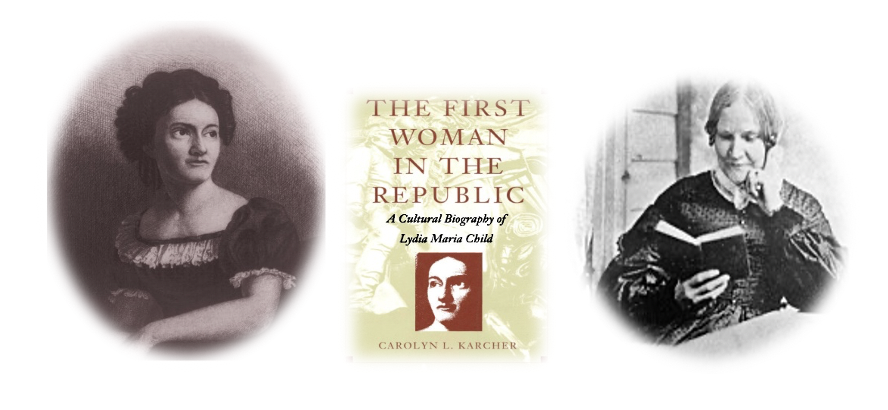
All but certainly you’ve heard those lines many times before without any idea who wrote them. They were written in 1844 for a book of children’s stories and poems called Flowers for Children. Sometimes known by its first line – “Over the River and through the wood” – its actual title is “The New-England Boy's Song about Thanksgiving Day.” [2] Although for almost all 21st century Americans they are their author’s most recognizable lines, curiously enough, they are probably one of the least interesting and least important accomplishments of Lydia Maria Francis Child.
Just like Sarah Josepha Hale, we’ve met Lydia Maria Child before in Book Notes #36 while exploring the history of Thanksgiving Day. It can be found here.
If Sarah Hale was the mid-19th century’s most influential woman, then the woman, pen in hand, who kept the heat on, who kept the needle of women’s and minority rights moving forward was Lydia Maria Child. Younger than Hale but older than the other early proponents of women’s rights, Lydia Maria Francis Child was one of the 19th century’s most prolific authors. With Lydia Sigourney and Sarah Josepha Hale, she was one of America’s very first women professional writers.
If Thanksgiving verse is among her least significant achievements, what makes Lydia Maria Child important? She was one of antebellum America’s most prolific and best-selling authors, whether considering her Juvenile Miscellany, the first children’s literature magazine in American culture, which she founded, wrote for, and edited, or her guide for middle-class and poor working women, The Frugal Housewife, or any of her many novels from Hobomok to Philothea to A Romance of the Republic to her numerous short stories to her Letters from New-York, in which she invented a new literary genre, to any of her three major non-fiction tracts – An Appeal in Favor of that Class of Americans Called Africans, History of the Condition of Women in Various Ages and Nations, and The Progress Of Religious Ideas, Throughout Successive Ages – or her guide to American life for the recently emancipated slaves, The Freedmen’s Book.
Ultimately, her staunch adherence to her radical convictions undercut her sales, particularly in the South and among Northern racists, but she never wavered in her beliefs. In all of her writings, at times shocking her audiences, she attacked male dominance and white supremacy, which she saw as intertwined evils preventing America from living up to its ideals of liberty, equality, and opportunity. A novelist, a journalist, and a passionate advocate for her causes, she was an abolitionist, a champion of African American rights, a women’s rights activist, and a Native American rights activist. Because of her unflinching advocacy, the famed abolitionist William Lloyd Garrison called her “The First Woman of the Republic.” [3]
If she was all of that, you might fairly ask why you might never have heard of her. In the “Afterword” to Carolyn Karcher’s massive, 800-plus page biography of Child, The First Woman in the Republic, she attempts to answer that question. Karcher wrote in the early-1990s so she didn’t use the term, but I’ll use it for her.
Child was cancelled.
We think of cancel culture as an early 21st century phenomenon; when we do, we point our fingers at the woke left wanting to rename this building, to remove that statue and to place trigger-warnings on any topic that might give discomfort. Although I’m not sure “woke” is the correct term, it is the militant right that bans books, passes laws limiting school curricula, and generally wants to return to a soft-focus 1950s America that, as Stephanie Coontz pointed out, never existed. [4]
One might say Child was cancelled three, maybe four times. The first cancellation came after Reconstruction’s failure and the triumph of southern Redemptionists espousing “The Myth of the Lost Cause” aided and abetted by Gilded Age northern Democrats who just wanted to get back to the business of making money. Child, who was one of America’s leading pre-Civil War abolitionists, suddenly found her audience shriveling. Then at the turn of the 20th century and the rise of Jim Crow laws indirectly supported by academics like Columbia University professor William Dunning, Child once again was cancelled. Dunning founded what became known as the Dunning School of historiography, which supported conservative factions opposed to southern civil rights. They erroneously described Reconstruction as an unmitigated failure because it gave Black Americans political power they were too ignorant to exercise. Early-20th century white America just wanted to forget abolitionists like Child. Her books went out of print, and she faded from memory.
With the first stirrings of renewed feminist literary theory in the 1960s combined with the Civil Rights Movement’s gathering momentum, one might have thought Child would finally get her moment. But, once again, in a deeply ironic turn of the cultural screw, Child fell victim to the newly emergent Foucauldian school of literary and historical analysis that traced how power relationships in society are manifested in language and cultural practice. On this score, Child failed the post-modern feminist and multicultural test.
For all her radicalism, like Sarah Josepha Hale, who has suffered a similar fate, Child came under attack for her acceptance of the 19th century’s dominant middle-class, Anglo-Protestant values. Unlike Hale, Child did not completely support the notion of Home as the source of woman’s power; she rebelled against it. Yet, somehow, she could never completely forsake it. Her ideal was an egalitarian marriage, which she never found. Moreover, although she was a complete integrationist, her view of society was not multicultural, but one in which the newly freed slaves would assimilate into white, Protestant, middle-class America. Child did not reject American values; she fought for America to live up to, as Martin Luther King, Jr. would say a century later, “what you said on paper.”
As a result, Child was cancelled again by the first wave of 1960s-1970s voguish, multicultural theorists too myopic to realize that perhaps it was not Child but they who needed a new theory to account for this paradoxical champion of the dispossessed. Like those who in our time some would cancel, Child needs to be seen and understood in the context of her own times. In her time, she was a revolutionary exposing American hypocrisy and calling America back to its foundational values. For as Karcher writes, Child needs to be treated:
lllllllllHolistically – as a woman contending with the same problems many face
llllllllltoday: an unsatisfying marriage, unfulfilled sexual desires, domestic
llllllllldrudgery, and thwarted professional ambitions; as a reformer dedicated to
lllllllllbuilding a just society that would allow people of all races and both sexes to
lllllllllexercise their talents and enjoy the rewards of their labor; and as a writer
lllllllllsearching for rhetorical strategies and narrative modes capable of
llllllllltransforming her readers’ consciousness. [5]
Lydia Maria Francis was born in Medford, Massachusetts in 1802. She went by her middle name Maria, but pronounced with a heavy accent on the middle syllable – Ma-RYE-ah. Child’s early education was at a local dame school – a school for young children taught by a young woman, often only a teenager. Later Child attended a women's seminary, but the educational level was not much above what we would call middle school.
Child’s parents did not encourage her to get an education. Like Hale, she benefited from a progressive older brother who believed his sister should be educated. Named after their father, Convers Francis was educated at Harvard College and Seminary. He became a Unitarian minister. As Karcher says, “ever since Child could remember, she and Convers … ‘shared a passion for books’ that differentiated them from their parents and their older siblings.” [6] Upon the death of her mother, she went to live with her older sister in Maine. There she studied to be a teacher. It was during this time that her brother Convers directed her education by sharing the classical education he received at Harvard. Like Hale benefitting from her brother Horatio’s Dartmouth education, Child indirectly got a Harvard education.
Of course, Lucy Stone, who we will meet next week, would later ask, “Why must it be indirect?”
Money would be a challenge throughout Child’s life. In her early 20s, she moved to Boston to live with her brother and to teach. In Boston, through Convers’ friends, she met many of the era’s leading writers and thinkers. Sometime during this period, Child, who had never thought of becoming a writer, read an article pointing out that there were no novels about early New England.
Child was nothing if not someone who seized the moment. She immediately wrote the first chapter of her novel Hobomok: A Tale of Early Times. Encouraged by her brother, she finished it in six weeks. Although it sold poorly at first, its publication made her famous. And for a while, it provided her with an income.
It also made her scandalous.
Why?
Because while other contemporaries like James Fennimore Cooper created a heroic literature celebrating revolution and conquest, Child, as she would all of her life, tried to tell it, in that 1960s slangy expression, “like it is,” or in this case “was.” Having become acquainted with Native Americans when she lived with her sister in Maine, Child treated them with respect. The novel also treated interracial marriage sympathetically. Her white heroine married a Native American. The white wife even had a baby, which, of course, meant she’d had sexual relations with her Native American husband. It created a scandal.
Child published Hobomok anonymously under the gender-neutral pseudonym "an American." Set in colonial New England, Hobomok takes place during the Great Puritan migration between 1629 and 1632. Its main character, Mary Conant, is forbidden by her father to marry an Anglican, what we would call an Episcopalian. The would-be husband is a white man, but he is nonetheless anathema to the Puritan father.
Child, who had a strained relationship with her own father, has the angry Mary flee to the woods to live with the Native Americans. There, to the horror of the white settlers, she marries the Native American Hobomok. After many a tribulation, however, the novel ends when Mary's white lover, who had been assumed dead, returns to the colony. Hobomok, in a bit of an emerging cliché as the inherently stoic and noble Native American, agrees to dissolve his marriage to Mary. Mary weds her Episcopalian Charles and reintegrates into white colonial society.
The sappy plot notwithstanding, Hobomok’s sympathetic treatment of Native Americans as the white man’s equal rankled early 19th century sensibilities.
Regardless, the rebellious Mary completes her triple play – she successfully rebels against her father’s authority, she marries and has a child with her Native American lover and then, completing the circle, she marries and has a family with the man her father had originally forbidden her to wed. As Karcher writes, “what dictates the plot of Hobomok is not its author’s awareness of racial issues, it’s her rebellion against patriarchy.” [7] For, “excluded as they were from the benefits that American democracy conferred on their male peers, middle- and upper-class white women often identified consciously or unconsciously with other excluded groups.” [8]
In her first novel, then, Child telegraphed her career’s trajectory. She would champion the rights of the excluded. She supported women in rebellion against patriarchy; she supported Native Americans resisting white encroachment (she famously wrote in opposition to Andrew Jackson’s racist removal of the Cherokee from their lands in the 1830s); and, lastly, she became one of antebellum America’s leading abolitionists and its foremost champion of African American rights.
Whether famous or infamous, the young author still scrambled to earn a living. She remained dependent upon her brother Convers. Child taught for a year or two before founding in 1826 the Juvenile Miscellany, America’s first monthly periodical for children. Within a year, it provided her with financial independence. It was immensely popular because its “wide range of selections, enhanced with illustrations and supplemented with riddles … appeal(ed) to children of both sexes and many ages.” [9] It was a prime instrument in the creation of the American middle class. In its mix, however, Child inserted oblique anti-slavery and anti-racist messages. It, in some respects, foreshadowed the dichotomy in Child’s character: on the one hand, she believed in Anglo-Protestant America; on the other, she wanted to reform it of its failures to be true to its foundational values. She kept the Miscellany in print for eight years before it closed. Her other works opposing slavery and northern racism turned many in her audience against her, especially in the South.
Lack of money, for several reasons, always hounded Child. First, she never backed down from her positions opposing slavery and supporting minority and Native American rights. Second, she married an idealistic but economically incompetent husband. After her 1828 marriage to David Lee Child, his failed enterprises constantly saddled her with debts. Although a decent man who agreed with her values almost completely, her husband for the rest of his life would be a drag on her fortunes. Repeatedly, her income as a successful author was frittered away paying off his debts. I found myself scrawling in the margins of Karcher’s biography, “How did such a competent woman ever marry such a nit-wit?” When I mentioned this to my wife Judy, she replied “You’d be surprised!”
Always a practical woman, Child knew how to read a market in search of opportunities. Although she produced a number of books, poems, and a guide for mothers, needing to increase her income her most successful work was The Frugal Housewife, which was “Dedicated to those who are not ashamed of Economy.” The Frugal Housewife contained mostly recipes, but also contained this advice for young housewives, "If you are about to furnish a house, do not spend all your money. ... Begin humbly." Child wrote that her book was for the poor and those who do not have servants. [10] The Frugal Housewife was the definitive guide to homemaking, cooking, and child rearing in the second quarter of the 19th century. Published in 1829, it went through 33 printings in 25 years. It was an American staple, but then, as with the Juvenile Miscellany, Child’s radical politics and abolitionist proselytizing undercut her. Both north and south, it cost her readers.
She continued to write novels and short stories. In the 1840s, living in New York City without her husband, she invented a new literary genre. Her Letters from New York transformed the personal letter into an essay commenting on the events of the day. Child’s life transforming event, however, occurred in 1831 when she began to read the great abolitionist William Lloyd Garrison’s The Liberator. Both she and her husband became abolitionists. Some of her abolitionist activities included: in 1834 in Boston, Child helped raised funds to finance the first abolitionist anti-slavery fair; after she and her husband settled in Wayland, Massachusetts, they provided shelter for runaway slaves trying to escape the Fugitive Slave Law; she wrote anti-slavery fiction to reach people who didn’t read political tracts; and she addressed issues of sexual exploitation affecting both the enslaved people and the slaveholder’s family.
A women’s rights activist, Child did not think women could progress until after slavery was abolished. In her view, white women and the enslaved people were both suppressed by white men who looked at them as property and not as human beings. Nonetheless, Child opposed women-only organizations. An integrationist both of races and genders, she believed that women would achieve more by working with men as women’s allies. She campaigned for equal female membership and involvement in the American Anti-Slavery Society, of whose Executive Committee she was a member. In 1840, she became the editor of the Society’s newspaper, the National Anti-Slavery Standard, in which her “Letters from New York” first appeared.
Prior to that, while still publishing her The Frugal Housewife and working in abolitionist causes, she wrote and published her two major works. In 1833, she published An Appeal in Favor of that Class of Americans Called Africans. Deploying the rhetorical tactic of appealing to her readers to trust her as the woman who had guided them in educating their children (The Juvenile Miscellany) and helped them establish their homes (The Frugal Housewife), Child argued in favor of the immediate emancipation of the enslaved people without compensation to their legal owners and their total integration into American society.
It was both the first book-length, anti-slavery tract and the first written by a white woman. In it, Child analyzed slavery from a variety of aspects confirming that emancipation would work, and that Africans were equal to white Americans. As Karcher notes, “An Appeal in Favor of that Class of Americans Called Africans provided the abolitionist movement with its first full-scale analysis of the slavery question. Indeed, so comprehensive was its scope that no other anti-slavery writer ever attempted to duplicate Child’s achievement.” [11] In eight chapters, Child provides a history of slavery from antiquity to the present and demolishes notions of African racial inferiority. Addressing the colonization movement to return freed slaves to Africa, she demonstrates how northern concessions to the slavocracy from the beginning of American history polluted American politics and, writing from a woman’s point of view, “focuses on the special ways in which slavery victimizes women and makes a mockery of the domestic ideology glorifying ‘true womanhood.’” [12]
In doing so, Child challenged those, like her friend Sarah Josepha Hale, who supported the 19th century notion of Home as the rock upon which American society rests. In doing so, Child exposed her own internal contradiction. She believed in the concept of Home, but she also believed in female empowerment. She struggled to balance her desire for Home and her central place in it with her ambitions to have the same freedom as men to seek professional success. She’d spend a great deal of psychic energy over the remainder of her life trying to resolve that paradox.
She never quite did.
Still, in 1835, she published The History of the Condition of Women, in Various Ages and Nations, which surveyed the status of women around the world from ancient times to the 1830s. Having learned from Hobomok that if you want an audience, don’t drive them away, Child avoided offending her readers by not speaking directly to feminist issues. Showing that societies in which women were free to use their talents were prosperous societies, Child neither analyzed nor argued her position. She let the data speak for itself. In a sense, Child prepared the path for others, like her young friend Margaret Fuller, to explicitly advocate for the feminist ideas she only sketched.
Child’s pioneering support for women’s rights and her appeal for African Americans caused her to be socially ostracized. Still she became a major defender of the abolitionist and anti-slavery movement. In the 1850s, responding to the near-fatal beating on the Senate floor of her good friend Massachusetts abolitionist Senator Charles Sumner, and the violence in Kansas between anti- and pro-slavery settlers, Child changed her opinion about the use of violence. She sympathized with the radical abolitionist John Brown. In 1860, Child edited and wrote the preface for Harriet Jacobs’ slave narrative, Incidents in the Life of a Slave Girl, which among other things detailed Jacobs’ sexual exploitation by her slave master.
In addition to her work supporting abolition, Child went further than Sarah Josepha Hale, who could never quite imagine an integrated America. Lydia Maria Child advocated for total integration of the freed slaves into American society. After the Civil War, in 1865 she wrote The Freedmen’s Book as a guide to the recently emancipated slaves’ full integration into American society. She arranged to have it published and given away free to the freedmen. Similarly, she opposed the Indian Wars. During the 1860s, Child wrote many articles in support of Native American rights. Her most famous, An Appeal for the Indians, urged government and religious leaders to treat American Indians justly.
Although it cost her readers and income, Child never wavered in her beliefs. Beginning with Hobomok, she fought for women’s and minority rights. Also, as Mary Conant in Hobomok, Child grew to resent her religious upbringing. Rejecting traditional theology, in her massive three volume exercise in comparative religions, The Progress of Religious Ideas Through Successive Ages, she said of theology, “What a destruction of the beautiful momentum of past ages, what waste of life, what disturbance of domestic and social happiness, what perverted feelings, what blighted hearts, have always marked its (theology’s) baneful progress.” [13]
In October 1880, Lydia Maria Child died at 78.
At her funeral, abolitionist Wendell Phillips shared the opinion of many within the abolition movement: "We felt that neither fame, nor gain, nor danger, nor insult had any weight with her." [14]
Child never conceded.
She fought the good fight for human rights until the end.
She merits your attention.