|
We Ignored a Coup in Tunisia. That Should Worry Every American.
When America looks away from tyranny abroad, it loses more than credibility. It begins to lose its own faith in democracy.
Imagine that an American president, frustrated with a gridlocked Congress, went on television one Sunday night, invoked emergency powers, fired his cabinet, and ordered the army to lock the doors of the Capitol. Imagine the Speaker of the House arriving before dawn to find soldiers and armored vehicles blocking the entrance. No serious American would hesitate to call that a coup. Our courts, our press, and our conscience would rise against it.
Yet, that is exactly what happened in Tunisia on July 25, 2021. President Kais Saied invoked an emergency clause of the constitution, dismissed the prime minister, froze parliament, and stripped its members of immunity. Military vehicles surrounded the parliament building. The elected speaker, Rached Ghannouchi, then 80 years old, sat outside its locked gates through the night after soldiers refused to let him, and a number of other members of parliament, in.
How did Washington and Brussels respond? With polite concern. Secretary of State Antony Blinken urged Saied to return to "the democratic path." The White House sent envoys to press for a new prime minister. European officials called for restraint. But neither capital would call the event by its name. The administration avoided the word "coup," in part because that word carries legal consequences for U.S. assistance.
Saied understood the message. A month later he extended the suspension of parliament indefinitely. Within a year he had dissolved parliament, abolished the independent council that oversaw the judiciary, and pushed through a new constitution, written largely by himself, in a referendum that fewer than one in three voters bothered to join. The Arab world's only surviving democracy, the one success story of the 2011 uprisings, was dismantled in plain sight, one decree at a time.
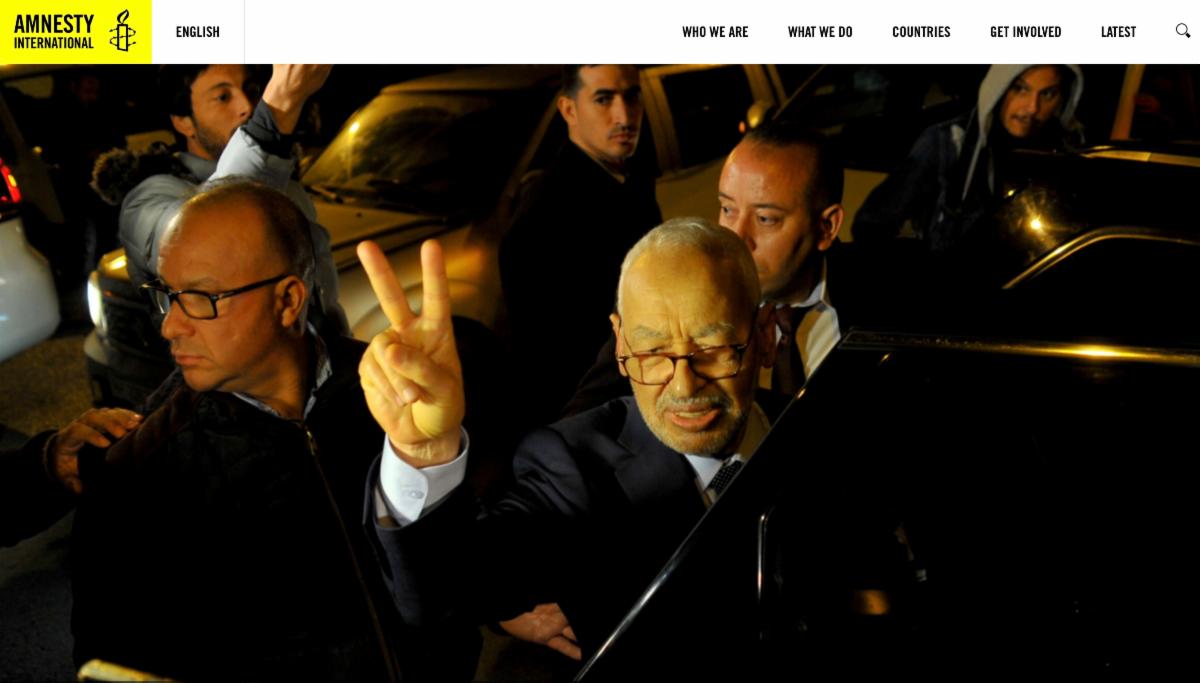
The cost is now measured in prison years. Ghannouchi was arrested at his home during a Ramadan gathering in April 2023. Tunisian authorities have since brought at least 12 criminal cases against him. In June, a court sentenced him to life in prison, on top of more than a century of cumulative sentences in other cases. A United Nations working group has declared his detention arbitrary, and his health has sharply deteriorated. He is not alone. Judges, lawyers, journalists, and opposition leaders from the Islamist center to the secular left now sit in Tunisian prisons. Saied does not distinguish among his critics, and neither should we.
Some in Washington argued in 2021 that Tunisia was a special case. Saied had won a free election. Parliament was dysfunctional. The economy was failing, the pandemic was raging, and many Tunisians cheered his move at first. All of that was true. None of it changes what a coup is. Elected leaders who use the army to shut down an elected legislature have not rescued democracy. They have ended it. Gridlock, corruption, and public frustration are the normal conditions of democratic life, not a license to kill it.
This is where the danger turns homeward. Every time we accept that argument abroad, we rehearse it for ourselves. The case for Saied was the case that strongmen everywhere make: institutions are slow, politicians are corrupt, the people are tired, and only a decisive leader can cut through the noise. That logic does not stay overseas. When American leaders of both parties decide that a coup is acceptable if it is popular, convenient, or carried out by a friendly government, they teach Americans, and the world, that democracy is a preference rather than a principle. And a principle we will not defend for others is one we will find hard to defend for ourselves.
The damage abroad is just as real. To young people across the Arab world, our silence on Tunisia confirmed what extremists and autocrats have long told them: that Western talk of democracy is a slogan, applied to adversaries and waived for partners. Each time we look away, we hand the recruiters of violence their best argument, which is that ballots are futile. We also tell every would-be autocrat watching, from North Africa to Latin America, exactly how much he can get away with.
The United States has never been a perfect democracy. Its power as an example has always rested less on perfection than on consistency: on the willingness to say the same thing about a coup in a friendly country that it would say about one in a hostile country, and to say about others what it would demand of itself. That consistency is what made America a beacon to dissidents in Warsaw, Seoul, and Cape Town. It is what Tunisians and Arabs believed in when they risked their lives in 2011.
Recovering it does not require military intervention or grand gestures. It requires calling coups by their name, even when diplomatically awkward. It requires conditioning security assistance on the release of political prisoners and the restoration of an independent judiciary, as members of both parties in Congress have already urged. It requires senior officials to say the names of prisoners like Rached Ghannouchi out loud, in public, and often. And it requires us to defend at home the very institutions we ask others to protect: independent courts, a free press, honest elections, and the peaceful transfer of power.
Democracy at home and democracy abroad are not two separate policies. They are one and the same, and democracy cannot survive being applied selectively. A nation that will not recognize a coup in Tunis may one day struggle to recognize one in Washington.
—
Radwan A. Masmoudi is the founder and president of the Center for the Study of Islam and Democracy (CSID) in Washington DC, and leads the international campaign to free Rached Ghannouchi.
###
|