EQUESTRIAN ORDER OF THE HOLY SEPULCHRE OF JERUSALEM
Middle Atlantic Lieutenancy
|
|
|
|
|
October 1 - St. Thérèse of the Child Jesus
October 2 - Holy Guardian Angels
October 4 - Twenty Seventh Sunday in Ordinary Time
October 7 - Our Lady of the Rosary
October 15 - St. Teresa of Jesus
October 17 - St. Ignatius of Antioch
October 18 - Twenty Ninth Sunday in Ordinary Time
October 19 - Sts. Isaac Jogues and John de Brébeuf and Companions
October 22 - St. John Paul II
October 23-24 - Investiture Weekend 2026
October 28 - Sts. Simon and Jude, Apostles
| | | | |
A Special Visit from Cardinal Filoni | |
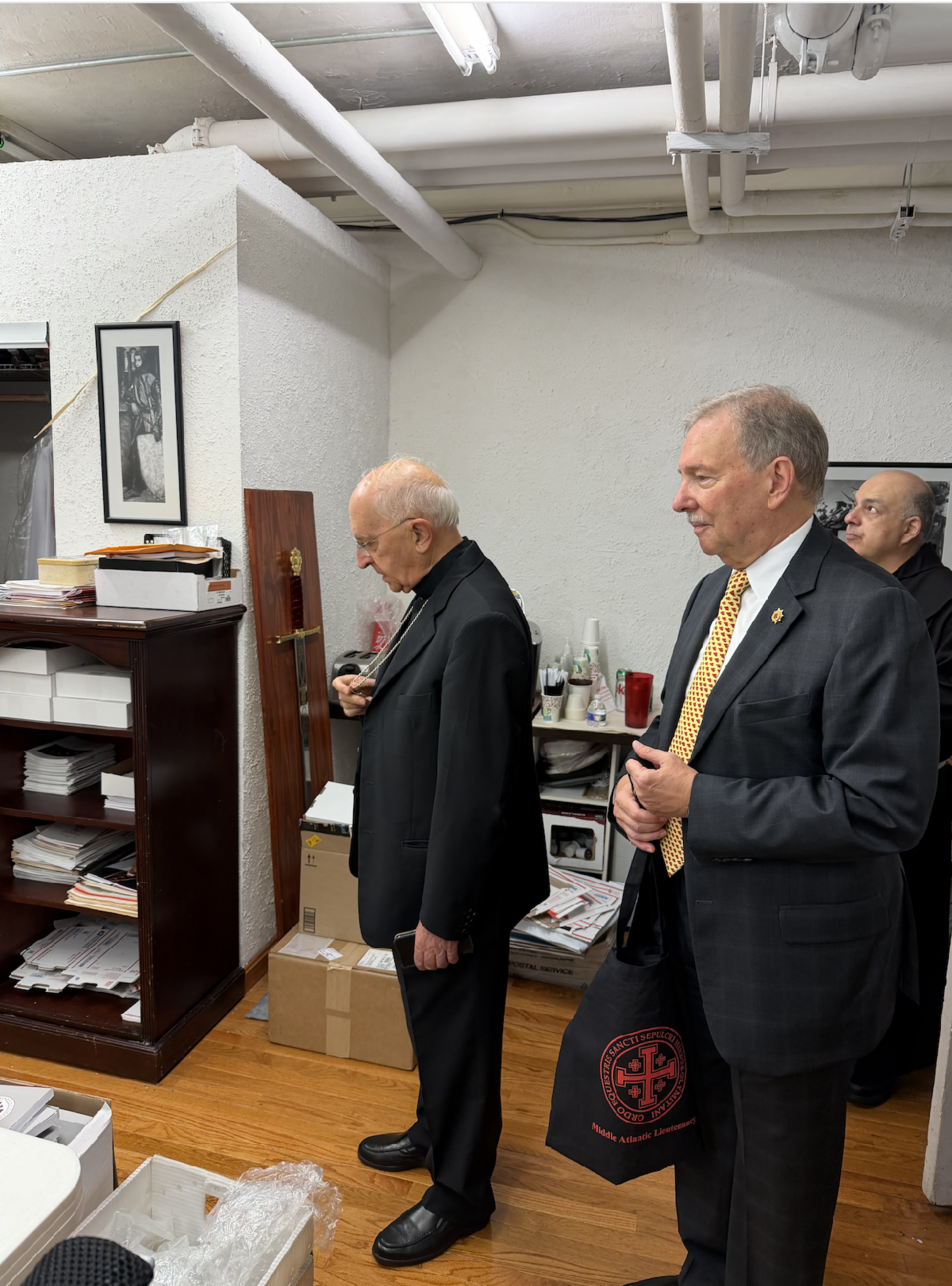
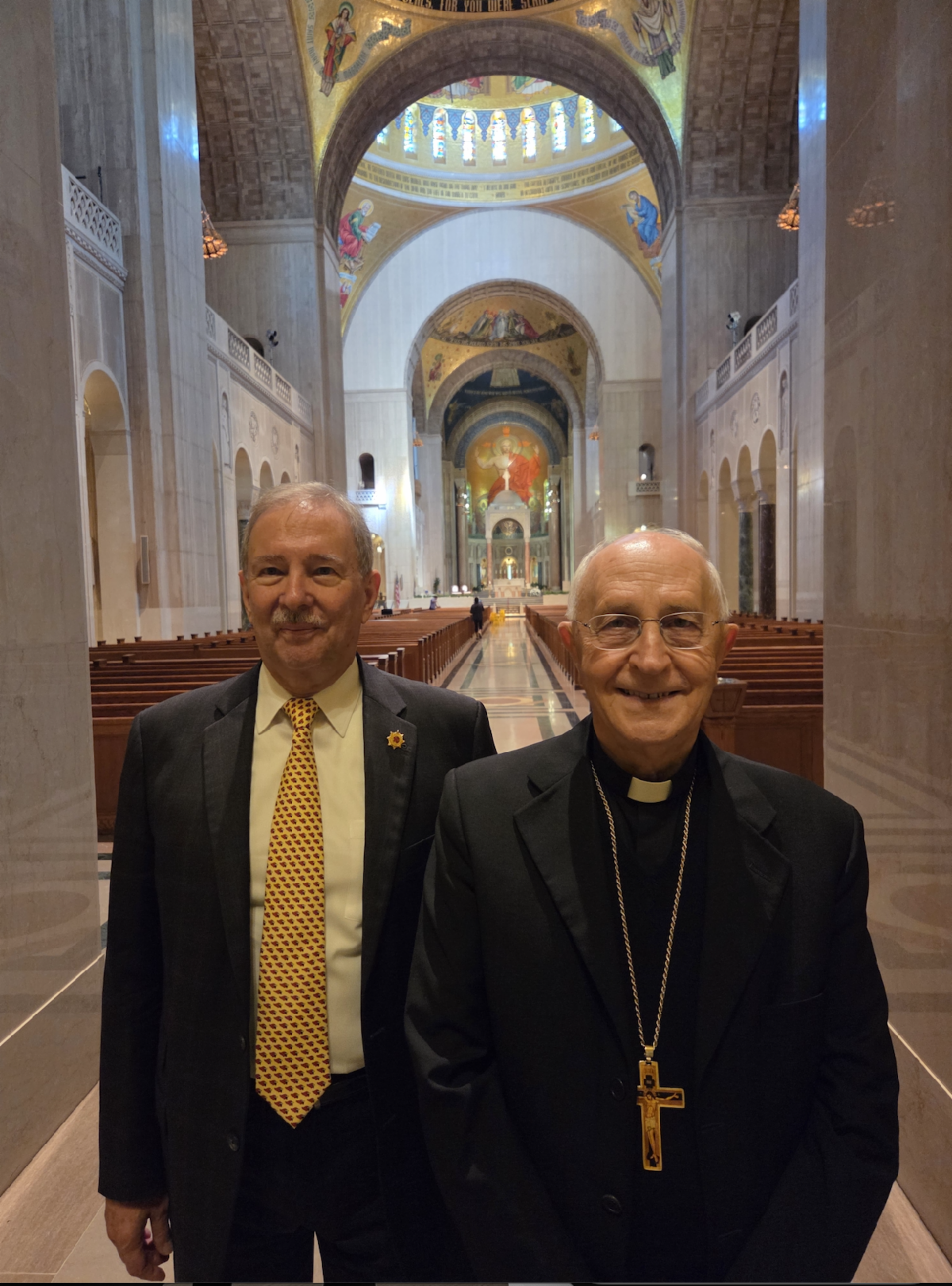
As His Eminence Cardinal Filoni concluded his visit to the United States, the Middle Atlantic Lieutenancy was honored to share a particularly meaningful moment from his time in Washington, D.C.
On the morning of September 30, Cardinal Filoni visited the Basilica of the National Shrine of the Immaculate Conception and the Franciscan Monastery of the Holy Land. During his visit to the Monastery, His Eminence visited and blessed our Lieutenancy office which is located at the Monastery.
We were especially honored that Cardinal Filoni also took the time to record a special video greeting for the members of our Lieutenancy. His message is a wonderful reminder of our shared commitment to the Church and to the Christian communities of the Holy Land.
We invite all members of the Lieutenancy to watch His Eminence's greeting on our Facebook page:
Watch Cardinal Filoni's video greeting on Facebook
We give thanks for Cardinal Filoni's leadership and example. He inspires us to live to the very best of our Order's traditions and works. Thank you Your Eminence for your remembrance of our Lieutenancy and its mission.
|
|
REFLECTION FROM OUR LIEUTENANT, MARK
The Role of Liturgy in Grounding the Mission
| |
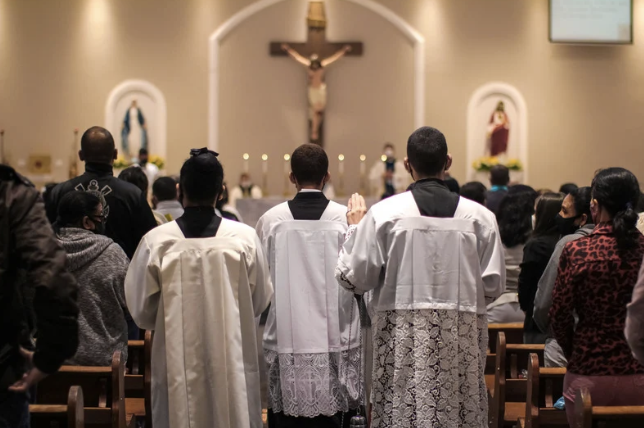
Liturgy has a way of keeping us anchored. In the midst of busy lives, responsibilities, and competing priorities, it draws us back to what is essential. It reminds us why we serve and whom we serve. For the Order, liturgy is not a backdrop to our mission, it is one of its foundations.
The rhythms of the Church year shape our understanding of time, purpose, and commitment.
Through feast days, seasons, and prayers repeated over a lifetime, liturgy forms us slowly and deliberately. It teaches patience, attentiveness, and reverence. These qualities are essential for anyone engaged in long term service, especially in support of Christian communities that live with daily uncertainty and strain.
Liturgy also unites us. Wherever celebrated, from the grandest cathedral to the simplest chapel, the prayers of the Church connect us across distance and circumstance. The same words, gestures, and readings draw us into a shared story and a shared responsibility. This unity is not symbolic. It strengthens our sense of belonging and reinforces that our work is part of something much larger than ourselves.
In my own experience, regular participation in the liturgy provides perspective. It reorders priorities and keeps ambition in check. It reminds me that leadership in the Church is rooted in service and that action must flow from prayer. Without that grounding, even well intentioned efforts can lose direction.
For the mission of the Order, liturgy serves as a continual point of return. It places our work within the life of the Church and within the mystery of Christ’s presence in the world. By grounding ourselves in prayer and worship, we ensure that our efforts in the Holy Land remain faithful, focused, and sustained by something deeper than human resolve alone.
|
| |
|
Who Was Saint Ignatius of Antioch
As we will celebrate his feast on October 17, it is fitting to reflect on Saint Ignatius of Antioch, an early Church father, bishop, and martyr. Recognized as one of the Apostolic Fathers, Ignatius was a direct spiritual successor to the apostles, serving as bishop of Antioch in the late first and early second centuries.
Ignatius is remembered for his unwavering faith and courage in the face of persecution. Living in a time when Christianity was illegal and believers faced the threat of arrest and execution, he remained steadfast in his commitment to Christ. Tradition holds that he was eventually arrested and sent to Rome, where he was martyred in the Colosseum around the year 108. His death marks a profound witness to the strength of faith and the call to bear Christ’s cross even unto death.
Ignatius is celebrated for his letters, written to early Christian communities. These letters offer deep insight into the life of the early Church, emphasizing unity, the centrality of the Eucharist, and the importance of remaining faithful especially in our trials. His writings continue to serve as a guide for Christians, illustrating how faith can be lived authentically even in the midst of challenge and opposition.
The feast of Saint Ignatius of Antioch is a chance for us to reflect on the cost of discipleship. His life encourages Christians to hold fast to their convictions, support one another in community, and understand that the call to witness Christ may come with trials. Saint Ignatius’ witness invites all of us today to live faithfully and boldly in our Christian journey.
| | | |
OUR CENTENNIAL
A Commemorative Medal for our Members
| | |
The Eastern Lieutenancy of the Order is where we began in the United States in 1926. From that simple beginning we have grown into every corner of the the country, including our own, with more than 10,000 Knights, Dames, and Knight Chaplains.
To commemorate this event, the Eastern Lieutenancy commissioned a Medal - in both silver and bronze - with the logo that you find at the top of this Journal. The Eastern Lieutenancy is sharing the opportunity for any of our USA members to purchase medals. The net proceeds will be sent to Grand Magisterium as a non-restricted contribution.
The links and a QR Code are found below.--
https://www.givecentral.org/appeals-form-registration/acp6ab9891155824/user/guest
https://www.givecentral.org/HolySepulchreMedals1
Please NOTE that orders for the medal will be taken only through November 2.
| | Cardinal Pizzaballa Visits the Latin Parish of Acre | |
On September 5, Cardinal Pierbattista Pizzaballa, Latin Patriarch of Jerusalem, made his first pastoral visit to the Latin Parish of Acre. During the visit, he met with parishioners, clergy, and representatives of Acre’s diverse communities, celebrating Holy Mass and spending time with faithful in their homes.
During the Mass, Cardinal Pizzaballa administered First Holy Communion and Confirmation to eight children, highlighting the importance of passing the faith on to the next generation. He also visited several parishioners who were unable to attend, praying with them and administering the Sacrament of the Anointing of the Sick.
The Latin Parish of Acre, dedicated to St. John the Baptist, is a small but deeply rooted community of approximately 320 faithful. Its church was built by the Franciscans in 1737, continuing a Franciscan presence in the city that dates back centuries, including the visit of St. Francis of Assisi.
The visit also brought Cardinal Pizzaballa together with members of Acre’s Melkite Greek Catholic and Maronite communities. Their shared commitment to cooperation and fraternity reflects the importance of preserving a living Christian presence in the Holy Land, even within smaller communities.
Throughout the visit, Cardinal Pizzaballa emphasized the importance of closeness, listening, and accompaniment. His time in Acre offered encouragement to a community that, while small in number, remains active in its faith and committed to building relationships with its neighbors and preserving a united Christian presence for future generations.
| | Displacement Continues in the West Bank | |
The humanitarian situation in the West Bank continues to raise concern as demolitions and displacement affect Palestinian communities. The United Nations reports that nearly 60 Palestinians were displaced this week after homes and other structures were demolished in two farming communities in the Masafer Yatta area of the southern West Bank.
According to the UN Office for the Coordination of Humanitarian Affairs, approximately 1,500 Palestinians have been displaced across the West Bank this year as a result of demolitions, while more than 2,600 others have been displaced because of settler violence and access restrictions.
The situation is also taking a heavy toll on families in Gaza. UN Women reports that nearly one in four households is headed by a woman, including widows and women whose husbands are missing, detained, injured, or displaced. Many are facing difficult decisions as continued violence and limited humanitarian access make it harder to provide for their families.
The Latin Patriarchate has a video review of the situation on the ground as of September 2026. It can be viewed here.
These circumstances are a reminder of the human cost of continued conflict and the particular burdens carried by families and vulnerable communities. We continue to pray for all those affected by violence and displacement, and for greater access to humanitarian assistance.
May God grant peace to the Holy Land and protect all innocent people caught in the conflict, while strengthening those who work to bring relief, stability, and hope to the region.
| | Pope Leo XIV Prays for the Victims in Gaza | |
Pope Leo XIV has expressed his sorrow following an Israeli airstrike in Gaza City that killed five civilians, including two Greek Orthodox Christian women, Maysa Khader Ibrahim Abu Daoud and her daughter, Mary Hafez Michel Najjar. The women had recently found refuge and were seeking to rebuild their lives amid the continuing conflict.
In a message to Father Gabriel Romanelli, parish priest of the Holy Family Catholic Church in Gaza, the Holy Father assured the victims' families and the Christian community of his prayers. Reflecting on the continued suffering of the people of Gaza, Pope Leo asked, “How long, O Lord?” He also thanked Father Romanelli for accompanying the parish and those who continue to seek peace.
The local Church continues to serve hundreds of displaced people, with Father Romanelli and the Missionaries of Charity providing assistance to those who have nowhere safe to go. Cardinal Pierbattista Pizzaballa, Latin Patriarch of Jerusalem, has likewise expressed his condolences and concern for the continued humanitarian suffering of both Israelis and Palestinians.
Amid the hardship, the reopening of Gaza's parish school has offered an important sign of hope. Cardinal Pizzaballa described the reopening as a declaration that the Christian community intends to begin again despite the enormous difficulties it faces.
The Holy Father's prayer and the continued presence of the Church in Gaza remind us of the importance of standing in solidarity with the Christian communities of the Holy Land, praying for peace, and supporting those who continue to serve others in the midst of profound suffering.
| |
FOLLOW US ON FACEBOOK AND INSTAGRAM FOR UPDATES
Stay Connected To Your Faith
| | | | |