PRODUCT STEWARDSHIP UPDATES |
|
EPR Legislation Introduced Nationwide!
|
|
2023 legislative sessions are now underway and it is clear that there is unprecedented momentum for EPR this year. During legislative session, we provide support for EPR bills; recently, we provided testimony in Connecticut on tires, in Washington on packaging and lighting, and Vermont on HHW – with more to come! Click here to learn more about recently-introduced EPR legislation.
We monitor activity on bills requiring new EPR programs or amending existing EPR laws in the United States; this information is shared with our Members and Partners through emailed Legislative Updates and is also available to them in our Legislation Library.
|
|
The Electronics EPR Evolution |
|
There are electronics EPR laws in 23 states and the District of Columbia, but some are out of date. PSI works to update these laws with our members in many states. This month, regulatory changes to New York’s program will go into effect – the culmination of a decade’s worth of work that began with a PSI report (funded by the Natural Resources Defense Council) and stakeholder meeting to develop solutions to the law's shortcomings. This work was well worth it, as New York has set an example for other states. PSI is currently working with Oregon Department of Environmental Quality to amend and modernize its electronics law.
|
|
Packaging EPR Laws Comparison: Part Four |
|
We continue our analysis of the four EPR packaging laws in the United States in our multi-part blog series, this time with a focus on funding inputs and allocations. For analysis of covered materials and products, please read part one; for a summary of covered materials, collection and convenience standards, please read part two. Part three covers whether or not there are unique provisions and/or exemptions in the legislation related to the producer responsible for funding and managing the EPR program; it also lays out each state’s criteria for determining the governance roles: program operations, administration, multi-stakeholder input, oversight, and enforcement. Read our analysis on the blog.
|
|
Members and Partners receive regular legislative updates and can track EPR bills and laws in our Legislation Library.
|
|
Packaging EPR was front and center around the globe in 2022. In the United States, legislation snowballed: Of the 62 EPR bills in 18 states that legislators considered last year, 33 were packaging EPR bills, two of which were enacted into law – in Colorado and California.
Most American laws and legislation focus on municipal reimbursement that maintains existing waste management systems. But in Canada, Ontario is moving towards full producer responsibility – meaning manufacturers pay for and manage collection and recycling services – within the context of a country-wide plastics reduction strategy. And in Europe, new packaging regulations are on the horizon.
There are different estimates as to where packaging EPR hotspots will next emerge. And with the existing laws, variations abound — from the definition of recycling and oversight agencies to marketing and labeling requirements. In this free webinar presented by EXPRA, a PSI Partner, we'll gather an international group of experts to discuss how global trends will affect implementation and management of packaging EPR laws in 2023. Register today!
|
|
February 15 Virtual - PSI’s Founder and CEO, Scott Cassel, will discuss packaging EPR at the U.S. EPA Trash Free Waters Webinar 11, joined by Nicole Grohoski, Maine State Senate District 7, and Kelly McBee, Circular Economy Senior Coordinator for As You Sow. Register here.
February 28 Virtual - Suna Bayrakal, PSI’s Director, Policy & Programs, will present at the NAHMMA Battery Webinar. We continue to work on battery EPR legislation around the country including in New York state. Register here.
March 10 Chicago, IL - Scott will join a fireside chat on “Challenges and Frustrations with Implementing EPR” at the Sustainability in Packaging conference in Chicago. Register here.
March 29 Tulsa, OK – Hanz Atia, PSI’s Associate, Policy & Programs, will present on PSI’s work to expand take-back infrastructure for medical sharps and pharmaceuticals in Oklahoma at the 2023 Oklahoma Indian Nations SWANA Conference. Register here.
May 22 Concord, NH – Scott will present a keynote at the Northeast Resource Recovery Association Conference. Early bird registration is open now. Register here.
|
|
Resource Recycling cited PSI’s ongoing packaging EPR comparison blog series in its coverage of Maine’s rule making process.
Azeez Mohammed, President and CEO of Covanta, a PSI Partner, was interviewed by WasteDive about changes in the company after acquisition by EQT Infrastructure in 2021, and new positioning as a sustainable materials management company.
In January, California’s Mattress Recycling Council submitted its revised Used Mattress Recovery and Recycling Plan to resolve the issue identified last November, in CalRecycle’s Request for Approval, and the compliance review was initiated.
MassDEP is hiring an Environmental Analyst lll (EA lll) within the Bureau of Air and Waste (BAW), Hazardous Materials Management, among other positions.
|
|
Just before the new year, Governor Kathy Hochul signed New York’s Digital Fair Repair Act into law. Despite a narrowed scope, the Act still requires many Original Equipment Manufacturers (OEMs) to make schematics, parts, and tools needed for the repair of digital electronic equipment available to any consumer or repair business. The Act also requires OEMs to make documentation and tools needed for unlocking security related functions available as well.
Last November, the EPA Office of Land and Emergency Management announced $100 million in funding to support recycling infrastructure, education, and outreach — the largest recycling investment in three decades. This includes $30 million in education and outreach projects, $30 million in planning and program implementation, and $40 million for projects that “improve post-consumer materials management and infrastructure, including collection, transport, systems, and processes related to post-use materials that can be recovered, reused, recycled repaired, refurbished, or composted.”
The new cigarette EPR program in Spain will force manufacturers to pay for cleanup. Millions of non-biodegradable and toxic butts are littered each year and the country banned smoking on many beaches in 2021.
Recent “GBH News” story on recycling featured Massachusetts Product Stewardship member Claire Galkowski, Executive Director of the South Shore Recycling Cooperative, alongside Steve Boksanski, Executive Director of the Massachusetts Beverage Association, who cited EPR as a solution to packaging waste.
We regularly share information like this on LinkedIn, Twitter, and Facebook. If you'd like to get these updates in real time, please follow our accounts. Thanks!
|
|
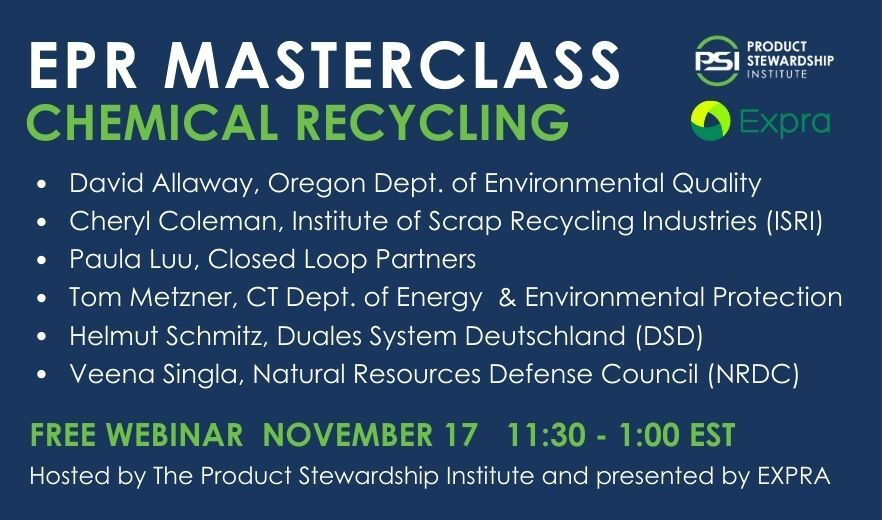
Scott moderated a conversation with a group of experts to discuss the wide range of technologies that fall under the chemical recycling umbrella. They considered criteria to determine which, if any, can support a sustainable economy, prevent waste and pollution, and curb greenhouse gas emissions. The webinar recording and "Making Sense of Chemical Recycling" report are available to our full community.
|
|
The Product Stewardship Institute is a policy advocate and consulting 501(c)(3) nonprofit that powers the emerging circular economy. We rely on the generosity of our members, partners, and supporters to convene diverse stakeholders to build extended producer responsibility (EPR) policies, programs, and laws. Thank you!
|
|
The Product Stewardship Institute, Inc. is an equal opportunity employer and provider. Persons with disabilities who require alternatively formatted materials to ensure effective communication should contact Amanda Nicholson at amanda@productstewardship.us or 617.236.4855, TTY: use 711 or 800-439-2730; MassRelay.
|
|
|
|
|
|
|