|
International Civil Liberties Monitoring Group
Coalition pour la surveillance internationale des libertés civiles
November 9, 2026 - 9 novembre 2026
| Bimonthly news round-up about national security's negative impact on civil liberties in Canada and abroad | |
Stop Bill C-22: ICLMG’s brief on the Lawful Access Act to the Senate Committee
| | |
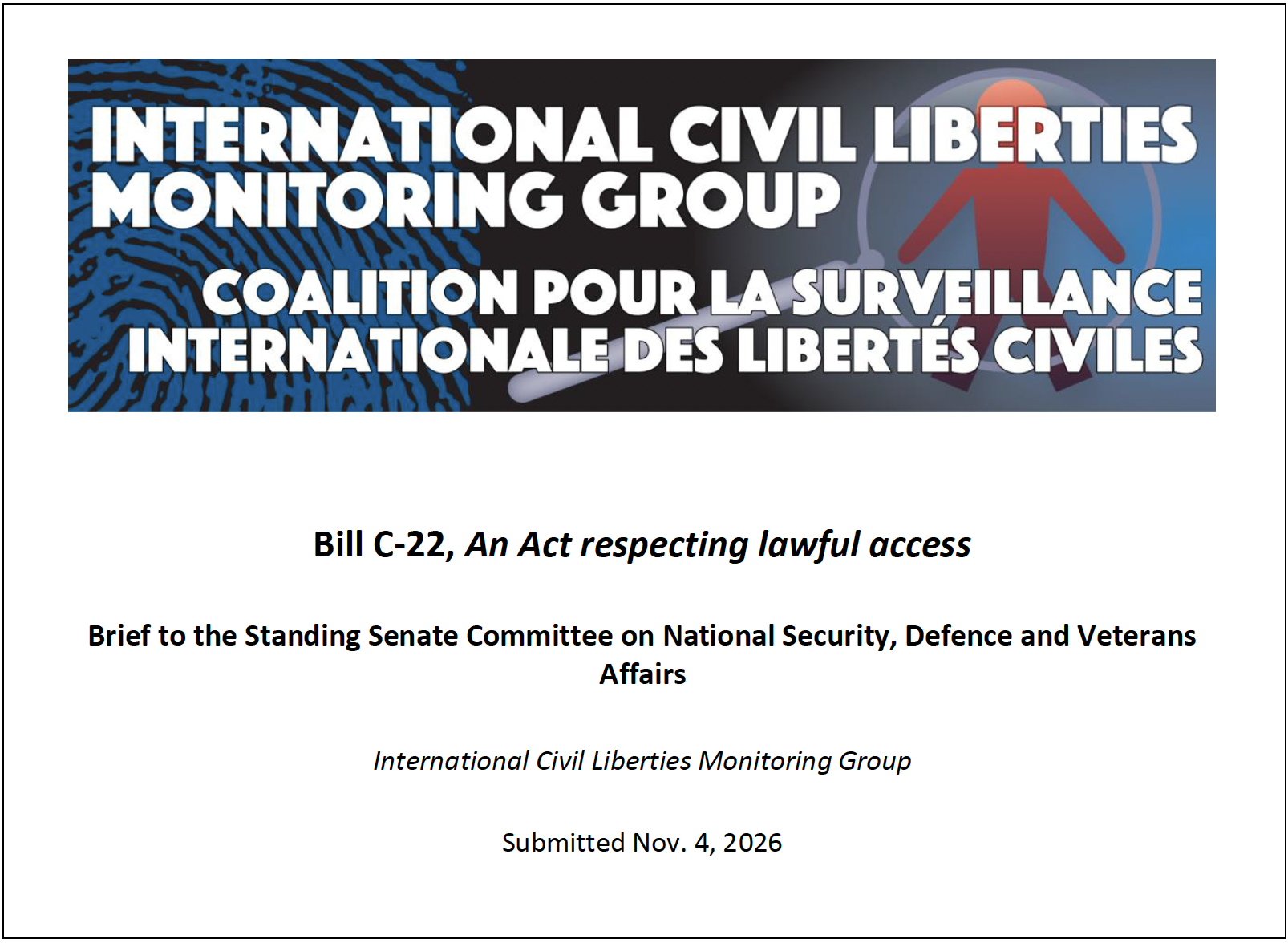
ICLMG 04/11/2026 - On November 4, 2026, the ICLMG submitted our brief on Bill C-22, the Lawful Access Act, to the Standing Senate Committee on National Security, Defence and Veterans Affairs for their study of the legislation. Read the introduction, table of contents and our recommendations below, or the full brief here.
++++++++
Over the past two decades, successive federal governments have attempted to weaken privacy protections under the name of ‘lawful access.’ However, each time, privacy experts, human rights and civil liberties advocates, and the general public have refused to trade the important protections that privacy laws afford us in exchange for promises of “security” built on nebulous justifications that these powers are necessary for law enforcement. Our coalition has contributed consistently to these conversations, through op-eds, briefs, consultation submissions and committee appearances.
There has also been a pattern, including regarding Bill C-22, of law enforcement arguing that new investigatory powers are necessary to address novel challenges whereas evidence shows that tools and powers that would allow them to adequately address these problems already exist. As described by the Citizen Lab, while law enforcement may present these issues as a blockage, in reality they are experiencing investigatory friction: difficulties exist, but investigations can still be carried out effectively. Furthermore, as detailed by Professor Michael Geist, the government has once again failed to present convincing evidence or scenarios to justify the reforms they are seeking in this legislation.
Position on Bill C-22
Our coalition is deeply concerned that, if enacted, Bill C-22 will significantly expand state surveillance and seriously threaten privacy rights, with concurrent impacts on free expression, freedom of association, and equality rights.
This legislation presents one of the greatest threats to privacy in Canada of the past two decades. Its provisions will weaken the rules governing police access to personal information, all while facilitating a vast expansion of government surveillance, and create a treasure trove of data that will be catnip to hackers. It is one more case in the decades-long trend of Canadian governments using national security as an excuse to erode civil liberties and human rights.
We acknowledge that the House of Commons adopted several amendments meant to address the concerns we and others have raised, but for the reasons explained below believe that they have failed to address the underlying problems with Bill C-22.
General recommendation: Based on the concerns below, Bill C-22 should not proceed to Royal Assent and should instead be withdrawn, reconsidered and subjected to further consultation. In the alternative, outstanding concerns with Part 1 of the Bill should be addressed through targeted amendments, while Part 2 should be removed altogether.
Part 1: Timely Access to Data and Information
a. “Information Demands” vs “Confirmation of Service”
Recommendation 1: That the committee fully examine the impact of precedent-setting warrantless Confirmation of Service Demands
Recommendation 2: That clauses 5 and 31 of Bill C-22 be amended to require annual public reporting by law enforcement and CSIS and/or the federal government on the use of Confirmation of Service Demands
b. Production orders for subscriber information
Recommendation 3: That clauses 6 and 7 of Bill C-22 be amended by replacing “reasonable grounds to suspect” with “reasonable grounds to believe”
Part 2: Supporting Authorized Access to Information Act (SAAIA)
Of greatest concern in Bill C-22 is the proposed creation, in Part 2 of Bill C-22, of the Supporting Authorized Access to Information Act (SAAIA).
Recommendation 4: Ensure Bill C-22 receives a full study, hearing from civil liberties, human rights, privacy, and cybersecurity experts.
Recommendation 5: Withdraw Part 2 as it can’t be amended in a way that upholds Charter rights.
Key issues with Part 2 of Bill C-22:
Issue 1: The definition of electronic service providers is unacceptably broad
Issue 2: Order making powers threaten privacy and security online
Three areas of risk are especially worrisome:
2.1 Bill C-22 will weaken online security and render encryption meaningless
2.2 Mandatory retention of metadata violates privacy rights
2.3 Secret orders undermine accountability, place rights & security at risk
Issue 3: How these powers could be used and associated risks
Issue 4: Inadequate safeguards and unjustified secrecy
4.1 Systemic vulnerabilities
4.2 Reporting requirements do not replace effective oversight
Conclusion
In response to Bill C-2, hundreds of civil society organizations spoke out how the bill’s new surveillance powers posed a serious attack on fundamental rights in Canada. While Bill C-22 makes modest efforts to address these concerns, it continues to pose not just a risk to privacy rights, but a wide range of associated rights that depend on access to private communications free from undue government surveillance and interference. Bill C-22 also unjustifiably creates cybersecurity risks that will further threaten the private information not just of people in Canada, but all individuals whose data is held by ESPS subject to the new regulations and secret orders regime created in the SAAIA. Over the past several months, privacy experts and civil liberties advocates in Canada have been joined by international experts, technology companies and law makers in echoing the need for the government to change course on Bill C-22.
Given these concerns, our coalition is calling on Senators to reject Bill C-22 and to vote against it. Barring that, significant amendments must be made to Part 1, and Part 2 must be withdrawn. Source
NEW SOCIAL MEDIA ACTION We don't want state surveillance. Senators: Stop Bill C-22!
Mémoire de la LDL : C-22, la mise en place d’une architecture de surveillance au Canada
Privacy watchdog urges Senate to further amend Liberals' controversial lawful access bill
Surveillance By Design: Government Officials Say Lawful Access Could Reach Gaming Platforms, Daycares and AI Services
Google warns lawful-access bill creates a ‘surveillance infrastructure,’ undermines transparency
The Internet Society webinar: Built-In Weakness: Lawful Access and Encryption in the Age of AI-Powered Cyber Threats
Lawful-access bill puts Canadian business at disadvantage with U.S., EU, Chamber of Commerce says
EFF: Canadians Are Running Out Of Time To Oppose The Dangerous C-22 Surveillance Bill
| |
Is it really intelligent to add more ‘Canadian’ intelligence? | |
Yves Engler 02/11/2026 - No Canadian CIA.
Mark Carney’s new National Security Strategy calls for increased intelligence capacities. Too many public resources are already devoted to secretive, US-aligned, elements of Canada’s government.
Released on Thursday, the National Security Strategy pledges to “Modernise Canada’s intelligence capabilities to anticipate and counter emerging threats: Our ability to collect, analyse, and leverage intelligence, together with our partners, ensures we are prepared to tackle emerging threats. Canada will strengthen our sovereign intelligence capabilities, deepen and diversify our intelligence partnerships, and modernise Canada’s intelligence enterprise by updating authorities to reflect evolving threats and technologies while safeguarding Canadians’ rights.”
There’s some suggestion that they might set up a Canadian version of the (foreign focused) US CIA or British MI6. A senior federal official told CBC, “I don’t think we’re on the verge of announcing a separate agency that would be akin to the CIA or MI6. But at the same time we’re looking at the capabilities that our intelligence agencies have and making sure that they are fit for purpose and for the challenges that we face today.”
Unlike CIA or MI6, the Canadian Security Intelligence Service is focused domestically. With an announced budget of a billion dollars year, CSIS is Canada’s best-known agency. Its close collaborator, the Communication Security Establishment (CSE), is largely foreign-focused. Canada’s NSA has 3,800 employees and an annual budget over $1 billion. It was recently reported that Ottawa plans to spend $1.85 billion to construct a new CSE data centre in Ottawa.
The capacities of CSE and CSIS put Canada among the best equipped intelligence operators in the world. According to different assessments, Canada’s intelligence apparatus is often listed around the tenth most sophisticated after the US, Israel, UK, Russia, China, India, Pakistan, Germany and France.
Besides CSIS and CSE, Canada’s military has vast intelligence gathering capacities. Thousands work in intelligence and cyber warfare, but little is known about their operations since there is no external oversight. The Canadian Forces Intelligence Command (CFINTCOM) carries out a wide range of intelligence activities. According to the government’s 2017 Defence Policy review, “CFINTCOM is the only entity within the Government of Canada that employs the full spectrum of intelligence collection capabilities while providing multi-source analysis.” Comprised of five units, CFINTCOM includes the Canadian Forces Joint Imagery Centre (providing imagery intelligence), Joint Meteorological Centre (providing weather related information to support CF operations), Mapping and Charting Establishment (providing geospatial information and geomatics), Canadian Forces National Counter-Intelligence Unit (which identifies and investigates threats by foreign intelligence services) and Joint Task Force X (human intelligence).
Global Affairs also has its own intelligence operations. In a highly revealing comment in an article focused on Canada spying in Cuba, former assistant director of operations at CSIS, Andy Ellis, recently told the Globe and Mail that officials at Global Affairs Canada’s elite Global Security Reporting Program “would take risks that nobody else would do. They would do whatever the CIA asked them to do. [The CIA] absolutely owned them.”
Some of the discussion of the National Security Strategy has focused on the need to spend more on intelligence to counter Donald Trump’s belligerence. In “Ottawa urged to boost sovereign intelligence assessments to reduce reliance on U.S.” the Globe and Mail quoted Vincent Rigby, a national security adviser to former prime minister Justin Trudeau, arguing this position. But Rigby is also quoted by the Globe saying, “should Canada’s relationship with the U.S. ‘ever return to some semblance of normalcy’ its increased assessment capacity would be valued by members of the Five Eyes,” which is the massive US/UK/Canada/Australia/New Zealand intelligence sharing arrangement.
Is there any evidence that CSE, CSIS and others have reduced the flow of intel to the US-dominated Five Eyes? Is Rigby calling to pause Canadian participation in the Five Eyes until Trump is gone? Even if that took place, CSE has extensive direct ties to the NSA and Canada would still be part of NORAD and NATO with the US. Additionally, the Canadian forces have various agreements with the US military on information sharing.
It’s more fundamental than just their intelligence agencies close ties to their US counterparts. Even if Canada’s intelligence apparatus were to become independent of the US, it’s still part of an imperialistic state apparatus. Economic espionage is a significant component of CSE’s focus with the CCPA Monitor labelling it the “espionage arm of corporate Canada”.
As part of NSA whistleblower Edward Snowden’s 2013 revelations the UK Guardian reported: “[CSE] has participated in secret meetings in Ottawa where Canadian security agencies briefed energy corporations. Claims of spying on the [Brazilian mining and energy] ministry by CSEC come amid the Canadian government’s increasingly aggressive promotion of resource corporations at home and abroad, including unprecedented surveillance and intelligence sharing with companies. According to freedom of information documents obtained by the Guardian, the meetings — conducted twice a year since 2005 — involved federal ministries, spy and police agencies, and representatives from scores of companies who obtained high-level security clearance.”
Carney’s push to boost the intelligence apparatus should be opposed. We don’t need or want a Canadian CIA. Source
Ottawa to expand CSIS’s powers to spy abroad
Mark Carney Promises CSIS Massive 60% Budget Increase
The implications of the Canada-EU summit and Canada’s national security plan for Indigenous frontline resistance to major projects
| Government watchdog raises questions about military collecting information about Canadians | |
Ottawa Citizen 02/11/2026 - The federal government’s intelligence watchdog has taken the Canadian Forces to task for not properly justifying its operations to collect information about Canadians.
The Department of National Defence and Canadian military are legally allowed to collect what is known as open source intelligence or OSINT about Canadians as long as there is a direct link to defence activities. But a ministerial directive requires that all collection of information on Canadians, such as from Facebook or other social media accounts, “must be demonstrably necessary.”
However, the National Security and Intelligence Review Agency (NSIRA) has discovered that the Canadian Forces isn’t keeping records on such actions or obtaining approval from senior officials to conduct such operations. So there is no way to verify whether such activities were even needed.
“NSIRA recommends that DND/CAF amends its policies to expressly address collection on Canadians from all open-source intelligence activities on the Internet, and ensure there is sufficient documentation demonstrating that the activities were necessary,” the agency said in its latest review. The Ottawa Citizen obtained that review through an access to information request.
NSIRA launched the review after the Ottawa Citizen reported in 2020 and 2021 that military intelligence officers had monitored and collected information from people’s social media accounts in Ontario, claiming such data-mining was needed to help troops working in long-term care homes during the pandemic. Negative comments made by the public about Premier Doug Ford’s government were also collected by the military.
Facebook, Reddit, Instagram and Twitter accounts were scanned by the five-person group called the Precision Information Team or PiT.The Canadian Forces maintained at the time there was nothing wrong with that initiative since the information collected was from publicly available websites and social media accounts of Ontarians.
Canadian officers also compiled information on peaceful Black Lives Matter gatherings and the movement’s leaders. Senior military officers claimed the data was needed to ensure the success of the Canadian Forces mission to help out in long-term care homes hit by COVID-19 and to aid in the distribution of vaccines in some northern communities.
Then chief of defence staff Gen. Wayne Eyre, however, admitted in June 2021 that military commanders violated federal rules and acted without authority when they ordered intelligence teams to collect information on the public as well as use other propaganda techniques against Canadians.
An internal Canadian Forces report determined that the data-mining of public accounts by military intelligence officers violated established rules. In its review of military practices after the data-mining incident, NSIRA found that military officers were still assigning some collection operations informally and no official records were being kept. The NSIRA review covers the post-pandemic period up until February 2025.
DND and Canadian military officials told NSIRA that since such activities were assessed as “low-risk, low impact” there was no need for formal record keeping when information about Canadians was collected. They argued that their intelligence analysts were trained to recognize when activities violated government policies and seek appropriate direction if that were the case.
But in the case of the inappropriate data collection on Canadians during the COVID pandemic, a number of lower-ranked soldiers raised concerns about the legality of the order to monitor online activities of their fellow citizens. In May 2026, CBC News reported that military leaders reprimanded those soldiers for raising concerns.
The NSIRA report also raised concerns about the Canadian military’s use of third-party companies to collect vast amounts of open source data on the public. The military has failed to do proper evaluations of these companies, the report noted. “Given that it is not always clear how this information was originally collected by third-party data providers, there may be associated legal risks if that data was hacked, leaked or stolen,” NSIRA warned. Source
| CCLA's submission to Ontario govt on proposed measures that would erode civil liberties without enhancing public safety | |
CCLA 30/10/2026 - On October 1, 2026, the Government of Ontario sought feedback on options to “advance barrier- and obstruction-free access to key economic and community infrastructure.”1 While the Province indicated that its proposal would “support public safety and promote economic development,” it did not demonstrate – or even attempt to demonstrate – that existing laws and police powers are inadequate to address any specific, documented, and legitimate public issue.
The impact of this flawed approach is two-fold. First, many elements of the Government’s proposal – for example prohibiting people from physically obstructing access to property – are duplicative of existing legislation and police powers. As a result, if enacted, these provisions would not increase public safety but would instead be redundant.
Second, proposed elements exceeding existing frameworks are described in a way that is so vague and broad that they risk unjustifiably infringing on some of the fundamental freedoms protected under the Canadian Charter of Rights and Freedoms. For example, prohibiting unauthorized roadway obstruction in the context of protests despite the absence of safety concerns would severely limit and chill constitutionally protected demonstrations.
Respecting the right to protest means recognizing that peaceful assembly need not be quiet and convenient in order to be constitutionally protected: a protest can be disruptive, interrupt the ordinary flow of daily life, and be offensive to some without ceasing to be peaceful and nonviolent. Canadian streets and sidewalks have long served as vital spaces for the exercise of democratic rights, providing a public forum where people can come together, make their voices heard, speak truth to power, and demand social and political change. From labour movements and civil rights demonstrations to contemporary protests, access to these shared civic spaces has been integral to the development of our democracy.
The Government’s proposal deviates from these principles by purporting to transform civil liberties into privileges than could be withdrawn by the state when they become inconvenient. The deleterious effects of this problematic approach risk being particularly harmful to equitydeserving communities, including Black, Indigenous, religious, pro-Palestinian and 2SLGBTQIA+ communities, who rely on civil liberties to advocate for social change and are already disproportionately subjected to surveillance and racial profiling by law enforcement. Read more - Lire plus
Government’s case for restricting workers’ rights doesn’t pass fact check: CLC
| The Canada-U.S. Safe Third Country Agreement: Safe for Refugees or Safe from Refugees? | |
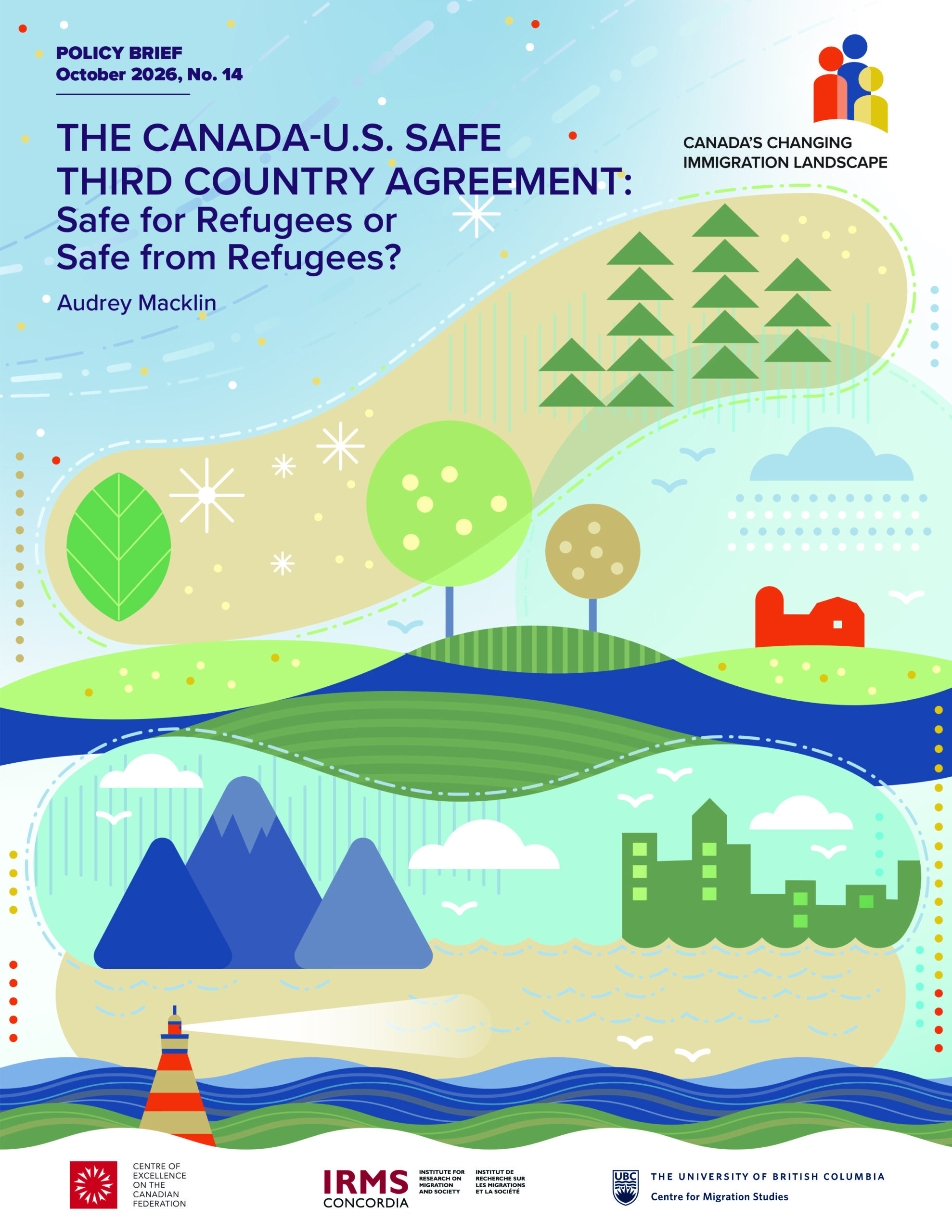
CECF 28/10/2026 - This brief is the second of two policy briefs analyzing the history, law and effects of the Canada-U.S. Safe Third Country Agreement (STCA). It focuses on changes to U.S. asylum law and policy since the second inauguration of President Donald Trump in January 2025, their impact on the safety of the United States for asylum-seekers and refugees, and the implications for the legality of Canada’s continued enforcement of the STCA.
The STCA’s legality depends on both Canada and the United States remaining safe countries in which to seek and obtain refugee protection. Federal law requires the government to conduct an ongoing review of whether the United States still meets that standard, but Ottawa has refused to disclose whether or how such a review is being carried out. In 2023, the Supreme Court of Canada upheld the STCA’s constitutionality based on U.S. conditions as they existed at that time. This brief argues that those conditions have since changed decisively.
Since 2025, the U.S. government has suspended asylum processing at the border, revoked parole and Temporary Protected Status for hundreds of thousands of people, expanded expedited removal, and detained a record number of people in increasingly punitive conditions. It has also struck removal agreements sending asylum-seekers to third countries with abysmal human rights records. This exposes asylum-seekers to human rights abuses in those third countries, as well as onward expulsion to the country of origin, what the UN Human Rights Committee has called “chain refoulement.”
The brief concludes that the United States is not presently a safe country for asylum-seekers, and that Canada’s continued enforcement of the STCA — applied ever more strictly even as U.S. conditions deteriorate — is legally and morally indefensible.
To address this, the brief recommends that Canada:
- Immediately suspend operation of the STCA because the United States is not a safe country to seek or obtain refugee protection.
- Provide formal notice of its intention to withdraw from the STCA within six months absent material improvement in U.S. conditions.
- Restore the ability of asylum-seekers to make a refugee claim at ports of entry along the Canada-U.S. border.
- Reverse the ineligibility of asylum-seekers who claimed protection in the United States before entering Canada, or who cross irregularly.
- Redirect the $1.3 billion committed to militarizing the border toward building a safe, orderly and adequately resourced asylum system, in partnership with provinces and municipalities.
The Canadian government has shown no indication that it intends to suspend or renegotiate the STCA, or even to supplement existing exceptions to STCA exclusion. If anything, recent enforcement decisions point toward a determination to maximize denial of access to protection in Canada, despite the known consequences to asylum-seekers’ lives and safety. That political reality does not change what is legally and morally required. These recommendations follow from the legal analysis presented in this brief, independent of whether the current government is prepared to act on them. Source
ACTION Canada: End the Safe Third Country Agreement
| Canadian man freed after being imprisoned, tortured in Ethiopia | |
The Globe and Mail 26/10/2026 - An Ethiopian judge has ordered the release of a Canadian man who suffered torture and beatings from police during a year of imprisonment in the country.
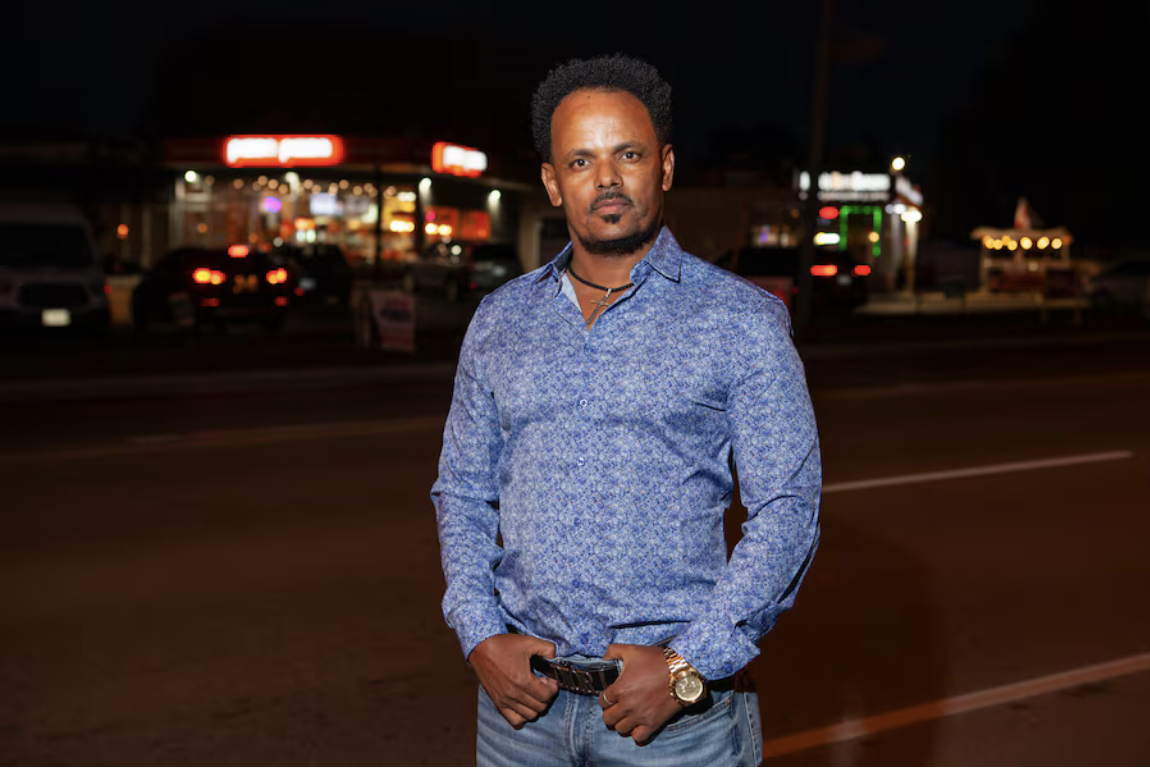
Thirty-nine-year-old Esubalew Birhanie was arrested at Ethiopia’s main airport last year when he tried to return home to Toronto after a month-long visit to his relatives. Accused of supporting rebels in the Amhara region, he was imprisoned without trial.
Mr. Birhanie had worked as a ground technician at Toronto Pearson Airport for more than two years when he was arrested in Ethiopia. He was finally freed this month when police failed to provide evidence to the judge to support their allegations. Now he is struggling to rebuild his life. “I’ve lost everything,” he said after returning to Toronto last week. “I lost my apartment, I lost my job, I lost my health – everything.”
Mr. Birhanie said he was tortured by police who wanted him to confess to “inciting terrorism” by supporting rebels. They handcuffed him, forced him face down on the prison floor and stomped on his neck until he fainted, he said. When he awoke, they were beating him on the back with clubs and batons, he said.
A nine-page report by the Ethiopian Human Rights Commission, obtained by The Globe and Mail last March, confirmed his story. The report said the commission had investigated the case and concluded that the Canadian man was “beaten by officers, resulting in significant physical injuries.”
The commission called for a full criminal investigation of the police who had perpetrated the abuse. It also recommended compensation be paid to Mr. Birhanie for the “physical and psychological trauma” he suffered. Instead, he was kept in prison for a further six months, until the judge decided there was no evidence against him.
Mr. Birhanie said the police made two allegations against him. The first was that he had incited opinion against the government at a public meeting in Toronto in 2020 when he spoke about the plight of Amhara people who had been killed or displaced. But the judge ruled that he was entitled to express his opinions, he said.
The second allegation was that he had posted anti-government statements on Facebook. But this was based on a fake Facebook account that the police had installed on his phone after his arrest, Mr. Birhanie said. When the judge requested proof of the posts, the police were unable to provide any because they had deleted the fake account to conceal the date when it was created, he said.
The Ethiopian government has often used anti-terrorism laws as a pretext to prosecute dissidents and journalists, according to several reports by human-rights groups. Corruption is another factor in some arrests. When he was first detained, the police offered to release him in exchange for a bribe, the equivalent of about $23,000, he said.
Mr. Birhanie said he was finally released from prison on Oct. 8. But when he arrived at the airport to return to Toronto, he was told he was prohibited from leaving the country. He went into hiding for two weeks, fearing another arrest, while he tried to get a court order to lift the travel ban. The restrictions were eventually lifted, and he flew back to Toronto on Friday. “I am incredibly relieved and excited to have finally left Ethiopia,” he told The Globe. “What I went through there was horrible and deeply traumatic.”
Now he is searching for a new job, a new apartment and specialized medical treatment for his back. He is taking painkillers but says he still feels pain when he sits or sleeps. He plans to launch legal action to seek justice and compensation from the Ethiopian government. Source
| CLC Calls for an End to Arms Shipments to Israel | |
CLC 28/10/2026 - The Canadian Labour Congress (CLC) Canadian Council has voted in support of a resolution calling on workers to refuse to handle weapons and military equipment destined for Israel.
The CLC stands in solidarity with Palestinian workers and their families, and with all those calling for peace, justice and respect for international law.
Canada has a responsibility to ensure that weapons and military equipment produced here are not used to harm Palestinian civilians or contribute to violations of international humanitarian law. We call on the Government of Canada to end all direct and indirect transfers of arms and military equipment to Israel.
The labour movement has always stood for the rights, safety and dignity of working people everywhere. We reject all forms of hatred and discrimination, including antisemitism, anti-Palestinian racism and Islamophobia. Canada must uphold international law, protect civilian lives and support a just and lasting peace for Palestinians and Israelis. Source
ACTION Elbit out of Canada now!
ACTION Canada: Intervene to Stop Israel’s Mass Starvation and Intensified Genocidal Attacks on Gaza
Crown withdraws criminal charges against Montreal protesters arrested at bank sit-in
| Israel has committed war crimes and crimes against humanity in the Occupied Palestinian Territory amid continuing genocide in Gaza, UN Commission of Inquiry finds | |
OHCHR 26/10/2026 - Israel has committed war crimes and the crimes against humanity of extermination, persecution, torture, rape and other forms of sexual violence in the Occupied Palestinian Territory, intentionally targeting Palestinian civilians as it continues to commit genocide in Gaza, the UN Independent International Commission of Inquiry on the Occupied Palestinian Territory, including East Jerusalem, and Israel said in a new report today.
The report to the UN General Assembly, which focuses on killings and bodily and mental harm by state-actors, found that the situation in the West Bank has deteriorated gravely since 7 October 2023. The number of deaths caused by airstrikes in the West Bank has increased significantly: six Palestinians were killed by airstrikes in the West Bank between 2008 and 6 October 2023, while 254 Palestinians were killed by airstrikes between 7 October 2023 and 30 September 2026. The Commission concluded that Palestinians in the West Bank are being targeted on the basis of their nationality, race and ethnicity, gender and age.
In Gaza, the report found that Israeli authorities and forces continue to commit genocidal acts even after the so-called ceasefire agreement, with the intent to destroy the Palestinian people, in whole or in part.
“The intentional killing and injuring of Palestinian civilians and destruction of homes in the West Bank combined with Israel’s persistent denial of responsibility form part of a broader strategy to exterminate and displace Palestinians and impose conditions of life that are unliveable,” said Srinivasan Muralidhar, Chair of the Commission. “Meanwhile, Israel’s expansion of territorial control in Gaza continues to result in the killing and harming of Palestinian civilians who approach or cross the Yellow Line.”
In the West Bank, the report found that Israel - through military operations reinforced by sustained settler violence - has waged a widespread and systematic attack against civilians since 7 October 2023. The conduct of Israeli authorities during this period indicates that they intended for military operations and settler violence to form part of a coordinated attack against Palestinians. Torture, reproductive violence, rape and other forms of sexual violence form part of the broader attack directed against the civilian population in the West Bank. Sexual violence has been used with the intent to displace, subjugate and destabilize the Palestinian people.
Israeli forces have also deliberately killed and inflicted serious bodily and mental harm against children in the West Bank – as they have in Gaza – committing age-based persecution against Palestinian children.
As part of a broader investigation into the root causes of recurrent tensions and protraction of conflict, the report outlines the key drivers of Israeli violence and concludes that Israel has striven to expand territorially and displace Palestinians through violence since the 1947-48 war. Military operations since January 2025 have led to the largest displacement of Palestinians in the West Bank since 1967, with 34,176 Palestinians remaining displaced as of August 2026.
“Seizing maximum land while minimizing the Palestinian population in relation to size, autonomy and viability stems from Israel’s colonising policies and is rooted in historical practices and patterns of action, resulting in the excessive and discriminatory application of lethal force, displacing, injuring and killing Palestinians over generations,” said Muralidhar. “Attempting to equate Palestinian statehood with a threat to the existence of Israel is blocking any viable attempts to realize Palestinians’ right to self-determination.”
The Palestinian Authority, the report found, has targeted Palestinians who voice dissenting views. Journalists and human rights defenders have been killed and injured, resulting in an increasingly diminished civic space. “Despite an increase in unnecessary or disproportionate use of force since 7 October 2023, the Palestinian Authority has failed to conduct effective and impartial investigations into incidents of killings and to ensure effective remedy, including financial compensation to victims and their family members,” said Muralidhar.
The Commission makes several recommendations to the concerned States and the international community. Israel should comply with the advisory opinion of July 2024 of the International Court of Justice and immediately end the unlawful occupation of Palestinian territory and remove all settlers and settlements. Essentially, Israel should end and reverse confiscation and appropriation of Palestinian property and reservation of Palestinian land for military purposes and return all confiscated land to its Palestinian owners. The Palestinian Authority must cease the targeting of human rights defenders and conduct independent investigations into alleged violations of international humanitarian and human rights law and provide remedies for the harm suffered by victims who were wrongfully killed and injured by the Palestinian security forces. Source
Nov 2, 2026: Israeli strikes kill 13 Palestinians in Gaza
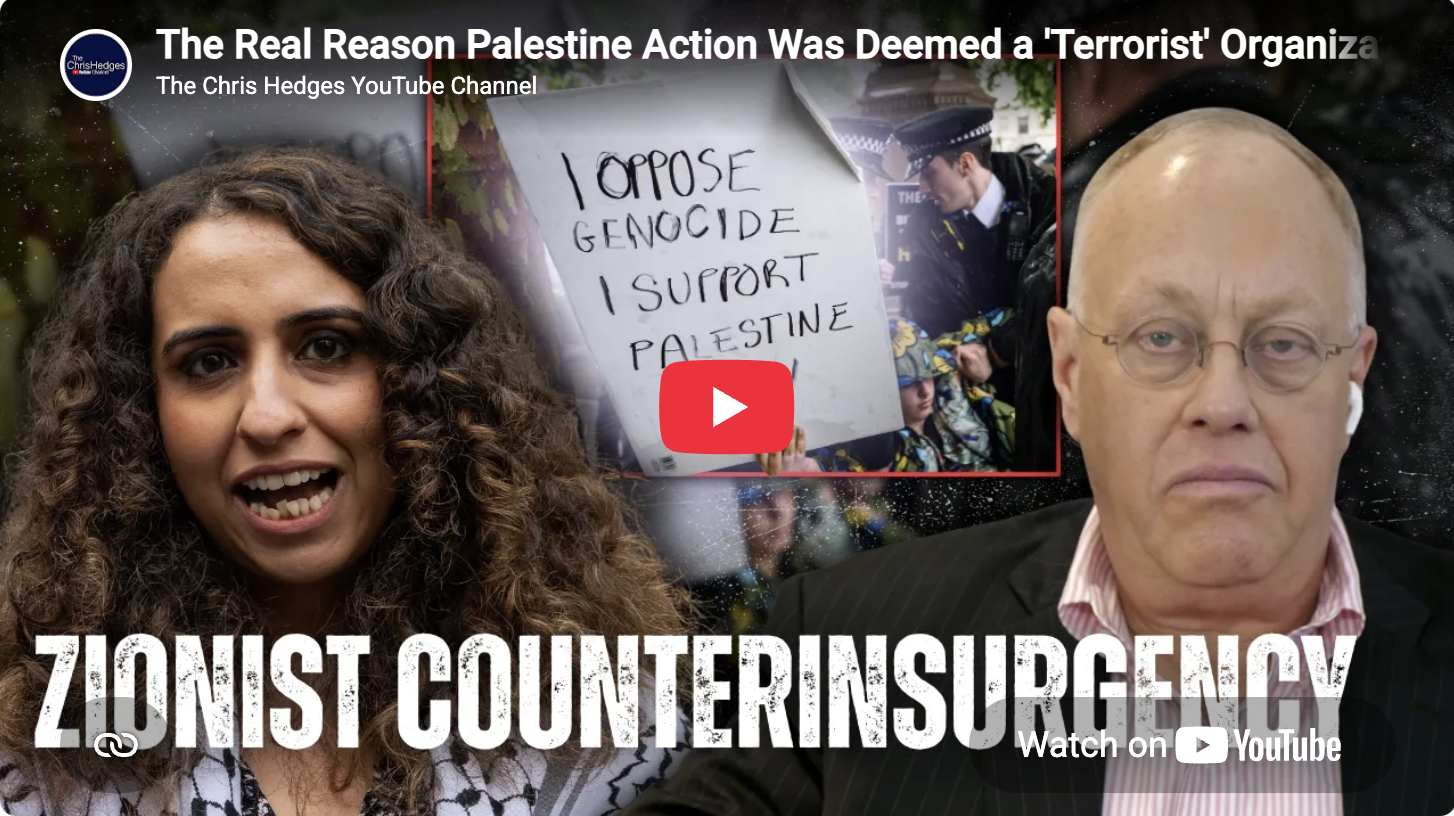
| The Real Reason Palestine Action Was Deemed a 'Terrorist' Organization (w/ Huda Ammori) | |
TCHR 28/10/2026 - The world watches in horror as the United States and Israel brazenly commit war crimes and genocide, defying international law and then sanctioning those institutions, such as the International Criminal Court, that endeavor to hold them accountable. Despite daily images of destruction, starvation and death in Palestine, now extending from Gaza to the occupied West Bank and farther to Lebanon and beyond, only Iran and Ansar Allah have taken effective action to stop the atrocities. Western nations, meanwhile, keep the gears of Israel’s war machine turning. Also, ordinary people have organized and are taking action in what Chris Hedges describes as “the final line of defense between a world that respects the rule of law and a world of unmitigated barbarism.”
One group that has made significant gains is Palestine Action, which has specifically targeted the Israeli weapons producer, Elbit Systems, in the United Kingdom. Palestinian activist and co-founder of Palestine Action, Huda Ammori, joins this episode of The Chris Hedges Report to discuss the draconian steps taken by the UK government to criminalize and dismantle Palestine Action. Much to the chagrin of the Zionist elements of the Western establishment, every attack by the UK and its allies has resulted in greater public support for Palestine Action.
Ammori’s family has a long history of fighting Zionism in Palestine. She reflects on the brutal subjugation they endured and her lifetime of activism, saying, “It’s an obligation for Palestinians to resist their occupiers and for each generation to pick up the mantle.” The limitations of the political system, however, have only impeded activists’ efforts to facilitate the liberation of Palestine from the death grip of Israel and its Western-backers; before starting Palestine Action, she realized that direct action was a necessary next step. When Ammori and her partner, Richard Barnard, launched Palestine Action they achieved significant material gains.
It was this progress that brought the full weight of the state against them, including the proscription of Palestine Action as a terrorist organization and the banning of all forms of solidarity and support for them. Law enforcement have raided their homes and arrested thousands of activists. The state has also held activists for prolonged periods in jail, which they protested with hunger strikes, and blocked their efforts to raise funds. Ammori is challenging the legality of the proscription, now headed to the UK Supreme Court, in what is considered “an extremely important case, not just for Palestine Action as a group, but for our Free-Speech rights in Britain in general.” Read more - Lire plus
London police make arrests outside court hearing Palestine Action ban appeal
UN Special Rapporteur on counter-terrorism intervenes in Supreme Court appeal on the proscription of Palestine Action
| Progressive Democrats Seek to Scrap U.S. Foreign Terrorist Organization List | Some left-wing Democrats in Congress want to abolish a terrorist designation system they say has been weaponized against pro-Palestinian activists | |
Haaretz 16/10/2026 - The proposal would eliminate existing designations of groups such as Hamas, Hezbollah and Al-Qaida. Supporters of the effort argue that the classification duplicates other laws and has been used to arbitrarily deny visas and prosecute Americans for legitimate political activity.
"The law currently allows broad authority to enact devastating measures against people unrelated to individualized suspicion of violent activity," said Elizabeth Beavers, a law professor at Widener University.
The proposed changes are included in the Reimagining Safety Act introduced this week by Rep. Delia Ramirez, an Illinois Democrat The bill would abolish Immigration and Customs Enforcement, or ICE, and Customs and Border Protection, replacing the Department of Homeland Security with a "Department of Community Safety."
Ramirez told Haaretz in a statement that the legislation was meant to help "every dissenter wrongfully branded, targeted, and persecuted as 'terrorist.'" The bill has only a handful of co-sponsors in Congress – including Reps. Rashida Tlaib and Ilhan Omar, who like Ramirez are fierce critics of Israel – and endorsements from dozens of civil society organizations.
Jamie Beran, CEO of Bend the Arc, the progressive Jewish group, said she backs the bill in part to "create a permission structure to build support for these policies long term." "Obviously it is important to have policies that are going to prevent violent terrorism from happening," Beran said in an interview. "But we know DHS doesn't make Jews any safer."
The proposed new department would oversee cybersecurity and disaster response, while airport security and customs functions would move to other departments. The bill would also end the secretary of state's authority to designate foreign terrorist organizations and terminate existing designations one year after enactment.
Ramirez's bill would maintain current grants issued by Homeland Security like the Nonprofit Security Grants Program, which funds a significant share of synagogue security, though authority for future grants would need to be set by Congress.
Unless Congress created a replacement system, the bill would prevent prosecutions under the law prohibiting material support to designated foreign terrorist organizations for conduct occurring after the designations expired. A separate federal law would still prohibit providing support with the knowledge that it be used to prepare crimes. The designation-based law was used to convict five leaders of the Holy Land Foundation in 2008 of providing material support to Hamas.
Supporters of the foundation leadership said they were engaged in legitimate charitable activity and the prosecution relied on guilt by association that would not have been possible without the federal government's global terror list. Separately, the bill would repeal terrorism-related grounds for denying noncitizens admission, alleged terrorist activity, association and material support, though visitors could still be barred for criminal activity The White House could still sanction suspected terrorists but those measures would expire after 30-days without approval from Congress.
Ramirez was elected in 2022 to represent a district covering parts of Chicago and its suburbs, which have a large Palestinian-American population, and introduced the Block the Bombs Act, which progressives who support limiting U.S. arms to Israel have rallied around.
The idea of reforming the designation process for foreign terrorist groups has been circulating for several years. Calls for change have intensified as the Trump administration has used immigration and terrorism statutes to go after pro-Palestinian groups, including Palestine Action, a British group that the Treasury Department designated as a Specially Designated Global Terrorist Organization in August. That designation falls under a separate sanctions system.
Palestine Legal, an advocacy group, and the Center for Constitutional Rights published a paper in 2024 titled "Anti-Palestinian at the Core," arguing that many U.S. antiterrorism laws are "essentially bespoke instruments for Zionist interests in crushing any Palestinian resistance." Any attempt to curtail the government's terrorist designation powers is likely to face stiff resistance. [...]
The Trump administration has expanded its use of terrorist designations, listing nearly two dozen Latin American cartels as terrorist organizations – a move critics blasted as likely to target innocent people, including immigrants forced to pay money to organized gangs. Meanwhile, Republicans in Texas and Florida have moved to create their own lists of terrorist groups as part of a wave of Islamophobic policymaking targeting groups like the Council on American-Islamic Relations [...]
Beran, of Bend the Arc, said the proposed changes would address national security needs while curbing government overreach. "The world is dangerous and we're not naive about this," she said. "But when you have this administration weaponizing and broadening the definition of 'terrorist' that calls for us to take a step back." Source
House Democrat Releases Critical Report Detailing the Trump Administration’s Coordinated Targeting of Nonprofits
C&SN Submits Amicus Brief to Supreme Court on Crucial Case for Future of Aid
|
U.S. boat strike kills five; 100+ killed in Sudan attack
| |
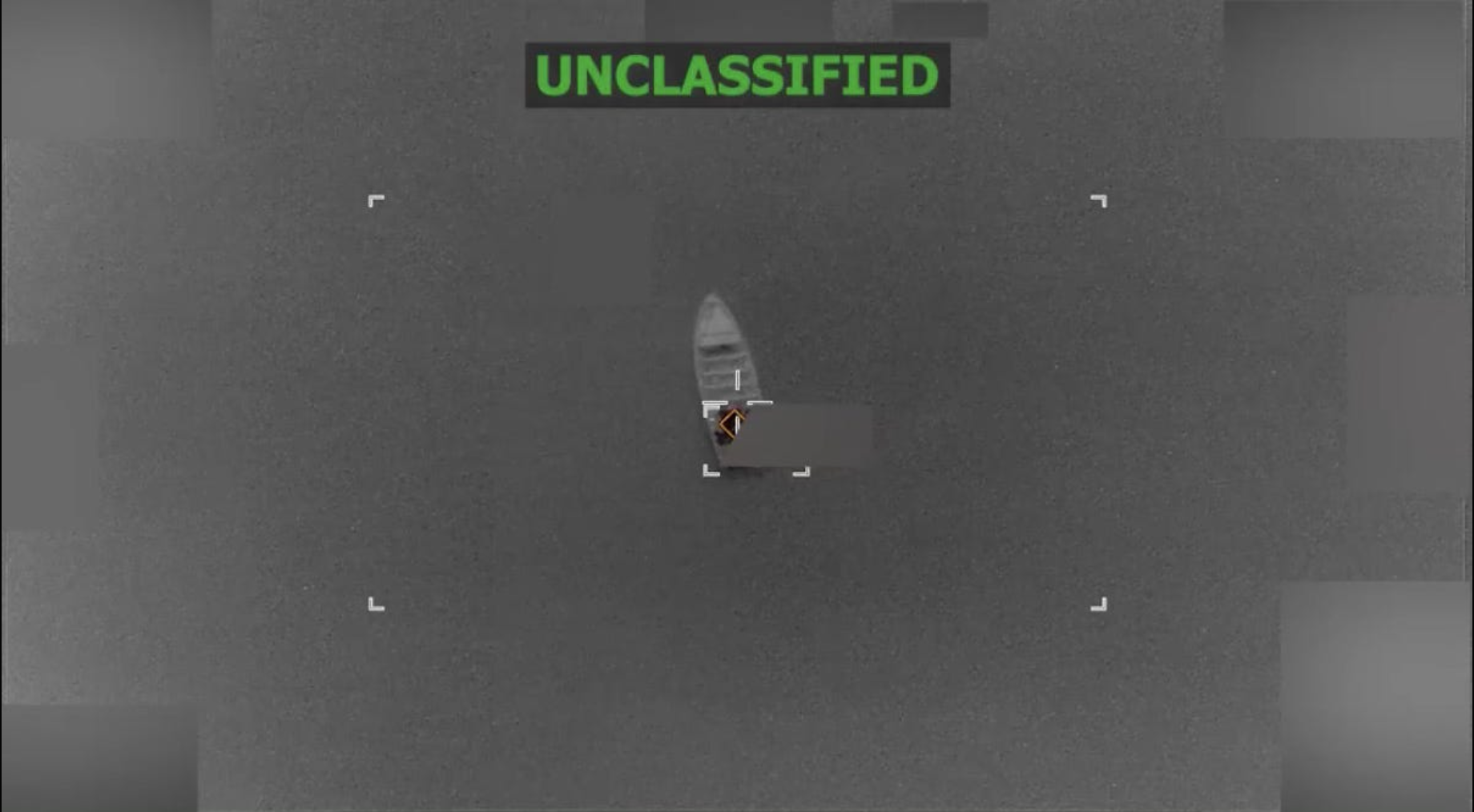
Drop Site News 28/10/2026 - U.S. strike on boat in Pacific kills five people: The U.S. military attacked what it said was a drug-smuggling boat in the eastern Pacific on Tuesday, killing five people. U.S. Southern Command claimed that “intelligence revealed the vessel’s active involvement in narcotrafficking,” without providing any evidence underlying the intelligence.
It published a video on X that shows a small boat enveloped by an explosion. Since the U.S. military began targeting what it calls “narcoterrorists” in September 2025, it has killed more than 240 people in more than 70 attacks. [...]
Toll from Sudanese military strike exceeds 100 deaths, rights group says: The death toll from a Sudanese Armed Forces (SAF) attack on a busy market in Nyala, South Darfur, rose to more than 100 deaths and 113 injuries, the rights group Emergency Lawyers said on Tuesday. Many of the victims were women and children. The SAF attacked the market on Monday evening. Source
US calls UN Special Rapporteur a terrorist sympathizer for condemning killings at sea
| | “Offensive Driving”: ICE’s Deadly Weaponization of Vehicles Against Civilians | |
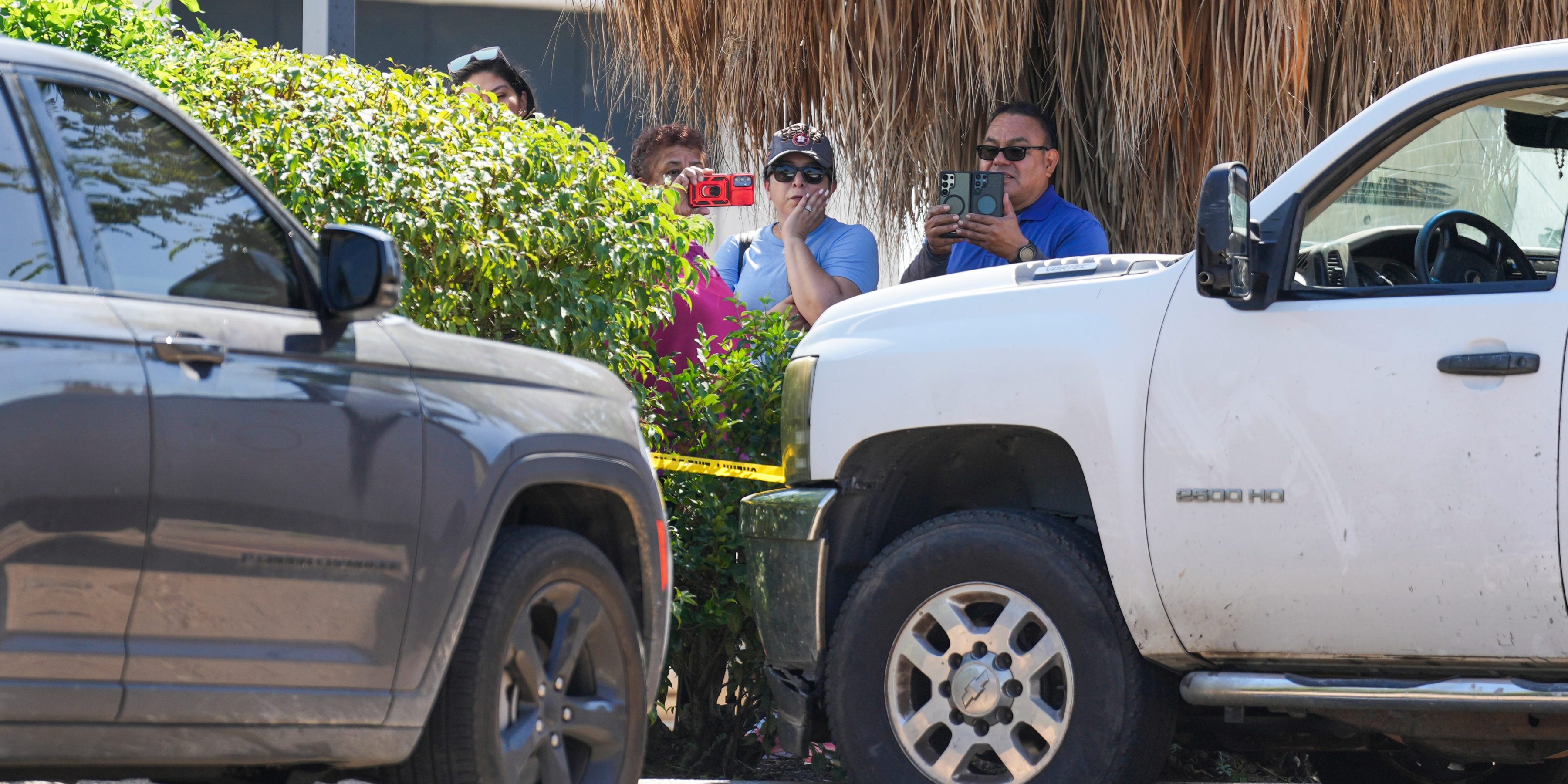
The Intercept 02/11/2026 - As Miguel Parra Hernandez, a Mexican national, was fleeing from U.S. Immigrations and Customs Enforcement on foot last month, he turned into a parking lot. An unmarked government vehicle came screaming into the lot after him and struck him.
When a grand jury in Harris County, Texas, charged the U.S. Immigrations and Customs Enforcement officer behind the wheel last week, the indictment pointed to a broader pattern in the Trump administration’s crackdown on immigrants and activists. The charge was assault with a deadly weapon; the weapon was the vehicle.
The Department of Homeland Security, ICE’s parent agency, claimed Parra Hernandez ran in front of the government vehicle; surveillance footage of the incident shows him running away from the car moments before he is hit. (An attorney for the ICE officer accused of assault against Parra Hernandez told The Associated Press his client had not committed any crime.)
In the same month, an unmarked ICE vehicle speeding the wrong way down a one-way street in Long Beach, California, struck a bicycle ridden by Ricardo Gonzalez, whose daughter later said he was a U.S. citizen. An agent immediately drew their gun on Gonzalez, who was later hospitalized for his injuries. The government said the man was not struck, but video released by the New York Times showed the ICE vehicle swerving into the bicycle.
Three days later after the collision in Long Beach, Antonio Moreida stood in the street in Woodland, California, outside Sacramento, documenting an unmarked ICE vehicle when the black Chevy Tahoe accelerated toward him. When the SUV hit him, Moreida told a meeting at Woodland City Hall last week, he was knocked to the ground — and the driver of the Tahoe did not stop to check on him. The Department of Homeland Security said Moreida jumped onto the hood of the unmarked car, but when video of the incident showed him standing in place, local police and the mayor publicly disputed ICE’s account.
In the national conversation about ICE’s heavy-handed crackdown on immigrants across the country, much has been made of the Department of Homeland Security’s claims that immigrants and activists “weaponized” their vehicles against federal agents. After immigration officers shot and killed Lorenzo Salgado Araujo, who was targeted by ICE, and community defender Renée Good in separate incidents, the government said the civilians had used their cars to attack agents — allegations that have not been borne out in criminal charges, or were called into question by witness accounts and video analysis.
What happened to Parra Hernandez, Gonzalez, and Moreida, however, was the opposite of what the government said about Good and Salgado Araujo: It was ICE agents who weaponized their vehicles against civilians.
As the Trump administration ramped up deportations over the last year, federal agents have effectively turned their cars into massive, deadly blunt objects. Common tactics, known collectively as “offensive driving techniques,” include ramming the cars of immigrant targets and activists; “brake-checking” volunteers trying to observe ICE activity; and, in some cases, outright driving into civilians. The Intercept reviewed two dozen cases of ICE using vehicles against civilians in these ways, including multiple incidents where victims were hospitalized or even died from their injuries.
“Vehicles are another tool ICE agents are using with unchecked force, just like their guns, Tasers, and pepper spray,” said Hannah Stauss, co-director of Hands Off NYC, a group that opposes ICE’s presence in New York City. “ICE’s deranged use of vehicles effectively weaponizes them against our immigrant neighbors and rapid responders, and will continue to kill people. We are witnessing in real time the results of a federal agency being allowed to operate with impunity, in secrecy, and with unfettered violence.” Source
‘They Are Terrorizing Us’: Video Shows ICE Agents Slashing Tires of Lawful Observers
ICE Is Running One of the Largest Anti-Left Surveillance Operations in US History
ACTION Time to abolish ICE!
| | |
LRB 09/2026 - If every accusation is a confession, then the US State Department report released on 20 July, which describes Cuba as ‘the capital of 21st-century communism’, must rank as one of the most deranged self-denunciations on record. Across its hundred pages, the report paints Cuba as the centre of hemispheric subversion, bent on destroying the United States through a ‘long war of attrition’ that made use of ‘espionage, infiltration, sabotage, proxy networks’ as well as ‘left-wing terrorism on American soil’. Cuba supposedly recruited an array of allies and dupes, ranging from the Black Panthers to the Democratic Socialists of America to ‘the highest reaches of US government’. This unparalleled ideological campaign, according to the report, has ‘in contrast to every other aspect of Cuba’s failed state ... yielded remarkable success’.
This charge sheet would make more sense if read backwards. It is, of course, the US that has been engaged in a decades-long project to contain and destroy the Cuban revolution, starting with the Eisenhower administration and culminating in Trump’s total blockade of the island. During the intervening 67 years, one American government after another has maintained or expanded measures intended to sink the Cuban economy, while also deploying an arsenal of covert tactics, all the way from the failed Bay of Pigs invasion of 1961 to the 1976 bombing of a Cuban airliner to the attempted motorboat assault off the coast of Villa Clara in February this year.
Even the short-lived thaw in US-Cuban relations under Obama should be understood not as a fundamental reversal of the American stance but as a shift in strategy: the expansion of free markets would loosen the Communist Party’s grip on power and achieve what decades of sanctions could not. As Obama told the journalist Jon Lee Anderson in 2016, ‘openness is a more powerful change agent than isolation.’ ‘If you are interested in promoting freedom, independence, civic space inside of Cuba’, he continued, helping people to ‘start a barbershop, or a cab service, was going to be the engine whereby individual Cubans ... can start expecting more’.
Soon after this, however, the first Trump administration reinstated the punitive approach. It reimposed the restrictions that had been relaxed under Obama and added new ones, squeezing the flow of remittances to the island and designating Cuba a ‘state sponsor of terrorism’. Biden did little to help: though he lifted some restrictions on remittances in 2022, he also resumed deportation flights. Deepening economic misery drove a massive surge in emigration from the island. According to one estimate, between 2021 and 2024 as many as two million people left Cuba – perhaps a fifth of the population.
Things got dramatically worse when Trump returned to power in 2025. With Marco Rubio now secretary of state, the strategy of ‘maximum pressure’ was restored. There have been several rounds of sanctions since, ostensibly targeting the regime and the armed forces, though they have also caused the few foreign companies operating in Cuba to withdraw. In January, the US began to block fuel shipments to the island – a blatant violation of international law, designed to inflict deadly harm on the entire civilian population. There can be no justification for such sustained and systematic cruelty towards the Cuban people.
Like so many of the activities of the second Trump administration, the State Department’s latest report on Cuba is both moronic and sinister. Although its main purpose is to justify further pressure on the island, it will also be used to clamp down on domestic dissent, in particular from the left. The report was issued four days after Rubio hosted an international summit during which he described the left as ‘an encroaching darkness’ and as ‘enemies of civilisation’. Given the killing and judicial persecution of internal critics such as those who have protested against ICE brutality, it’s easy to imagine the treatment that will greet any expressions of solidarity with Cuba.
The tightening of the US chokehold follows the intervention in Venezuela in January, which even at the time was billed by American politicians as a trial run for a takeover of Cuba. Pundits have wondered whether there is a ‘Cuban Delcy’: a figure inside the regime with whom the US can negotiate the terms of subordination. For the past few months, Trump and Rubio have alternated direct threats with demands for negotiations, smugly announcing the imminent collapse of Communist Party rule while at the same time seeking interlocutors within the regime, such as Raúl Castro’s grandson Raúl Guillermo Rodríguez Castro. The talks have led to the release of some prisoners but little else, unless the package of reforms the Cuban government announced in June, liberalising the economy in a desperate attempt at survival, was part of the deal. The lack of movement on this front perhaps explains why, as the New York Times reported on 5 August, the CIA has set up a ‘task force’ on the island, its remit being ‘to create fissures among the Cuban political elite’.
It is unlikely that events in Cuba will unfold along similar lines to Venezuela. For one thing, Cuba has only limited oil reserves and its infrastructure is dilapidated. For the Trump administration, it’s not so much a lucrative prospect as an irresistible ideological prize. But behind the question of whether the ‘Venezuela model’ can be repeated lies a larger one: what is the Venezuela model? Was the abduction of one leader and his replacement with a more pliable successor a one-off, determined by the specific weaknesses of the chavista system? Or might this new version of regime change, combined with the seizure of oil revenues, set the pattern for US relations with the hemisphere as a whole? Read more - Lire plus
| Everywhere and Nowhere All at Once: On Afghanistan, empire, and American amnesia on the 25th anniversary of the US invasion | |
LARB 09/10/2026 - September 11 is narrated by the US media and politicians as a shock that came out of nowhere, a senseless attack. This frames 9/11 as an inciting incident: the start of a new war, a new history, a new reality. This happened anew this past September, on the 25th anniversary. Even progressive voices, supposedly critical of US empire, reproduce this story. The more accurate account is that 9/11 was a turning point: by the time the planes crashed into the Twin Towers, the Pentagon, and that field in Pennsylvania, by the time Bush invaded Afghanistan a few weeks later, the United States had already been involved in some kind of war in Afghanistan for nearly 50 years.
Beginning in the 1950s, shortly after World War II, when my father was a boy in Kabul, Moscow and Washington turned Afghanistan into what the CIA called an “economic battlefield,” competing with each other to build factories, dams, highways, telephone and telegraph lines, airports, and pipelines to industrialize Afghanistan. All this infrastructure needed engineers and managers, so the Americans and Soviets opened and developed institutes and colleges, and my father, the eldest son in a poor family, was lifted off the streets and onto the US educational track. In secondary school at the new Afghan Institute of Technology in Kabul, and then at Kabul University, he was educated in English by American teachers. With a USAID fellowship, he came to the United States for graduate school and met my American mother at a college in New York State. I was born a few years later, in 1975, my whole existence owed to imperial funds that brought together a Slovak American Catholic girl from Binghamton, New York, and an Afghan Muslim guy from Kabul, mobilizing an unlikely romance.
Sounds generous—the United States and the Soviet Union “helping” a poor nation, my father rising into Afghanistan’s new Cold War–funded technocratic class—but the whole concept of “developmental” aid was invented, post–World War II, as a disguised form of colonialism. The aid was essentially economic conquest and ideological warfare, a battle over Afghan hearts and minds. One wrong move and the “economic” in “economic battlefield” could be dropped. Afghanistan’s leaders’ delicate balancing of Moscow and Washington earned global respect—an Afghan became president of the United Nations General Assembly in 1966—but the equilibrium didn’t hold. When the Soviets invaded in 1979, the superpowers revealed their true agendas: together, they spent, along with matching funds from Saudi Arabia and other US allies, $50–70 billion to blow up the country they’d just built up.
While my childhood Afghan community pilgrimaged with their dishes and rugs and tea every weekend down the New York thruway in the 1980s, waiting to return home, more weapons were flowing into Afghanistan than anywhere else on the planet. The majority of the billions of dollars provided through the CIA’s Operation Cyclone was funneled to the most religiously fundamentalist freedom fighters, including openly anti-Western and anti-American commanders. Afghan boys in Pakistani refugee camps were educated with “jihad primers,” courtesy of the University of Nebraska, that used guns, missiles, and grenades to illustrate reading and math lessons. As millions of Afghans fled the violence overtaking their country, Arab militants, with Western and Saudi funding, poured in. From all over the Middle East, they migrated, ready to fight the infidel communists who had invaded Afghanistan. With their more ideological and militant Islam, these new mujahideen often clashed with Afghan Muslim traditions and local cultural practices and operated largely in their own camps, separate from Afghan fighters.
The Soviet Union withdrew in 1989 and collapsed shortly thereafter, an achievement for the United States, which had wanted to give the Soviets their own debilitating “Vietnam quagmire,” as one Pentagon strategist described it. American leaders declared Cold War victory and abandoned Afghanistan, pulling all humanitarian aid but leaving behind the weapons, the militants, and the jihad educational system. Armed to the teeth and increasingly radicalized, the mujahideen militants turned on each other. Warlords fought for control of the capital, and my father watched, on the news, his home city of Kabul being turned into rubble. Out of this wreckage rose the Taliban, many of whom were educated in refugee camps with the University of Nebraska’s jihad curriculum. The Taliban promised a return to the peace and security Afghanistan had once known, and along with their rise, the Arab militants, high on their successful anti-communist jihad, switched their mission to defeating America. One empire down, one to go.
September 11 can’t be an inciting incident unless you’re erasing history. The president of the “brightest beacon for freedom” knew all about it. Jimmy Carter’s national security adviser explained the original gamble: “What is more important in world history? The Taliban or the collapse of the Soviet empire? Some agitated [Muslims] or the liberation of Central Europe and the end of the cold war?”
¤
Despite this long history—from the Cold War to September 11 and the US invasion—ask Americans what “Afghanistan” means to them and you’ll likely hear: War. Lots of war. Afghanistan equals war. Also militants and soldiers and radicals and Islamists and fundamentalists and extremists and insurgents. You might hear a sigh that suggests Afghanistan is an intractable mess, some mutterings about the Taliban and the terrible situation for women, a tired colonial trope or two (“graveyard of empires” is a favorite), and a slew of manufactured 9/11 memories embedded in brain matter by politicians and the media. It’s astounding how little is known about Afghanistan, and how infrequently Afghans’ humanity and history show up on American radar. And yet this not-knowing isn’t for lack of evidence. Afghanistan is everywhere in American history. It was, for a decade, the site of the United States’ most expansive covert operation, and then, for 20 years, the site of the longest war in US history. Those events, and all that came before, between, and after, add up to eight decades that have metabolized Afghanistan into everyday American life.
For decades, Afghanistan has been in CIA reports and congressional budgets, in presidential addresses, in the Pentagon’s discretionary funds. Afghanistan is in the taxes taken out of our direct deposits, in the national deficit deepened by the eight trillion dollars borrowed for the War on Terror—money that killed, directly and indirectly, nearly four million people across Afghanistan, Iraq, Syria, Yemen, and Pakistan. We feel that indebtedness in the United States every day, in the drawdown on the nation’s wealth, in the ambient decline of American society visible in the defunding of social services, public education, civil infrastructure, and arts and culture.
Afghanistan is present in the architecture of the Department of Homeland Security, in the Patriot Act of 2001 and the rise of domestic surveillance, in the militarization of your local police department. The armored trucks that rolled through Ferguson, Missouri, in the 2014 Black Lives Matter uprising and through cities nationwide in the 2020 George Floyd protests were MRAPs—mine-resistant ambush protected vehicles—designed to defend US troops in Iraq and Afghanistan from IEDs. Surplus MRAPs and other military gear are distributed to local law enforcement by the Pentagon’s 1033 program. Read more - Lire plus
The Motorcycle Man He Confessed to an Afghanistan War Murder. The U.S. Military Promptly Closed the Case.
| France's Forever Suspects | When France’s cost-of-living protests turned violent, the far right blamed Arabs and Africans. But in Barbès, the heart of North African Paris, nothing was broken | |
Forever Wars 28/10/2026 - WHEN THOUSANDS OF French protestors marched through Barbès on Saturday, October 17, nothing was smashed.
Angry at Emmanuel Macron’s government, they filed down the main boulevard, past the snack counters and dress shops of Paris’s historical North African quarter, and moved on peacefully. "They bought from us, ate, and left," said Rabah, 47, who worked at a counter run by Algerians and asked to be identified only by his first name.
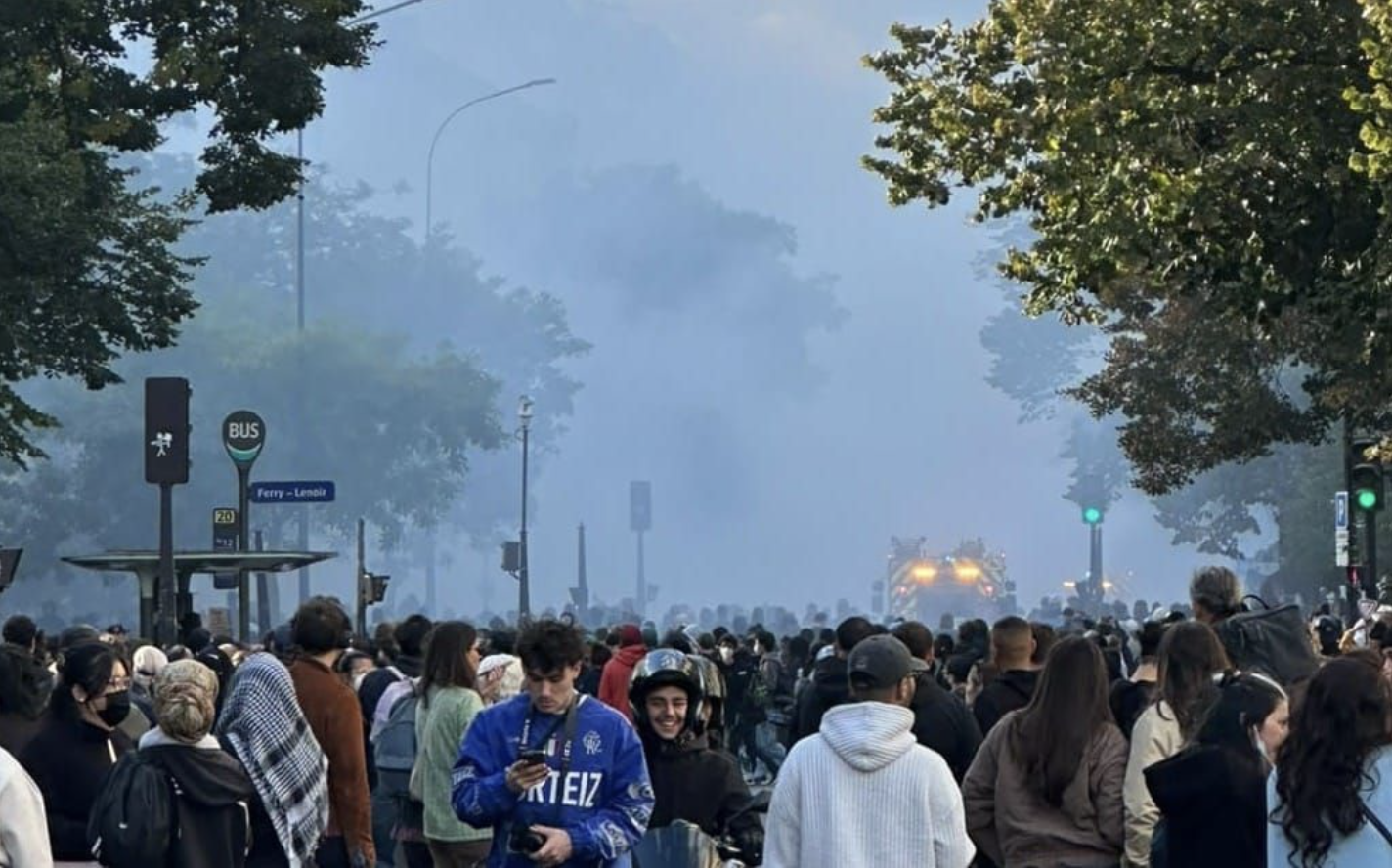
But a few kilometers south, near the Place de la République, the same demonstration ended in looting and fire. Police fired water cannons and tear gas to subdue the violence. That day, protestors had climbed the Marianne statue and hung a banner reading “1961, the police drown Algerians. 2026, the police maim high school students,” a reference to the massacre of Algerian demonstrators by Paris police. The banner invoked one of the darkest chapters in French history. On October 17, 1961, during Algeria’s war of independence, some 30,000 Algerians marched peacefully in Paris against a curfew imposed on Algerians alone. Police under Paris prefect Maurice Papon crushed the march, killing anywhere from about 30 to more than 200 protesters. Many of the victims were beaten and thrown into the Seine. Long denied by the French state, the massacre was called “inexcusable for the Republic” by President Emmanuel Macron in 2021, and in 2024 the National Assembly condemned the “bloody and murderous repression.”
Sixty-five years later, protesters again marched in the streets. About 550,000 people across France participated in the October 17 protests, according to the interior ministry. More than 1,800 people were arrested. The violence shifted the debate from what the protestors wanted to where the rioters were from. Even though the demonstration had passed through Arab and immigrant neighborhoods in peace, prominent political figures blamed the violence on France’s immigrant communities.
"What we saw yesterday is the true face of the Great Replacement," said Éric Zemmour, leader of the far-right party Reconquête, echoing the ethno-nationalist theory that a European population is being replaced by non-European immigrants. "It has an appearance, a horde of North African and African barbarians who enter the cities." U.S. President Donald Trump also waded in, blaming the unrest on "migrants, jihadists and communists who hate Christianity." French President Emmanuel Macron pushed back, saying during his October 21 visit to Doha that the idea that France had been “invaded by hordes of migrants and Islamists” was “completely false.”
A week later, on October 24, another wave of protest convulsed France, bringing 410,000 out into the streets nationwide, with more than 100,000 of them in Paris alone. Most marches were peaceful, but clashes with police and some looting broke out at the end of the protests in Paris, Marseille and about a dozen other cities. Interior Minister Laurent Nuñez blamed the violence on groups of people “most of them dressed in black, activists of the radical far left, of the ultra-left.” Police made nearly 1,000 arrests.
Yet for all the scapegoating, back in the North African neighborhood of Barbès, a homeless man stopped outside a dress shop and offered a line that has become a running joke among the shopkeepers. “Did you see, madame? They didn’t break anything in Barbès.”
From the classroom to the street
The protest movement started in mid-September at the Saint-Exupéry high school in Créteil, a suburb southeast of Paris. Students blockaded their school to support teachers who were protesting staff shortages. The shortages are a nationwide problem. According to one study, 9.8 percent of teaching hours in French public secondary schools went untaught in the 2024-2025 school year.
Rejection of the school shortages has since grown into a nationwide movement against the rising cost of living. It has been joined by unions, farmers, and the Gilets Jaunes (Yellow Vests), who came to prominence in 2018 for their demonstrations against rising energy and fuel costs.
“We need better resources so that young people are excited about their future and inspired by it, and want to get up in the morning and go to study in conditions that respect their dignity,” said Manal Benazzouz, a 21-year-old Sorbonne student. Benazzouz joined the protests, for the first time, on October 24 with a friend. “We are the future of this country,” she said, and described “a great spirit of unity” during the demonstrations.
Ahead of the second nationwide day of protests on October 24, the French government called in soldiers from Operation Sentinelle to guard sensitive sites while police faced the crowds. Sentinelle is an anti-terror mission launched after the January 2015 jihadist attacks on the satirical magazine Charlie Hebdo and a kosher supermarket in Paris. It has kept thousands of soldiers on French streets for over a decade, at times up to 10,000.
In March 2019, at the height of the Yellow Vest movement, its troops were redeployed to protect public buildings so police could focus on demonstrators, a move that sparked fierce political backlash. Benazzouz, who is of Algerian and Moroccan origin, carried a sign honoring the events of October 17, 1961 “as a tribute to the martyrs of Algeria”—the same history invoked by the banner on the Marianne statue. [...]
Watched, Not Protected
The police are a constant in Barbès. "You often see someone pressed against a wall being searched by the police. It’s common," Sonia said. For Fattah, their presence weighs heavily on Fridays. “Police officers standing in front of the mosque, as if they’re telling you, ‘we are watching you,’” he said. “Why don’t the police stand in front of the synagogue or the church?”
That scene is the visible face of a counterterrorism system built over the past two decades. In response to the September 11, 2001 attacks in the United States, France raised national security alerts across the country. Within weeks, it expanded police powers and required telecom operators to keep users’ data. After the 2015 attacks in France, the government imposed a state of emergency for nearly two years. In 2017, a new counterterrorism law, known as SILT, moved some of those powers into ordinary law, including the closure of places of worship, and in 2021, the so-called separatism law gave the state new powers to monitor religious organizations, which the government said was meant to combat radicalization.
Fattah does not experience the police presence as protection. “Anything that happens in France, they link to Arabs and Muslims. Anything,” he said. “Most of us are here to work, to change our lives,” Sonia added. “We are not here to create problems.” Read more - Lire plus
17 Octobre : deux morts et une omerta d’État
Des mesures antiterroristes utilisées pour empêcher des militants de manifester ces derniers jours sont dénoncées en justice
| Inside the Baghdad trial of French ISIS suspects handed over from Syria | |
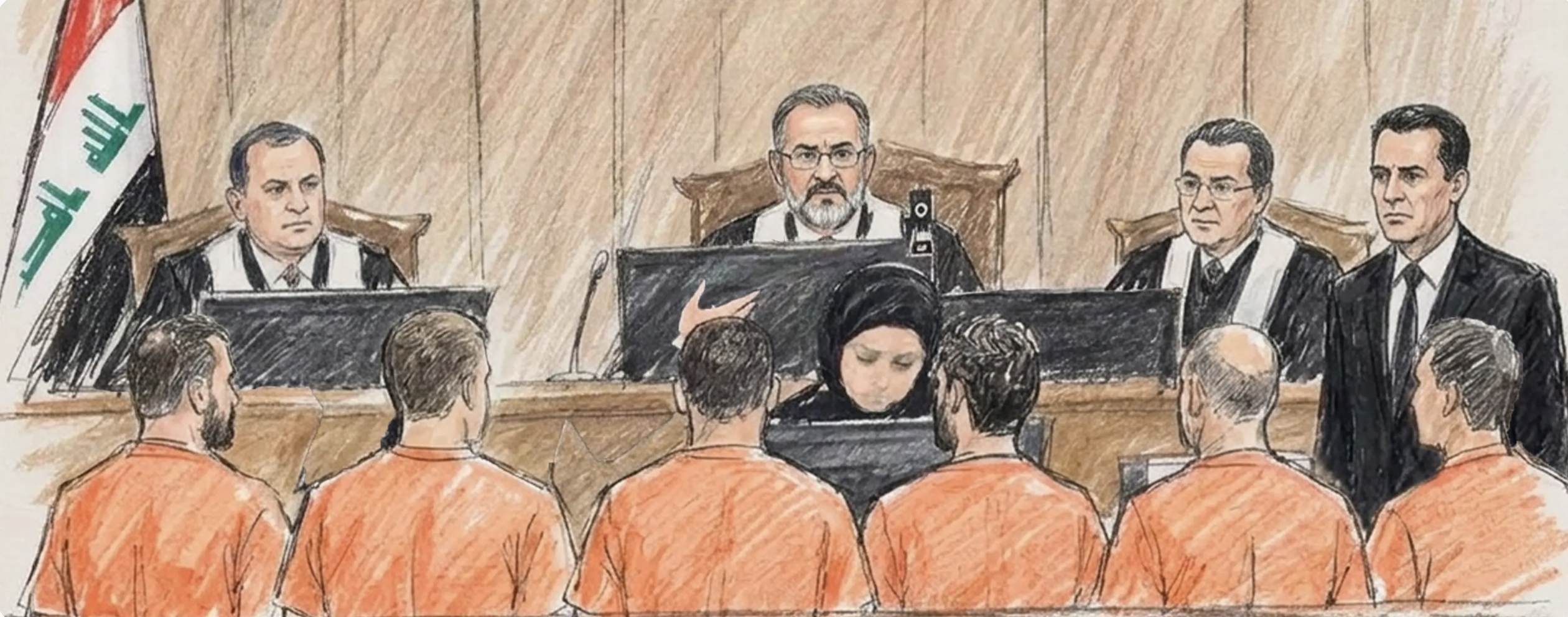
Rudaw 04/11/2026 - A French medical student who joined Islamic State (ISIS) stood trial in a Baghdad criminal court on Wednesday alongside five other French nationals, including a father of four daughters, before a judge who adjourned the hearings over their lack of access to legal counsel. The court has recently sentenced 10 other French nationals for their membership in the group.
The hearings come amid a series of ongoing prosecutions of foreign ISIS suspects in recent weeks following the transfer of around 5,704 detainees from facilities in neighboring Syria during a US-led coalition mission between January and February. An Iraqi court in late October sentenced nine French nationals to life imprisonment and another to 15 years in separate trials after convicting them of ISIS membership in the presence of their defense lawyers and representatives from the French Embassy in Iraq.
On Wednesday’s trial stood Sofiane Ahmed Issa, 32, in a yellow prison uniform. "Your Honor, I was forced under torture [in Iraqi prison] to make those statements,” Issa said during the hearing attended by French diplomats and journalists, including those from Rudaw. Born in 1995 to an Algerian family in Lille, France, Issa studied general medicine before joining ISIS. He was part of the 47-member group of French nationals who were handed over to Iraqi authorities in 2025. The judge ruled that Issa would be allowed to write down his statement by hand during the second session. [...]
Approximately 5,704 suspects representing 67 nationalities were transferred from Syria to Iraq earlier in the year. Iraqi authorities said in early September that investigating the suspects had concluded and would be followed by judicial proceedings. The detainees included 3,543 Syrians, 467 Iraqis, 710 nationals of other Arab countries and 983 foreigners from Europe, Asia, Australia and the United States.
Iraq prosecutes most ISIS suspects under Article 4 of its 2005 Anti-Terrorism Law, which provides for the death penalty or life imprisonment for those who commit, incite, plan, finance or assist terrorist acts. However, the proceedings have drawn scrutiny from international rights organizations.
In February, Human Rights Watch accused Iraqi authorities of conducting rushed trials of ISIS detainees, raising concerns about due process and alleging that some convictions relied on confessions obtained through torture. The organization also estimated that approximately 8,000 detainees were on death row.
France in late October acknowledged that Iraqi law provides for the sentences imposed on French nationals convicted of ISIS membership, while emphasizing its respect for Iraq’s sovereignty and judicial independence. A diplomatic source from the French foreign ministry said in a written response to Rudaw that it does not comment on judicial decisions in other countries or interfere in ongoing legal proceedings. Read more - Lire plus
ACTION Canada must urgently repatriate all Canadians from NE Syria and Iraq!
Jury convicts American woman trafficked by her father to ISIS despite lack of direct evidence
| | OTHER NEWS - AUTRES NOUVELLES | | ICLMG ACTIONS DE LA CSILC | | The Justice Minister must end the injustice against Hassan Diab! | | |
In April 2023, despite clear exculpatory evidence, the French Court of Assize conducted an in absentia trial that unjustly declared Dr. Hassan Diab guilty and sentenced him to life in prison. The proceedings amounted to a sham trial and a mockery of justice.
Since that ruling, Dr. Diab and his family have lived in constant uncertainty, facing the ongoing threat that a second extradition request could be made at any time.
Please click below to send a new letter demanding that Justice Minister Sean Fraser categorically refuse any future extradition request and put an end—once and for all—to this ongoing miscarriage of justice.
| |
Canada: Abolish rights-violating terrorist entities list!
| | |
On October 15, 2024, the Canadian government placed the Samidoun Palestinian Prisoner Solidarity Network on Canada’s terrorist entities list. While ostensibly a tool to protect the safety and security of people in Canada and internationally, the list is an arbitrary political tool that undermines freedom of association, of expression and due process in the courts. Its effectiveness as a national security tool has never been demonstrated in a manner that justifies its use.
Due to these deep flaws, and more, the ICLMG has consistently called for the list to be abolished since the Canadian coalition’s founding in 2002. Please join us in urging the Canadian government to abolish the rights-violating terrorist entities list once and for all. Thank you!
| | Canada must repatriate all Canadians detained in NE Syria/Iraq now! | Every day the government fails to bring these Canadians home, it places their lives at risk from disease, malnutrition, violence, and ongoing military conflicts. United Nations officials have even found that the conditions faced by Canadians in prison are akin to torture. Please click below to urge the federal government to repatriate all Canadians illegally and arbitrarily detained in northeast Syria without delay. | | 23 years of fighting deportation to torture: Justice for Mohamed Harkat! | | CSIS isn't above the law! | | |
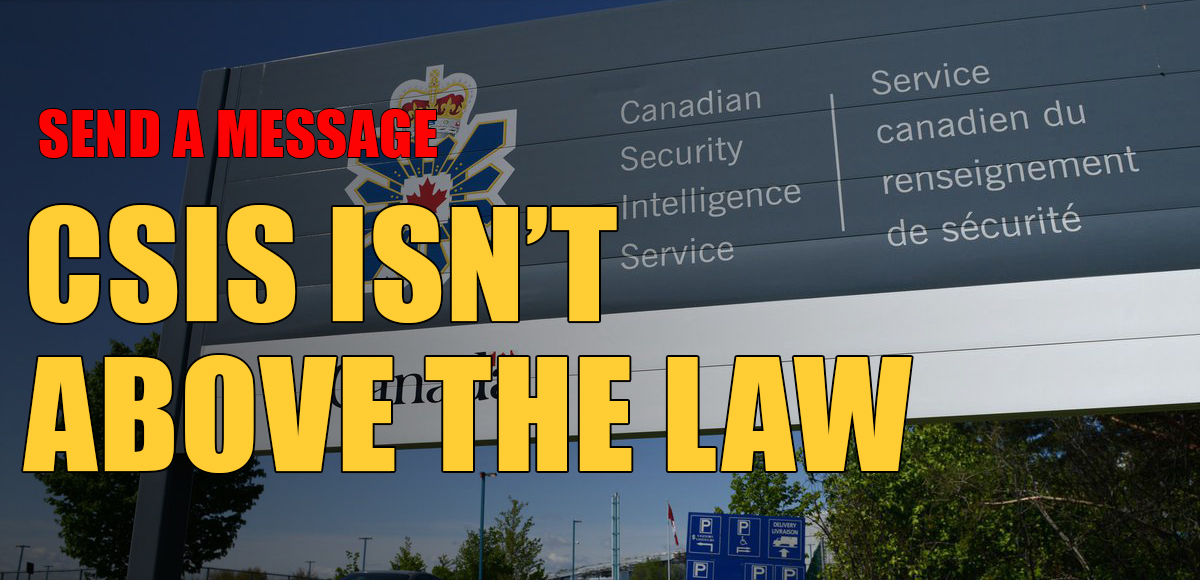
In recent years, at least three court decisions revealed the Canadian Security and Intelligence Service (CSIS) engaged in potentially illegal activities and lied to the courts. This is utterly unacceptable, especially given that this is not the first time these serious problems have been raised. CSIS cannot be allowed to act as though they are above the law.
Send a message to the Public Safety Minister demanding that he take immediate action to put an end to this abuse of power and hold those CSIS officers involved accountable. Your message will also be sent to your MP and to the Minister of Justice.
| | Reform Canada's extradition law now! | |
Canada’s extradition system is broken. One leading legal expert calls it “the least fair law in Canada.” It has led to grave harms and rights violations, as we’ve seen in the case of Canadian citizen Dr Hassan Diab. It needs to be reformed now.
Click below to send a message to urge the Prime Minister, the Minister of Justice and your MP to reform the extradition system before it makes more victims. Thank you!
Version française: Le Canada doit réformer la loi sur l'extradition!
| | Canada must protect encryption! | |
Canada, with other G7 nations, continues to push to weaken our access to strong, reliable encryption, after decades of being supportive of strong encryption. We need encryption to safeguard our data, our online transactions, our communications, and to protect the lives of journalists and human rights activists.
Please send a message to the Prime Minister of Canada, the Minister of Public Safety, as well as your Member of Parliament, to urge them to reverse course and once again commit to protecting encryption.
Regardez la vidéo avec les sous-titres en français + Agir
| | Protect our rights from facial recognition! | Facial recognition surveillance is invasive and inaccurate. This unregulated tech poses a threat to the fundamental rights of people across Canada. Federal intelligence agencies refuse to disclose whether they use facial recognition technology. The RCMP has admitted (after lying about it) to using facial recognition for 18 years without regulation, let alone a public debate regarding whether it should have been allowed in the first place. Send a message to the Prime Minister and the Public Safety Minister calling for a ban now. | | What we've been up to in the first half of 2026! | |
ICLMG 01/07/2026 - Thanks to the support of our members and donors, we were able to do a lot and work on the following issues since January:
- State surveillance bill C-22
- New social media and online harms bill C-34
- Impacts of Countering Terrorism Financing on charities, non-profits, solidarity work and international assistance
- Canada’s complicity in torture
- Islamophobia and anti-Palestinian racism
- Artificial Intelligence regulatory frameworks & national security
- Canada's No Fly List
- Foreign interference regulations
- Xenophobic bill C-12
- Anti-protest and anti-freedom bill C-9
- Review of Canada’s 7th report on the International Covenant on Civil and Political Rights
- UN Global Counter-terrorism strategy
- We were interviewed or quoted in a dozen media pieces
- We published our News Digest every two weeks
-
Our National Coordinator, Tim McSorley, received CMPAC’s 2026 Community Partner Award
Read our full summary of activities for the first half of 2026 and our plan for the rest of the year
| | Les opinions exprimées ne reflètent pas nécessairement les positions de la CSILC - The views expressed do not necessarily reflect the positions of ICLMG. | | |
THANK YOU
to our amazing supporters!
We would like to thank all our member organizations, and the hundreds of people who have supported us over the years, including on Patreon! As a reward, we are listing below our patrons who give $10 or more per month (and wanted to be listed) directly in the News Digest. Without all of you, our work wouldn't be possible!
James Deutsch
Bill Ewanick
Kevin Malseed
Brian Murphy
Colin Stuart
Bob Thomson
James Turk
John & Rosemary Williams
Jo Wood
The late Bob Stevenson
Nous tenons à remercier nos organisations membres ainsi que les centaines de personnes qui ont soutenu notre travail à travers les années, y compris sur Patreon! En récompense, nous nommons ci-dessus nos mécènes qui donnent 10$ ou plus par mois et voulaient être mentionné.es directement dans la Revue de l'actualité. Sans vous tous et toutes, notre travail ne serait pas possible!
Merci!
| | | | |