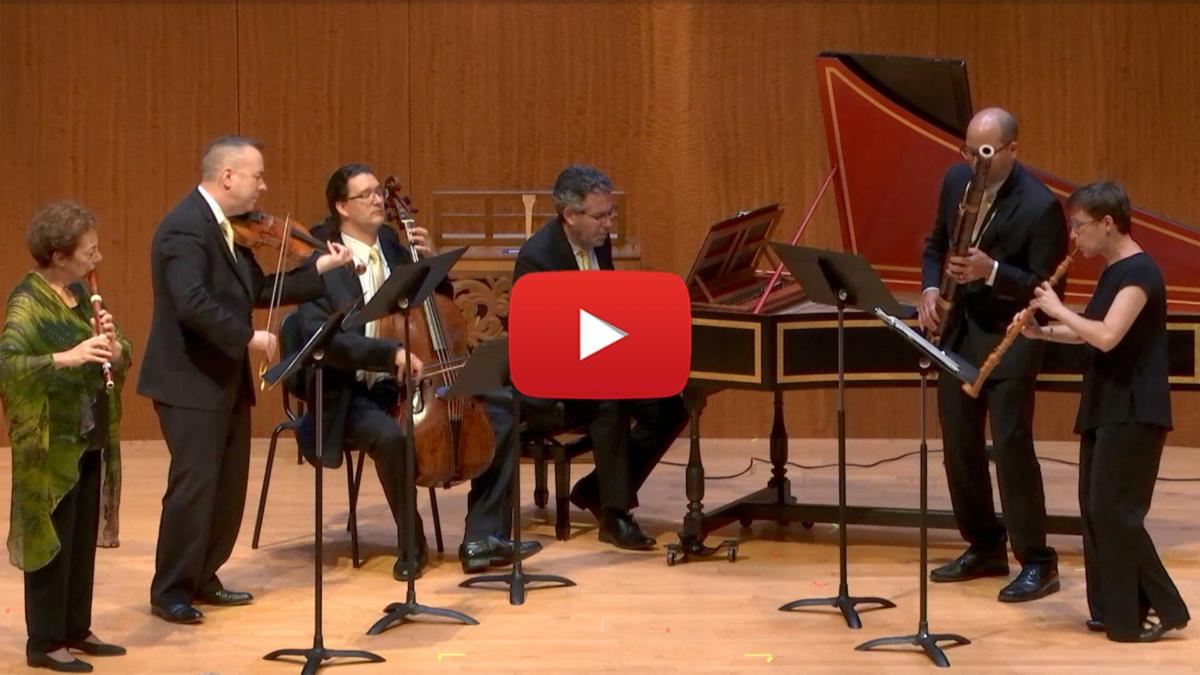
Notes About the Music by Steven Lehning
Joseph Bodin de Boismortier was perhaps one of the musicians and composers who best represented the spirit of his time (and place). Although we know nothing about his early training, we do know that he was an exceptionally gifted performer on both the violin and flauto traverso (the latter was always his first choice).
While living in Paris he was extraordinarily prolific, and much of his work was also published. Primarily through those publications, he was one of a very elite group of artists who were able to make a good living without the support of a major institution or a wealthy and influential patron. He was keenly aware of the Parisian public’s desire to explore more Italianate music, and he was able to adapt qualities of the Italian style into his own sonatas and concertos. This was a very desirable talent. As the opera and cantata composer André Campra observed, a composer who had the ability to “meld the delicacy of French music with the vivacity of Italian music” would be welcomed by Parisians.
Alongside predictable solo and trio sonatas, cantatas, motets, etc., Boismortier published works for a variety of instrumental combinations, both with and without the expected Basse continue (Basso continuo). There are works for flute and violin only, for two musettes (a type of French bagpipe), two violas da gamba, and for two or three flutes, or even more, all without a bass. Flute participants in prior Academy years have been delighted when their studio had enough people to play his compositions for five flutes alone!
His output was vast. Between 1724 and 1747 he released over 100 music publications. The author Pierre-Louis D’Aquin de Chateau-Lyon wrote in 1754 that the “fertile Monsieur Boismortier composed light and pleasing things and all that he gave to the public quickly sold. He came at the right time; people were avid for these pleasant trifles, which have a very attractive effect on the flutes and musettes: he took advantage of the current fashion, and made double use of his talent.”
However, D’Aquin de Chateau-Lyon continues, “his reputation would have been unalloyed had he possessed the discretion to publish but a portion of his works.” This is unfortunate, for within his tremendous corpus hides tremendous art. This was noticed even 30 years after Boismortier’s death by Jean-Benjamin de Laborde in his Essai sur la musique ancienne et moderne (1780): “Even though his works be long forgotten, whoever might undertake the task of exploring this abandoned mine might well find enough flecks of gold to produce an ingot.”