The RNA Transcript, November 9, 2020 |
|
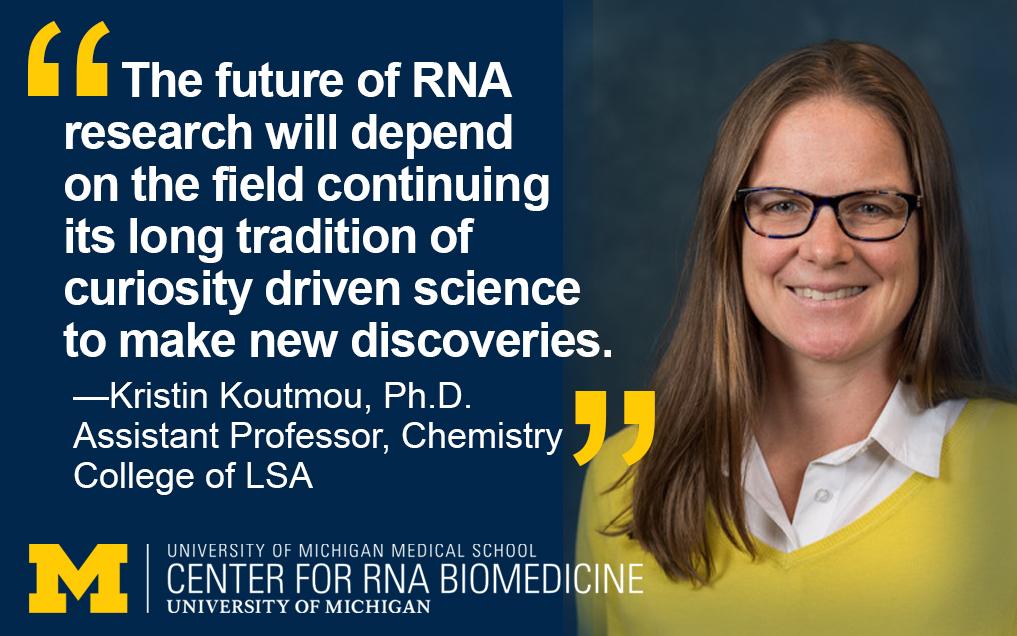
Cells face the daunting challenge of synthesizing the correct number of proteins at the right time with high fidelity. My lab studies how cells control the process of protein synthesis by the ribosome. We are developing and implementing analytical, biochemical, and biophysical approaches to generate a quantitative, mechanistic framework for understanding how mRNA sequence, peptide sequence, and RNA post-transcriptional modifications impact translation. |
|
Tuesday, November 10, 3:00 PM EST | Harvard Medical School RNA Medicine Seminar
“Y Chromosome LncRNAs and Radiation Sensitivity in Lung Cancer: Don’t Lose Your Maleness!”
Ivan Martinez, Ph.D., Associate Professor, School of Medicine, Department of Microbiology & Immunology, West Virginia University Cancer Institute
|
|
Thursday, November 12, 11:00 AM EST | Harvard Medical School RNA Medicine Seminar
Ioannis Vlachos (www.non-coding.org), Director of the Bioinformatics Unit at the Non-coding RNA Precision Diagnostics and Therapeutics Core, HIRM, BIDMC.
|
|
Monday, November 16, 4:00–5:00 EST | U-M Center for RNA Biomedicine, RNA Innovation Seminar Series
"Splice-switching Antisense Oligonucleotides for the Treatment of Disease"
Professor, Cell Biology and Anatomy; Director, Center for Genetic Diseases, Rosalind Franklin University of Medicine and Science
|
|
Weeks of November 16, and November 30 | NSF Grants Conference
The National Science Foundation (NSF) is hosting its first-ever NSF Virtual Grants Conference taking place during the weeks of November 16 and November 30, 2020.
|
|
“Targeting telomerase RNA in degenerative diseases”
“Role of coding and non-coding genes in aggressive thyroid cancer”
Moderator: Frank Slack, Ph.D.
|
|
Registration and abstract submission for the 2020 Bay Area RNA Conference are now open: https://barc.ucsf.edu
Once you are registered, you may submit speaker/poster presentation abstracts on your profile page, ie “Submit a New Presentation.” Deadline for abstract submissions: November 01.
|
|
Our members' publications are available through Altmetric. Five queries are currently available: "RNA," "microRNA," "Transcriptome," "Translation," and "Molecule." Please make sure to have at least one of these key words in your title or abstract. Below are recent highlights.
|
|
UAE1 inhibition mediates the unfolded protein response, DNA damage and caspase-dependent cell death in pancreatic cancer
Yajing Liu, Sahezeel Awadia, Amy Delaney, Merna Sitto, Carl G. Engelke, Heli Patel, Andrew Calcaterra, Sylvia Zelenka-Wang, Hojin Lee, Joseph Contessa, Nouri Neamati, Mats Ljungman, Theodore S. Lawrence, Meredith A. Morgan and Alnawaz Rehemtulla
Translational Oncology, 2020-11-01, Volume 13, Issue 11, Article 100834
Highlights
• Inhibition of Ubiquitin activating enzyme 1(UAE1) leads to an accumulation of misfolded proteins within the ER.
• Persistent drug treatment mediates a robust induction of apoptosis in mouse models of Pancreatic Cancer demonstrating antitumor activity at a dose and schedule that did not exhibit obvious normal tissue toxicity.
|
|
High-throughput small molecule screening reveals Nrf2-dependent and -independent pathways of cellular stress resistance
David B. Lombard, William J. Kohler, Angela H. Guo, Christi Gendron3, Melissa Han,
Weiqiao Ding, Yang Lyu, Tsui-Ting Ching5, Feng-Yung Wang, Tuhin S. Chakraborty, Zaneta Nikolovska-Coleska, Yuzhu Duan, Thomas Girke, Ao-Lin Hsu, Scott D. Pletcher and Richard A. Miller, Science Advances, 02 Oct 2020: Vol. 6, no. 40, eaaz7628,
DOI: 10.1126/sciadv.aaz7628
Here, we identify compounds that induced resistance to the superoxide generator paraquat (PQ), the heavy metal cadmium (Cd), and the DNA alkylator methyl methanesulfonate (MMS). Some rescue compounds conferred resistance to a single stressor, while others provoked multiplex resistance. Induction of stress resistance in fibroblasts was predictive of longevity extension in a published large-scale longevity screen in Caenorhabditis elegans, although not in testing performed in worms and flies with a more restricted set of compounds. Transcriptomic analysis and genetic studies implicated Nrf2/SKN-1 signaling in stress resistance provided by two protective compounds, cardamonin and AEG 3482. Small molecules identified in this work may represent attractive tools to elucidate mechanisms of stress resistance in mammalian cells.
|
|
A new, multidisciplinary cancer research grant is available to U-M graduate students and postdocs.
The Richard G. Hankett Memorial Grant Foundation (RGHG) supports university-level
multidisciplinary scientific studies on viral and bacterial infection-induced cancers. We welcome graduate student and postdoctoral scientists from chemistry, pharmacology, biochemistry, engineering, biology, and any related disciplines to apply for our 2021 grant.
The RGHGF is a crowd-funded research grant started by four U-M alumni. It offers approximately $13,500-14,000 to support academic research projects. Applications for the Fall 2021 grant are due by April 1, 2021.
|
|
|
|
SHARE YOUR NEWS AND COMMENTS
|
|
|
|
|
|
|