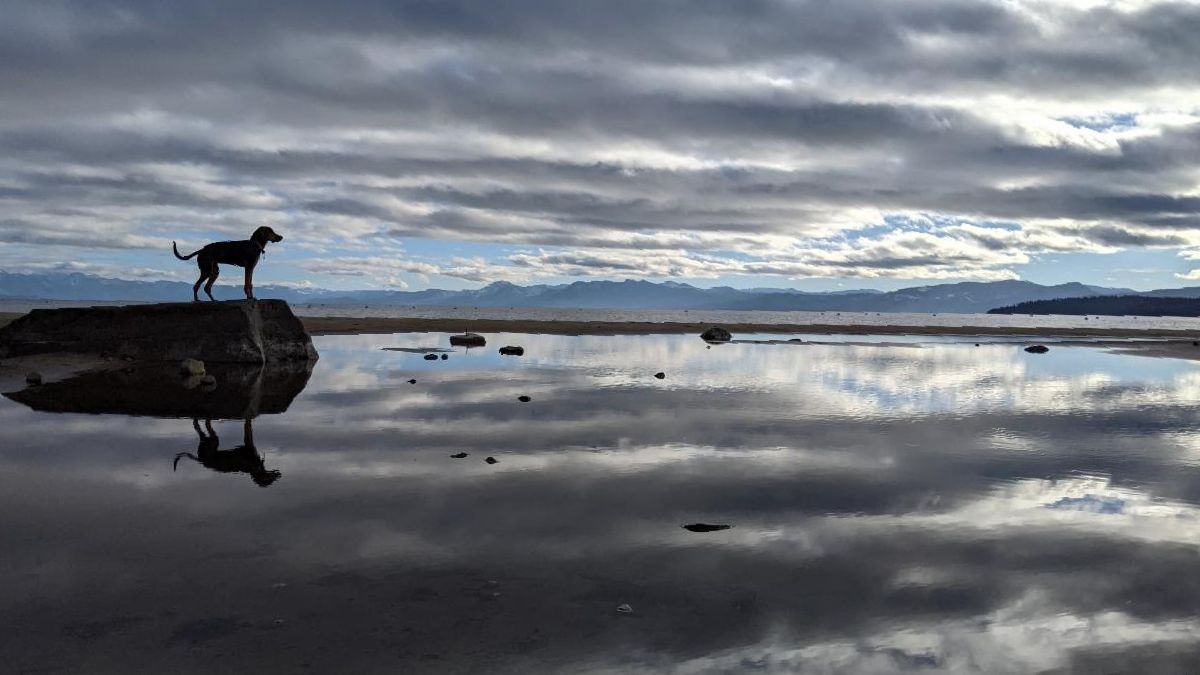
Lake Tahoe is commonly referred to as the “Lake of the Sky,” a fitting metaphor for the largest of high elevation lakes. But is it just a metaphor? Could there really be a lake in the sky? Seems that the answer is a resounding yes, according to some new research presented at the American Geophysical Union (AGU) Conference in December.

According to Brian Mapes of the University of Miami, atmospheric lakes are compact pools of moisture in the atmosphere. They are similar to atmospheric rivers (ARs) that stream across the Pacific Ocean to deliver intense precipitation to the west coast of North America. We are still recovering from a whole series of ARs that inundated us with record levels of snow.

Atmospheric lakes differ as they are more blob-like and move very slowly as they rotate, as seen in the GIF below. To date, they have only been observed in the Indo-Pacific and bring water to the dry lowlands along East Africa’s coastline.
Source: An atmospheric lake over the Indian Ocean (Brian Mapes/NOAA ERA-Interim reanalysis data set)

Could we ever experience an atmospheric lake over Lake Tahoe? Possibly. Global atmospheric conditions are rapidly changing with unexpected phenomena that seemingly occur more and more frequently. Let’s say we did have one. How much precipitation would that bring? According to Mapes, an atmospheric lake has enough moisture to produce a puddle approximately 600-mile wide and 2 inches deep. Translating that into Tahoe terms, if all that water was added to Lake Tahoe, it would represent a more than 250 ft. rise in lake level. But, as we all know, only the precipitation that actually falls within our watershed would actually flow into the lake. So, an atmospheric lake would more likely translate into less than a 1-foot rise in water level for Tahoe, but a lot of much water needed for California and Nevada.

Bring it on!
To learn more, update your UC Davis TERC mailing lists options, visit the UC Davis Tahoe Science Center in person, check out the UC Davis Tahoe YouTube channel, and stay social with us on Facebook, Instagram, and Twitter.

Support Science to Save the Lake