Elmo Peeler Note-for-Note Piano Transcriptions
|
|
|
Today is the first day of November and time again for my monthly newsletter to keep you informed of recent transcriptions and other news of the last month.
This month I have transcribed
|
|
 |
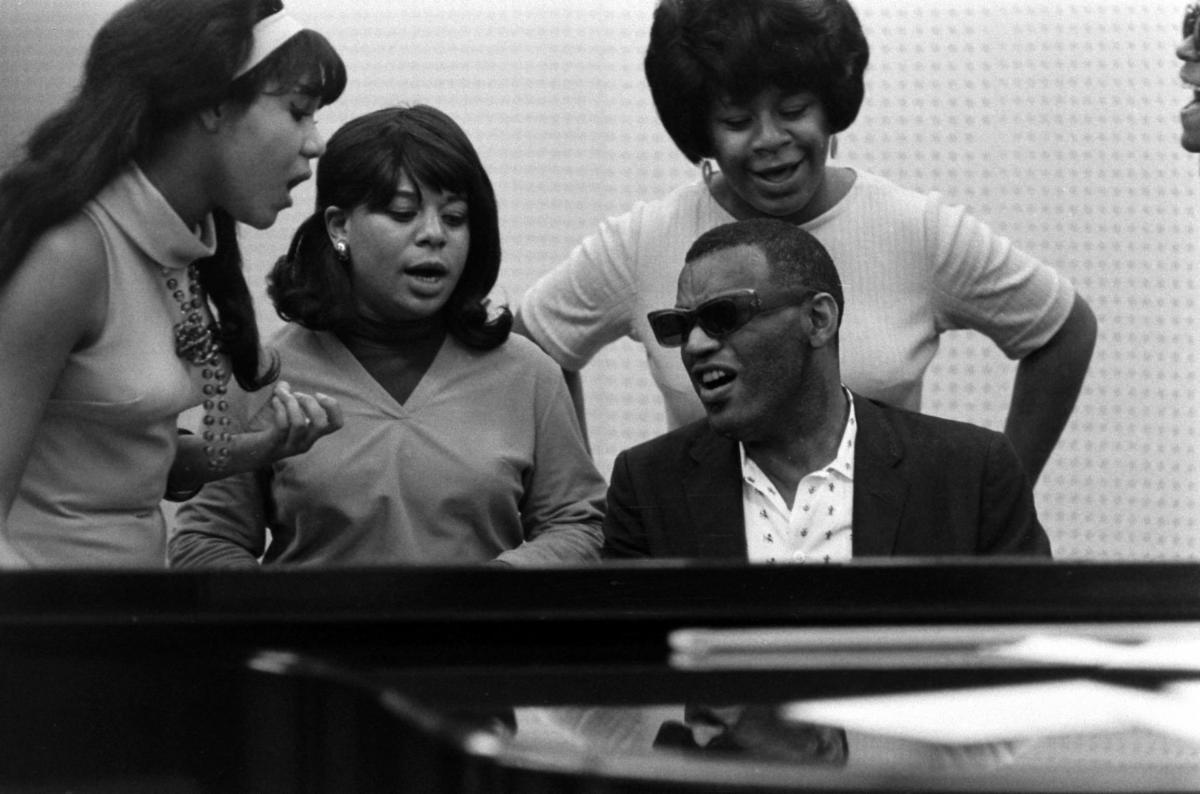
Ray Charles & the Raelettes (Clydie King, far left)
|
|
an extraordinary uptempo Ray Charles solo piano boogie-woogie - one of the very best piano instrumentals that he ever recorded - no exaggeration.
Like last month's Ray Charles slow blues instrumental, this rollicking uptempo piano gem was never heard for 52 years after its 1953 recording.
They both emerged in 2005 on the 7-CD comprehensive Rhino set,
Pure Genius: The Complete Atlantic Recordings (1952 - 1959).
Also new this month is an exercise for learning one of Ray Charles' favorite left-hand boogie-woogie patterns.
Plus, I've transcribed the haunting harmonica solo in Gilbert O'Sullivan's "Clair".
BTW, to make sure that my email doesn't end up in your Spam folder, please add me to your Contact list and/or mark my email as "Not Spam".
Note that every Title Heading is clickable.
Elmo Peeler
|
|
|
ALL of the Sheet Music listed on my website has been personally transcribed by me, and guaranteed to be note-for-note perfect.
Whether you:
-
have a cover band and want to get your keyboard parts exactly correct,
-
are a professional who wants to study the styles of rock's greatest keyboard players, or
-
are a hobbyist that wants to learn how to play pop/rock and great piano music,
...these note-for-note transcriptions will prove extremely helpful.
And as always, if you ever need any help, just drop me a note at: elmo@manymidi.com
|
In the News!
- Ray Charles - "Boogie Woogie" Instrumental
Another Truly Great Solo Piano Recording from the R&B/Jazz Genius
|
|
|
| Ray Charles - 'Pure Genius' |
|
This month may seem like a continuation of last month's newsletter -
déjà vu all over again - because they both feature Ray Charles, but it wasn't planned that way.
Last month when I transcribed his bluesy
"Heartbreaker", I hadn't planned to transcribe
"Boogie Woogie", not because I didn't like it - it was actually my favorite of the two - but because it seemed like too daunting a challenge, a project that would just take too much time.
However, since boogie-woogie is my favorite piano genre, and this particular recording is a sublime example of Ray Charles' genius elevating the boogie art form, I couldn't resist tackling the project. I myself wanted to know just how did he get those sounds, what were the voicings of those cool chords, exactly what was his left hand hand doing...
So I went to work, and after a lot of hours, managed to nail every note of Ray's amazing
"Boogie Woogie". I'm as proud of this transcription as I am of
"American Pie" or
"Green-Eyed Lady" because of the notes that Ray sets forth during those two amazing minutes.
As brilliant as Albert Ammons, Pete Johnson, and Meade 'Lux' Lewis certainly were in creating the boogie-woogie art form, Ray Charles, their musical equal, added his own elegant contribution in "Boogie Woogie".
|
|
|
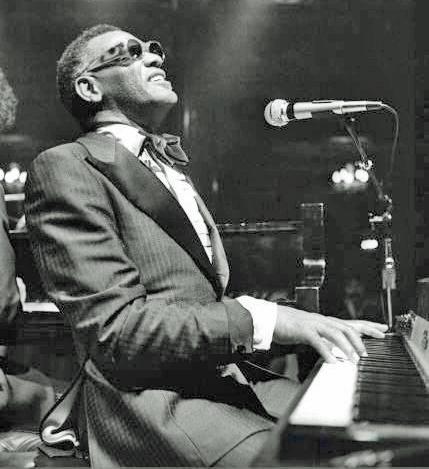
Ray Charles in concert
|
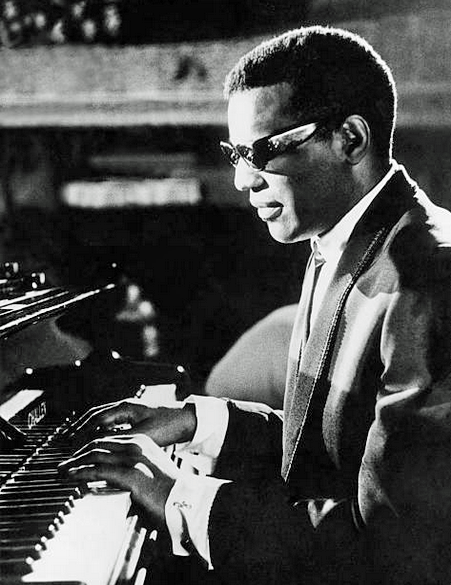
Not only are Ray's notes and rhythms wonderful but also listen to his bouncy, light, detached (but not totally staccato) touch - a unique touch never used by Ammons/Johnson/Lewis.
If you want to learn more about Ray's background, please re-read last month's newsletter, or see my
What's New page.
One of the 20th century's greatest musicians, he was gifted with perfect pitch, learned to play the classical piano music of Bach, Mozart and Beethoven using braille music, loved R&B and C&W, and could play straight-ahead jazz with the most cutting-edge players. He had it all.
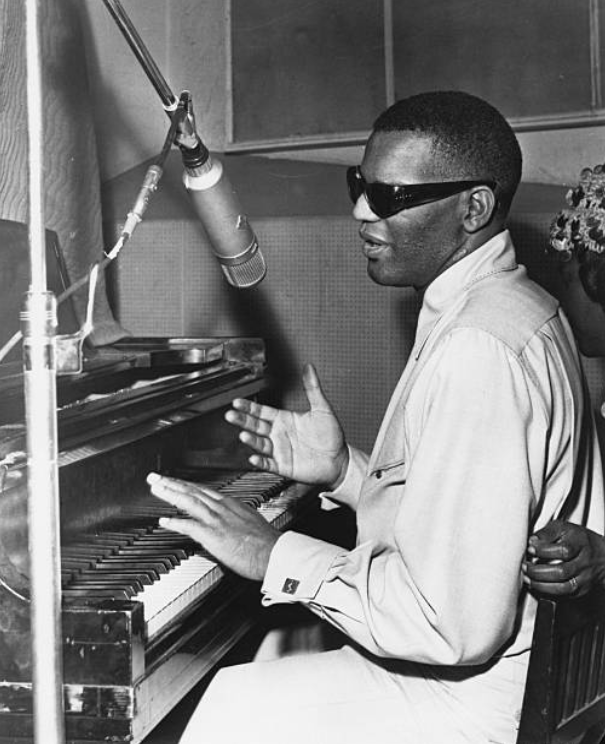
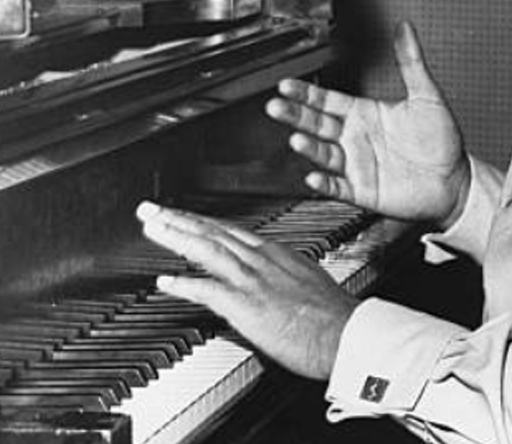
Back in 1953 with Ahmet Ertegun standing feet away in the NYC Atlantic studio, Ray recorded the rousing, foot-patting "Boogie Woogie" using only an acoustic piano - no other instruments, no vocals whatsoever - just young 22-year-old Ray Charles revealing his genius to the world through his piano and ten amazing fingers.
Here are my transcriptions of Ray Charles recordings:
If you haven't heard "Sweet Sixteen Bars" and you like blues or gospel piano, you owe it to yourself to
listen to it here - an amazing recording.
Also, Dr. John liked to play what he called the
'Ray Charles Ending', a cool walk-down progression that can sometimes be tacked onto the end of a piece.
|
November's New Transcriptions
- Ray Charles "Boogie Woogie"
Last month's newsletter announced one of my most historically important transcriptions yet - a remarkable, bluesey Ray Charles solo piano recording,
"Heartbreaker".
I'm proud that this month I've matched that achievement, and perhaps exceeded it.
At the same 1953 session that produced last months' "Heartbreaker", Ray also recorded another solo piano masterpiece - a rollicking uptempo (185 BPM) boogie-woogie that truly blows out the jams - only Ray's piano, without vocals or any other instruments to distract from those sublime, flying ivories - appropriately titled
"Boogie Woogie".
Based upon a bouncy, propulsive left hand boogie pattern, "Boogie Woogie"'s right hand includes lots of great piano tricks: from exquisitely dissonant quarter-note triplets to bluesy sixths to hugely fat 6-note chords. And one chorus (the 3rd, at 1:04) swaps the normal 5ths-based L.H. pattern for a broken-octave walking arpeggio that really raises the roof.
In 1953 Ahmet Ertegün put 22-year-old Ray into the studio and recorded "Boogie Woogie" and "Heartbreaker", which was the B-side to "Feelin' Sad", his fourth single for Atlantic Records.
Gifted with perfect pitch, Ray Charles was a spectacular improviser, as comfortable in jazz as in R&B. During that session Ray recorded an instrumental piano solo version of "Boogie Woogie" that would not be released until 52 years later, on a 2005 compilation,
Pure Genius: The Complete Atlantic Recordings (1952 - 1959).
Ray's "Boogie Woogie" is almost two minutes long, a total of seven amazing 12-bar-blues stanzas of nothing but Ray on piano - no vocals, no other instruments. During those seven 'chapters' Ray gives a seminar on boogie-woogie piano-playing.
This is a note-for-note transcription of the entire recording - all 88 bars, complete with Performance Notes explaining the nuances and suggesting fingering for those huge 6-note chords.
Every phrase is classic Ray Charles - a boogie-woogie piano seminar, demonstrated in 88 bars. If you like Brother Ray, it's hard to do better than this rousing classic, hidden for 52 years.
Also new this month is my transcription of the hauntingly beautiful harmonica solo in Gilbert O'Sullivan's 1972 hit, "Clair". It was played by three-year-old Clair's father, Gordon Mills, who happened to be Gilbert O'Sullivan's manager and an award-winning harmonica virtuoso. This transcription of the 8-bar solo also contains the bass guitar line during the harmonica solo.
(click here to hear the harmonica solo in "Clair")
|
November's New Exercise - Ray's Boogie-woogie Left Hand
Learn One of Ray Charles' Favorite Left Hand Patterns
The Left Hand phrase that Ray Charles uses in his 1953 recording of "Boogie Woogie" is a classic variant on 5ths-based boogie patterns. His version uses not only the open-fifth sound but also adds a sixth.
This new exercise will help you gain proficiency in this wonderful - and important - boogie-woogie left hand pattern.
It contains three parts, each one a little more difficult than the previous one.
The first gives you repetitive practice on the pattern while starting to introduce simple coordination-challenging 'stabs' in the Right Hand.
The second increases the coordination challenge with more difficult Right Hand 'stabs'.
And the third section goes beyond Right Hand 'stabs' and introduces a riff loosely based upon a riff in Ray's 1953 recording of "Boogie Woogie".
By the time you master these three sections, you should be well on your way to having added a classic, important boogie pattern to your repertoire - one that Ray Charles got a lot of mileage out of.
|
'Crowdfund' a Transcription - What Do You Want To Play?
Submit Your Own Suggestion
'Custom' (to-order) transcriptions can be expensive because of the time required. And when a recording is particularly long and/or complex, the expense can be too much for one person.
if you'd like to suggest a transcription - a complete song, or perhaps just a keyboard solo.
My 'CrowdFunded' transcriptions to-date:
|
This month is a good time to reflect upon the many blessings each of us has been given, and the ability to make music is one of the most special.
If you'd like to cultivate your own talent, and learn to play at a significantly higher level, feel free to call me and talk about it (323-650-6602).
I've
toured the world playing keyboards and arranging/conducting for these Rock and Roll Hall of Fame Artists:
- The Beach Boys
- Ricky Nelson - Stone Canyon Band
- Rod Stewart - All 'Unplugged' concerts
I've also won classical piano competitions performing Beethoven, Rubinstein and Saint-Saens' Piano Concerti. See me playing here. "Josie's Boogie" is quite the virtuoso dramatic minor-key showpiece; check out the ascending double-octave run at the ending... :)
Thanks to the internet, I can help you play piano better - rock or classical, by ear or by note.
Perhaps all you need is just an hour or two on Skype discussing rock keyboards.
If you're serious about wanting to improve, drop me a note at info@manymidi.com. Tell me three things:
1) Your musical background
2) Where you are currently, musically-speaking
3) Your musical goals
My students include members of:
- Weezer (Rivers & Brian)
- Vampire Weekend (Ezra & new addition, Greta)
- Incubus (Mike)
- The Strokes (Nick)
- Rooney (Robert)
- Jason Schwartzman ("Mozart in the Jungle")
- Courteney Cox
- Sasha Spielberg
|
|
|
|
|