|
How the Budget is Funded
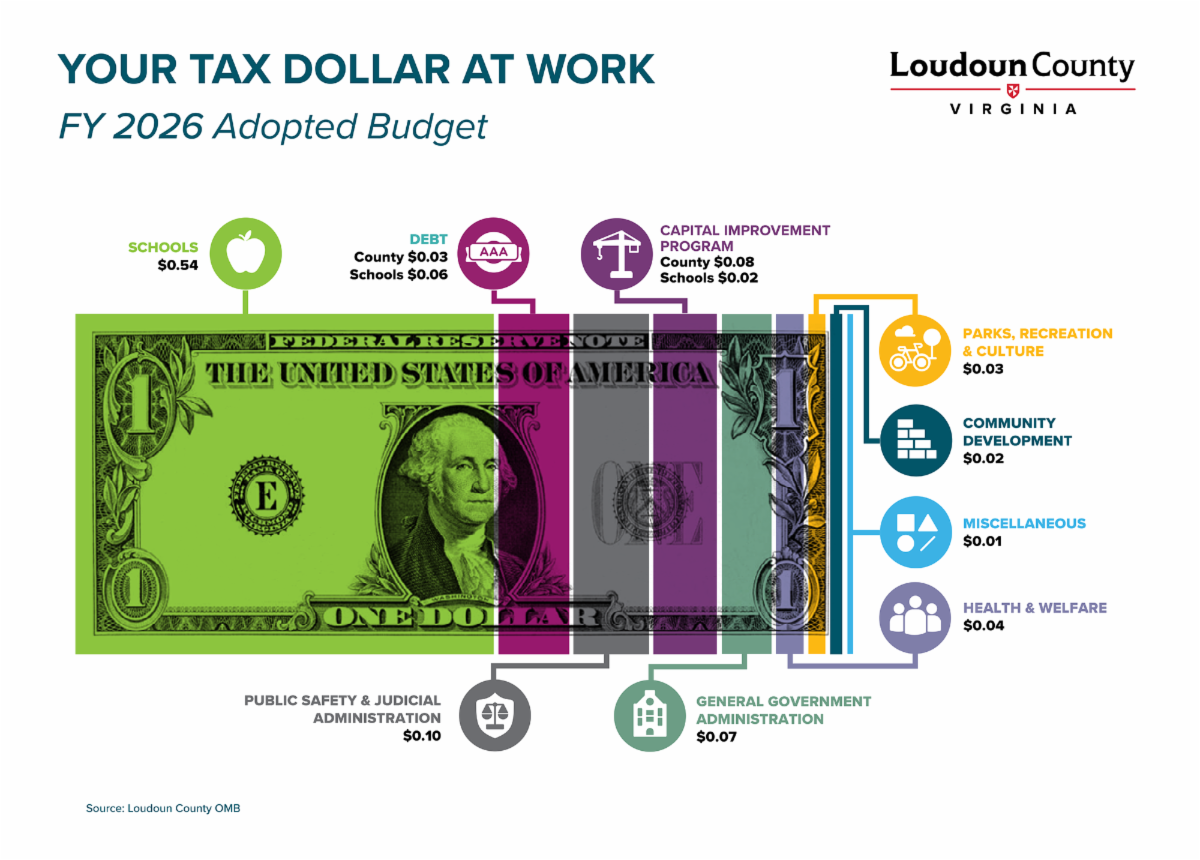
The County budget each year consists of both the operating budget, which funds County departments and keeps the local government running efficiently throughout the year, and the six-year Capital Improvement Program (which I’ll be referring to throughout this document as the CIP), a funding plan of future road, school, park, and other infrastructure projects. The two components of the budget are funded differently. The operating budget is funded primarily through local tax revenue out of the tax rates discussed above. The CIP is funded from a variety of different sources and is fiscally constrained, which means we can’t fund everything we want every year. In any given budget cycle, CIP projects receive funding from sources such as General Obligation Bonds, local tax collection, Northern Virginia Transportation Authority (NVTA) funds, and state revenue matching grants. I will note that the County once again received AAA bond ratings from the nation’s leading credit rating agencies, which allow us to borrow money for capital projects at the lowest possible interest rate. New criteria in place highlighted the County’s diverse and resilient economy, and our strong long-term fiscal outlook.
LCPS Budget
As you’ll recall, the Board of Supervisors is responsible for funding Loudoun’s public schools, but we do not have line-item authority over their final budget. The LCPS budget request this year totaled $1.95 billion, which we are fully funding. This request represented a 7.2% increase over FY25, which translates to about $131.7 million. About 90% of the budget will cover personnel costs, including new positions and increased benefits and compensation for staff (4% cost of living adjustment and 4% strategic teacher scale adjustment resulting in an average pay increase of 5.5%). New budgeted positions include teachers and teacher assistants for English Learner and Special Education students, as well as maintenance and technology staff. Other items include behavior support, additional athletic trainers, new programs such as Recovery School and ACCESS Academy with George Mason University, funding to cover increased operational costs due to inflation, and improvements to school safety.
I have expressed concerns with the growth of the school budget in light of limited enrollment growth. The Superintendent has explained that many of the personnel costs have risen due to a continued increase in IEPs and special education services, as well as safety and security enhancements. I am hopeful that this year’s budget will catch the system up in those areas and that we won't see a similar level of growth next year.
County Government FY26 Operating Budget
During the budget process, the Board goes through each County department individually to evaluate enhancement requests and ask questions about existing expenditures. As always, my personal philosophy is to get the tax rate as low as possible while still funding important initiatives and departmental requests to ensure a high level of public service. Thanks to increased revenue, we are able to start at a lower tax rate and still fully fund requests, fiscal reserves, and initiatives for FY26.
Transportation
Staffing in the area of transportation has grown significantly over the past several years. This growth is primarily driven by the County’s aggressive Capital Improvement Program (which I will address later) and growing transit operations. This year, the Board is funding six new positions for administrative and planning support, which will allow the department to plan for future growth and match demand for land development referrals - which are not usually processed within time requirements under current levels of staffing. The portion of the CIP for which the department is responsible has grown rapidly in recent years – since FY20, the total dollar amount of projects has increased by 32% and the number of transportation projects by 37%.
Sheriff’s Office
The Sheriff’s Office is receiving about $128 million in local tax funding this year, up from $123 million last year. The first departmental request was the conversion of six temporary positions into full time positions to meet growing workloads: an administrative assistant, public information officer, two civilian background detectives/investigators, a civilian financial crimes investigator, and an inmate program assistant for the Adult Detention Center. LCSO’s largest addition is seven second lieutenant and six sergeant positions for Patrol Operations. LCSO is planning to implement a third shift model, and these positions are necessary to improve resource efficiency and response times. Funding these positions also supports the long term goal of decentralizing the Patrol Division, which was one of the recommendations of the 2021 study conducted by the International Association of Chiefs of Police. Finally, we are providing one new uniformed position (first lieutenant) and three new civilian positions (two victim advocates and a victim advocate supervisor) to the Victim Advocate Unit. These positions will enhance service to individuals who are the victims of crimes and provide professional civilian support. These positions will support victims of domestic violence, sexual assault, etc.
Commonwealth’s Attorney
The Office of the Commonwealth’s Attorney is receiving an administrative assistant to meet service level expectations and remove some of the burden from paralegals and other assistants. This position will support administrative work associated with the County’s body-worn camera program, misdemeanor cases, and more. The department is also receiving a program manager for their Sexual Assault Response Team (SART), which coordinates the multidisciplinary response to criminal sexual assault mandated by Virginia Code. The addition of a program manager enhances reporting capabilities and data collection. The volume and severity of criminal behavior in this field is expected to continue growing at about 1.5% in tandem with the County’s population, so this new position is an unfortunate necessity.
Fire-Rescue
The Loudoun County Combined Fire and Rescue System is receiving a lot of new staffing to prepare for the opening of new facilities. The Aldie Fire and Rescue Station, which will come online this summer, gets 31 positions to ensure it is fully functional upon opening. The old, outdated volunteer-owned station is being replaced with a modern, well-equipped, County-owned facility. The request covers increased engine staffing as well. Similarly, nine new positions are being added for the Round Hill Fire and Rescue Station, which will be operational in late FY26. Like in Aldie, this request increases engine staffing and adds a dedicated tanker driver as well as addressing other operational needs that will greatly improve response time and internal efficiency.
Fire-Rescue is receiving two new quality assurance and quality improvement positions to address recommendations made in the Silver Ridge Incident Investigation Report, which came about after the disastrous explosion that resulted in the death of a firefighter in Sterling last year. These two new positions will enable LCFR to expand reviews beyond EMS calls to all critical incidents, which in turn helps identify training needs and optimizes system performance.
Parks & Recreation
Parks & Recreation always has a lower percentage of local tax funding because the department charges for some services based on what it costs to provide them, such as admission fees to the Recreation Center, preschool tuition, and after school programs.
In the FY26 budget, we are adding an arts manager and arts curator to support the development of a Countywide Arts Program, as well as $240,000 in funding to conduct verification and enforcement of park boundaries by a professional surveyor to ensure proper management and protection of resources in the County’s parks. A natural resources manager is funded to support the Board of Supervisors’ Linear Parks and Trails Program, which is a 10-year plan that seeks to enhance the trail system Countywide and construct missing links. LPAT is also receiving two new trail crew members to perform enhanced maintenance.
Library Services
This year, Library Services is receiving an Assistant Division Manager for Branch Services to support the division manager – who is responsible for overseeing ten branch managers and indirectly supervises over 84% of all staff in the department. Branch staffing levels have increased by 42% due to recent growth, so another oversight position is necessary to keep pace with rising demand. The County’s libraries remain a vibrant place for students and adults alike. Local tax funding to our library system has increased over $5 million since FY23, with another $1 million increase anticipated in FY27.
Health & Welfare
This year, we are funding 15 new positions in the Public Benefits Unit of the Department of Family Services. DFS and other health-related needs have been steadily on the rise in recent years, exacerbated by the COVID-19 pandemic. These positions will help DFS scale the organization while maintaining adherence to state and federal regulations. The Public Benefits Unit saw an 83% increase in caseload size from FY20-FY24, again mostly driven by COVID and a growing population. Last year, we added new positions to reduce cases to 1,008 per service worker – a ratio that was still far too high. The new positions – which include eight public benefits specialist, one public benefits case reviewer, one public benefits supervisor, two program assistants, fulltime conversion of a public benefits specialist, one internal auditor, and one administrative assistant – will bring that ratio down to 900 cases per service worker, which is still on the high end of the 550-850 regional average but is trending in the right direction. We are also giving DFS seven customer service positions across locations in Leesburg and Sterling, as well as three new employees for Adult and Aging Services: the County’s older adult population is expected to grow by 162% by 2030, which means increased demand for services. Finally, we are adding eight positions in the Domestic and Sexual Violence Services unit, which will improve organizational structure and supplement the County’s Domestic Abuse Response Team, which is often the first responder to high-risk situations.
Loudoun’s Health Department, which is now locally administered, is receiving five new positions to support safety net services and communicable disease prevention teams. Current staffing in the department is unable to meet increased demand for two critical programs: Long Term Services and Supports screenings and Tuberculosis care programs, which are currently managed by the same staff. We are adding two positions to support the department’s Rabies Program, a disease which is on the rise as more rural development and population growth leads to more encounters with potentially rabid animals. The Health Department investigated over 1,400 animal exposure cases last fiscal year, up from 885 in FY19.
The County continues to invest heavily in our Department of Mental Health, Substance Abuse, and Developmental Services, committing to mental health care as a critical component of overall health. This year, we are funding operations and an administrator for the Crisis Receiving and Stabilization Center, which will provide urgent psychiatric care, 23-hour assessment, and a Crisis Stabilization Unit for those experiencing a mental health emergency. We are also funding thirteen positions to support increased caseloads expected from the Governor’s “Right Help Right Now” plan to provide Medicaid Developmental Disability Waivers to approximately 3,440 individuals with intellectual and developmental disabilities in Virginia. In FY26, MHSADS is the mandated provider for case management services to about 250 individuals with such a waiver. Finally, we are funding an Opioid Response Program coordinator, which was previously a part-time position and oversees the department’s response to opioid overdoses and crisis addiction treatment.
Affordable Housing
The County continues to dedicate the equivalent of one cent on the tax rate to meeting the goals of the Unmet Housing Needs Strategic Plan. Affordable housing is a regional issue and local governments are limited in what we can do to affect change in this area, but we continue to try. Interest rates continue to be a major driver of housing affordability, and since we seem to be done with an extended period of low interest rates, they are having a major impact on housing affordability.
For the County this year, $17.3 million is set aside for affordable housing, up from $7.4 million last year and bringing our total to $35.9 million since we began dedicating money each year from the tax rate. We have other tools at our disposal that we continue to utilize in the quest for affordable housing as well: the state and federal Rental Assistance Programs, Community Development Block Grant funding, and our Housing Trust Fund, which supports various County initiatives and programs such as the Affordable Multi-Family Housing Loan Program.
Several of the positions added in various departments will also support affordable housing programs and initiatives.
Employee Compensation
Most of our annual operating budget consists of personnel costs, and the tight labor market is a major driver of budget increases. The FY26 budget includes an additional $24.7 million for employee compensation, including a 4% merit increase for the general workforce, a 5.5% average pay increase for Fire & Rescue, and an 8% average pay increase for the Sheriff’s Office. We closely track our competitor pay scales and provide adjustments as needed.
The County has also recently agreed to collective bargaining contracts with the Service Employees International Union (SEIU) for the general public employee workforce and the International Association of Fire Fighters (IAFF) for Fire-Rescue employees. The SEIU contract has a three-year expected cost of $42.8 million with funding subject to annual appropriation and contingent on budget adoption, and the IAFF contract has a three-year expected cost of $47.2 million. The FY26 budget contains funding for both agreements.
Other Departments
There are a few other new positions to highlight:
- Elections and Voter Registration: We are adding a position to support early voting, which will be necessary when the Board’s two new approved satellite early voting sites in the Ashburn area come online.
- General Services: We are committing $1 million of funding to the pilot program for commuter bus service into Loudoun County. This program will test three morning and afternoon trips per day from Dale City, VA and two morning and afternoon trips per day from Frederick, MD. The initial fare will be $8.25 with reevaluation after one year of operations. This pilot program comes in response to a study which indicated that employers are having a hard time getting employees from out of the County since there are limited transportation options. Many of our local bus routes have seen diminished ridership since the pandemic, so I had the idea to repurpose some of our buses for commuter service into the County. I am eager to see how the pilot goes. Also in General Services, we are funding a Countywide LED streetlight program, adding a flood mitigation program manager, and funding the Stewardship Management Plan for County properties.
- Human Resources: We are adding a Human Resources Information Systems specialist to address the creation, management, and control of positions within the department’s management systems.
- Animal Services: We are adding new positions to meet service level objectives in foster care, clinic services, and humane law enforcement. These positions allow for better workload distribution.
- Planning and Zoning: We are adding ten positions to improve the development review process in one of our more crucial and overworked departments at the County. An assessment of the department conducted in 2024 found some issues with efficiency and quality of the process that these positions are intended to address. Response times will improve and senior staff will be freed up to work on more complicated applications and respond to higher priority requests.
Six-Year Capital Improvement Program
FY26 is an amendment year for our six-year Capital Improvement Program, which totals $3.5 billion for the entire six-year period. An amendment year means that no new projects are added, but existing ones are updated. All Dulles District projects are still on track. Transportation projects total $1.4 billion (40% of the CIP), County projects total $1.1 billion (32%), and school construction and renovation projects total $996 million (28%). Local tax funding accounts for $750.9 million in the six-year CIP, debt financing about $2.3 billion, and intergovernmental assistance (federal, state, etc.) about $434.4 million. We are constantly on the lookout for ways to fund and accelerate projects in our CIP, and that often includes applying for government grants and seeking multiple sources to coalesce around a single project.
I will cover the projects in the CIP that are of interest to residents in the Dulles District. If you read my newsletters or received my annual report mailer, you’ll recognize the information here. Since this is an amendment year for the CIP, nothing has changed since my month-to-month reporting, but I know people still find it useful to have all the projects in one place. I’m only covering projects that are still in our CIP for future planning here. I continue to discuss completed and in-progress projects, as well as projects proffered by developers, in my monthly newsletters, which you can find here.
Arcola Mills Drive
Arcola Mills Drive (previously Evergreen Mills Road) will be widened from Belmont Ridge Road to Stone Springs Boulevard at a total cost of $72.3 million. Construction funding becomes available in FY29. This portion of Arcola Mills Drive will be a three lane roadway with a continuous left turn lane between Belmont Ridge and Stone Springs. Construction includes intersection improvements at Belmont Ridge and Stone Springs and a new bridge over the South Fork of the Broad Run. The road will feature a sidewalk on one side and a shared use path on the other. Design work has commenced.
Braddock Road Projects
The widening project on Braddock near the Gum Spring intersection has taken longer than expected, mainly due to delays with utilities, but final paving is complete with striping and signage due next week. All signal modifications are also in place and operational.
Braddock Road will also be widened to four lanes from the eastern entrance of Paul VI to Loudoun County Parkway. Construction is expected to begin in FY27. The total project cost is $43 million, and the Board endorsed the location and design guidelines for the project last fall. The project also includes construction of shared use paths on both sides of the road. Utility relocation and land acquisition are funded this year.
In 2023, Fairfax County approved an agreement with VDOT to move forward on improvements to Braddock Road and Old Lee Road. This allows VDOT to begin preliminary engineering and design to straighten the “S” curve and intersection improvements as recommended in the safety study that was completed in 2020. This has been a major priority for me. Several years ago, I requested a VDOT study on the safety and operations of the Braddock Road corridor which led to action. Design is underway and could take another year or more before land acquisition and utility relocation will begin – which is required before construction and will likely be very challenging for this project. VDOT crews applied High Friction Surface Treatment (HFST) to the “S” curve in Fairfax County last year which seems to have provided some improvement, especially in wet conditions. I've sent recent updates about changes to the proposed project and won't get into details here, but the timeline is for construction in about 2028 and completion in 2030.
Just outside our district, Dulles commuters will be interested to know that a roundabout is planned for the intersection of Braddock Road and Trailhead Drive. Construction funding will begin in FY28 at a total expected cost of about $12.3 million.
A roundabout is also planned for the intersection of Braddock Road and Route 15. It is currently slated to receive $28.4 million in funding with construction funding becoming available in FY29.
Bull Run Post Office Road
Last year, I was able to get a project added to the budget to realign Bull Run Post Office Road, removing the two curves at Buffalo Run Lane and Holly Springs Lane between Cedar Ridge Boulevard and Souther Drive. In addition to realignment, this section of the road will be upgraded to current VDOT geometric and operational standards.
The project was not originally in the proposed plan, but I worked with staff to identify funding that had become available when another project elsewhere in the County was no longer needed. Bull Run Post Office Road seemed like a natural replacement given its priority ranking for safety improvements. Funding will come online in FY28 for design, land acquisition, and utility relocation. Construction will take place in future fiscal years after these preliminary steps are taken. The total cost of the project is estimated at $21.7 million. Despite the advanced timeline and project cost, I thought it was important to begin working on this.
Dulles West Boulevard
This four-lane median divided roadway between Arcola Boulevard and Northstar Boulevard will cost $81 million and include shared use paths on both sides of the road. It will further relieve Route 50 and allow for better traffic flow. Utility relocation and land acquisition is funded this year. Construction is expected to begin in 2026.
Northstar Boulevard
Northstar Boulevard will be widened from Tall Cedars Parkway to Braddock Road; the project is budgeted at $42.3 million with construction funding becoming available in summer of 2027. Design is underway and we recently received approval from VDOT to include a signal at Sacred Mountain in the widening plans. We had been planning for a pedestrian tunnel due to prior denials of a signal in this location. There will be a public information meeting on the design plan this summer.
Route 50 Corridor Improvements
The County is undertaking a project to make safety and operational improvements at several locations along Route 50 between Gum Spring Road and the Fairfax County line. These projects are being administered by VDOT and came out of a safety and operations study completed several years ago. Design work for these projects is underway and VDOT will be planning information sessions in the near future. We expect construction to begin as soon as next year.
• Gum Spring Road/Arcola Boulevard: A second left turn lane will be added from eastbound 50 to northbound Arcola Boulevard and the existing left turn lane will be extended.
• Pleasant Valley Road (west): Plans are still in place to convert a westbound left turn lane to a through lane and add an additional westbound through lane between Pleasant Valley Road and Tall Cedars Parkway.
Route 50/Loudoun County Parkway Interchange
VDOT is still reviewing the County’s application for an interchange as part of the Interchange Access Report process, which has taken a very long time, much to my frustration. The County has already allocated $130 million in the current six-year CIP for this project. Though our Capital Plan shows construction funding beginning to be allocated in FY30, the project is expected to cost about $300 million and will require regional, state, and federal dollars to bring to fruition. We received $32 million in NVTA funding and $1 million in federal budget earmarks that will help fund design and right of way acquisition.
Route 50 Northern Collector Road
The Route 50 Northern Collector Road would serve as an alternative to 50 that would connect from Tall Cedars Parkway to Route 28 at the Air and Space Parkway interchange. This may be the most challenging project we’ve ever attempted. I have been working with both MWAA and Fairfax County on the alignment. Fairfax has signaled their support for the project with plans to add it to their long-term transportation plan by the end of this year - an important new development since last year's update on the project.
The current cost of this project in the CIP is $445 million, which has been revised upward from the previous estimate of $246.9 million. Much of this increase is driven by costs associated with an underground tunnel portion of the road to travel beneath the taxiway connecting Dulles Airport to the Udvar-Hazy Air and Space Museum. While I think there are much more cost effective ways of managing the relatively rare air traffic entering the museum, the Smithsonian and therefore MWAA are requiring there to be unobstructed access at all times and there simply was no negotiating on this point. Design is funded in FY28 and land acquisition is funded in FY29, but there is no funding for construction currently in the budget. The benefits of this project are clear: it will reduce congestion on Route 50 and the regional road network in general. But it will be a mammoth task to pull together all the funding and coordination necessary to make this project a reality, especially given the rate at which estimated costs are increasing.
Route 50/Trailhead Drive Roundabout
A hybrid roundabout is under construction at the intersection of Route 50 and Trailhead Drive with the potential for future expansion. The scope of the project includes two westbound lanes to provide for left-turning and through/right-turning traffic. The northbound approach from Trailhead will include a bypass lane to eastbound 50. The project is expected to be completed this summer.
Intersection Improvement Program
Old Ox Road/Dulles Summit Court
This project will enact various improvements at the Old Ox Road/Dulles Summit Court intersection including repositing the stop bar, extending the median nose, modifying the curb ramps, and installing additional warning signs. The project also includes a new curb, gutter, and mill and overlay pavement within the north side of the intersection. The project is expected to cost $584,000 and be completed in FY26.
Sidewalks and Trails Program
Millstream Drive – Village Center Plaza/Loudoun Park and Ride to Stone Carver Drive
This project will design and construct a sidewalk segment along the south side of Millstream Drive between the Village Center Plaza/Loudoun Park and Ride to an existing sidewalk east of Stone Carver Drive. The project is expected to cost about $1 million and be completed in FY27.
Parks and Recreation Projects
Eastern Loudoun Community Arts Center
The Board voted to endorse a design option for an Eastern Loudoun Community Arts Center and directed staff to use $500,000 of contingency funds for the planning, preliminary design, and site assessments in the FY26 Capital Improvement Program and to prepare a capital budget scenario for inclusion in future CIP discussions. The concept design that ultimately came out of the public input process is a “scaled” performance and visual arts facility: an integrated arts building supporting both performing and visual arts. The configuration provides for a centralized arts hub and a scaled, multi-purpose performance hall with 800-900 seats, an enhanced Blackbox Theater with 300-350 seats, an art display space/gallery, and art-making spaces. Total square footage would be around 112,066. The total estimated project cost is $181.3 million with an annual estimated operating cost of $4.7 million. These details will be used as the basis of planning and preliminary design, as well as potential site assessment.
PRCS Renovation Program
The PRCS Renovation Program is funded in our CIP at $35.8 million. The program will provide large-scale maintenance projects for capital facilities, upkeep and improvement of athletic fields, and the replacement of aging playgrounds Countywide. The program will be ongoing and intended to maintain facilities as they age and wear.
Dulles South Community Park
Dulles South Community Park will be co-located on the Lightridge High School site and is undergoing the County’s design process. The park will cost about $23 million and construction funding is planned this year. A completion date of FY28 has been estimated at this point.
Dulles Adult Day Center
The Dulles Adult Day Center will include amenities such as a kitchen, dining room, quiet room, restrooms, small and large activity rooms, clinic, staff offices, storage, screened porch, and a fenced-in courtyard. The facility will provide a safe and engaging environment through professionally designed programs that meet the specific needs of each participant. Services will include physical activities, medication administration, nutritious meals, health monitoring, mentally stimulating activities, assistance with personal care needs, limited transportation services, and more. The total expected cost is $17.4 million and the estimated year of completion has actually been moved up to FY29. Land acquisition is funded this year with construction funding coming online in FY28.
School-Related Capital Projects
ES-34
ES-34 will be a Dulles North elementary school on a proffered site in the Silver District West development. Construction is funded beginning in FY29, with an estimated completion date of FY30. Total funding is anticipated at $76.9 million, and the school will house 960 students.
HS-14
HS-14 will be a Dulles North high school co-located with Watson Mountain Middle School; the site will one day house an elementary school as well. Construction funding is in FY25 with the total anticipated cost being $271 million. Project completion is estimated in fall of 2028, and the school will house 2,100 students.
Facility renewals and alterations
$1.4 billion is set aside in the six-year CIP for replacements, repairs, and updates to critical systems such as heating, air conditioning, ventilation, etc. at LCPS facilities Countywide.
School bus replacement and acquisition
$155 million is set aside in the six-year CIP for annual school bus replacement and acquisition and supporting required associated infrastructure.
School bus radio replacements
$24.8 million is set aside in the six-year CIP for periodic updates to radio systems on the County’s school buses.
In Summary
FY26 is one of the most revenue-flush budget years we’ve ever experienced, and as a result we are able to lower the tax rate significantly (both real property and personal property) while still funding initiatives, positions, the schools, and our fiscal reserves. I don’t expect future budget cycles to be quite this simple, but the revenue we receive from the data center industry made it possible. As always it was a pleasure to work with my colleagues and County staff to produce a balanced budget that funds our needs while keeping a reasonable tax rate that is significantly lower than that of our neighbors. I also want to thank all members of the public who wrote, commented, spoke, and provided feedback. Your engagement was incredibly valuable as we crafted our budget. Before long the Finance Committee, which I am a member of, will start looking at the FY27 budget and the process will begin again! As always, if you have any questions on the budget, CIP, or any other topic, feel free to reach out at matt.letourneau@loudoun.gov. I look forward to seeing you all out and about in the community this year. Take care!
|