|
In This Issue:
- Market Update: U.S. Rice Sale to Iraq Brings Relief
- Washington, D.C. Update
- Stoesser Scholar in Washington by Ryan Williamson
- RMTC 2025: Register Before Price Increase
- RMTC 2025: Exhibitor Highlight
- Video from Rice Country
| |
U.S. Rice Sale to Iraq Brings Relief | |
|
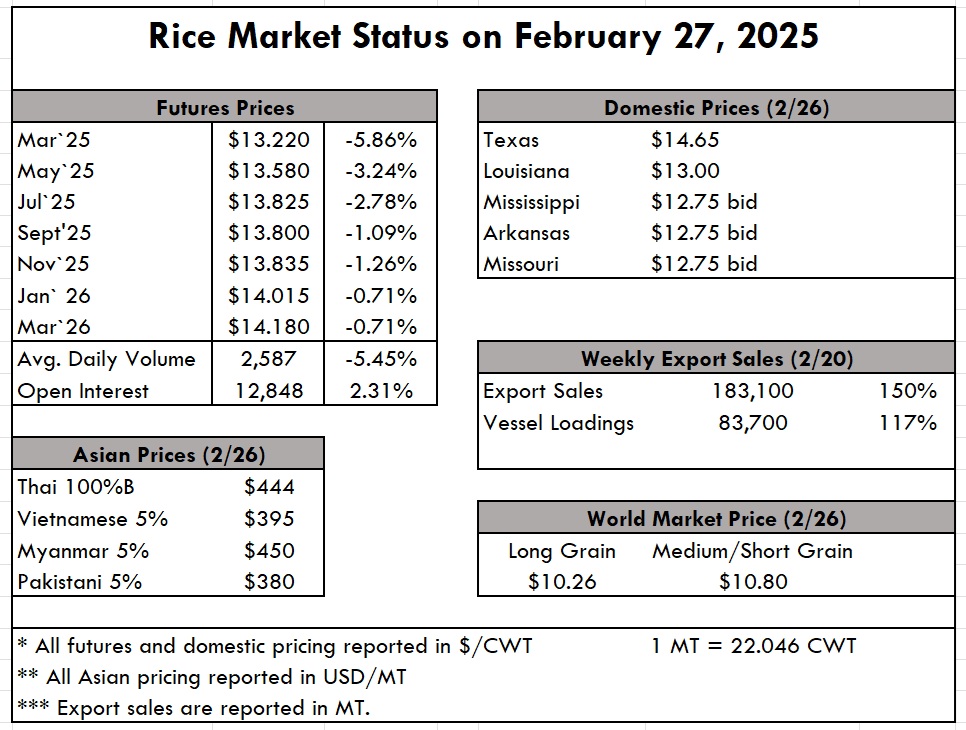
This week's biggest news is Iraq’s purchase of 88,000 metric tons of U.S. long grain. This is excellent news; the MOU calls for 200,000 metric tons per year, but this acquisition now brings sales up to 220,000 metric tons. If you recall, there were problems with transactions due to banking/currency issues last year, so in effect, Iraq is helping to make up the shortfall from the previous year’s deficit. The Creed Report indicates prices at $675pmt bulk FOB vessel NOLA, and we agree that this was a needed purchase to clean up old crop supplies.
Prices on the ground remain soft in the month of February. Texas remains at $14.70/cwt and Louisiana at $14.50-$14.80. But Arkansas, Mississippi, and Missouri have all been at $13/cwt since the start of the month, and there hasn’t been much movement. The February FAO report (next paragraph) doesn’t offer much hope either from a global perspective. The bright spot is truly the Iraq purchase for any cash sellers looking for demand in the spot market in the near term, as paddy exports have been difficult with the quality of this year’s crop not being preferred by most buyers.
The Mercosur harvest continues in the early stages where the crop continues to be reported in good condition. Brazilian farmers looking for a “break-even” price from mills and exporters. FOB paddy prices for what little business has been completed are reported to be in a range of $330-$350 per ton depending on the specific loading port. A few sales to Central America, Mexico, and Venezuela have been confirmed.
The FAO All Rice Price Index from February dropped to 113.6 points in January, falling 4.7% from December and 20.4% lower than last year. Indica rice saw the biggest drop, down 5.4% to a 25-month low due to weak demand on top of huge supplies. Aromatic & Glutinous rice also declined, down 4.0% and 1.8%, respectively. Japonica rice, however, increased by 3.0%, driven by tight supplies in Vietnam and Japanese import demand. The report further outlines that export prices for Indica rice fell across Asia and the Americas, with trade slowing due to Lunar New Year celebrations. Apart from Bangladesh, most buyers were inactive, including India, where demand slowed after heavy shipments in late 2024.
In Asia, the market is undeniably soft. It’s no surprise to any involved, but the pain is working down to the farmer levels in Thailand and Vietnam. If it’s India’s huge supplies or quiet demand centers, prices in Thailand are off 31% from this time last year, and off in Vietnam 35% from this time last year. The culprit: India, as they had an export ban at this time last year. In the Western Hemisphere, we can’t call the market “strong” at this point, but we can’t say it’s as soft as the Eastern Hemisphere either. Harvest has just begun in Uruguay and full swing in Argentina. Prices are reported at $630pmt and $595pmt respectively, while USA is at $680pmt.
The weekly USDA Export Sales report shows net sales of 183,100 MT this week, a marketing-year high, were up noticeably from the previous week and from the prior 4-week average. Increases were primarily on account of Iraq. Exports of 83,700 MT were up noticeably from the previous week and up 18% from the prior 4-week average.
| |
|
The House and Senate Both Advance the Chamber’s Budget Resolution
On Tuesday, the House of Representatives took to the floor and passed their budget resolution (H.Con.Res.14) by a vote of 217-215, with all Democrats and just one Republican voting against it. Notably, Rep. Thomas Massie (R-KY) was the lone Republican. This legislative package directed $230 billion in cuts to be made within the Agriculture Committee's jurisdiction over a ten-year spend. This vote and passage comes after the Senate passed their budget resolution (S.Con.Res.7) last Friday. In the Senate's version, the Senate Committee on Agriculture, Nutrition, and Forestry was directed to cut no less than $1 billion in mandatory spending over the next ten fiscal years. Now, with both chambers having passed their respective bills, they turn to the conference where they ultimately have to agree upon the same topline numbers throughout to move forward with the reconciliation process.
Senate Ag Hosts Second Hearing in Farmers’ Perspectives on the Agricultural Economy Series
On Wednesday, the Senate Committee on Agriculture, Nutrition, and Forestry held a hearing titled, “Perspectives From the Field: Farmer and Rancher Views on the Agricultural Economy, Part 2.” Republicans and Democrats alike expressed the need to help the agriculture industry receive better and more effective assistance from the federal government, specifically highlighting testimonies from various producers within the specialty crop and livestock sectors. There was bipartisan agreement over the highly pathogenic avian influenza (HPAI) outbreak needing an urgent and comprehensive response. Republicans emphasized the burdens created by over-regulation within the various agriculture industries and the desperate need for H2-A program reform. Democrats focused on the Administration's actions that have negatively impacted the agriculture industry, like immigration reform and trade and tariff uncertainty. Other topics mentioned included high input costs and lack of domestic competitive advantage, expanding markets, and issues caused by foreign trade and competitors. You can watch the entire hearing here.
| |
Stoesser Scholar in Washington by Ryan Williamson | |
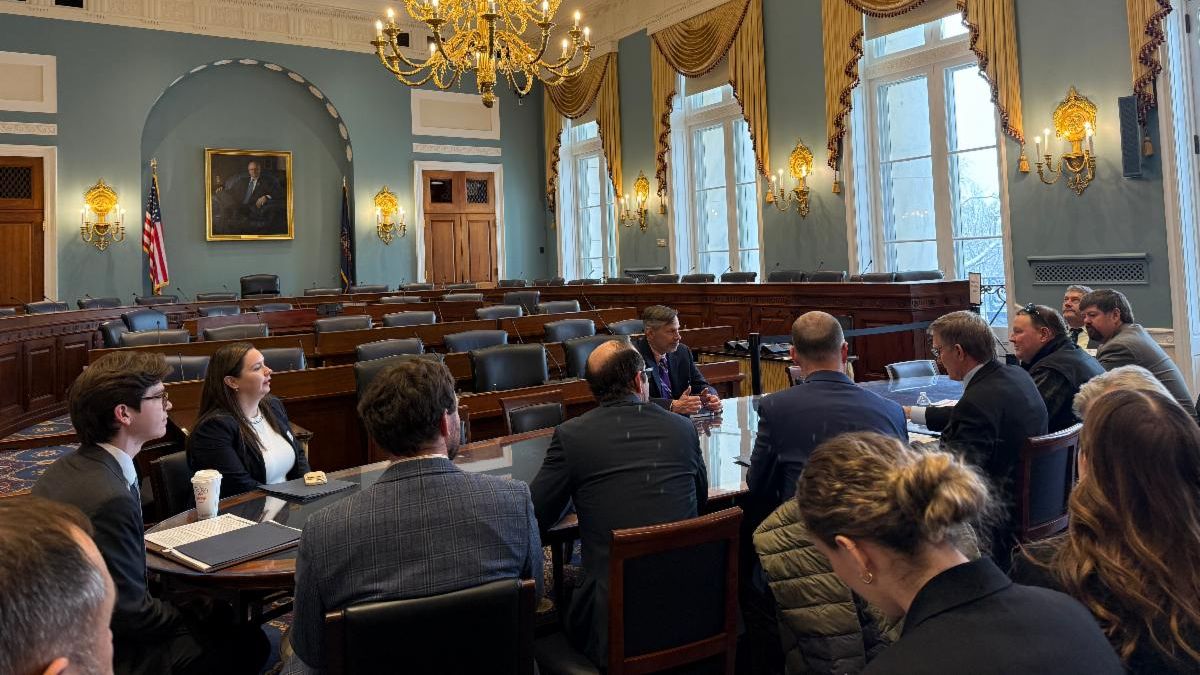
Ryan Williamson, USRPA staff and board members meeting with House Minority Committee on Agriculture. | |
|
When I first learned that I was the recipient of the USRPA Ray Stoesser Memorial Scholarship, I underestimated how profoundly it would impact my life. I knew that, like other scholarships, it would help pay for my undergraduate education at Texas A&M University and that I would travel to Washington, D.C. Yet, I didn’t realize how much my year as a scholarship recipient would broaden my perspective on the rice industry and reinforce my goal of working in agricultural policy.
I grew up in El Campo, Texas, at the heart of Texas rice country. Although I did not grow up on a rice farm, agriculture was always a significant part of my life. My grandpa worked as an agricultural mechanic for farmers in Wharton County—many of whom produce rice—and I was actively involved in 4-H and FFA. These experiences fostered a deep passion for agriculture, leading me to attend Texas A&M and eventually take a gap year to serve as a National FFA Officer. In that role, I traveled across the country to advocate for American agriculture and help FFA members realize their leadership potential.
While these experiences ignited my desire to make a difference in agriculture, USRPA and the Ray Stoesser Scholarship provided something truly invaluable: the producer’s perspective. Although classroom learning and news articles are valuable, I always felt that my education was incomplete without hearing firsthand how policies directly impact farmers' livelihoods. In my mind, USRPA filled that missing piece. This past December, I attended USRPA’s annual International Trade Promotions Committee meeting, where I was fortunate not only to learn about current and potential markets for U.S. rice but also to observe producers sharing their insights on key issues.
The most enlightening experience, however, was the legislative fly-in that took place just two weeks ago in Washington, D.C. As the culmination of my scholarship year, it felt like a once-in-a-lifetime opportunity to attend meetings with the USDA, the United States Trade Representative, and several members of Congress. I even helped lead our meeting with the House Minority Committee on Agriculture—which pushed me outside my comfort zone and challenged me to demonstrate my knowledge and passion for the rice industry. In every meeting, I was in awe of how thoughtful, honest, and passionate the producers were as they discussed their legislative priorities and advocated for their causes. I especially valued the one-on-one conversations I had with them, as they not only encouraged me but also offered profound insights into how policies affect their livelihoods.
Overall, my time as the Ray Stoesser Memorial Scholarship recipient has made me a stronger, more knowledgeable advocate for the rice industry. As I embark on a career in agricultural policy after graduating in May, I plan to keep in touch with everyone I met through this experience. I extend my heartfelt gratitude to the Stoesser family, the USRPA staff, and all who supported me during this incredible year. I feel incredibly fortunate for this opportunity and will always remember the generosity and kindness each of you has shown me.
| |
RMTC 2025: Register Before Price Increase | |
RMTC 2025: Exhibitor Spotlight | |
|
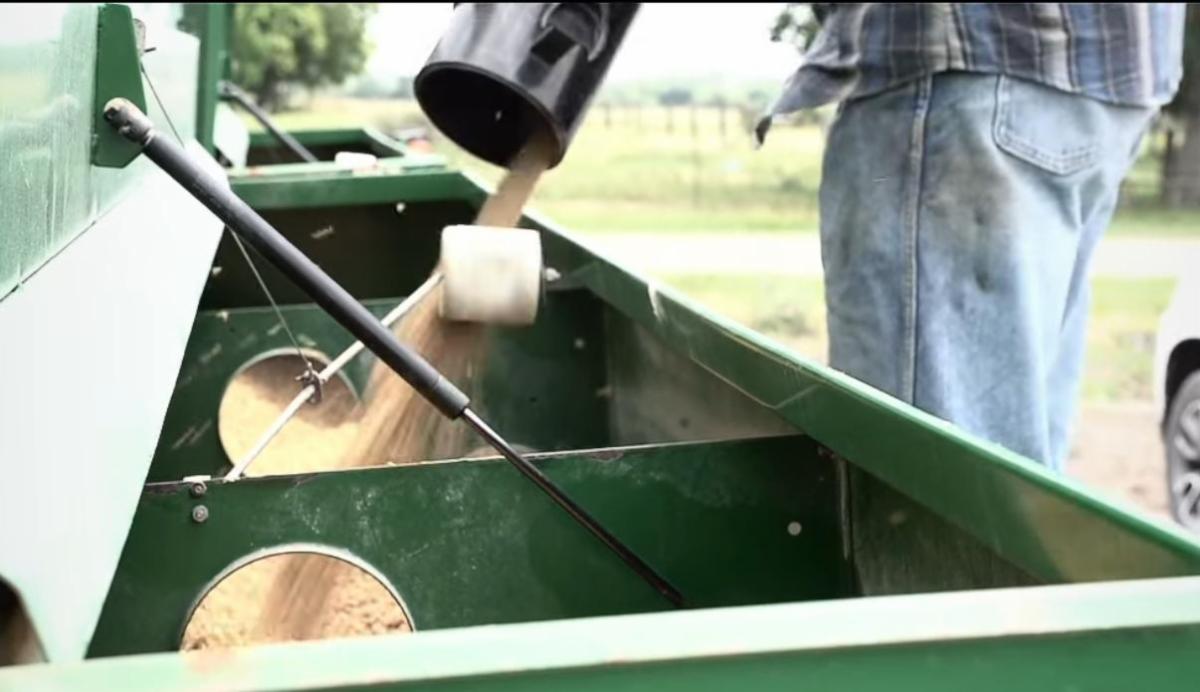
Click here to check out this Instagram reel shared by Texas farmer Andrew Boettcher @andycboettcher.
Send us your Rice Country photos or videos on Facebook, Instagram, or via email!
| | |
|  |
Food & Agriculture
Regulatory & Policy Roundup
| | |
|
May 28 - 30, 2025
Rice Market & Technology Convention
Miami, Florida
More Information
| |
| |
USRPA does not discriminate in its programs on the basis of race, color, national origin, gender identity, sexual orientation, religion, age, disability, political beliefs, or marital/family status. Persons who require alternative means for communication of information (such as Braille, large print, sign language interpreter or translation) should contact USRPA at 713-974-7423. |
| | | |