|
American College of Vedic Astrology
The ACVA Comet, March 2024
|
|
|
Letter from the President of ACVA
By Professor Charlotte Benson (Jyoti Devi) President, ACVA
March 2024 Edition
Dear Friends of ACVA,
Welcome to this edition of ACVA’s quarterly journal, The Comet. I’ll keep my comments brief since we have so much of interest for you to read in this issue.
Recognized author and experienced jyotishi Alan Annand has recently joined our Leadership Team. Thank you for your selfless service to the college, Alan!
We are pleased to offer you excellent articles by friend of ACVA Steve Stuckey, and by our new Team member Alan Annand. Of course we also have our wonderful recurring contributions from Dr. Lynn Bootes, Professor Juliana Swanson, and Julene Louis. Enjoy!
Click here for more ...
| |
Professor Charlotte Benson (Jyoti Devi)
President, American College of Vedic Astrology
| |
|
Gola – Spring 2024
By Julene Louis,
Jyotish Ratna, Jyotish Visharada, ISAR-CAP
ACVA Curriculum Coordinator
Gola is the observational astronomy limb of Jyotish. This spring Mangala and Shani are visible throughout the season in the morning sky. Shukra has morning visibility until mid-April. Guru and Budha begin the season in the evening sky, undergo periods of invisibility, and then appear in the morning sky. By the end of spring four grahas will be visible in the morning and none will be visible in the evening.
Go out and observe the grahas as they travel through rashis and pass the primary stars of nakshatras. Commune with them in the heavens and experience a level of Seeing, beyond a computer screen, that deepens your understanding and practice of Jyotish. Chandra passes other visible grahas during its 27.5-day cycle through the zodiac, which provides opportunities to witness their conjunctions and helps you to locate the starry grahas in the night sky.
Spring’s evening sky viewing begins with Guru and Budha becoming visible in the west as sunset darkens the sky. Guru will be high and bright above the western horizon as it travels through Mesha rashi and Bharani nakshatra marked by the star Menkar, in the constellation Cetus below and the star Almach in the constellation Andromeda above. Budha will be dimmer and low to the western horizon. Budha is travelling through Mina rashi directly below the star Alpherg marking Revati nakshatra. We will lose sight of Budha during the first few days of April and Guru during first few days of May.
Click here for more ...
| |
|
The Observatory - New Year 2024 EDITION
By Dr. Lynn Bootes, MD
ACVA Dean of Students and Registrar
registrar@acvaonline.org
Dear Readers,
Welcome to the Equinox season – Spring in the Northern Hemisphere, Fall in the Southern, and the day when the day and night are equal world-wide.
Take a moment to mark the sunrise at your time and place and you will find that the sunlight is coming from exactly geographical East. While there are many great celestial events this season, this fundamental rhythm of day and night, direction, earth and sky, Moon cycles and season rule all beings on the Earth we share. Om Shanti Shantih.
HIGHLIGHTS OF THE SEASON
This is an event-filled season in the stars. Between the total Solar Eclipse, the visit of a visible comet, and the ingress of Jupiter and Uranus into Taurus, keep your eyes on the skies and your spiritual focus on the essentials of equanimity and compassion.
Venus and Mars visit Saturn in Aquarius on March 21 and April 11.
New Moon in Pisces – Chatur Sanrkati, March 25, which is also an annular Lunar Eclipse.
April 8, Total Solar Eclipse in parts of the USA. You may refer to our contributing authors. As a resident of the South-Central USA, I would comment that this eclipse path will track along a common spring storm path for tornadoes, hail, and floods.
Mercury is retrograde April 9-25 – after dipping into Aries, it returns for a few more weeks in Pisces before moving on to Aries on May 10.
Click here for more ...
| |
|
2024 Vedic Lunar New Year
What the Start Of the New Year Can Tell Us About the Next Twelve Months
By Professor Juliana Swanson
ACVA Provost and Dean of Academics
The Vedic Lunar New Year will begin on April 8 this year. This is a special day that celebrates the creative power of the Universe and the divinity within all of life. Among certain sects and traditions of Hindu culture, the beginning of the Vedic Lunar New Year is known as Ugadi or Samvatsaadi. Vedic Astrologers cast a special horoscope at this time, which can tell us about some of the themes and events that may impact us during the year to come.
| |
|
Solar Eclipse April 2024
By Alan Annand
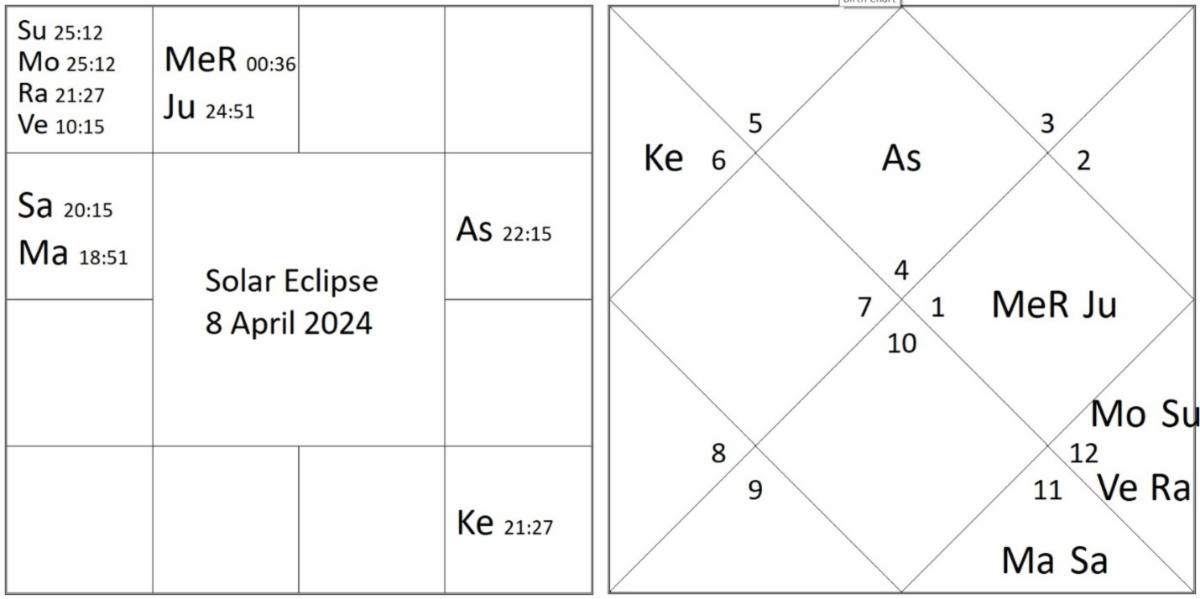
The “Great North American Eclipse” at 2:21 pm EDST on Monday, 8 April 2024, will be notable as the only total solar eclipse in the 21st century where totality will be visible in Mexico, the United States, and Canada. It will also be the last total solar eclipse visible in the continental United States until August 23, 2044.
The path of totality will sweep from northern Mexico into Texas and from there through the eastern half of the USA up into New England before entering Eastern Canada. The horoscope of the event, shown here from the vantage point of Washington, DC, can be taken as a snapshot of generic consequence for the USA, as well as Canada, since both of their capitals are in the same time zone. In such close proximity to the path of totality, the sun will be 90% eclipsed as viewed in Washington, and 95% in Ottawa. The eclipse will occur earlier in the day in Mexico City, such that a local ascendant of late Gemini would put the Sun/Moon pair in the 10th house.
|  | |
|
The Astrology of the Devil Comet
Why There's No Need to Fear This Rare and Remarkable Celestial Messenger
By Professor Juliana Swanson
ACVA Provost and Dean of Academics
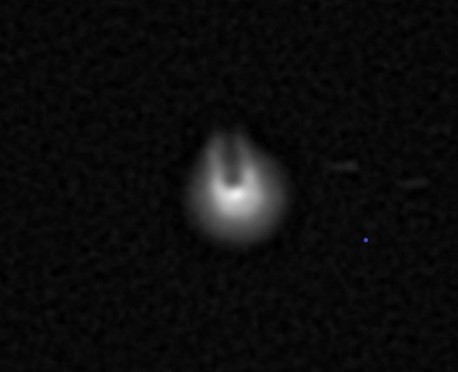
The so-called “Devil Comet” is here! Better known as Comet 12P/Pons-Brooks, this short-period comet enters our inner solar system every 71 or so years. Despite its ominous name, there's no need to be afraid of this celestial visitor.
In this article, I'll explain the astrology behind the Devil Comet and discuss some of the lessons it could be trying to teach us.
The History of Comet 12P/Pons-Brooks
Comet 12P is so named because it is the twelfth in a long list of periodic comets. It was first recorded by Chinese observers in 1385 and 1457. Jean-Louis Pons also identified the comet in 1812, and it was independently rediscovered again in 1883 by William Robert Brooks. Hence, it was named Pons-Brooks.
After Comet 12P was seen in 1883, it returned again in 1954. It was then observed in June of 2020 with the Lowell Discovery Telescope. Since then, it has had several bright outbursts that represent an increase in its activity. These occurred in July, October, and November of 2023. The comet will swing back around for its next pass in April 2024. The next time it will appear after this round will be in 2095.
|  | |
|
The Vedic Yearly Chart – New Moon in Pisces
By Steve Stuckey
The Vedic yearly chart is used by astrologers as a mundane chart to predict the yearly outcome of events related to the affairs of state of any particular city or country and includes such things as the disposition of heads of state, the economy, education, employment, foreign affairs, geological phenomena, and weather patterns. The chart is calculated for the exact time of the New Moon in sidereal Pisces that occurs between March 15th and April 15th (dates will vary slightly depending on the ayanamsa used).
Western or tropical astrologers use a similar mundane chart for predicting the year’s events that is based on the Sun’s entrance into zero degrees of Aries. This phenomenon always occurs exactly at the vernal equinox or the first day of spring on March 20th (in the Northern Hemisphere). Other charts used by tropical astrologers for mundane prediction include lunation’s (new and full moons), eclipses, solar cardinal ingress charts, planetary ingress charts and times of important planetary conjunctions. These same charts may also be used by sidereal or Vedic astrologers for yearly predictive work, but the main emphasis for the year is placed upon the New Moon in Pisces chart.
The question naturally arises, why the New Moon in Pisces? Unfortunately, there does not appear to be an answer forthcoming from Jyotish classical texts on this subject. However, there is a reference in the Brahma Purana and the Chaturvarga Chintamani of Hemadri (approx. 1300 CE), wherein it is stated that Lord Brahma created the universe on the Chaitra Shukla Pratipada or the first day of the first month of the year. The month of Chaitra occurs in the March/April period when the Sun is transiting sidereal Pisces (or tropical Aries), and is regarded by many Hindus as the first month of the lunar calendar year. The Chaitra Shukla Pratipada is celebrated as one of a number of Indian New Years.
| |
|
It is due to the generosity of our patrons that ACVA can continue to offer its current special tuition rates. Thank you.
ACVA is a 501-C3 not-for-profit educational institution that provides a very valuable service to learners of Vedic astrology.
It is due to the generosity of our volunteers and patrons that ACVA can continue to thrive. If you choose to press the "donate" button, your donation will be tax-deductible.
To donate, Visit our Website!!
https://acvaonline.org/donate/
In gratitude,
The Leadership Team
| |
American College of Vedic Astrology | |
|
ACVA Leadership Team
-
Prof. Charlotte Benson (Jyoti Devi) - President, ACVA’s External Relations Leader
-
Dr. Sisira K. Amarasinghe, Ph.D. – ACVA Vice President, Executive Director of Corporate Strategy and Technology
-
Prof. Juliana Swanson - ACVA Provost and Dean of Academics
-
Dr. Lynn Bootes, M.D.- Registrar, and Dean of Students
-
Julene Louis – Curriculum Leader
-
Arjun Kodikannath – ACVA Corporate Communications Officer
ACVA Staff
-
Dr. Arjuna de Silva, MBBS (ACVA LMS & IT Operations Manager)
-
Sudath Mudalige (IT Administrator)
To contact any one of us
| |
American College of Vedic Astrology Inc, 2675 W. S.R. 89A #190, Sedona, AZ 86336 | | | | |