Greetings!

Welcome to the November 2019 eNewsletter of the International Foundation for Gastrointestinal Disorders (IFFGD)

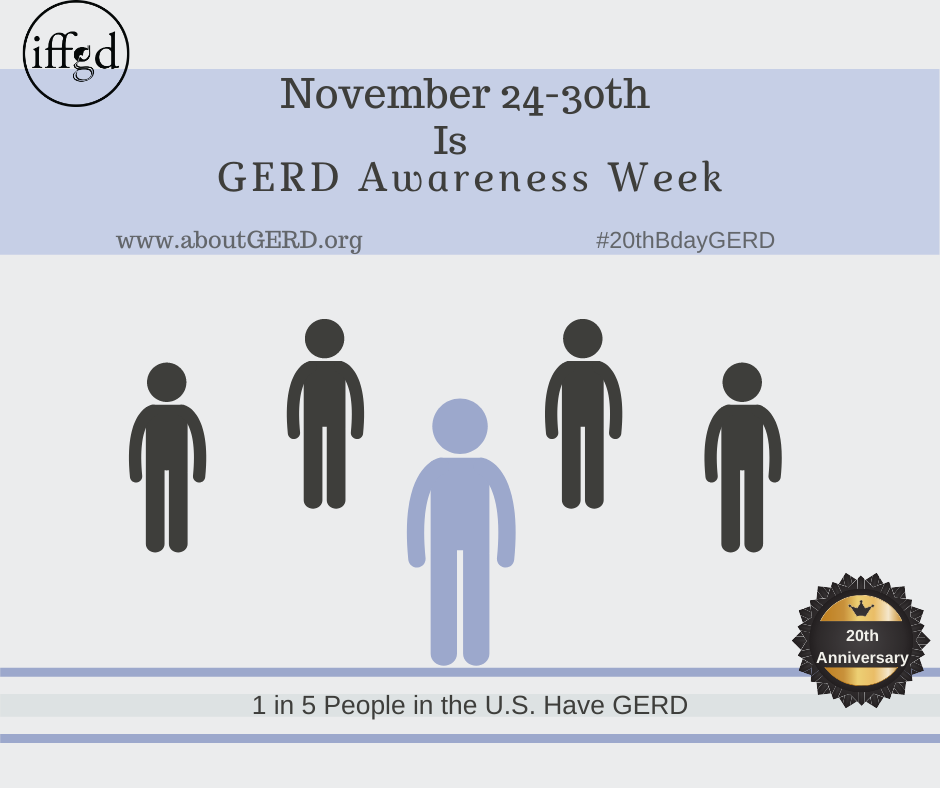
Every year during the week of Thanksgiving we acknowledge Gastroesophageal Reflux Disease (GERD) Awareness Week. This November 24th-30th, we are celebrating 20 years of GERD being recognized on the National Health Observance calendar. Health observances are days, weeks, or months devoted to promoting and increasing public knowledge about particular health concerns.

In 1999 IFFGD unveiled their first GERD campaign, to increase awareness for those living with such a life altering condition such as GERD. Next week w e encourage you to join us during GERD Awareness Week using #20thBdayGERD to share what you have learned about this condition over the past 20 years!
November is GERD Awareness Month
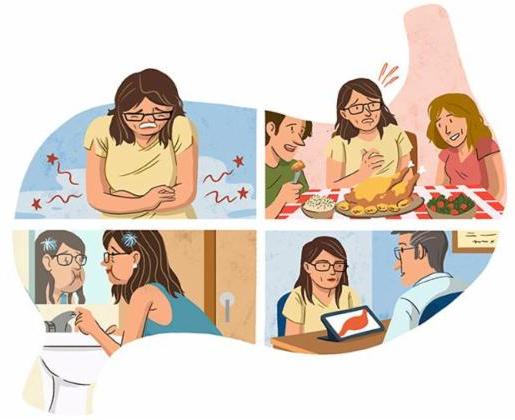
Gastroesophageal reflux disease, or GERD, is very common, affecting up to 1 in 5 or more of adult men and women in the U.S. population. As well as children.

Heartburn is the most frequent but not the only symptom of GERD. Other symptoms may include;
  • Belching
  • Difficulty or pain when swallowing
  • Chronic sore throat
  • Erosion of the enamel of the teeth

To learn more about GERD click here
November Spotlight
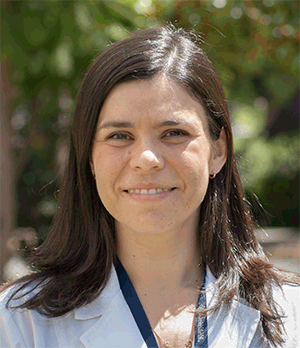
María Francisca Jaime Méndez, MD from Chile
Last month IFFGD announced its inaugural ambassadors for the IFFGD Ambassadors Program. This program was c reated to expand our reach in Mexico and South America by collaborating with local Pediatric Gastroenterologist.
This month we are highlighting Ambassador María Francisca Jaime Méndez, MD for the work she has done in Chile.

Dr. María Francisca Jaime is a Pediatric Gastroenterologist and she currently works at Pontificia Universidad Católica de Chile, Clínica Alemana and Hospital Padre Hurtado.
Dr. María Francisca Jaime is particularly interested in functional gastrointestinal disorders and conducted research in the field to support the publication of the first report about the prevalence of functional gastrointestinal disorders in Chilean school children. " I really appreciate this opportunity to contribute in my country to improve the awareness and care of patients with FGID," said Dr. María Francisca Jaime.

We would like to thank Dr. María Francisca Jaime for the work that she has done in her country and for helping to increase the awareness of the online Spanish language educational material that IFFGD has available on gastrointestinal disorders.
Eating with GERD
This month in recognition of GERD Awareness Week, for our Diet and Digestive Health (#DDHChat) Twitter Chat we will be joined by GI dietitian from Northwestern Medicine, Bethany Doerfler, MS, RD, LDN.

Next week Dr. Doerfler will help us learn more about how food may trigger GERD related symptoms.

When: Tuesday, November 26th at 12:00 PM EST
Where: Join us on Twitter using #DDHChat
FDA Recall on Zantac
Acid-lowering Medications  – H2 blockers such as ranitidine (Zantac)**, cimetidine (Tagamet), nizatidine (Axid) or famotidine (Pepcid) are the initial agent used by many primary care providers, and are marginally better than placebo at improving upper-center abdominal (epigastric) pain, although they do not improve other dyspeptic symptoms.

**Beginning September 2019, the US Food & Drug Administration (FDA) alerted health care professionals and patients of specific recalls of ranitidine (Zantac).

The FDA has recently provided updates on this recall. To find out more click here
Understanding GI Disorders
Small Intestinal Bacterial Overgrowth (SIBO) is typically defined as the presence of excess bacteria in the small intestine.

Each part of our small intestine preforms an important role in nutrient absorption.

For those living with SIBO s ymptoms occur after eating due to the bacteria in the intestine begin to consume the food in the small intestine before it can be absorbed.
Common symptoms associated with SIBO
• Chronic diarrhea
• Bloating
• Abdominal swelling
• Gas and belching
•Abdominal pain or fullness after eating

If you would like to learn more about how SIBO is diagnosed and treated click here .
Giving Tuesday is December 3rd and You Can Make a Difference
Fundraise for Digestive Health
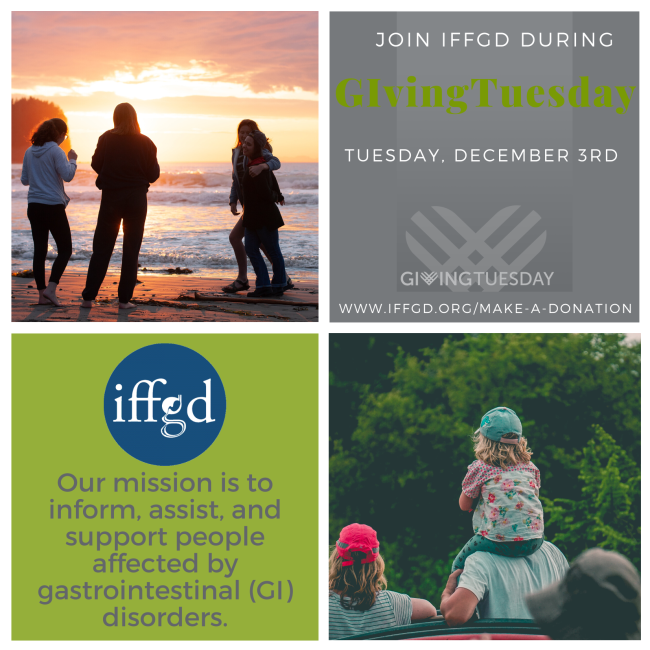
This #GivingTuesday, the International Foundation for Gastrointestinal Disorders (IFFGD) will celebrate the season of giving by joining the #GivingTuesday movement on December 3rd to raise awareness about the development of research which supports those living with chronic gastrointestinal illnesses .

In 2020 IFFGD will attend six scientific meetings and at each meeting IFFGD will interview medical professionals on various topics. This #GivingTuesday you can help support IFFGD’s 2019 initiative by sponsoring the attendance of one meeting along with an episode of GI Research on the Road, sponsoring one full episode, or by sponsoring part of an episode of GI Research on the Road.
Sponsor benefits are as follows;
Meeting Sponsor $2,000:
  • Sponsor name or donation acknowledgment will be displayed on a slide that is to be displayed before each episode for the meeting being sponsored.
  • Sponsor can suggest one topic for an episode of GI Research on the Road

Episode sponsor $250:
  • Sponsor can suggest one topic for an episode of GI Research on the Road

Partial Episode Sponsor $25:
  • Sponsor part of the filming for one episode of GI Research on the Road
**You and 9 others from your community can band together to raise $250 in donations for GI Research on the Road and you can suggest a topic for an episode of GI Research on the Road**

Click here to learn how you can start other fundraisers to help support IFFGD's mission this #GivingTuesday.Follow along with us the day of using #GIvingTuesdayIFFGD.
How is Diabetes Related to Gastroparesis?
November is #DiabetesMonth. Of the almost 5 million Americans who are living with gastroparesis, it is estimated that half develop this condition as a result of long-term #diabetes.

For Stacie, trying to figure out how to manage her gastroparesis & keeping her diabetes under control was a roller-coaster but not impossible.

Click here to read more about her story.

RESEARCH CORNER
Clinical trials and research studies help to improve our understanding of the underlying mechanisms of diseases and advance the development of new and better treatment options. By participating in a study, you can help further the advancement of research and learn more about your condition.

Here are 3 studies currently recruiting participants:
All functional GI disorders
HealthMode / Remote Study of an Electronic Means to Characterize Bowel Movements in Adult Populations

Veterans of active service in the Gulf War theater of operations with GI Disorders
The War Related Illness and Injury Study Center is Recruiting for Multiple Studies

IBS
Men and Women with IBS Needed for an Imaging Study on the Brain, the Gut and the Microbiome


IFFGD is a nonprofit organization. We rely on donor support to fund research and to provide reliable information and support to those affected by chronic gastrointestinal disorders.
IFFGD | 414-964-1799 | iffgd@iffgd.org | www.iffgd.org